#1
An open-source Postgres development platform bundling a database, auth, auto-generated APIs, realtime, storage and vector tools, often chosen as a Firebase alternative.
- GitHub stars
- 115k
- Last commit
- today
- Latest release
- v1.26.08
- Licence
- Apache-2.0
- Self-hosted
- Yes
- Hosted version
- Available
supabase.com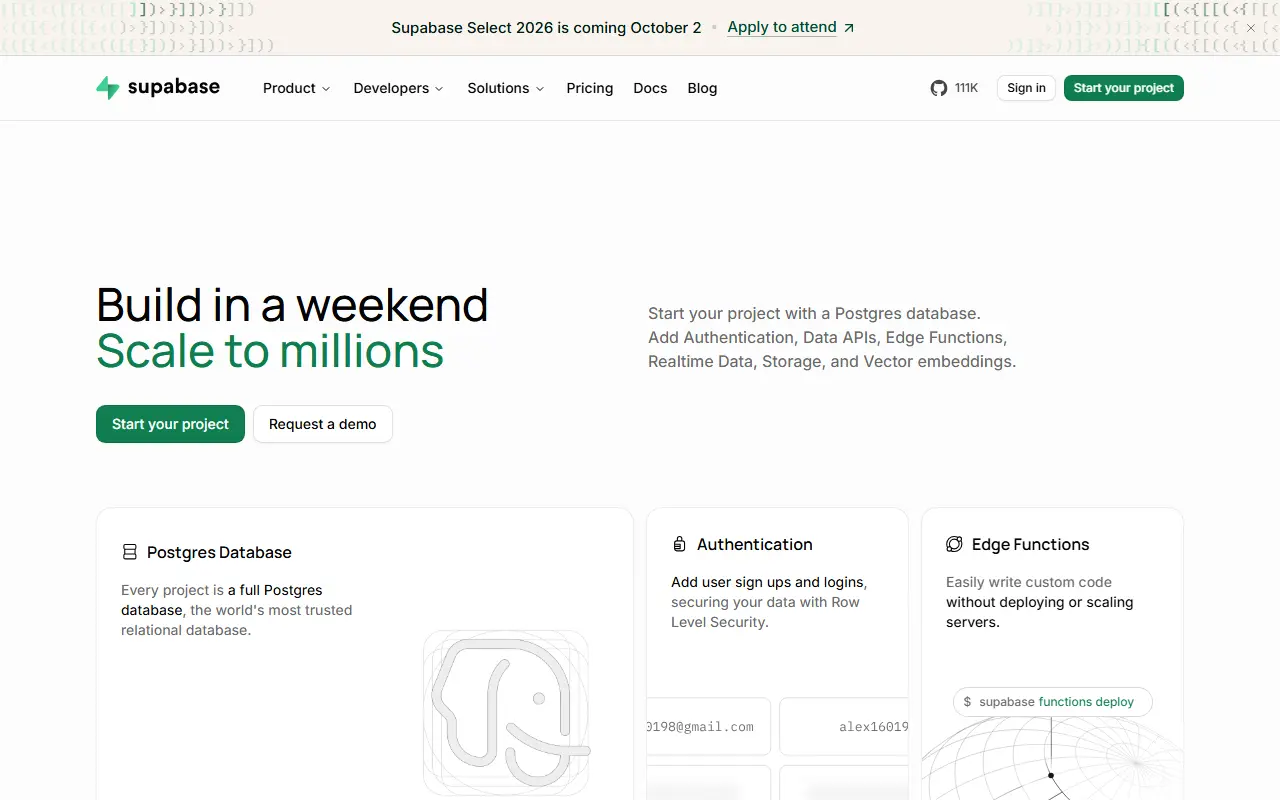
Supabase is a backend platform built around a dedicated Postgres database. It packages the pieces most web, mobile and AI apps need, including authentication and authorization, auto-generated APIs, file storage, serverless functions and a dashboard, so developers can start without assembling separate services. Its stated aim is a developer experience similar to Firebase, built from open-source components.
APIs are generated from your schema as REST and GraphQL, with realtime subscriptions over websockets. Logic can live in database functions or in Edge Functions that run on Deno. For AI work there is a toolkit for vectors and embeddings built on pgvector, and Postgres extensions such as PostGIS are available. Supabase combines existing open tools with ones it builds itself when nothing suitable exists.
The code is Apache-2.0 licensed. Supabase is offered as a hosted platform you can sign up for without installing anything, and the same stack can be self-hosted or run locally for development. It suits teams that want Postgres at the core of their app but prefer not to build the surrounding backend themselves.
Key features
- Hosted Postgres database with a dashboard
- Authentication and authorization
- Auto-generated REST and GraphQL APIs
- Realtime subscriptions over websockets
- Edge Functions and database functions
- File storage for user uploads
- Vector and embeddings toolkit with pgvector
Pricing: Free plan with 50,000 monthly active users. Pro starts at $25 and Team at $599 per month, with usage and extra compute billed on top; Enterprise is custom.
#2
An open-source backend platform offering auth, databases, storage, functions, messaging, realtime and hosting, available as a managed cloud or self-hosted with Docker.
- GitHub stars
- 58k
- Last commit
- today
- Latest release
- 2.7.2
- Licence
- BSD-3-Clause
- Self-hosted
- Yes
- Hosted version
- Available
appwrite.io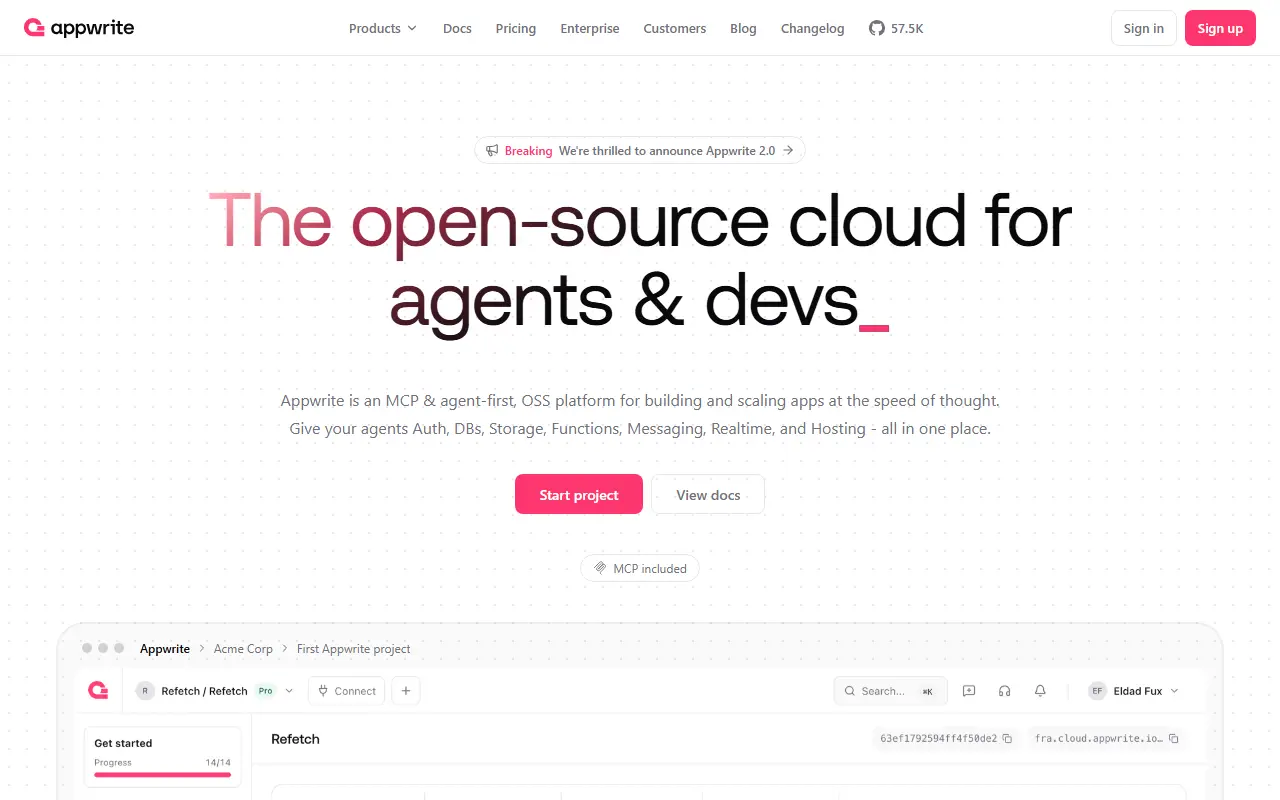
Appwrite is an open-source platform for building and scaling web, mobile and AI apps. It bundles the backend services most apps need, namely auth, databases, storage, functions, messaging, realtime and hosting, and presents them as an agent-friendly cloud with MCP support. It can run as a managed cloud platform or be self-hosted on infrastructure you control.
Auth supports email, SMS, OAuth, anonymous sessions and magic URLs. Databases can be modeled and queried through Appwrite itself or backed by managed PostgreSQL and MySQL. Storage keeps files with compression, encryption, image transformations and permission controls, and Functions run serverless code in isolated runtimes triggered by events. Sites deploys static, SSR and CSR frontends from Git with previews, and Messaging sends email, SMS and push notifications.
Developers integrate through client and server SDKs, including Flutter, Swift, React Native and JavaScript, or let coding agents such as Cursor, Claude Code and Codex operate a live project through a hosted MCP server. Appwrite is BSD-3-Clause licensed and written mainly in PHP, with Docker-based self-hosting for Unix and Windows.
Key features
- Auth with email, SMS, OAuth and magic URLs
- Databases including managed PostgreSQL and MySQL
- File storage with encryption and image transformations
- Serverless functions in isolated runtimes
- Messaging via email, SMS and push
- Realtime updates and static or SSR site hosting
- Hosted MCP server and client and server SDKs
Pricing: A free plan and a Pro plan exist, but the captured page does not show their prices. Dedicated databases start at $10 a month each and go up to $960 a month; serverless databases have no fixed fee.
#3
A self-hostable no-code database platform that puts a spreadsheet-style interface and auto-generated APIs on top of SQL databases, positioned as an Airtable alternative.
- GitHub stars
- 66k
- Last commit
- yesterday
- Latest release
- 2026.10.1
- Self-hosted
- Yes
- Hosted version
- Available
nocodb.com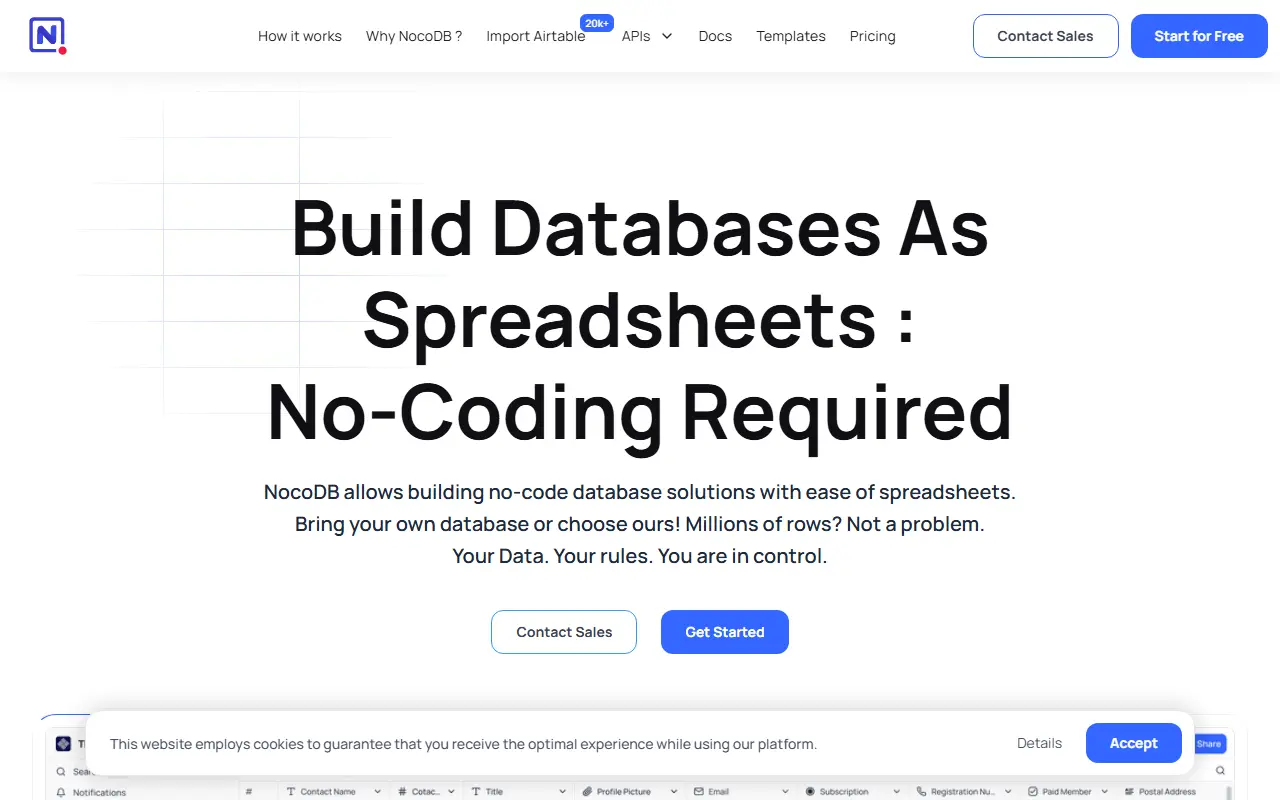
NocoDB is a no-code database platform presented as a free, self-hostable alternative to Airtable. It gives relational databases a spreadsheet-like interface, so people who do not write SQL can create tables, add records and build views, while developers keep a real database underneath.
Its topics point to automatically generated REST APIs documented with Swagger, with PostgreSQL and SQLite among the supported databases. Installation is flexible: you can run it with Docker backed by SQLite or PostgreSQL, or use the auto-upstall script, which sets up a production-style stack with PostgreSQL, Redis and a Traefik gateway through Docker Compose, handles SSL certificates and renewal, and upgrades the install when you run it again. Prebuilt binaries for macOS and Linux are meant only for quick local testing.
The license is listed as 'Other', so check the repository terms before commercial redistribution. NocoDB also runs a hosted service for teams that would rather not manage a server, and it suits groups who want Airtable-style workflows while keeping data in their own database.
Key features
- Spreadsheet-style interface over SQL databases
- Auto-generated REST APIs with Swagger docs
- Works with PostgreSQL and SQLite
- Docker and Docker Compose installation
- One-command production installer with SSL
- Prebuilt binaries for quick local testing
Pricing: Cloud Free covers up to 3 users. Paid plans start at $12 per seat per month billed annually (Plus), then Business $24 and Scale $45. Self-hosted Community is free; Enterprise is custom.
#4
An open-source low-code platform for building admin panels, internal tools and dashboards that connect to more than 25 databases and any API.
- GitHub stars
- 41k
- Last commit
- today
- Latest release
- v2.7.0
- Licence
- Apache-2.0
- Self-hosted
- Yes
- Hosted version
- Available
appsmith.com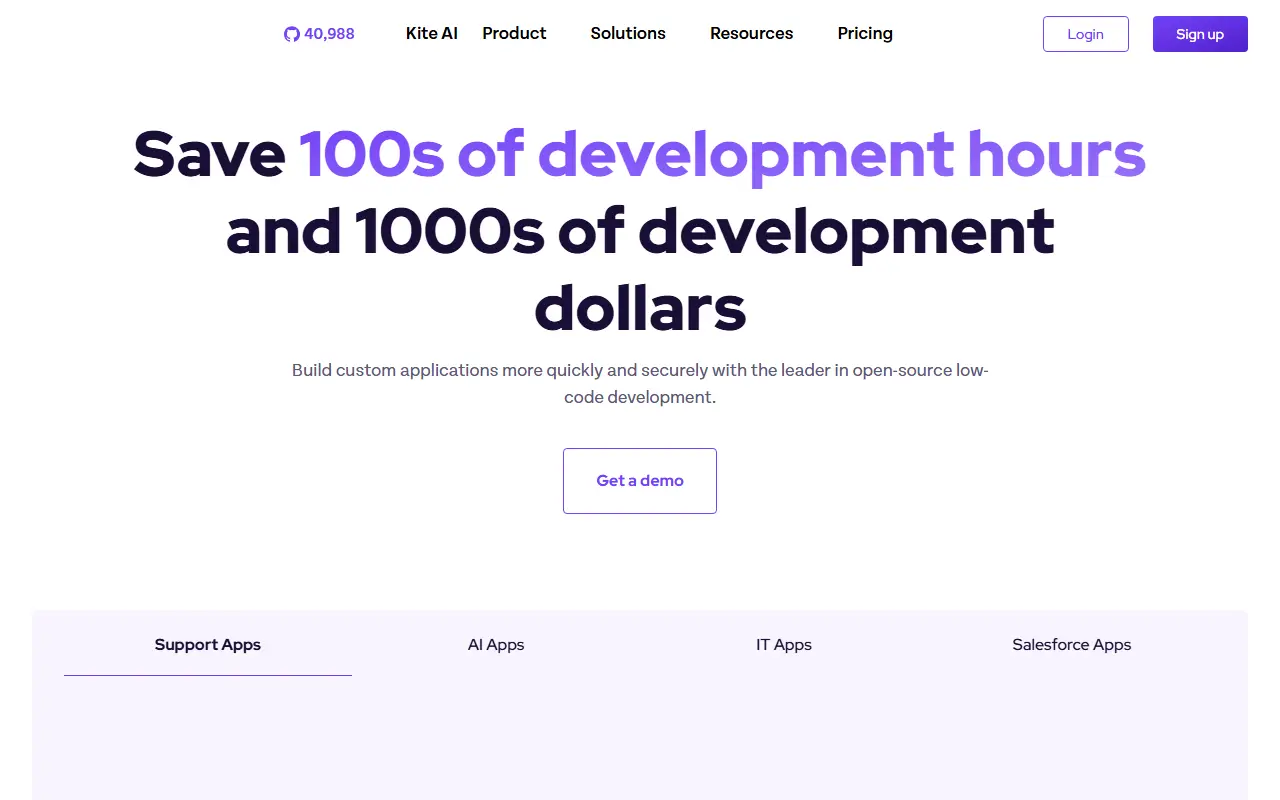
Appsmith is an open-source low-code platform for building custom internal applications such as dashboards, admin panels, customer 360 views, IT automation and service management tools. It aims to simplify building, deploying and maintaining these apps, which otherwise tend to be tedious to code from scratch.
You assemble interfaces visually and connect them to data through integrations with more than 25 databases and any REST or GraphQL API, with JavaScript available where you need custom logic. Topics also point to CRUD generation, workflows and automation. The front end is built with React and TypeScript, and the server side is mostly Java.
You can sign up for Appsmith Cloud or install it on your own machine, with Docker as the recommended method, plus Kubernetes and an AWS AMI. The code is Apache-2.0 licensed. It is a common choice for engineering teams that want to ship internal tools quickly without maintaining a bespoke front-end codebase.
Key features
- Visual builder for internal tools
- Integrates with 25+ databases and any API
- JavaScript for custom logic
- Admin panels, dashboards and CRUD apps
- Docker, Kubernetes and AWS AMI installation
- Cloud or self-hosted deployment
Pricing: Free for up to 5 cloud users. Business is $15 per user per month with a 15-day trial; Enterprise is listed at $2,500 per month for 100 users. The open-source Community edition is free.
#5
An open-source platform for building internal tools, dashboards and workflows visually or from prompts, with an MCP server so coding agents can build apps.
- GitHub stars
- 41k
- Last commit
- today
- Latest release
- v3.20.257-lts
- Licence
- AGPL-3.0
- Self-hosted
- Yes
- Hosted version
- Available
tooljet.com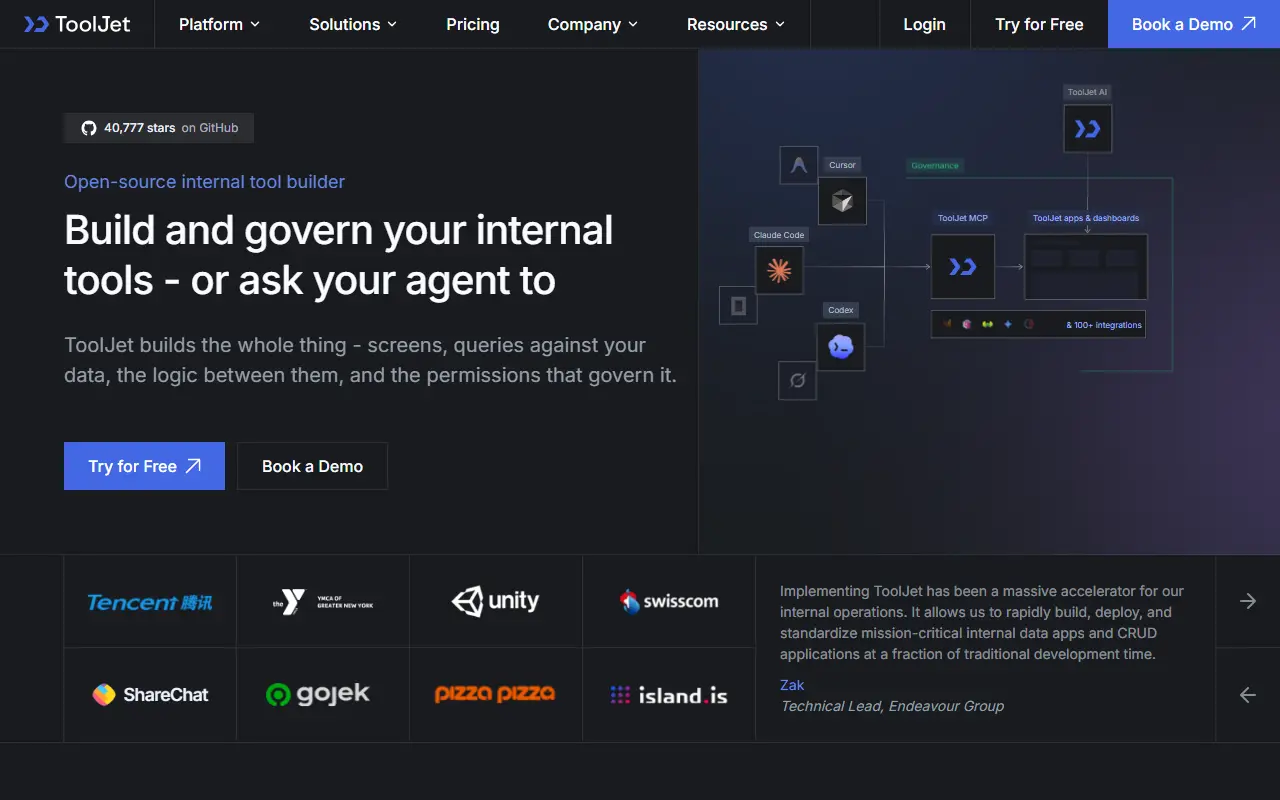
ToolJet is an open-source platform for creating internal software, including admin panels, dashboards and operational apps that sit on top of your existing databases, APIs and SaaS systems. Apps are assembled visually in a builder, so teams can ship tools without writing a full front end.
AI plays a large role. ToolJet AI turns a text description into pages, queries and components, and a Model Context Protocol server lets coding agents such as Claude Code and Codex build and modify ToolJet apps directly. Agents work against the platform's real component and data contracts, so the output is an ordinary ToolJet app that the team can keep editing in the visual builder with the same permissions, environments and version history. Workflows and AI agents are part of the offering.
You can self-host ToolJet or use ToolJet Cloud, and the open-source foundation is AGPL-3.0 licensed with a JavaScript and TypeScript codebase. It targets teams that need internal software quickly and want an open-source option with a managed alternative.
Key features
- Visual builder for internal tools and dashboards
- AI generation of pages, queries and components
- MCP server for coding agents
- Permissions, environments and version history
- Workflows and AI agents
- Self-hosted or ToolJet Cloud
Pricing: A free plan covers 2 builders. Paid plans are priced per builder per month: Basic $29, Pro $99 and Team $249 on monthly billing, with 20% off annually; Enterprise is custom.
#6
An open-source developer platform that turns scripts into APIs, background jobs, workflows and auto-generated UIs, positioned against Retool, Pipedream and Temporal.
- GitHub stars
- 19k
- Last commit
- today
- Latest release
- v1.871.1
- Self-hosted
- Yes
- Hosted version
- Available
windmill.dev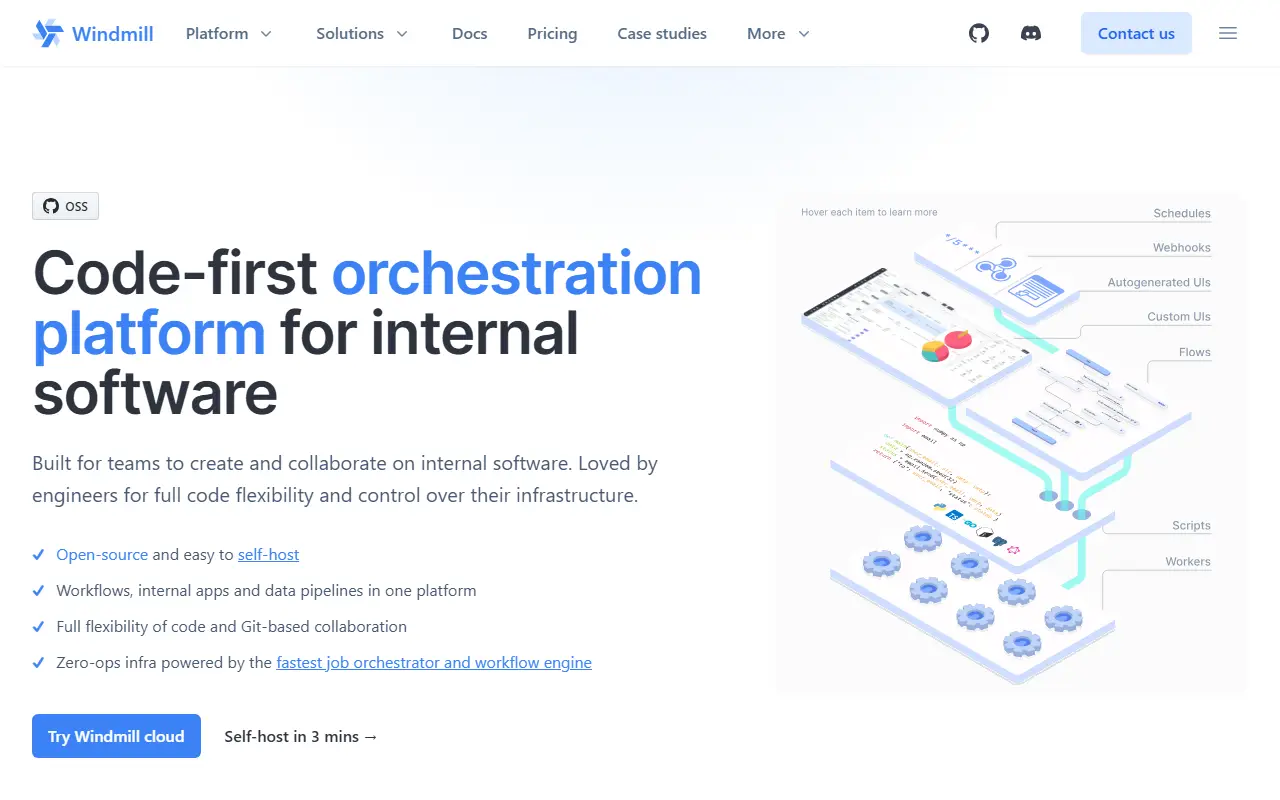
Windmill is an open-source platform for developers to run internal code as APIs, background jobs, workflows and user interfaces. It is pitched as a self-hostable alternative to Retool, Pipedream and Superblocks and as a simplified version of Temporal, and it automatically generates UIs so a script can be shared and triggered as an internal app.
Scripts can be written in languages including Python, TypeScript, Go, Bash, SQL, PowerShell, Rust and GraphQL. They can be composed into flows or used within richer apps built with its low-code builder. The backend is written in Rust on PostgreSQL, and the README describes it as a very fast self-hosted workflow engine, citing a comparison with Airflow. Sections of its documentation cover main concepts, local development, architecture, security, performance and self-hosting with Docker Compose.
Windmill is open source under AGPLv3, and Windmill Labs sells dedicated instances, commercial support and licenses, so the repository license is listed as 'Other' on GitHub. It suits engineering teams that want to turn existing scripts into reliable internal tools and automations without building each interface by hand.
Key features
- Scripts turned into APIs and auto-generated UIs
- Multi-language support including Python and TypeScript
- Workflows composed from scripts
- Low-code builder for internal apps
- Rust workflow engine on PostgreSQL
- Self-hosting with Docker Compose
Pricing: The Community Edition is free to self-host. Team is $10 per seat per month; Enterprise is $20 per developer and $10 per operator per month, with a one-month trial.
#7
An open-source, model-agnostic operations platform for building AI agents, automations and internal apps that connect to your business systems.
- GitHub stars
- 28k
- Last commit
- yesterday
- Latest release
- v4.0.0
- Self-hosted
- Yes
- Hosted version
- Available
budibase.com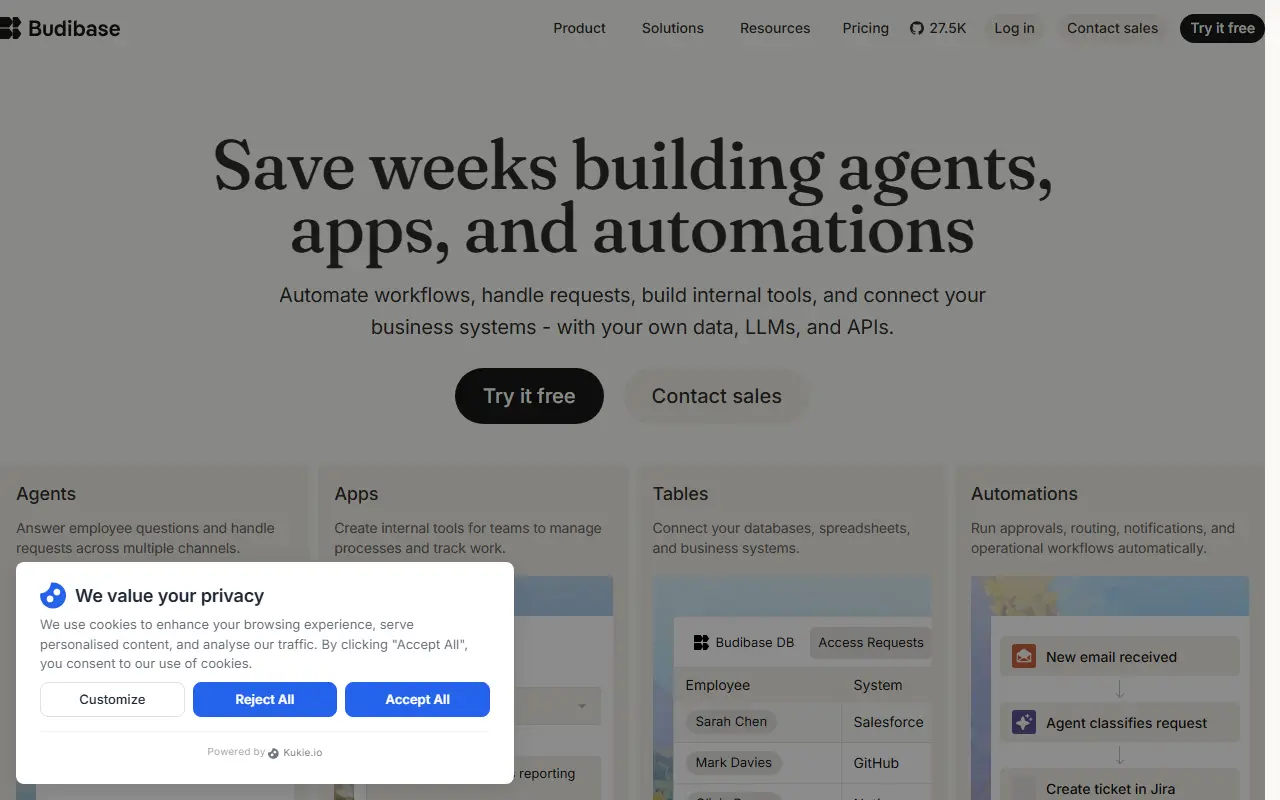
Budibase is an open-source operations platform for building AI agents, automations and apps that run internal processes. It is model agnostic and describes itself as saving engineers many hours when building these tools, while handling security concerns. Topics place it in the low-code and no-code internal tools space, with CRUD apps and an SQL GUI.
The idea is to run requests, approvals and workflows on one platform instead of stitching several tools together. Staff constantly ask questions, request sign-offs and flag problems, and Budibase agents interpret those requests and carry out the work: creating records, sending approvals to the right people, updating apps and alerting teams. You connect the business systems your operations already rely on, and the platform also supports building data applications over databases and REST APIs.
You can use Budibase Cloud, where the vendor hosts it, or host it yourself with Docker, Kubernetes or DigitalOcean. The repository is written in TypeScript, and its license is listed as 'Other' on GitHub, so check the terms for enterprise features. It suits operations and engineering teams that want internal tools and AI automation without building everything from scratch.
Key features
- AI agents that run workflows
- Internal app builder for CRUD tools
- Automations connecting business systems
- Works with any AI model
- Self-host with Docker or Kubernetes
- Budibase Cloud hosting
Pricing: The open-source edition is free to self-host. Cloud plans are Pro $19, Premium $49 and Business $299 per month, each with a 14-day trial; Enterprise is custom and quoted through sales.
#8
A headless React framework for creating internal tools, back-office admin panels, dashboards and B2B apps, with pluggable data, auth and UI integrations.
- GitHub stars
- 36k
- Last commit
- 2 mo ago
- Latest release
- @refinedev/core@5.0.12
- Licence
- MIT
- Self-hosted
- Yes
refine.dev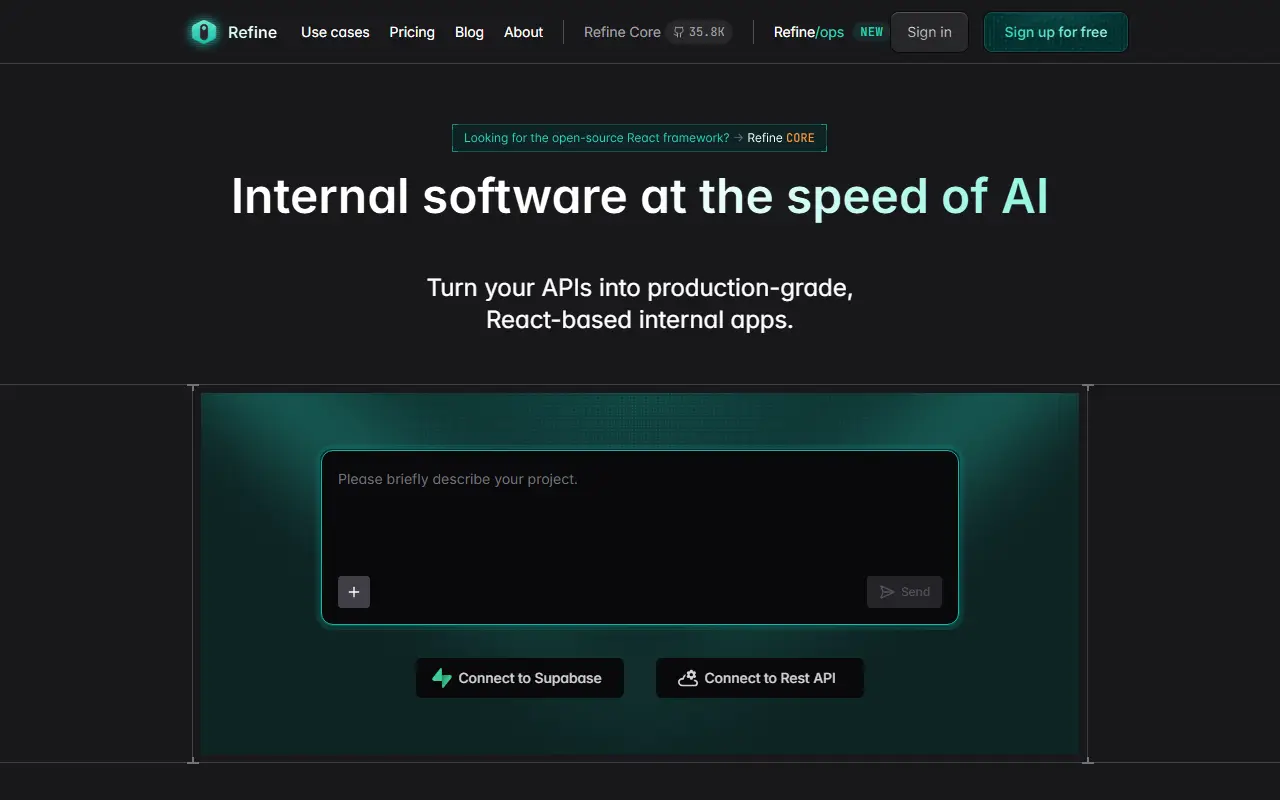
Refine is a React-based framework aimed at internal tools, admin panels, dashboards and business-to-business applications. It is described as headless, meaning it provides the logic for data fetching, routing, authentication and other CRUD concerns through hooks and components while leaving the visual layer to the UI library you prefer.
Its topics reference Ant Design, GraphQL, NestJS and Next.js, which reflects the range of UI kits, data sources and runtimes it can be paired with. Because it builds on plain React, teams can use it as a low-code accelerator for common admin screens while still writing normal TypeScript where they need custom behavior.
Refine is MIT licensed and distributed as npm packages, with the core published as @refinedev/core. It runs inside your own project, so there is nothing to host separately. It suits front-end teams who are tired of hand-building the same tables, forms and permissions in every back-office project.
Key features
- Headless React hooks for CRUD operations
- Data provider abstraction for APIs and GraphQL
- Authentication and access control hooks
- Works with Ant Design and other UI libraries
- Integration with Next.js apps
- Written in TypeScript
Pricing: Refine's credit-based AI plans: Starter is $0.99 a month for 300 credits and Pro is $20 a month for 1,500 credits; Enterprise is quoted on request.
#9
A visual builder for React that lets teams drag and drop their own components to build pages, apps and content, integrated with an existing codebase.
- GitHub stars
- 7.2k
- Last commit
- yesterday
- Licence
- MIT
- Hosted version
- Available
plasmic.app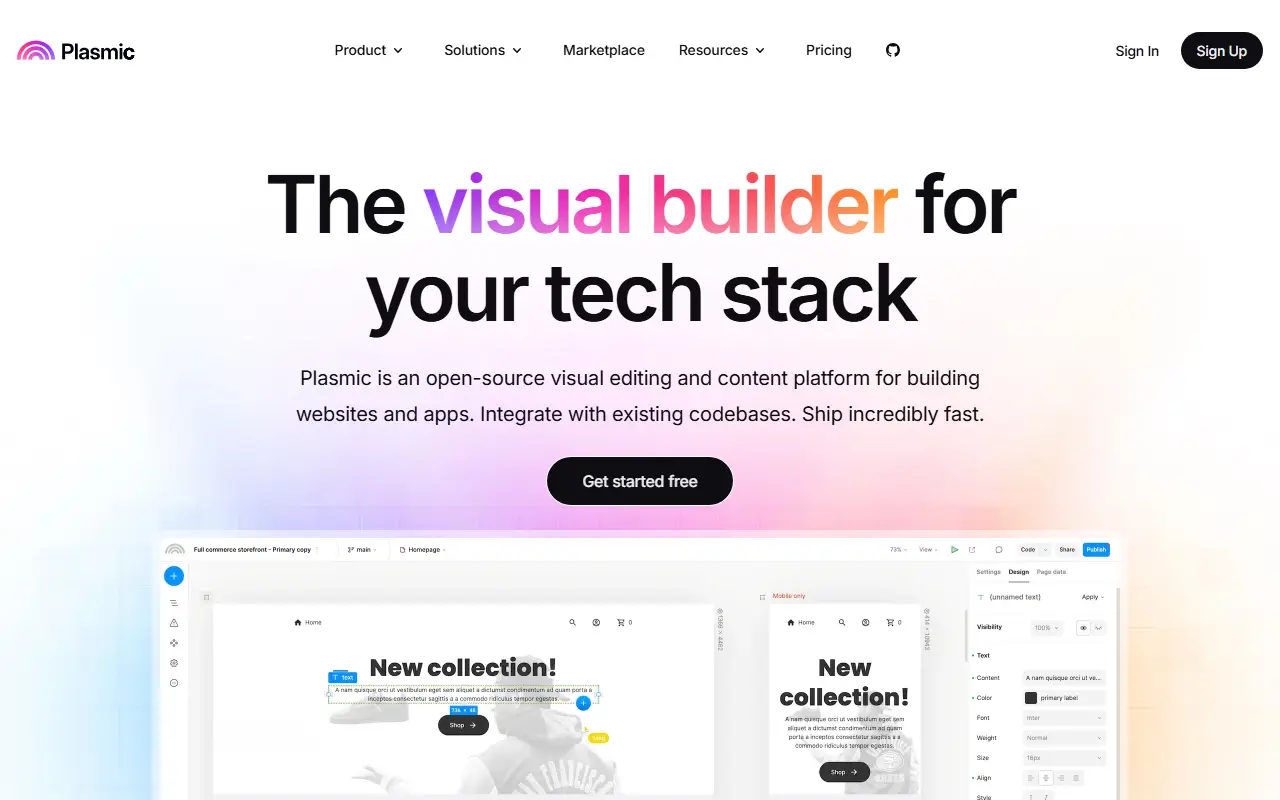
Plasmic is a visual builder for the web that enables rapidly designing and building applications and websites, with code optional. Its distinguishing idea is codebase integration: you register your own React components so that marketers and designers can arrange them visually, which the project says removes the ceiling usually associated with low-code tools.
The README names three main use cases: content management, where marketing teams drag and drop React components to build landing pages in a Next.js site within design guardrails, applications such as internal tools, client portals and business software built quickly by developers and technical users, and a website builder and design tool that is not limited to a built-in ecommerce platform, CMS or hosting. It works with Next.js, Gatsby and other frameworks, and also acts as a headless CMS.
Plasmic is licensed under MIT and written in TypeScript, with documentation, a quickstart, a forum and a Slack community. The visual editor is offered as a hosted service at plasmic.app, and demos show examples such as a Shopify headless storefront. It suits front-end teams that want non-developers to build with their component library.
Key features
- Drag-and-drop visual builder for React
- Register your own code components
- Works with Next.js and Gatsby
- Headless CMS capabilities
- Design guardrails for content editors
- Internal tools and website building
Pricing: Free forever plan with 3 collaborators. Starter is $39, Pro $103 and Scale $399 per month on yearly billing; Enterprise is custom.
#10
Config-first web stack for building internal tools, admin panels, and dashboards from YAML configuration instead of hand-written front-end code.
- GitHub stars
- 3k
- Last commit
- today
- Latest release
- v7.3.0
- Licence
- Apache-2.0
- Self-hosted
- Yes
lowdefy.com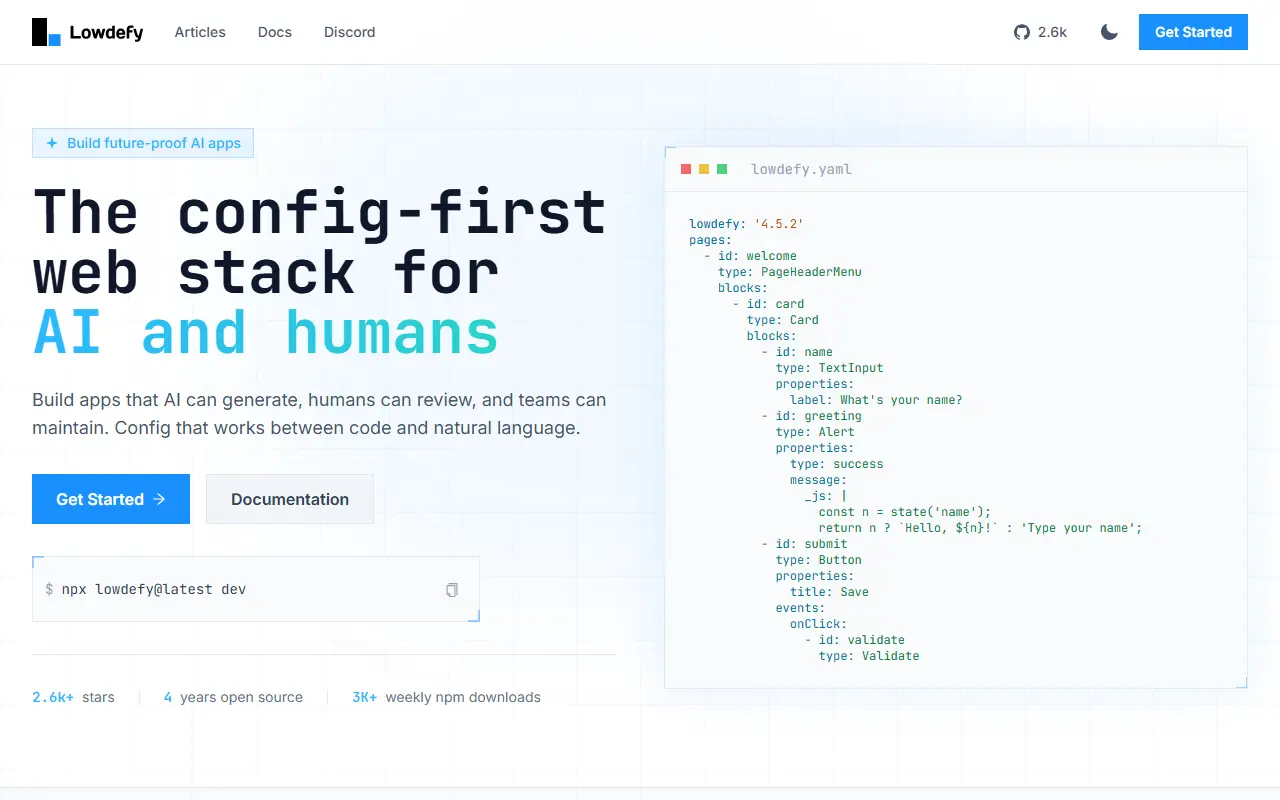
Lowdefy is an open-source framework for building web apps from configuration files rather than code. Its pitch is that concise, schema-validated config is easier for both people and AI tools to generate, review, and maintain than thousands of lines of generated React. It is released under the Apache-2.0 license.
Apps are described in YAML, and the runtime interprets the config instead of executing arbitrary code, with authentication, permissions, and data validation built in. The framework includes over 70 UI components such as forms, tables, charts, and markdown, more than 50 logic operators for dynamic behavior, and over 10 data connectors including MongoDB, PostgreSQL, MySQL, REST APIs, Google Sheets, and S3.
It is built on Hono, Vite, and Auth.js and can be deployed anywhere Node.js runs. A framework update upgrades every app at once, which the authors present as a maintenance benefit. It suits teams building CRUD apps, admin panels, dashboards, and workflow tools who want something between a low-code platform and a custom codebase.
Key features
- YAML configuration instead of front-end code
- 70+ built-in UI components
- 50+ logic operators for dynamic pages
- Connectors for MongoDB, PostgreSQL, MySQL, and REST
- Built-in authentication and permissions
- Deployable anywhere Node.js runs
Pricing: Free and open source under the Apache-2.0 license.
3 more Superblocks alternatives
Commercial Superblocks alternatives
Hosted, closed-source products that compete with Superblocks.
Superblocks alternatives: questions
- What is the best open-source alternative to Superblocks?
- Supabase is the top-ranked open-source alternative to Superblocks on Enlisted: An open-source Postgres development platform bundling a database, auth, auto-generated APIs, realtime, storage and vector tools, often chosen as a Firebase alternative. Other strong options are Appwrite, NocoDB, Appsmith and ToolJet.
- What are the best commercial alternatives to Superblocks?
- Forest Admin, UI Bakery, DronaHQ, Retool and Basedash are among the hosted, closed-source alternatives to Superblocks listed on Enlisted, which lists 9 in total. Compare their pricing and features on each tool page.
- Are these Superblocks alternatives free?
- All 13 are open source, so the code is free to use under its licence, and all of them can be self-hosted on your own server or computer. 10 also offer a paid or managed cloud version if you'd rather not host it yourself.
- How is this list of Superblocks alternatives ranked?
- By a score built from GitHub stars, star growth over the last 30 days and how recently the code changed. 10 of these projects shipped code in the last 30 days. Data is refreshed daily, and nobody can pay to move up.
 TrackMedia
 TrackRev