 TrackMedia
 TrackRev

 Bubble
 DronaHQ
 Jet Admin
 Forest Admin
 Backendless
 Betty Blocks
 Mendix
 OutSystems
 FlutterFlow
 Adalo
 Thunkable
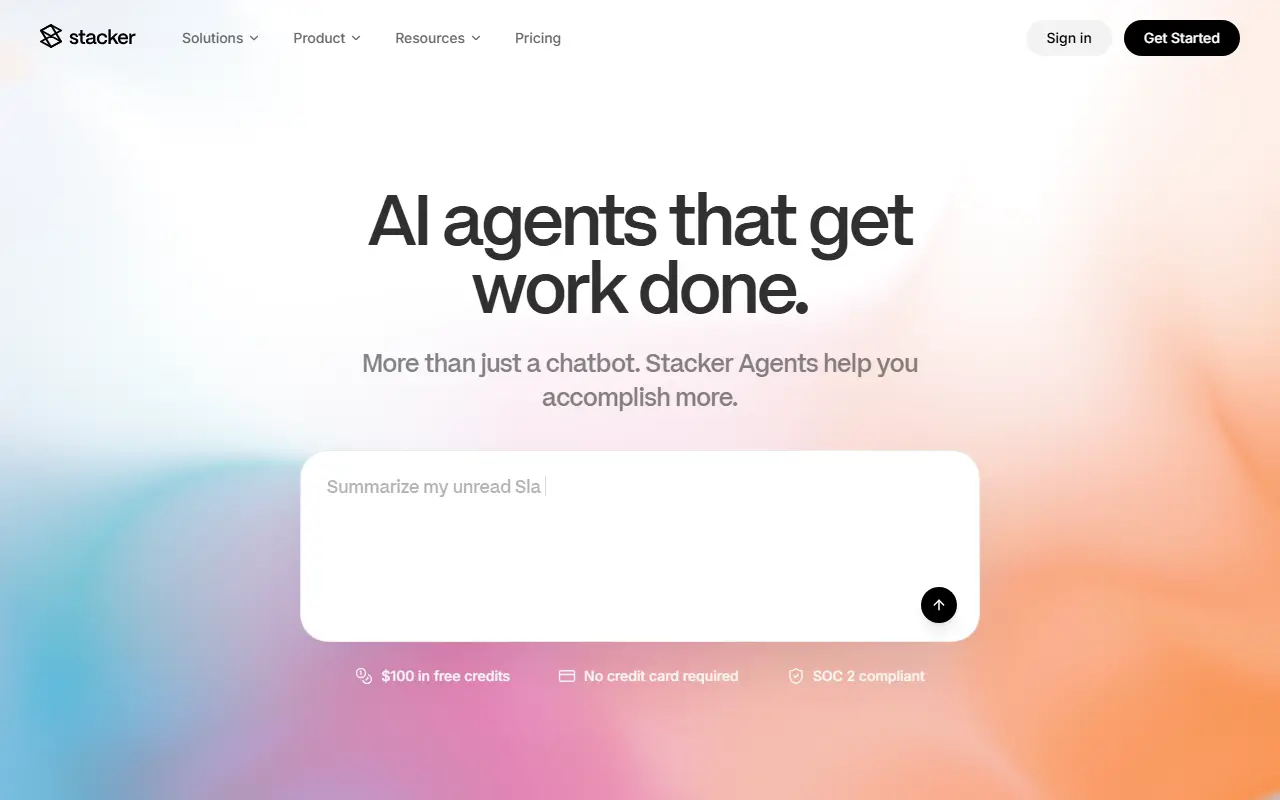
About Stacker
Stacker is organised around agents that carry out tasks for a team, and the pricing page spells out how they are metered. Each agent action uses credits depending on how complex it is: quick lookups, summaries and CRM updates cost 1 to 3 credits, multi-step workflows 5 to 15, and larger projects such as research or media generation 20 to 50.
The Standard plan is the one plan with every feature, from unlimited agents and more than 2,000 integrations to white-label customer portals with custom domains. Agents can work through Slack, email and web channels, run scheduled tasks, use a knowledge base and memory, and execute custom skills and code.
Teams share one pool of credits, so there is no per-user fee. New accounts start with a trial of 100 dollars in credits and no credit card. Larger organisations can move to Enterprise for custom credit volumes, onboarding, an SLA, a security review and DPA, SSO and the option to bring their own LLM.
Key features
- Unlimited agents, portals and 2,000+ integrations
- Works through Slack, email and web
- Scheduled tasks and automations
- Credits scale with how complex each action is
- Enterprise adds SSO and bring-your-own LLM
- Enterprise includes SLA and security review
Good fit for
- CRM updates and lookups
- Outbound email automation
- Research and competitive analysis
- White-label customer portals
Stacker: questions and answers
- What is Stacker used for?
- Stacker sells credit-based AI agents with customer portals, integrations and scheduled automations, priced per month by credit volume with no per-seat fees. It is a good fit for CRM updates and lookups, outbound email automation, and research and competitive analysis.
- How much does Stacker cost?
- Paid plans for Stacker start at $50 per month, and there is no free plan. A free trial is available.
- Is Stacker open source?
- No. Stacker is proprietary (closed-source) software. Open-source alternatives to Stacker include Budibase, NocoBase and Appsmith.
- What are some alternatives to Stacker?
- Stacker competes with Softr, Noloco and Glide. For open-source options, see Enlisted's ranked list of open-source Stacker alternatives.
Open-source alternatives to Stacker
See all
Budibase
Low-code & Internal Tools
AI agents, automations and apps that run your operations. Model agnostic.
OSSvs Retool★ 28k
NocoBase
Low-code & Internal Tools
Open-source AI no-code platform for building reliable business systems. Use AI coding agen
OSSvs Microsoft Power Apps★ 25k
Appsmith
Low-code & Internal Tools
Stop grappling with data, scouring for the perfect React library, and coding everything fr
Apache-2.0vs Retool★ 41k
ToolJet
Low-code & Internal Tools
ToolJet is the open-source, AI-native low-code platform for internal tools. Build with AI,
AGPL-3.0vs Retool★ 41k
Lowdefy
Low-code & Internal Tools
Build apps that AI can generate, humans can review, and teams can maintain. Config that wo
Apache-2.0vs Retool★ 3k
Rowy
Database Tools
Low-code backend platform. Manage database on spreadsheet-like UI and build cloud function
OSSvs Airtable★ 6.8k
SaaS alternatives to Stacker
See all
Softr
Low-code & Internal Tools
Builds client portals and internal tools on top of Airtable and other data sources
SaaS
Noloco
Low-code & Internal Tools
No-code app builder for portals and internal tools on top of existing data
SaaS
Glide
Low-code & Internal Tools
Builds apps from spreadsheets and databases with a visual editor
SaaS
Knack
Low-code & Internal Tools
No-code database app builder for portals and internal tools
SaaS
Airtable
Database Tools
Airtable is an app-building platform that combines a relational database with interfaces, automations and AI agents so teams can build their own business apps.
SaaS
Retool
Low-code & Internal Tools
Retool is a platform for building internal tools and business apps that connect to any database, API or LLM, with an AI app builder and agent support.
SaaS