
About Phone-verif
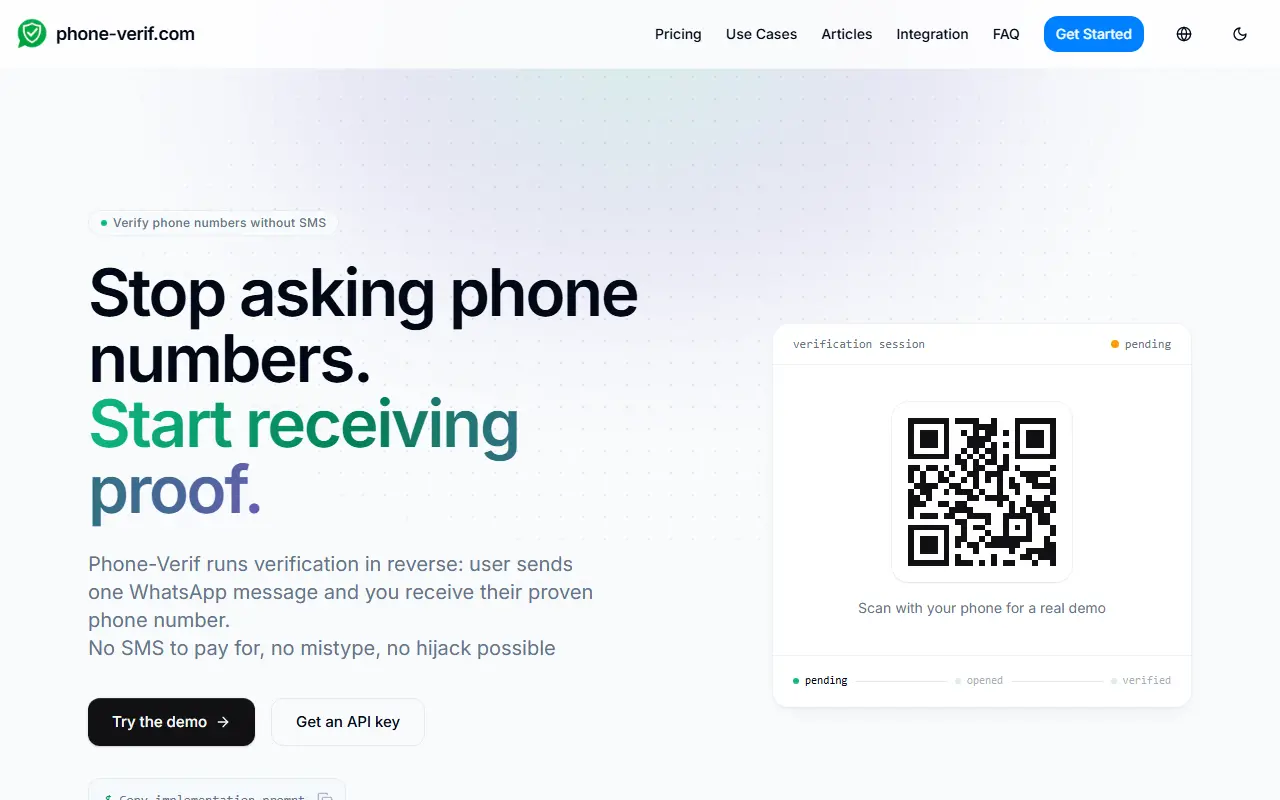
Phone-Verif replaces SMS one-time codes with a reverse flow. Your server opens a verification session through an API call that gives back a QR code together with a WhatsApp link, the user sends one WhatsApp message from their phone, and your server reads back the verified phone number. The user does not type a number or a code, so there are no typos, and no secret travels over the SMS network, which the site says removes risks such as interception, SIM swap and SMS pumping fraud.
The API has two endpoints: one to start a verification and one to check its status. SDKs exist, but none are required, and the service works in any country where WhatsApp works. The site contrasts this with classic OTP flows, where the user must receive, memorize and retype a code and the sender pays a carrier whether or not the message arrives.
Pricing is per successful verification, from 0.01 euros, and failed attempts cost nothing. Credits never expire. The site offers a live demo and an implementation prompt for developers, along with articles and use-case pages.
Key features
- Reverse OTP through a WhatsApp message
- Two-endpoint REST API
- QR code and WhatsApp deep link sessions
- No SMS costs or codes to type
- Billing only on success
- SDKs available but optional
Good fit for
- Verifying signups without sending SMS codes
- Avoiding SMS pumping fraud costs
- Capturing a phone number without typing
Phone-verif: questions and answers
- What is Phone-verif used for?
- Phone-Verif verifies phone numbers in reverse: the user sends one WhatsApp message and your app receives their proven number, with no SMS codes. It is a good fit for verifying signups without sending SMS codes, avoiding SMS pumping fraud costs and capturing a phone number without typing.
- How much does Phone-verif cost?
- Phone-verif is a paid product with no free plan. Prepaid credit packs that never expire: 1,000 credits cost 15 EUR and 1,000,000 credits cost 10,000 EUR, with volume discounts in between.
- Is Phone-verif open source?
- No. Phone-verif is proprietary (closed-source) software and can't be self-hosted. In the Auth & Identity category, open-source options include privacyIDEA, Keycloak and Authelia.
- What are some alternatives to Phone-verif?
- Phone-verif competes with Twilio Verify, Vonage API and Sinch.
Open-source alternatives to Phone-verif
See all
privacyIDEA
Auth & Identity
:closed_lock_with_key: multi factor authentication system (2FA, MFA, OTP, FIDO Server)
AGPL-3.0vs Duo Security★ 1.8k
Keycloak
Auth & Identity
Open Source Identity and Access Management For Modern Applications and Services
Apache-2.0vs Auth0★ 37k
Authelia
Auth & Identity
The Single Sign-On Multi-Factor portal for web apps. OpenID Certified™ and Post-Quantum Cr
Apache-2.0vs OneLogin★ 29k
Authentik
Auth & Identity
The authentication glue you need.
OSSvs Auth0★ 26k
SuperTokens
Auth & Identity
Open Source User Authentication. Build fast, maintain control, with reasonable pricing.
OSSvs Auth0★ 15k
OAuth2 Proxy
Auth & Identity
A reverse proxy that provides authentication with Google, Azure, OpenID Connect and many m
MITvs Cloudflare Zero Trust★ 15k
SaaS alternatives to Phone-verif
See all
Twilio Verify
Auth & Identity
API for one-time passcodes and verification over SMS, voice, email and WhatsApp
SaaS
Vonage API
Backend as a Service
Communications APIs for messaging, voice, video and verification
SaaS
Sinch
Backend as a Service
Messaging, voice and verification APIs for customer communication
SaaS
Infobip
Backend as a Service
Omnichannel cloud communications platform for SMS, chat apps, email and voice
SaaS
Stytch
Auth & Identity
Authentication and authorization APIs for passwordless login, MFA and B2B SSO
SaaS
Authsignal
Auth & Identity
Step-up authentication and passkey APIs for fraud-resistant logins
SaaS