
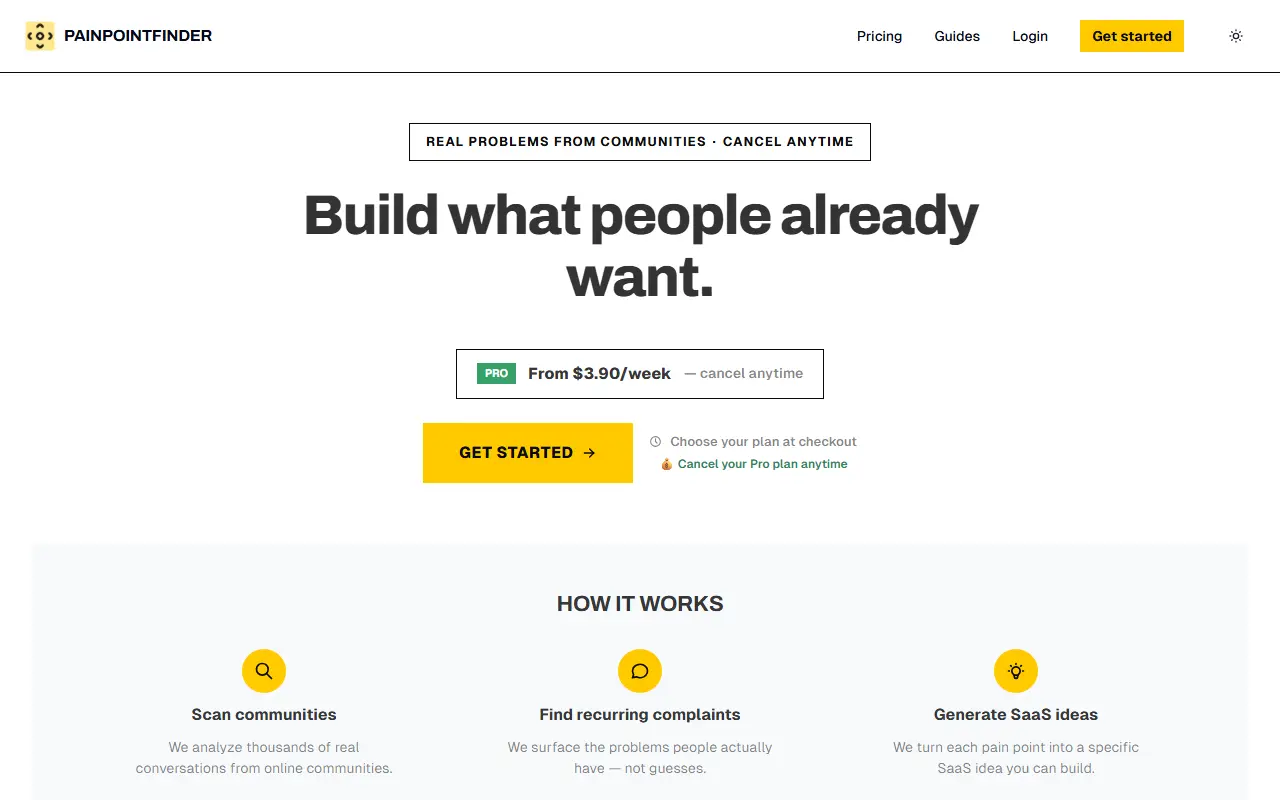
About PainPointFinder
PainPointFinder helps people decide what software to build by showing problems users already talk about. It collects conversations from Reddit, Hacker News, Stack Overflow and TikTok comments, then an AI pipeline filters out venting, jokes and unrelated chatter and keeps only posts describing a concrete, recurring problem.
Each surfaced pain point is paired with a SaaS idea proposal containing a problem summary, a proposed solution and context about who has the problem. You can browse by category or niche, such as freelancers, e-commerce, health tech, edtech, fintech and developer tools, check how many times a problem comes up, and open the original source before judging whether it is worth building.
The free tier lets you browse the latest pain points with the first 15 results per search. Pro costs $9 per month and adds the full history of daily-generated pain points, saving items, unlimited AI-powered pain point analysis and priority access to new features. It can be canceled at any time.
Key features
- Pain points mined from Reddit and other communities
- AI filtering of venting and off-topic posts
- SaaS idea proposal for every problem
- Browsing by category and niche
- Recurrence counts for each problem
- Links to original source posts
- Saved pain points on the Pro plan
Good fit for
- Choosing a SaaS idea backed by real demand
- Researching problems in a specific industry
- Checking how often a complaint recurs
PainPointFinder: questions and answers
- What is PainPointFinder used for?
- PainPointFinder mines online communities for recurring complaints and pairs each real problem with a specific SaaS idea you could build. It is a good fit for choosing a SaaS idea backed by real demand, researching problems in a specific industry and checking how often a complaint recurs.
- How much does PainPointFinder cost?
- Paid plans for PainPointFinder start at $9.90 per seat per month, and there is no free plan.
- Is PainPointFinder open source?
- No. PainPointFinder is proprietary (closed-source) software and can't be self-hosted. In the Analytics category, open-source options include Umami, Plausible and Matomo.
- What are some alternatives to PainPointFinder?
- Other SaaS products in the Analytics category include PeopleWant, PainOnSocial and SaasNiche.
Open-source alternatives to PainPointFinder
See all
Umami
Analytics
Umami is a privacy-first analytics platform. Traffic, campaigns, behavior, conversions, an
MITvs Google Analytics★ 39k
Plausible
Analytics
Plausible is a lightweight and open-source Google Analytics alternative. Your website data
AGPL-3.0vs Google Analytics★ 29k
Matomo
Analytics
Popular analytics tools can miss up to 40% of traffic. Matomo delivers accurate, GDPR-comp
GPL-3.0vs Google Analytics★ 22k
QGIS
Analytics
QGIS is a free, open source, cross platform (lin/win/mac) geographical information system
GPL-2.0vs ArcGIS★ 14k
Rybbit
Analytics
Open source, cookieless web & product analytics with an 11 KB script and one readable
AGPL-3.0vs Google Analytics★ 13k
OpenPanel
Analytics
OpenPanel is an open-source web and product analytics platform, an open-source alternative
AGPL-3.0vs Mixpanel★ 7.1k
SaaS alternatives to PainPointFinder
See all
PeopleWant
Analytics
Scans online conversations to detect recurring pain and show the evidence behind emerging software opportunities
SaaS
PainOnSocial
Analytics
Analyses Reddit communities to surface real problems and generates AI solution ideas for entrepreneurs
SaaSSaasNiche
Analytics
Analyzes Reddit communities to surface real problems and generates AI solution ideas for founders
SaaS
IdeaSaaS
Analytics
Scans Reddit, Hacker News, Dev.to and other sources to surface pain points and validate SaaS opportunities
SaaS
IdeaFast
Analytics
Turns Reddit discussions into structured customer pain reports to validate product ideas
SaaS
Proven
Analytics
Idea validation tool that analyses Reddit, Hacker News, App Store reviews and competitors to judge market demand
SaaS