
About Ossium
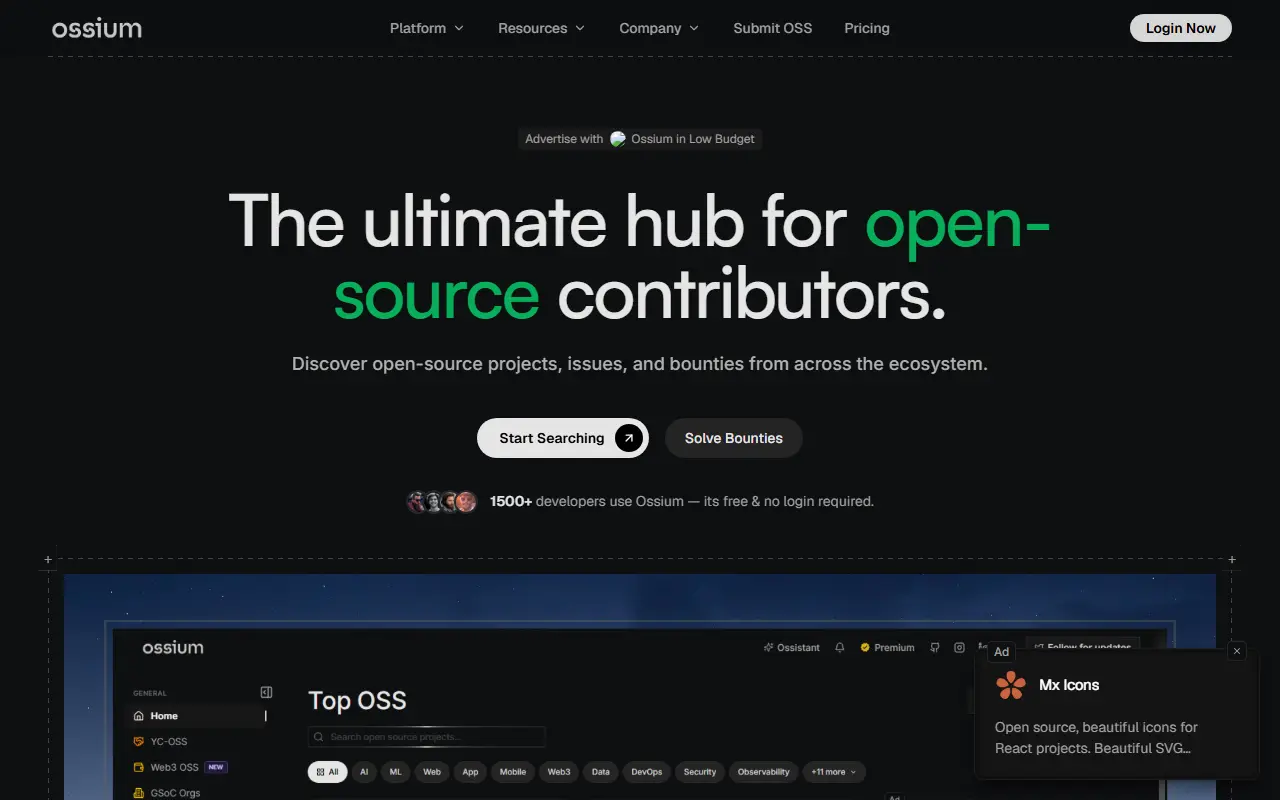
Ossium collects resources for people who want to contribute to open-source software. Its discovery tools include a curated project catalog, trending GitHub repositories, good first issues, Web3 open-source projects, a list of FOSS alternatives to SaaS products and a list of projects that can be self-hosted.
It also lists programs such as Google Summer of Code organizations, fellowships, Y Combinator open-source companies, eligibility requirements and open-source perks like free tools and credits. Product tools include Ossistant, an AI helper for open source, a GitHub selfbot for automating repositories, a repo analyzer and alert rules for issue notifications.
The community section covers a contributors leaderboard, a forum, a bounties board of paid open issues, a learning resource hub and a blog, and maintainers can claim a project by verifying ownership. A jobs marketplace and bookmarks for saved repositories are included. Exploring is free with no login, and a Premium and sponsorship page supports the site.
Key features
- Curated open-source project catalog
- Good first issues and trending repositories
- GSoC organizations and program listings
- Bounties board for paid open issues
- Repo analyzer and issue alert rules
- FOSS alternatives and self-host project lists
- Claim a project by verifying ownership
Good fit for
- First-time contributors looking for beginner issues
- Students preparing for Summer of Code
- Maintainers promoting their project
Ossium: questions and answers
- What is Ossium used for?
- Ossium is a hub for open-source contributors with curated projects, good first issues, bounties, program listings and repo tools, free to browse. It is a good fit for first-time contributors looking for beginner issues, students preparing for Summer of Code and maintainers promoting their project.
- Is Ossium free?
- Yes. Ossium has a free plan, and paid plans start at $1.69 per month.
- Is Ossium open source?
- No. Ossium is proprietary (closed-source) software and can't be self-hosted. In the Developer Tools category, open-source options include Godot, VSCodium and GitHub Desktop.
- What are some alternatives to Ossium?
- Ossium competes with GitHub.
Open-source alternatives to Ossium
See all
Godot
Developer Tools
Godot Engine – Multi-platform 2D and 3D game engine
MITvs Unity★ 118k
VSCodium
Developer Tools
binary releases of VS Code without MS branding/telemetry/licensing
MITvs Sublime Text★ 34k
GitHub Desktop
Developer Tools
Focus on what matters instead of fighting with Git.
MITvs GitKraken★ 22k
GitHub Metrics
Developer Tools
📊 An infographics generator with 30+ plugins and 300+ options to display stats about your
MIT★ 17k
Wakapi
Developer Tools
📊 A minimalist, self-hosted WakaTime-compatible backend for coding statistics
MITvs WakaTime★ 4.4k
Sourcerer
Developer Tools
🦄 Sourcerer app makes a visual profile from your GitHub and git repositories.
MIT★ 6.7k
SaaS alternatives to Ossium
See all
GitHub
CI/CD & DevOps
GitHub is a developer platform for hosting Git repositories, reviewing code, automating workflows and using AI coding tools such as Copilot.
SaaS
Codeown
Social Media
Platform where developers share projects, collaborate on code and build a professional profile
SaaS
Opire
Developer Tools
Platform for posting bounties on open-source issues so developers can get paid for solving them
SaaS
Orbi
Developer Tools
Open-source coding agent that turns a labeled GitHub issue into a reviewed, merged pull request and a tagged release
SaaS
ActivityProof
Developer Tools
Live GitHub-based shipping-status badge you embed as an SVG on indie product sites
SaaS
Burg AI
Developer Tools
AI pull request review agent that uses your own API key to keep data private and control costs
SaaS