
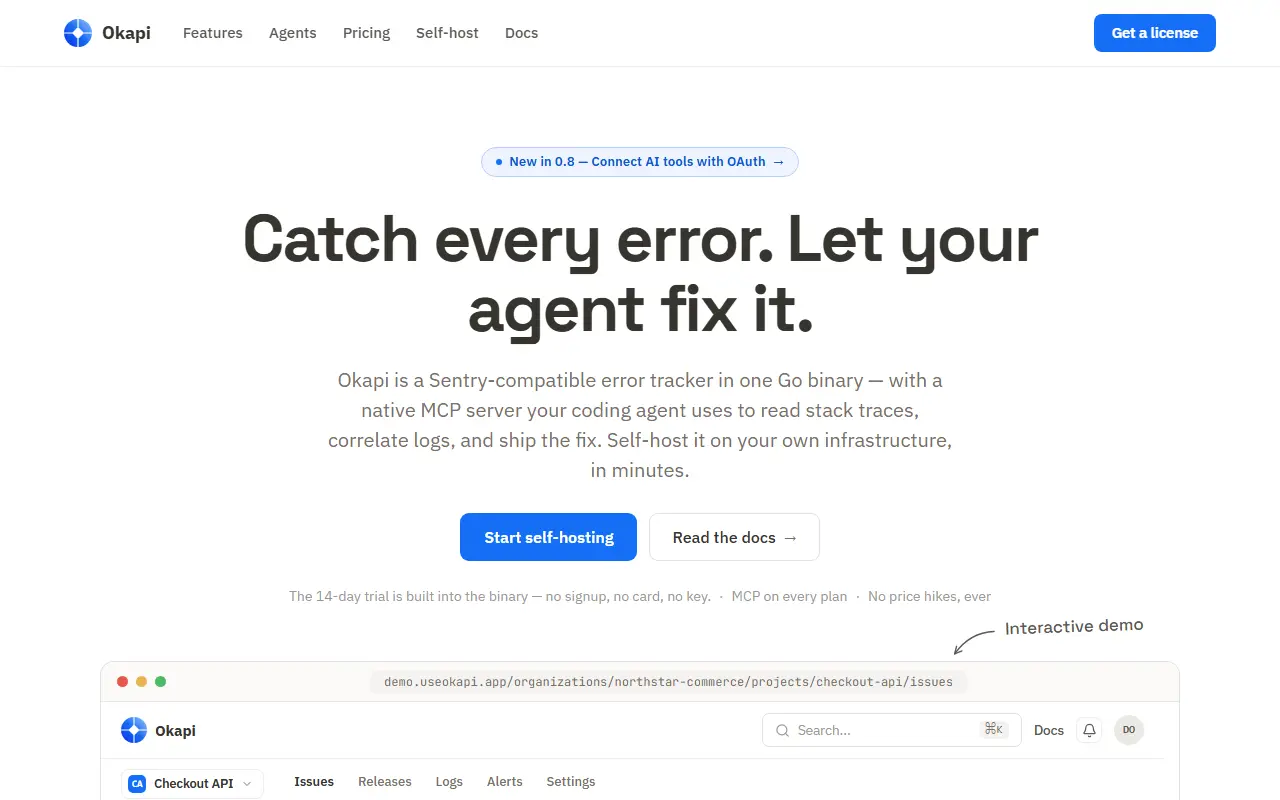
About Okapi
Okapi tracks application errors while keeping your existing Sentry SDK. It runs as one Go binary with Postgres on your own infrastructure, groups errors with smart fingerprinting based on exception type and an in-app stack trace hash, and reopens regressions automatically when a fixed bug returns.
A native MCP server on every plan lets a coding agent read fenced stack traces, correlate logs by trace id and resolve issues through a scoped, audited interface, and a recent release added OAuth for connecting AI tools. The trial of 14 days is built into the binary with no signup or card. Pricing is flat, with an example of $35 a month for a million errors and soft daily limits so that a spike costs a day, not a month, with no overage bills. A cloud option is listed as coming soon.
Key features
- Sentry SDK compatibility
- Single Go binary with Postgres
- Native MCP server on every plan
- Smart error grouping by fingerprint
- Automatic regression reopening
- Flat pricing with soft daily limits
Good fit for
- Solo developers who want predictable error tracking costs
- Letting an AI agent triage and fix production errors
Okapi: questions and answers
- What is Okapi used for?
- Okapi is a self-hosted, Sentry-compatible error tracker in a single Go binary with a built-in MCP server so coding agents can read traces and ship fixes, at flat pricing. It is a good fit for solo developers who want predictable error tracking costs, and letting an AI agent triage and fix production errors.
- How much does Okapi cost?
- Paid plans for Okapi start at $79 per year, and there is no free plan. A free trial is available.
- Is Okapi open source?
- No. Okapi is proprietary (closed-source) software. In the Monitoring & Observability category, open-source options include Logdy, Nightingale and Sentry.
- Can I self-host Okapi?
- Yes. Although Okapi is closed source, it can be self-hosted on your own servers.
- What are some alternatives to Okapi?
- Okapi competes with Sentry, Bugsnag and Rollbar.
Open-source alternatives to Okapi
See all
Logdy
Monitoring & Observability
Realtime log viewer with web UI, tail -f for logs with a web interface browser.
Apache-2.0vs Papertrail★ 2.3k
Nightingale
Monitoring & Observability
Nightingale is to monitoring and alerting what Grafana is to visualization.
Apache-2.0★ 13k
Sentry
Monitoring & Observability
How you can run all of Sentry on your own server, without paying anything.
OSSvs Sentry★ 9.6k
OpenStatus
Monitoring & Observability
🫖 Status page with uptime monitoring & API monitoring as code 🫖
AGPL-3.0vs Pingdom★ 9.2k
Netdata
Monitoring & Observability
The fastest path to AI-powered full stack observability, even for lean teams.
GPL-3.0vs Datadog★ 81k
Sentry
Monitoring & Observability
Developer-first error tracking and performance monitoring
OSSvs Rollbar★ 45k
SaaS alternatives to Okapi
See all
Sentry
Monitoring & Observability
Sentry is an error tracking and application performance monitoring platform that helps developers find, trace and fix problems in web, mobile and backend code.
SaaS
Bugsnag
Monitoring & Observability
Error monitoring and stability scoring for web and mobile apps
SaaS
Rollbar
Monitoring & Observability
Error tracking that groups and alerts on application exceptions
SaaS
Honeybadger
Monitoring & Observability
Error tracking, uptime checks and cron monitoring for developers
SaaS
Raygun
Monitoring & Observability
Crash reporting, real user monitoring and APM for web and mobile apps
SaaS
Airbrake
Monitoring & Observability
Error and performance monitoring for application exceptions
SaaS