
About Moodist
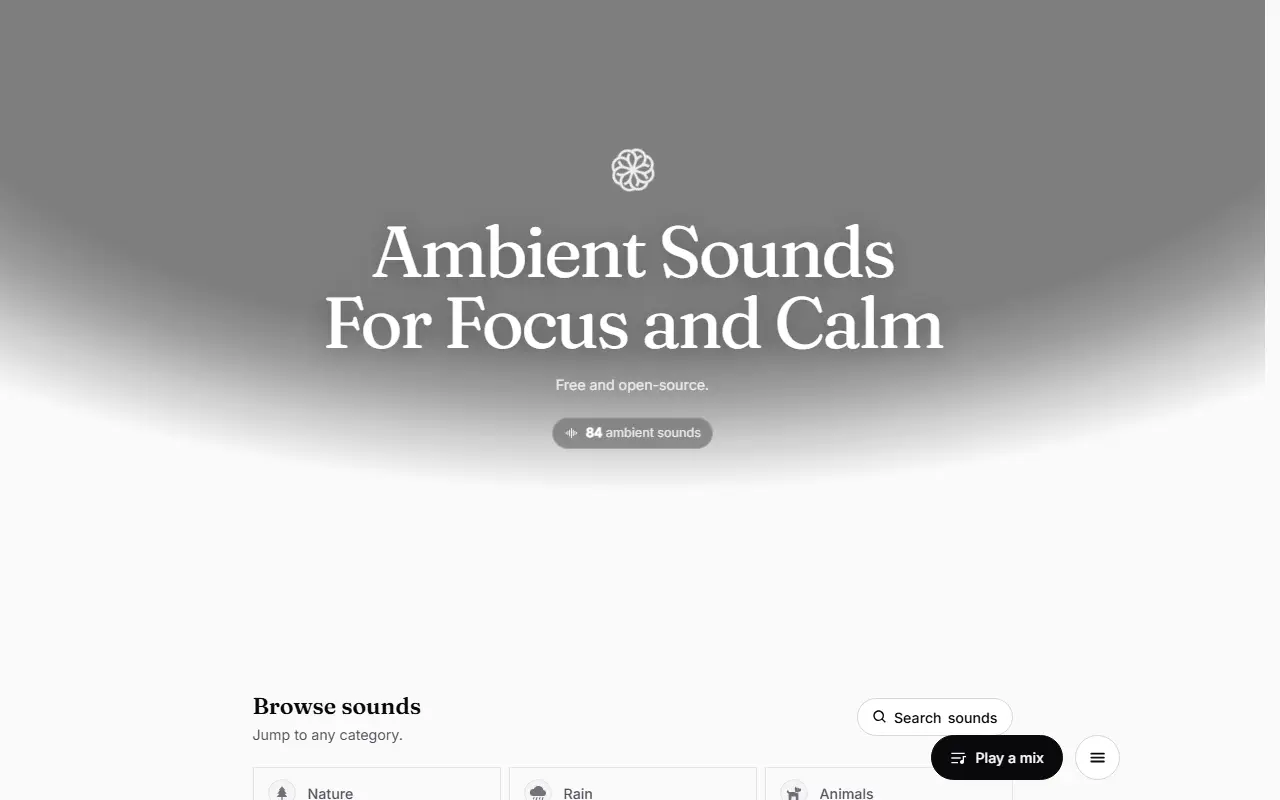
Moodist is an ambient sound app for concentration and calm. It offers 84 curated sounds that you can mix together into your own soundscapes, with smooth fade transitions when you play or stop and when a sleep timer ends the session.
Mixes can be shared by URL for one-click import, and presets let you save, rename, delete and reapply favorites. Built-in binaural beat and isochronic tone generators sit alongside small productivity tools: a breathing exercise, a Pomodoro timer, a countdown, a to-do list and a notepad. It is an installable progressive web app with offline caching, so it keeps working without a connection.
Moodist is MIT-licensed, built with React and TypeScript, and can be self-hosted with Docker or Docker Compose, in addition to using the public site. It suits people who want background noise for work or sleep without ads or a subscription.
Key features
- 84 curated ambient sounds
- Layer sounds into custom mixes
- Sleep timer with fade-out
- Shareable mixes via URL
- Binaural beat and isochronic tone generators
- Installable offline-capable PWA
Good fit for
- →Background noise for focused work
- →Sleep and relaxation soundscapes
- Tags
- ambient-sounds
- focus
- white-noise
- pwa
- productivity
- self-hosted
- relaxation
- react
Moodist: questions and answers
- What is Moodist used for?
- Moodist is a free web app of ambient sounds you can layer into custom soundscapes for focus, relaxation and sleep, with self-hosting via Docker. It is a good fit for background noise for focused work, and sleep and relaxation soundscapes.
- Is Moodist open source?
- Yes. Moodist is open source under the MIT licence. Its source code is on GitHub at remvze/moodist and is written mainly in TypeScript.
- Is Moodist free?
- Yes. Moodist is open source, so the software itself is free to use. A managed cloud version is also available.
- Can I self-host Moodist?
- Yes. Moodist can be self-hosted on your own server or infrastructure.
- What are some alternatives to Moodist?
- Similar open-source tools in the Productivity category include Trek, Homer and Linkding. SaaS products in the same category include 1 Pixel Workout, Amazing Marvin and DeadBolt.
- Is Moodist actively maintained?
- Yes. The most recent commit to Moodist was on 27 September 2026. The project has 3.9k stars on GitHub.
Open-source alternatives to Moodist
See all
Trek
Productivity
A self-hosted travel/trip planner with real-time collaboration, interactive maps, PWA supp
AGPL-3.0★ 15k
Homer
Productivity
A very simple static homepage for your server.
Apache-2.0★ 12k
Linkding
Productivity
A self-hosted bookmarking service that is designed to be minimal, fast and easy to set up.
MITvs Raindrop.io★ 11k
OmniTools
Productivity
Self-hosted collection of powerful web-based tools for everyday tasks. No ads, no tracking
MITvs iLovePDF★ 10k
Personal Management System
Productivity
Your web application for managing personal data.
MIT★ 4.2kYarr
Productivity
yet another rss reader
MITvs Feedly★ 4.1k
SaaS alternatives to Moodist
See all
1 Pixel Workout
Productivity
Site blocker that swaps distracting scrolling for short 60-second workouts
SaaSAmazing Marvin
Productivity
Customizable task manager with built-in productivity strategies and time tracking
SaaS
DeadBolt
Productivity
Locks distracting apps until you finish your tasks
SaaS
DeepTrack
Productivity
Gamified tracker for deep work sessions
SaaS
DockFlow
Productivity
Mac app that switches you into the right workflow when moving between coding, design and other tasks
SaaS
Focusmate
Productivity
Virtual coworking service that pairs people for live body-doubling work sessions
SaaS