 TrackMedia
 TrackRev

 Tot
 mymind
About Memos
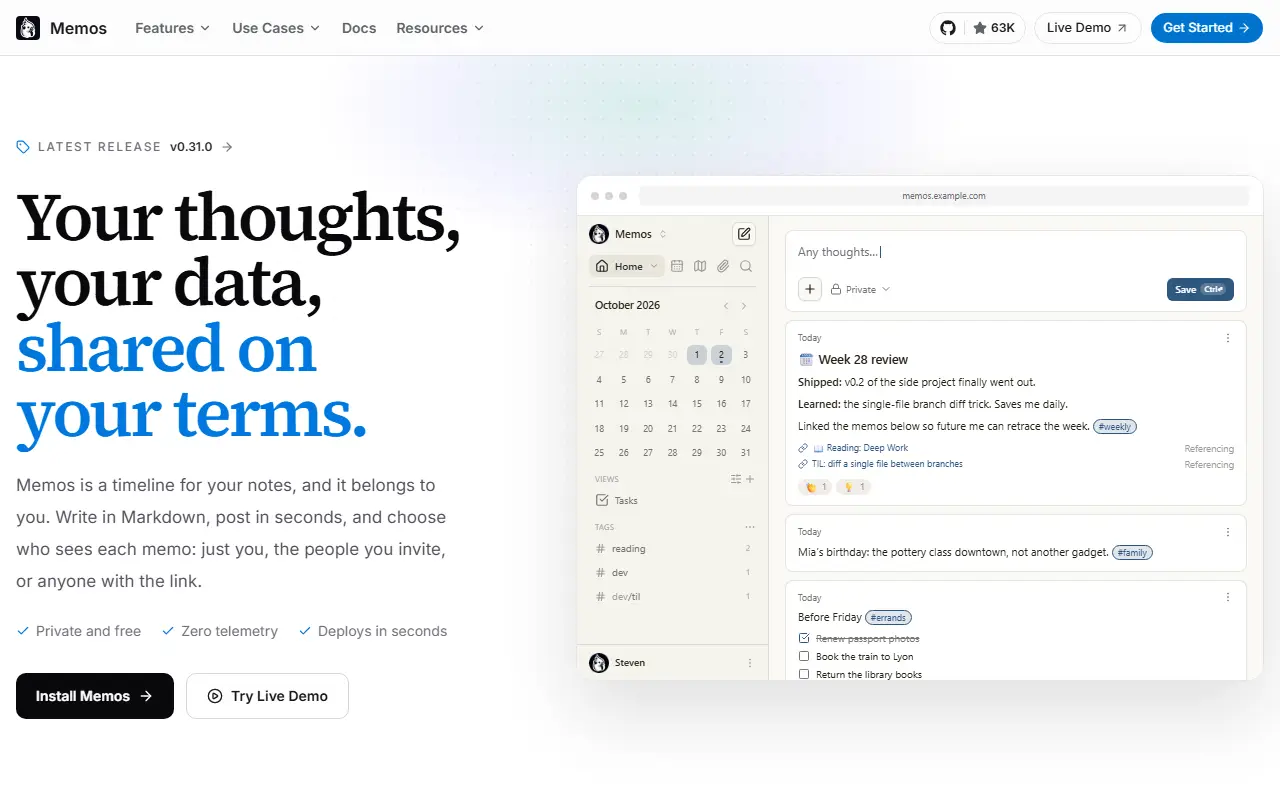
Memos is a personal timeline for quick notes that you host yourself. The idea is to write first and organize later: you save a thought in Markdown without choosing a title or folder, optionally attach images and files, and it lands on a chronological feed.
Finding things again relies on search, tag filters and a view of any given day on the timeline. You can pin important memos and save frequently used filters as views. New memos are private, and you decide per memo whether to keep it to yourself, show it to signed-in users or invite specific people, or make it public with a link. The project advertises zero telemetry and a full export of your data.
Memos is MIT licensed and built with Go on the back end, React on the front end and SQLite for storage. The quickest way to run it is a Docker container, with other options in the deployment guide, and there is a live demo to try first. Releases follow a year-and-month version scheme.
Key features
- Markdown notes with images and file attachments
- Chronological timeline of memos
- Search, tag filters and saved views
- Per-memo visibility controls
- Pinned memos for important notes
- Full data export with zero telemetry
Good fit for
- Personal journal or microblog on your own server
- Capturing quick thoughts without organizing them
- Sharing selected notes with a link
Memos: questions and answers
- What is Memos used for?
- Memos is a self-hosted, Markdown-based notes timeline for capturing quick thoughts, private by default, with search, tags, pinned memos and per-note visibility. It is a good fit for personal journal or microblog on your own server, capturing quick thoughts without organizing them and sharing selected notes with a link.
- Is Memos open source?
- Yes. Memos is open source under the MIT licence. Its source code is on GitHub at usememos/memos and is written mainly in Go.
- Is Memos free?
- Yes. Memos is open source, so the software itself is free to use.
- Can I self-host Memos?
- Yes. Memos can be self-hosted on your own server or infrastructure; there is no official hosted version.
- What is Memos an alternative to?
- Memos is an open-source alternative to Google Keep, Evernote, Apple Notes and Zoho Notebook. Other open-source alternatives to Google Keep include Standard Notes, Joplin and Simplenote.
- Is Memos actively maintained?
- Yes. The most recent commit to Memos was on 12 November 2026, and the latest release is 26.11.0, published on 1 November 2026. The project has 64k stars on GitHub, with 683 added in the last 30 days.
Open-source alternatives to Memos
See all
Standard Notes
Note Taking
Think fearlessly with end-to-end encrypted notes and files. For issues, visit https://stan
AGPL-3.0vs Evernote★ 6.7k
Joplin
Note Taking
Joplin - the privacy-focused note taking app with sync capabilities for Windows, macOS, Li
OSSvs Evernote★ 57k
Simplenote
Note Taking
Simplenote for Web, Windows, and Linux
GPL-2.0vs Evernote★ 5.3k
Logseq
Note Taking
A privacy-first, open-source platform for knowledge management and collaboration. Download
AGPL-3.0vs Notion★ 46k
TiddlyWiki
Note Taking
A self-contained JavaScript wiki for the browser, Node.js, AWS Lambda etc.
OSSvs Notion★ 8.7k
Anytype
Note Taking
Official Anytype client for MacOS, Linux, and Windows
OSSvs Notion★ 9.1k
SaaS alternatives to Memos
See all
Google Keep
Note Taking
Lightweight notes, checklists and reminders synced with Google accounts
SaaS
Evernote
Note Taking
Evernote is a note-taking app for capturing notes, documents and web clippings and keeping them organized and searchable across devices.
SaaS
Apple Notes
Note Taking
Built-in Apple notes app with folders, checklists, document scanning and iCloud sync
SaaS
Zoho Notebook
Note Taking
Notebook app with note cards, voice notes and document scanning
SaaS
Drafts
Note Taking
Quick-capture text app for Apple devices with actions to send notes elsewhere
SaaS
UpNote
Note Taking
Notes app with notebooks, tags and sync across mobile and desktop
SaaS