6,598 open-source and SaaS tools, with GitHub stats refreshed every day.

4 alternatives ranked by real activity

Open-source Tot alternatives

A curated, ranked list of the 4 best open-source alternatives to Tot.

The best open-source alternative to Tot is Memos. If that doesn't suit you, other good options are Simplenote, Heynote and Cowyo.

Tot alternatives are mainly Note Taking tools. 2 of them shipped code in the last 30 days, 3 can be self-hosted, and 1 uses a permissive licence.

Last updated October 2, 2026 · ranked by GitHub stars, growth and recent commits

Memos

A self-hosted, Markdown-based notes timeline for capturing quick thoughts, private by default, with search, tags, pinned memos and per-note visibility.

GitHub stars
63k
Last commit
today
Latest release
v0.31.0
Licence
MIT
Self-hosted
Yes
usememos.comMemos homepage screenshot

Memos is a personal timeline for quick notes that you host yourself. The idea is to write first and organize later: you save a thought in Markdown without choosing a title or folder, optionally attach images and files, and it lands on a chronological feed.

Finding things again relies on search, tag filters and a view of any given day on the timeline. You can pin important memos and save frequently used filters as views. New memos are private, and you decide per memo whether to keep it to yourself, show it to signed-in users or invite specific people, or make it public with a link. The project advertises zero telemetry and a full export of your data.

Memos is MIT licensed and built with Go on the back end, React on the front end and SQLite for storage. The quickest way to run it is a Docker container, with other options in the deployment guide, and there is a live demo to try first. Releases follow a year-and-month version scheme.

Key features

  • Markdown notes with images and file attachments
  • Chronological timeline of memos
  • Search, tag filters and saved views
  • Per-memo visibility controls
  • Pinned memos for important notes
  • Full data export with zero telemetry

Pricing: Memos is free, MIT-licensed software with no paid tiers, seat fees or usage charges. Only your own hosting costs apply.

Simplenote

The open-source Simplenote client for web, Windows and Linux, a React app packaged in Electron that syncs notes through Simperium.

GitHub stars
5.3k
Last commit
today
Latest release
v2.27.1
Licence
GPL-2.0
Self-hosted
No
Hosted version
Available
app.simplenote.comSimplenote homepage screenshot

Simplenote Electron is the open-source desktop and web client for Simplenote, a note-taking service from Automattic. The app is built with React and packaged with Electron, which lets the same codebase run in a browser and as an installable application, with packages producible for macOS, Windows and Linux.

Notes are synchronized through the Simperium library, and the interface is written in TypeScript with ReactJS. The repository documents how to build packages and how to run unit tests. Local development currently requires an existing account on the test server or access to production credentials, because the email-first signup flow no longer allows creating accounts in the test database, and sharing and publishing features do not work in development builds.

The code is released under GPL-2.0 and follows the coding guidelines used by wp-calypso. As a client for the hosted Simplenote service, it is meant for people who already use that service rather than for self-hosting their own notes server.

Key features

  • React note-taking client packaged with Electron
  • Runs on the web, Windows and Linux
  • Note syncing through Simperium
  • Build targets for macOS, Windows and Linux
  • TypeScript codebase with unit tests

Heynote

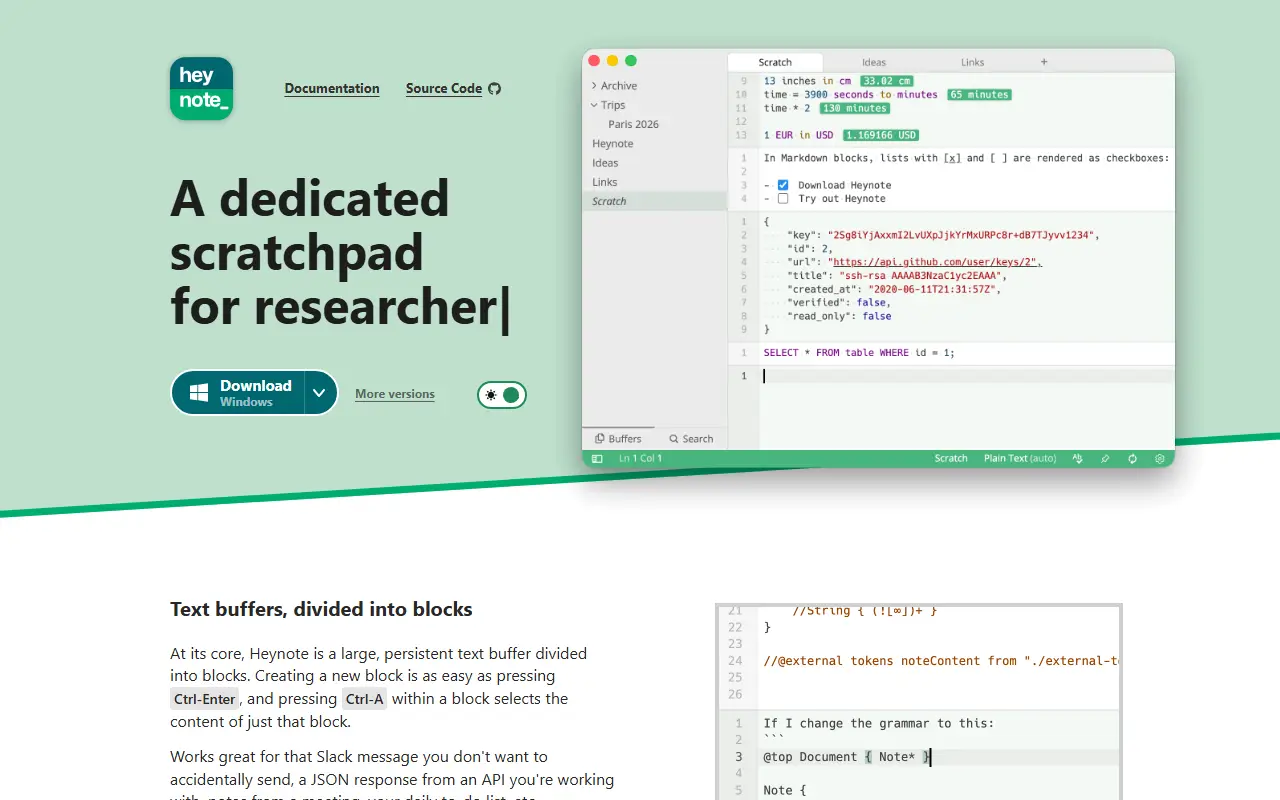
Heynote is a desktop scratchpad for developers and power users, built around a persistent, block-based text buffer with per-block syntax highlighting.

GitHub stars
5.4k
Last commit
3 mo ago
Latest release
v2.9.1
heynote.comHeynote homepage screenshot

Heynote is a scratchpad and note-taking app for developers and power users. It works like one large persistent text buffer where you can drop anything: a Slack message you are not ready to send, an API's JSON response, meeting notes or a daily to-do list.

Buffers are divided into blocks, and each block can be assigned a language such as JavaScript, JSON or Markdown, giving syntax highlighting and auto-formatting for JSON. Language auto-detection, multiple buffers in tabs, single and multi-buffer search, inline images, a math and calculator mode with currency conversion, multi-cursor editing, spell checking and dark and light themes are included. A global hotkey can show or hide the app, and key bindings can be default, Emacs-like or custom.

Heynote runs on macOS, Windows and Linux; there is no mobile app. It is built with JavaScript and its license is listed as Other, so check the repository terms before reuse. The author accepts contributions that fit the project's vision, especially bug fixes.

Key features

  • Block-based persistent text buffers
  • Per-block syntax highlighting for many languages
  • Math mode with currency conversion
  • Multiple buffers in tabs
  • Auto-formatting and language detection
  • Global hotkey and custom key bindings

Cowyo

Minimal self-contained scratchpad wiki and pastebin in Go with real-time shared editing and optional browser-side encrypted private pages.

GitHub stars
979
Last commit
1 mo ago
Latest release
v3.0.1
Self-hosted
Yes
Hosted version
Available
cowyo.comCowyo homepage screenshot

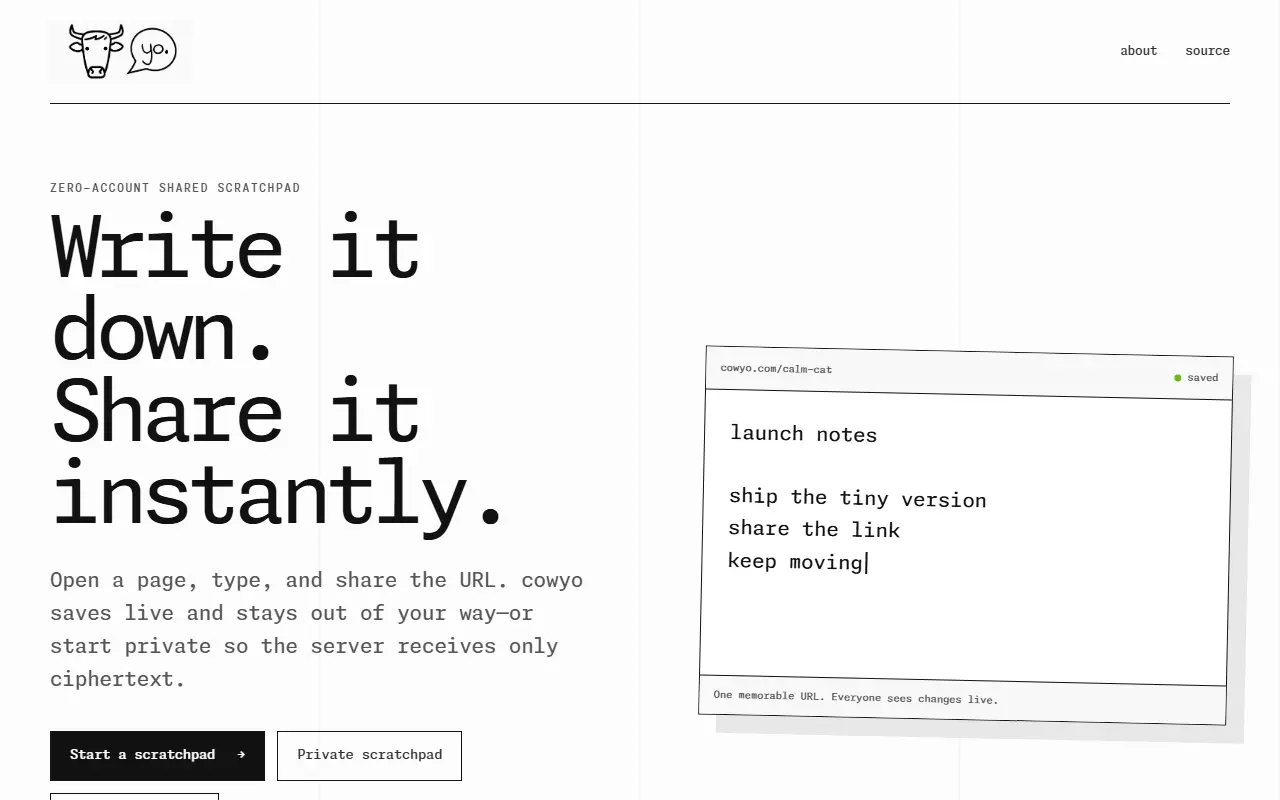
Cowyo is a shared scratchpad for quick notes, described as a pastebin for minimalists. You open a page, start typing and it saves automatically, then share the URL so others can edit in real time. Visiting the root creates a page with a memorable alliterative name such as calm-cat.

While several people edit a page, each editor's caret appears as a dim gray line. For sensitive notes you can choose a private scratchpad, where the content is encrypted in the browser and the plaintext is never sent to the server. The README warns that lost key links cannot be recovered.

It is written in Go, uses SQLite by default and can use PostgreSQL via a database URL setting. Production options include a public site URL for canonical links and a sitemap, plus optional Umami analytics, AdSense and ads.txt settings. You can try it at cowyo.com or build and run it yourself on port 8001. No licence is declared in the repository metadata.

Key features

  • Auto-saving shared scratchpad pages
  • Real-time collaborative editing with carets
  • Private pages encrypted in the browser
  • Memorable generated page names
  • SQLite by default, PostgreSQL optional
  • Single Go application

Pricing: The pricing page only carries markup listing cowyo at 0 USD, and no paid plans appear.

Tot alternatives: questions

What is the best open-source alternative to Tot?
Memos is the top-ranked open-source alternative to Tot on Enlisted: A self-hosted, Markdown-based notes timeline for capturing quick thoughts, private by default, with search, tags, pinned memos and per-note visibility. Other strong options are Simplenote, Heynote and Cowyo.
Are these Tot alternatives free?
All 4 are open source, so the code is free to use under its licence, and 3 of them can be self-hosted on your own server. 2 also offer a paid or managed cloud version if you'd rather not host it yourself.
How is this list of Tot alternatives ranked?
By a score built from GitHub stars, star growth over the last 30 days and how recently the code changed. 2 of these projects shipped code in the last 30 days. Data is refreshed daily, and nobody can pay to move up.

People also look for alternatives to…

View all