7,363 open-source and SaaS tools, with GitHub stats refreshed every day.

9 alternatives ranked by real activity

Open-source Zoho Notebook alternatives

A curated, ranked list of the 9 best open-source alternatives to Zoho Notebook.

The best open-source alternative to Zoho Notebook is Memos. If that doesn't suit you, other good options are Joplin, Notesnook, Standard Notes and Simplenote.

Zoho Notebook alternatives are mainly note-taking tools, but some are also productivity tools. 7 of them shipped code in the last 30 days, 8 can be self-hosted, and 2 use a permissive licence.

Last updated October 3, 2026 · ranked by GitHub stars, growth and recent commits

Memos

A self-hosted, Markdown-based notes timeline for capturing quick thoughts, private by default, with search, tags, pinned memos and per-note visibility.

GitHub stars
63k
Last commit
yesterday
Latest release
v0.31.0
Licence
MIT
Self-hosted
Yes
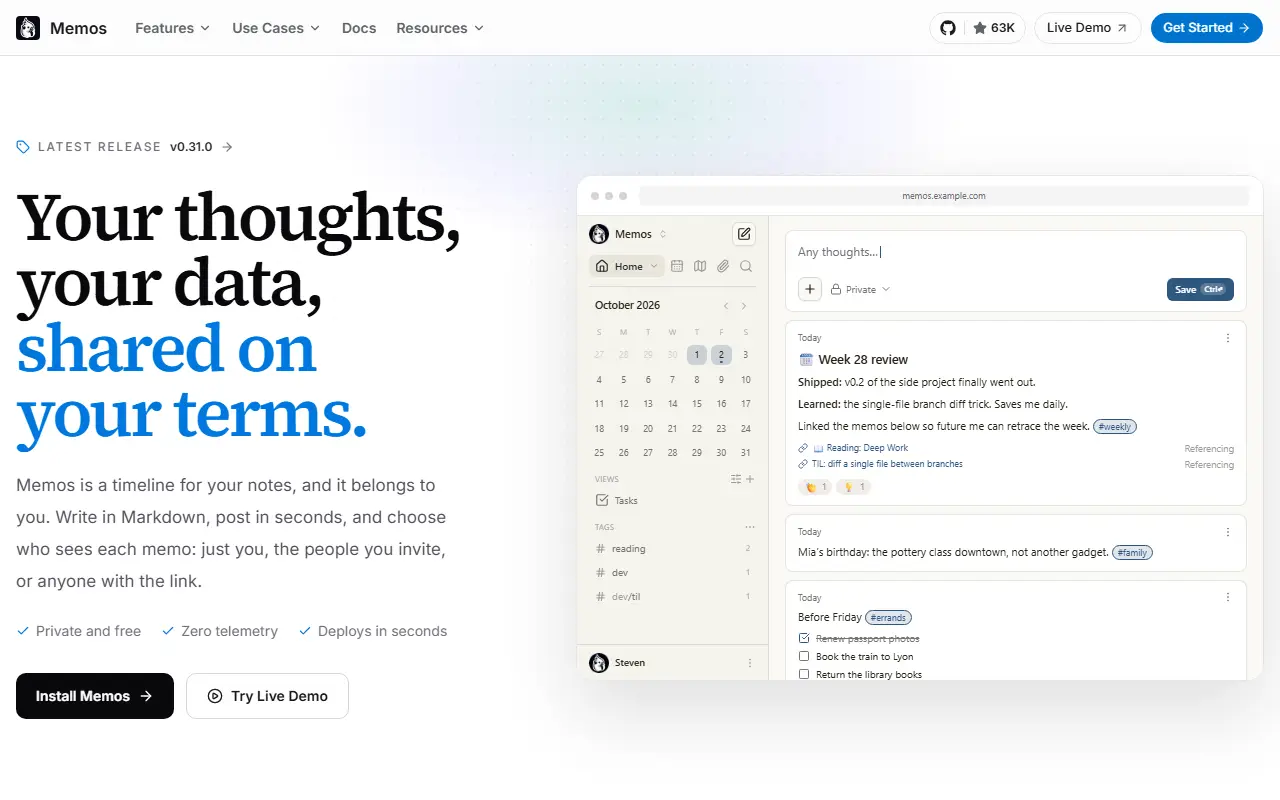
usememos.comMemos homepage screenshot

Memos is a personal timeline for quick notes that you host yourself. The idea is to write first and organize later: you save a thought in Markdown without choosing a title or folder, optionally attach images and files, and it lands on a chronological feed.

Finding things again relies on search, tag filters and a view of any given day on the timeline. You can pin important memos and save frequently used filters as views. New memos are private, and you decide per memo whether to keep it to yourself, show it to signed-in users or invite specific people, or make it public with a link. The project advertises zero telemetry and a full export of your data.

Memos is MIT licensed and built with Go on the back end, React on the front end and SQLite for storage. The quickest way to run it is a Docker container, with other options in the deployment guide, and there is a live demo to try first. Releases follow a year-and-month version scheme.

Key features

  • Markdown notes with images and file attachments
  • Chronological timeline of memos
  • Search, tag filters and saved views
  • Per-memo visibility controls
  • Pinned memos for important notes
  • Full data export with zero telemetry

Pricing: Memos is free, MIT-licensed software with no paid tiers, seat fees or usage charges. Only your own hosting costs apply.

Read more about MemosWebsite GitHub

Joplin

A free, open-source, offline-first note-taking and to-do app with Markdown notes, end-to-end encrypted sync, plugins and apps for desktop and mobile.

GitHub stars
57k
Last commit
2 days ago
Latest release
v3.7.21
Self-hosted
Yes
Hosted version
Available
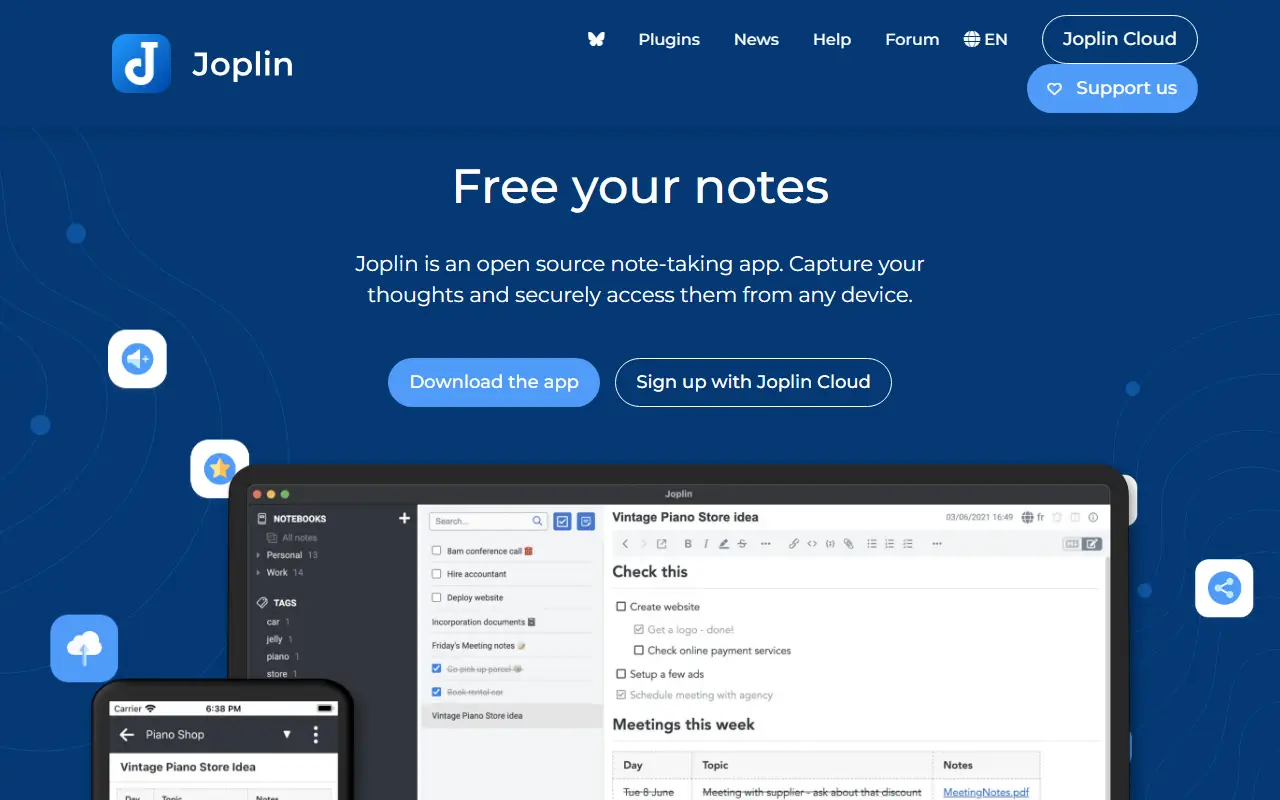
joplinapp.orgJoplin homepage screenshot

Joplin is a note-taking and to-do application, free and open source, that can manage large collections of notes organized into notebooks. Notes are written in Markdown, are searchable, can be tagged, and can be edited either in the app or in your own text editor. Apps are available for Windows, macOS, Linux, Android and iOS.

The app is offline first, so all your data lives on your phone or computer and stays accessible without a connection. Notes can be synchronized with end-to-end encryption through services such as Nextcloud, Dropbox, OneDrive and Joplin Cloud, and topics also mention WebDAV. Full-text search is available on every platform, and plugins and themes let you customize the app. A web clipper saves pages, and notes exported from Evernote can be imported with formatting, attachments and metadata intact; plain Markdown files can be imported as well.

The repository license is listed as 'Other', so check its terms if you plan to redistribute. Joplin is a popular choice for people who want an Evernote replacement that keeps data local or on storage they already control.

Key features

  • Markdown notes organized into notebooks
  • Offline-first storage on your own devices
  • End-to-end encrypted sync via Nextcloud, Dropbox or OneDrive
  • Evernote import with attachments and metadata
  • Plugins and themes
  • Web clipper for saving pages
  • Apps for desktop and mobile

Pricing: Joplin Cloud costs 2.99€ (Basic), 5.99€ (Pro) or 9.99€ (Pro 100 GB) per month, and Teams 7.99€ per user per month. Self-hosted Server Business is 3.33€ per user per month; 14-day trial.

Read more about JoplinWebsite GitHub

Notesnook

A free, open-source, end-to-end encrypted note-taking app with web, desktop and mobile clients, positioned as a private alternative to Evernote.

GitHub stars
15k
Last commit
yesterday
Latest release
v3.4.8
Licence
GPL-3.0
Self-hosted
Yes
Hosted version
Available
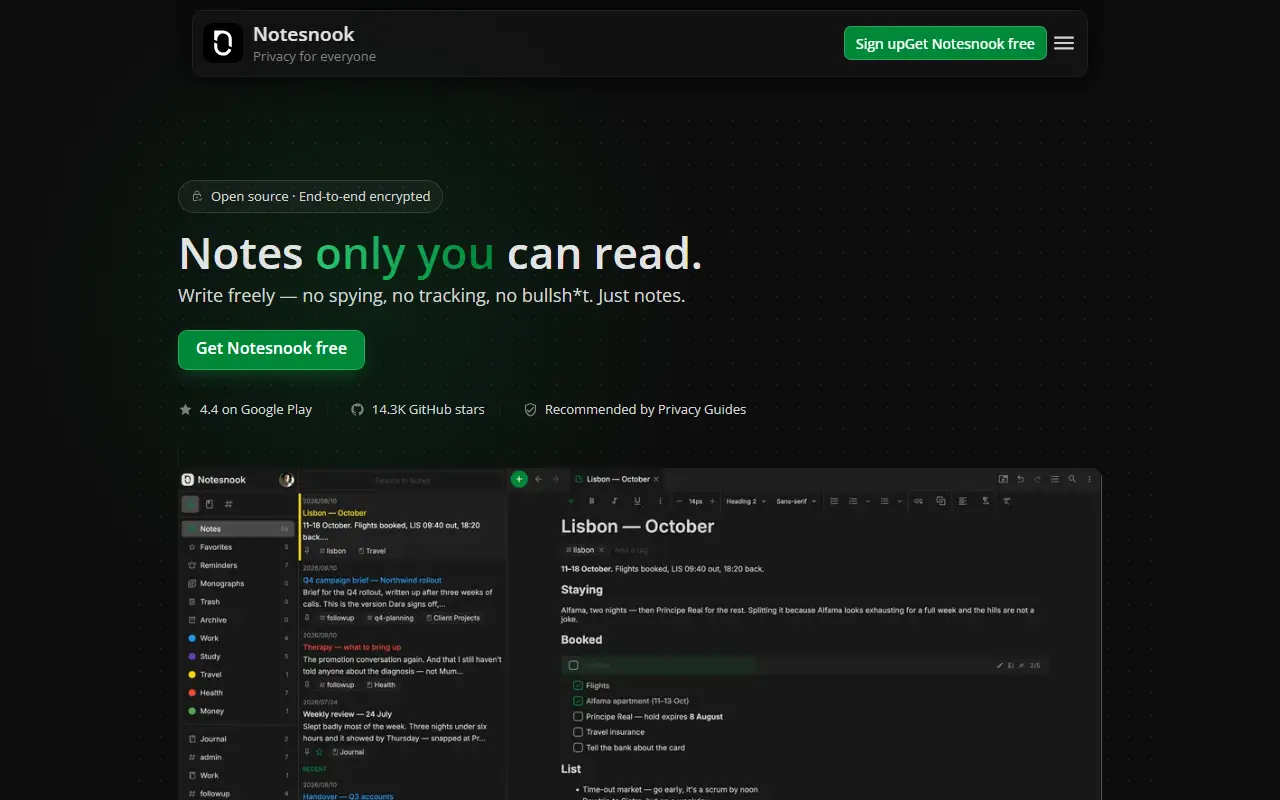
notesnook.comNotesnook homepage screenshot

Notesnook is a note-taking app that puts privacy first. Everything is encrypted on your device with XChaCha20-Poly1305 and Argon2 before it syncs, following zero-knowledge principles, and the whole thing is open source. It is presented as an end-to-end encrypted alternative to Evernote, aiming to show that privacy does not have to cost convenience.

The repository contains all the code needed to build and use the web, desktop and mobile clients. They are built mainly with TypeScript and React, with Electron for desktop and React Native for mobile, and parts of the code base are still being ported from JavaScript. A server component written with .NET appears in the topics. The website covers the full feature list, roadmap and downloads, and the team encourages community involvement through Discord.

Notesnook is licensed under GPL-3.0. A hosted sync service is operated by the company behind it, and the open-source code lets you inspect how encryption is handled. It suits people moving away from Evernote or other cloud notes who want strong encryption and cross-platform apps.

Key features

  • End-to-end encrypted notes
  • XChaCha20-Poly1305 and Argon2 encryption
  • Web, desktop and mobile apps
  • Open-source clients you can audit
  • Notebooks and organization tools
  • Evernote-style note-taking workflow

Pricing: Unlimited encrypted notes are free forever. Essential, Pro and Believer add storage (1GB, 10GB, 25GB) with a 14-day trial, and yearly and 5-year billing options.

Read more about NotesnookWebsite GitHub

Standard Notes

An end-to-end encrypted note-taking app with sync across devices and a self-hostable server, available on web, desktop and mobile.

GitHub stars
6.6k
Last commit
3 days ago
Latest release
@standardnotes/desktop@3.202.7
Licence
AGPL-3.0
Self-hosted
Yes
Hosted version
Available
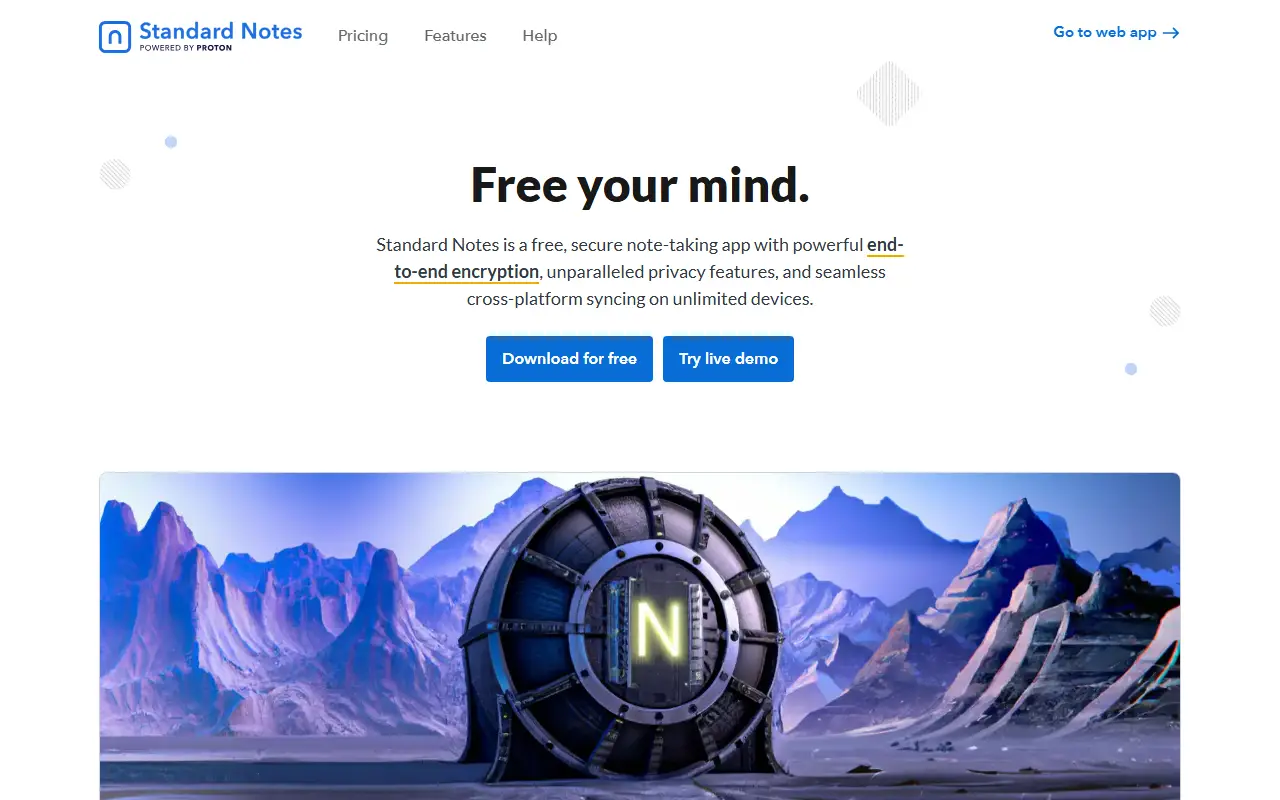
standardnotes.comStandard Notes homepage screenshot

Standard Notes is a note-taking app with end-to-end encryption, built for digitalists and professionals, aiming to keep notes, files and life's work in one secure place. Only the user can read their notes, and sync across devices is encrypted by default.

You register for an account on the web app and install clients for Mac, Windows, Linux, iOS and Android. The README highlights fast, free and encrypted sync on an unlimited number of devices, public source code, the option of hosting your own server with a few steps, and a focus on longevity and sustainability. A companion service called Listed turns notes into an online publication with email newsletters, and developers can build and publish extensions.

The web app compiles to static HTML, JavaScript and CSS files that can be served from any web server, and the README includes build and development instructions. Standard Notes is written in TypeScript and licensed under AGPL-3.0, with a forum and help pages for support. It suits privacy-minded users who want encrypted notes with the option to host their own backend.

Key features

  • End-to-end encrypted notes and files
  • Sync across unlimited devices
  • Apps for web, desktop and mobile
  • Self-hostable sync server
  • Listed publishing and newsletters
  • Extensions published by developers

Pricing: Free Standard plan includes end-to-end encryption and device sync. Productivity costs $90 and Professional $120 per year; there is no trial, but refunds are offered.

Simplenote

The open-source Simplenote client for web, Windows and Linux, a React app packaged in Electron that syncs notes through Simperium.

GitHub stars
5.3k
Last commit
today
Latest release
v2.27.1
Licence
GPL-2.0
Self-hosted
No
Hosted version
Available
app.simplenote.comSimplenote homepage screenshot

Simplenote Electron is the open-source desktop and web client for Simplenote, a note-taking service from Automattic. The app is built with React and packaged with Electron, which lets the same codebase run in a browser and as an installable application, with packages producible for macOS, Windows and Linux.

Notes are synchronized through the Simperium library, and the interface is written in TypeScript with ReactJS. The repository documents how to build packages and how to run unit tests. Local development currently requires an existing account on the test server or access to production credentials, because the email-first signup flow no longer allows creating accounts in the test database, and sharing and publishing features do not work in development builds.

The code is released under GPL-2.0 and follows the coding guidelines used by wp-calypso. As a client for the hosted Simplenote service, it is meant for people who already use that service rather than for self-hosting their own notes server.

Key features

  • React note-taking client packaged with Electron
  • Runs on the web, Windows and Linux
  • Note syncing through Simperium
  • Build targets for macOS, Windows and Linux
  • TypeScript codebase with unit tests
Read more about SimplenoteWebsite GitHub

Blinko

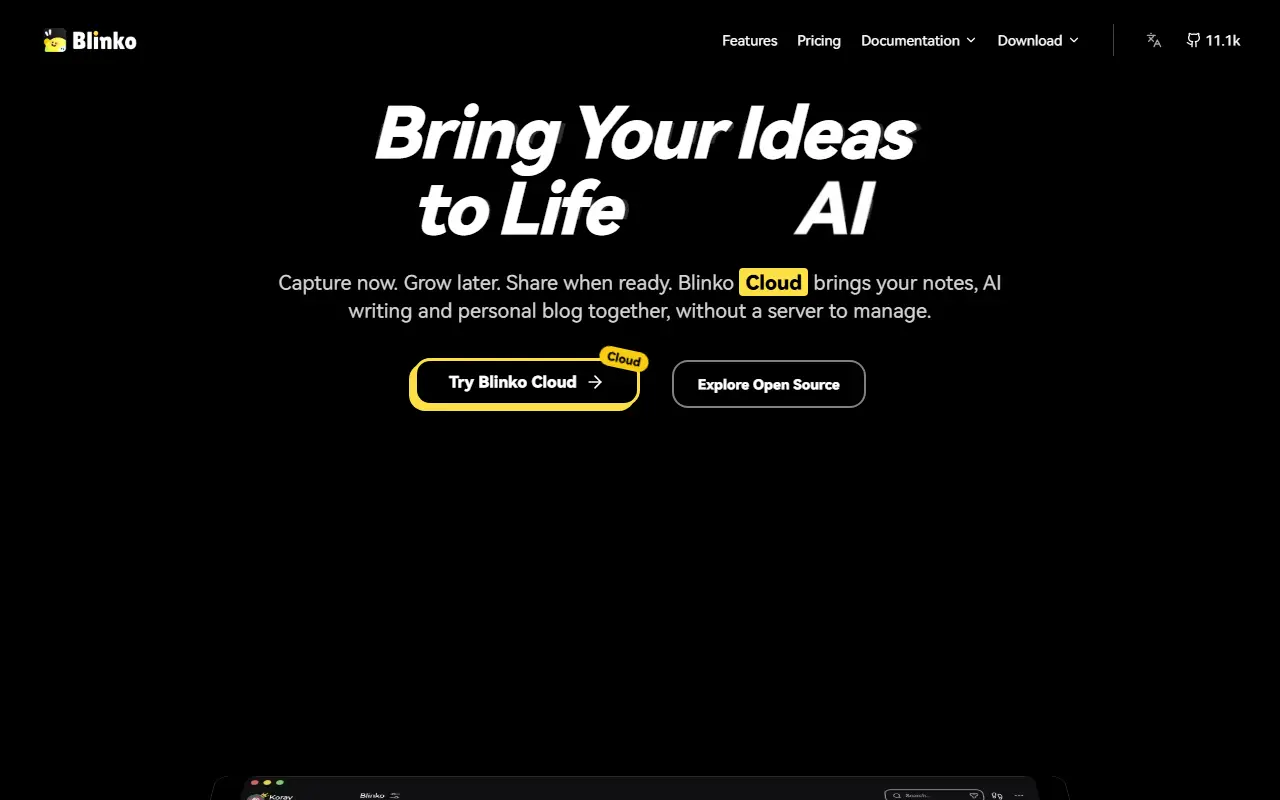
Blinko is an open-source, self-hosted personal AI note app that lets you capture quick card notes and search them in natural language.

GitHub stars
11k
Last commit
1 mo ago
Latest release
1.8.8
Licence
GPL-3.0
Self-hosted
Yes
blinko.spaceBlinko homepage screenshot

Blinko is a card-style note-taking app with AI features, designed for people who want to capture fleeting ideas the moment they happen. It is self-hosted and puts privacy first, so your notes stay on a server you control. The interface is built with Next.js and React in TypeScript, backed by PostgreSQL.

Its AI-enhanced retrieval uses retrieval-augmented generation, so you can find notes by asking in natural language rather than remembering keywords. Notes use Markdown and the project is tagged for memos and notebooks. A live demo, official site, documentation and English and Chinese Telegram communities are linked from the README.

Blinko is licensed under GPL-3.0 and installed on your own server, typically with Docker. It suits individuals who want a private alternative to cloud note and memo apps and are comfortable connecting their own AI provider.

Key features

  • Quick card-style note capture
  • AI-powered natural language note search
  • Markdown note support
  • Self-hosted with privacy focus
  • Next.js and PostgreSQL stack
  • Live demo available

Pricing: The open-source edition is free to self-host, and Blinko Cloud has a free plan. Paid cloud plans are Pro at $5.99 and Pro Plus at $10.99 per month.

Read more about BlinkoWebsite GitHub

Jotty

Lightweight self-hosted app for checklists and notes that stores data as files on your own server, with optional note encryption, OIDC single sign-on, and MFA.

GitHub stars
2k
Last commit
yesterday
Latest release
1.28.0
Licence
AGPL-3.0
Self-hosted
Yes
jotty.pageJotty homepage screenshot

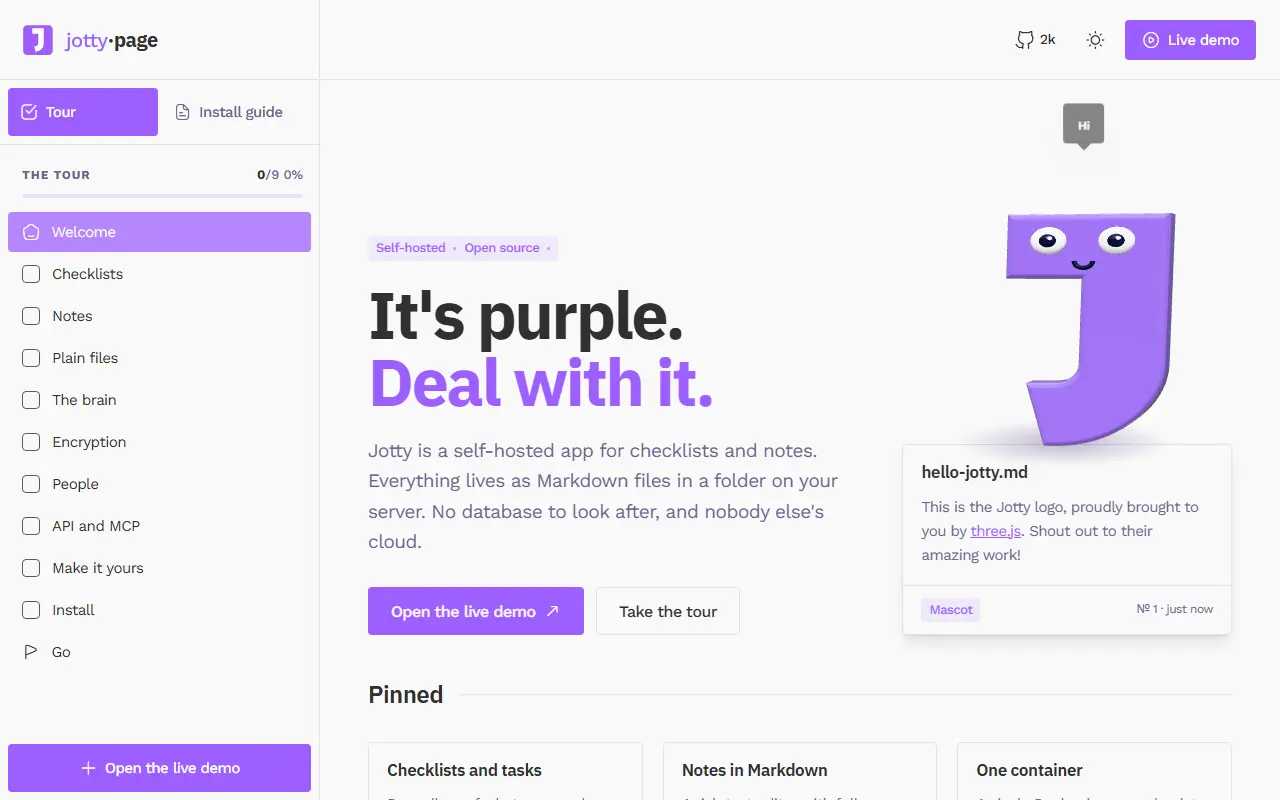
Jotty is a self-hosted application for managing personal checklists and notes. It is easy to deploy, keeps all data on your own server, and can encrypt and decrypt notes for extra privacy. It was previously known as rwMarkable and is released under the AGPL-3.0 license.

The interface offers task lists with drag-and-drop ordering, a rich text editor for notes, keyboard shortcuts, translations, and custom themes and emojis. Data is stored as files rather than in a database, which keeps backups simple. For access control it supports single sign-on through OIDC and multi-factor authentication, and it exposes an API.

Docker Compose is the recommended way to install it, and the documentation covers initial setup, data storage, the versioning scheme, and encryption. Jotty suits homelab users and individuals who want a simple, private alternative to cloud to-do and note apps.

Key features

  • Checklists with drag-and-drop ordering
  • Rich text note editor
  • Optional note encryption
  • File-based data storage
  • OIDC single sign-on and MFA
  • API and custom themes

Pricing: Free and open source under the AGPL-3.0 license.

Read more about JottyWebsite GitHub

Flatnotes

Flatnotes is a self-hosted note-taking web app that stores notes as plain markdown files in one folder, with no database.

GitHub stars
3.2k
Last commit
1 mo ago
Latest release
v5.5.5
Licence
MIT
Self-hosted
Yes
Hosted version
Available

Flatnotes is a self-hosted, database-less note-taking web app that keeps all notes as markdown files in a single flat folder. Its design principle is a distraction-free app that puts note content first: there are no folders or notebooks, only your notes, backed by search and tagging. The code is written in Vue and licensed under the MIT license.

A second principle is that your notes are never held hostage. Because they are ordinary markdown files without a database or proprietary format, you can move them to another app at any time. The only thing flatnotes caches is the search index, which syncs incrementally on every search and at startup, so you can add, edit or delete files outside the app even while it runs.

Features include a mobile-responsive interface, raw and WYSIWYG markdown editor modes, advanced search, tagging, a customizable home page, wikilinks between notes, light and dark themes, a REST API and several authentication options from none to read-only, username and password, or two-factor authentication. A quick full-text search is available with the slash key. A demo resets every 15 minutes, and PikaPods offers hosting.

Key features

  • Notes stored as plain markdown files
  • No database required
  • Raw and WYSIWYG editor modes
  • Full-text search and tagging
  • Wikilinks between notes
  • Multiple authentication options including 2FA
  • REST API

Pricing: Free and open source under the MIT license; third-party hosting is available through PikaPods.

Read more about FlatnotesGitHub

NotallyX

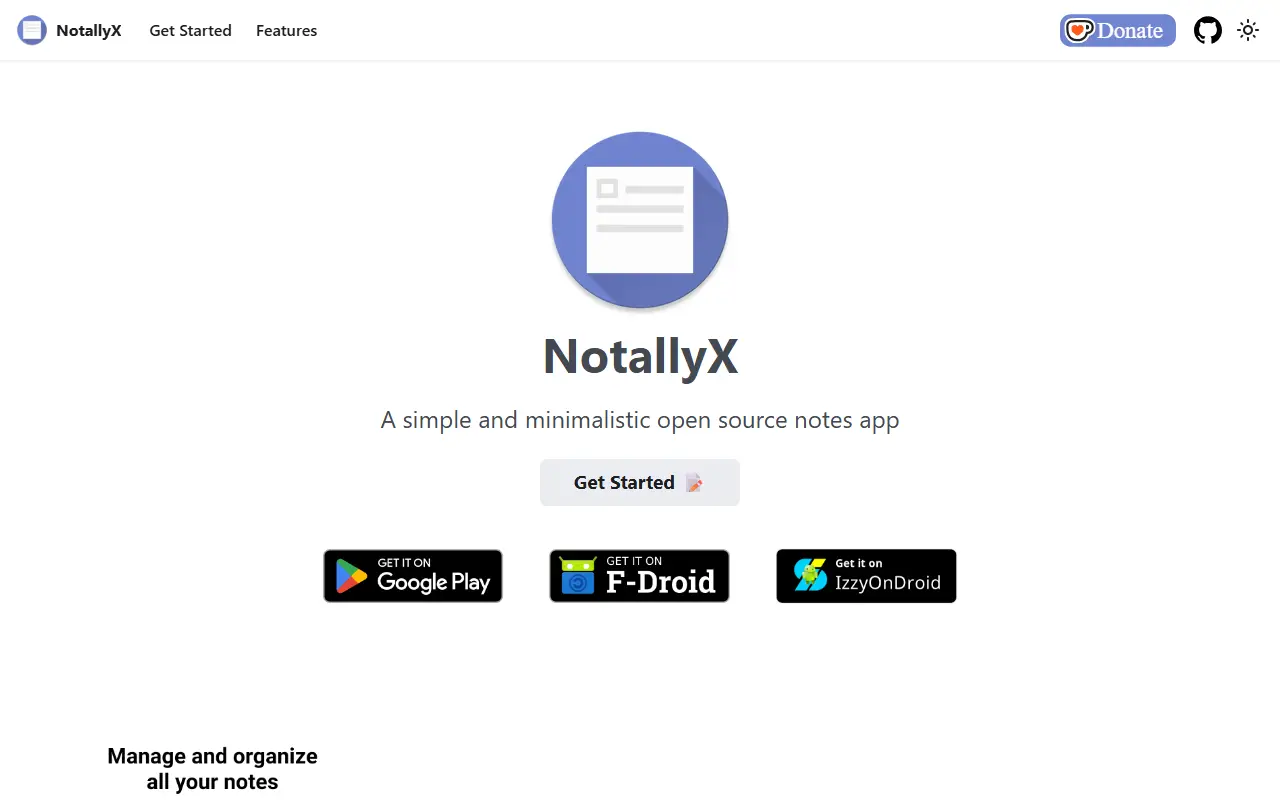
NotallyX is a minimalist Android note-taking app with rich text, task lists, reminders, file attachments and optional auto-backup.

GitHub stars
746
Last commit
2 days ago
Latest release
v7.11.2
Licence
GPL-3.0
crustack.github.ioNotallyX homepage screenshot

NotallyX, published under the Crustack account, is a minimalistic note-taking app for Android that extends the original Notally app. It lets you write rich text notes with bold, italics, monospace and strike-through, and create task lists with subtasks and automatic sorting of checked items to the end.

Further features include reminders with notifications, attachments of pictures, PDFs and other files, sorting by title or date, colors, pins and labels, clickable links for phone numbers, emails and URLs, undo and redo, a home screen widget, locking by biometrics or PIN, configurable auto-backups, quick audio notes and list or grid views. Notes can be imported from Evernote, Google Keep and Quillpad.

The developer notes that the app was temporarily removed from the Google Play Store after users reported data loss, and strongly advises setting up automatic backups, ideally also backup on save. It is written in Kotlin, licensed under GPL-3.0, supports Android Lollipop and up, and has occasional beta releases.

Key features

  • Rich text notes with formatting
  • Task lists with subtasks
  • Reminders with notifications
  • File and picture attachments
  • Biometric or PIN note locking
  • Import from Evernote and Google Keep

Pricing: Free and open source under the GPL-3.0 license.

Read more about NotallyXWebsite GitHub

Zoho Notebook alternatives: questions

What is the best open-source alternative to Zoho Notebook?
Memos is the top-ranked open-source alternative to Zoho Notebook on Enlisted: A self-hosted, Markdown-based notes timeline for capturing quick thoughts, private by default, with search, tags, pinned memos and per-note visibility. Other strong options are Joplin, Notesnook, Standard Notes and Simplenote.
Are these Zoho Notebook alternatives free?
All 9 are open source, so the code is free to use under its licence, and 8 of them can be self-hosted on your own server or computer. 5 also offer a paid or managed cloud version if you'd rather not host it yourself.
How is this list of Zoho Notebook alternatives ranked?
By a score built from GitHub stars, star growth over the last 30 days and how recently the code changed. 7 of these projects shipped code in the last 30 days. Data is refreshed daily, and nobody can pay to move up.

People also look for alternatives to…

View all