 TrackMedia
 TrackRev

About Logflare
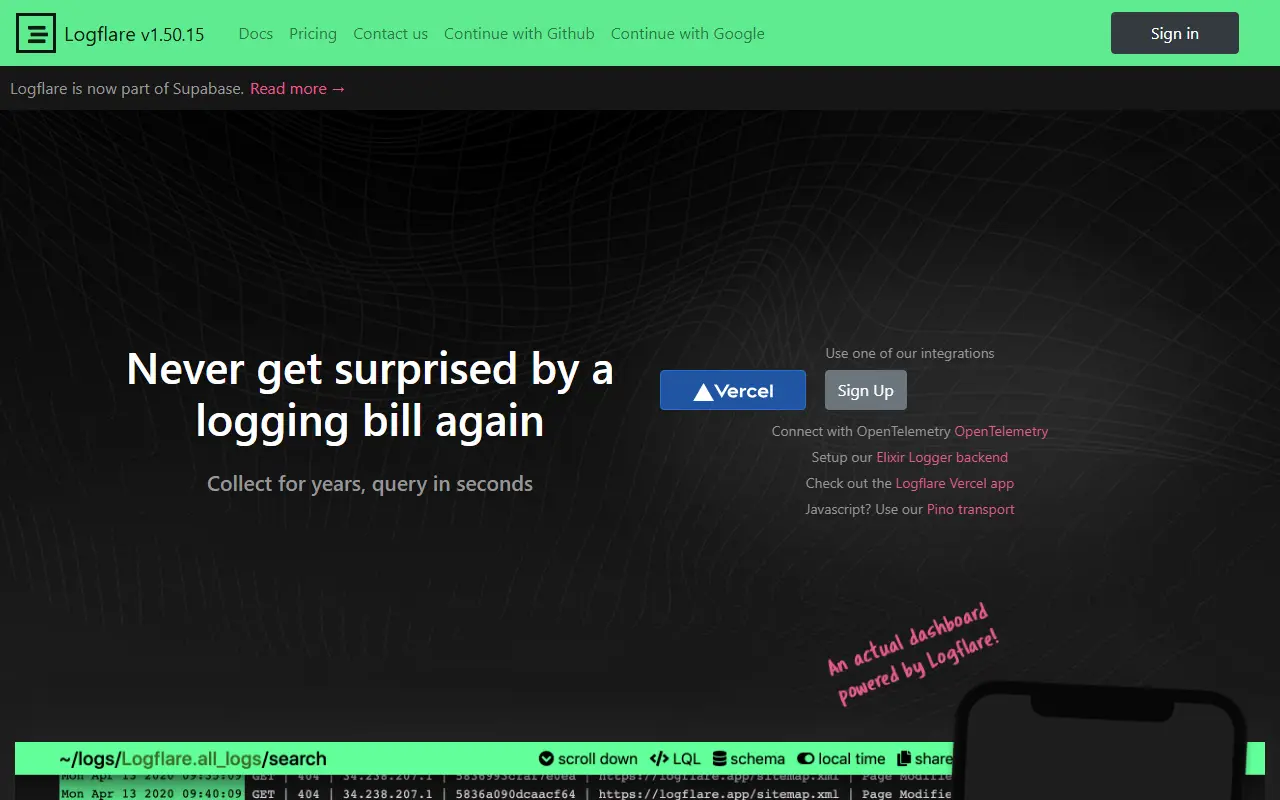
Logflare collects logs and application events and writes them into Google BigQuery, so they can be queried with standard SQL. It is now part of Supabase, and the site presents it as a way to collect data for years and query it in seconds without a separate archiving pipeline.
Data comes in through integrations: a Cloudflare app that logs each request asynchronously, a Vercel app, an Elixir Logger backend, a Pino transport for JavaScript and OpenTelemetry. Logs are kept in BigQuery for 7 days by default, and bringing your own BigQuery table extends that for as long as you like. Events can be routed with regular expressions, trigger email or SMS alerts, and be shared through a public URL.
The service is hosted and sign-in is with GitHub or Google. Billing is metered per million events, and the repository carries the Apache-2.0 licence.
Key features
- Cloudflare app logs every request
- Logs stored in Google BigQuery
- Regex-based log routing
- Email and SMS alerts in real time
- Public URL for sharing a source
- Structured metadata queried with SQL
Good fit for
- Cloudflare request logging
- Elixir application logging
- Sharing live event streams by public URL
Logflare: questions and answers
- What is Logflare used for?
- Logflare is a log and event service backed by Google BigQuery, with Cloudflare, Vercel and Elixir integrations and metered per-event pricing. It is a good fit for Cloudflare request logging, Elixir application logging and sharing live event streams by public URL.
- Is Logflare open source?
- Yes. Logflare is open source under the Apache-2.0 licence. Its source code is on GitHub at Logflare/logflare and is written mainly in Elixir.
- Is Logflare free?
- Yes. Logflare is open source, so the software itself is free to use. A managed cloud version is also available.
- Can I self-host Logflare?
- Yes. Logflare can be self-hosted on your own server or infrastructure.
- What is Logflare an alternative to?
- Logflare is an open-source alternative to Loggly and Axiom. Other open-source alternatives to Loggly include Grafana Loki, Fluentd and OpenObserve.
- Is Logflare actively maintained?
- Yes. The most recent commit to Logflare was on 11 November 2026, and the latest release is v1.54.8, published on 10 November 2026. The project has 1k stars on GitHub.
Open-source alternatives to Logflare
See all
Grafana Loki
Monitoring & Observability
Like Prometheus, but for logs.
AGPL-3.0vs Datadog★ 29k
Fluentd
Monitoring & Observability
Fluentd: Unified Logging Layer (project under CNCF)
Apache-2.0vs Sumo Logic★ 14k
OpenObserve
Monitoring & Observability
High-performance, unified observability for the AI era. 140x lower storage cost.
AGPL-3.0vs Datadog★ 23k
SigNoz
Monitoring & Observability
SigNoz Cloud is a one-stop observability tool built on top of OpenTelemetry. Get APM, logs
OSSvs Datadog★ 33k
Vector
Monitoring & Observability
A high-performance observability data pipeline.
MPL-2.0vs Cribl★ 23k
Kibana
Monitoring & Observability
Your window into all of your data
OSSvs Splunk★ 21k
SaaS alternatives to Logflare
See all
Loggly
Monitoring & Observability
Cloud log management with search, dashboards and alerting
SaaS
Axiom
Monitoring & Observability
Cloud service for ingesting, storing and querying logs, traces and event data
SaaS
Tailstream
Monitoring & Observability
Real-time visualisation and time-based playback of server logs
SaaS
Honeycomb
Monitoring & Observability
Observability service for querying high-cardinality traces and events
SaaS
Logier
Monitoring & Observability
Log analysis tool that parses any log format, clusters duplicate errors and surfaces root causes
SaaS
Mezmo
Monitoring & Observability
Telemetry pipeline and log analysis platform
SaaS