About GPT-Load
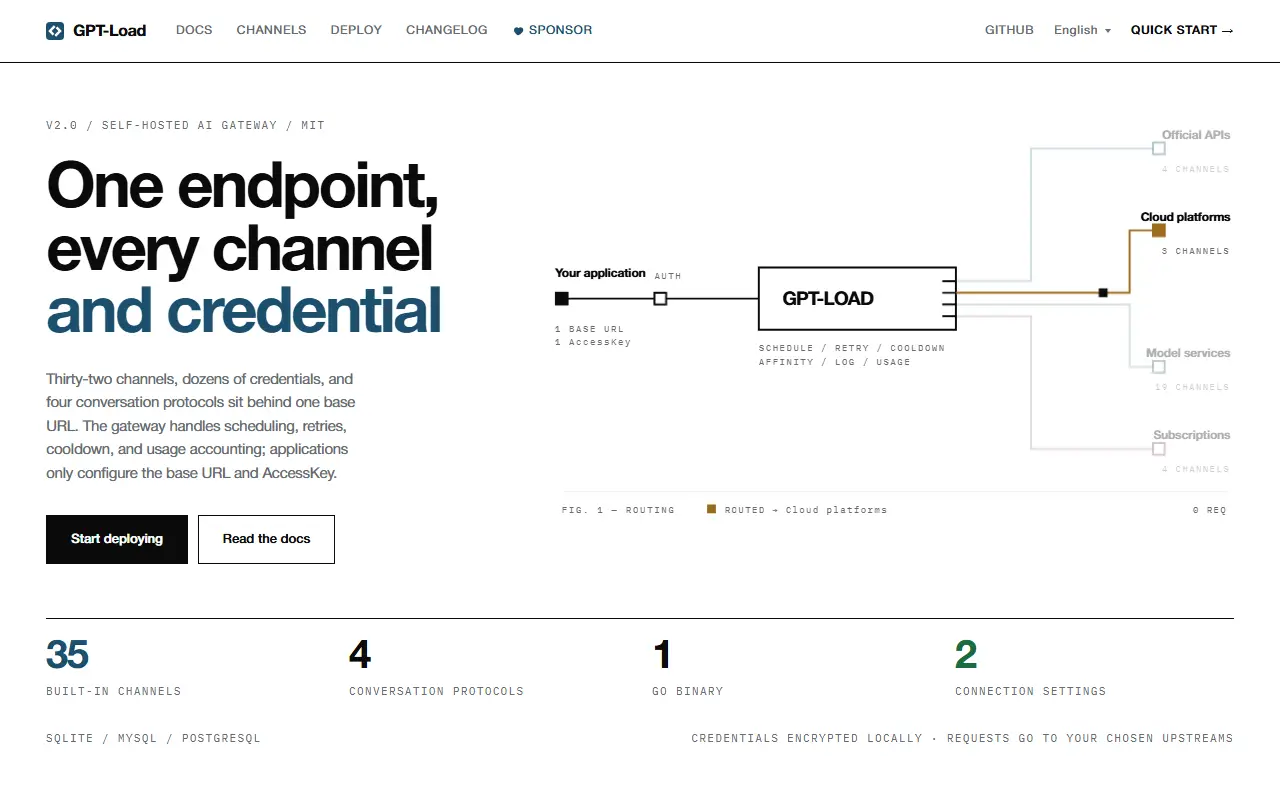
GPT-Load is a self-hosted AI gateway for setups that use several model channels and credentials. It puts API keys, subscription accounts, traffic scheduling, error handling, request logging and usage accounting behind a single entry point, so applications talk to a single endpoint instead of juggling providers.
Its topics show support for OpenAI, Gemini and Anthropic style interfaces and use with tools such as Claude Code and Codex, and it works as an LLM gateway and load balancer. Credentials can be rotated and scheduled across channels, failures can fall back to other credentials, and logs and usage give visibility into what each key or account is used for.
GPT-Load is written in Go with the Gin framework and licensed under MIT. The current 2.0 line is in release-candidate stages, and the README is available in English, Chinese and Japanese. It suits individuals and teams that pool multiple AI provider keys or accounts and want central control.
Key features
- Single endpoint for many AI channels
- API key and subscription account pooling
- Traffic scheduling and load balancing
- Failover on credential or channel errors
- Request logs and usage accounting
- Go-based lightweight server
Good fit for
- →Pooling several AI provider keys
- →Routing coding agents through one gateway
- →Tracking AI usage per credential
- Built with
- Go
- Tags
- ai-gateway
- llm-gateway
- load-balancer
- api-gateway
- self-hosted
- openai
- anthropic
- golang
- failover
GPT-Load: questions and answers
- What is GPT-Load used for?
- GPT-Load is a self-hosted AI gateway that puts many model channels, API keys and subscription accounts behind a single endpoint with scheduling, failover, request logs and usage accounting. It is a good fit for pooling several AI provider keys, routing coding agents through one gateway and tracking AI usage per credential.
- Is GPT-Load open source?
- Yes. GPT-Load is open source under the MIT licence. Its source code is on GitHub at tbphp/gpt-load and is written mainly in Go.
- Is GPT-Load free?
- Yes. GPT-Load is open source, so the software itself is free to use.
- Can I self-host GPT-Load?
- Yes. GPT-Load can be self-hosted on your own server or infrastructure.
- What are some alternatives to GPT-Load?
- Similar open-source tools in the AI Infrastructure category include CoAI, New API and LLM Gateway. SaaS products in the same category include AllToken, Costbase and AI Stats.
- Is GPT-Load actively maintained?
- Yes. The most recent commit to GPT-Load was on 2 October 2026, and the latest release is v2.0.0-rc.41, published on 2 October 2026. The project has 7k stars on GitHub.
Open-source alternatives to GPT-Load
See all
CoAI
AI Infrastructure
🚀 Next Gen Multi-tenant AI One-Stop Solution. Builtin Admin & Billing System. Enterprise-
Apache-2.0★ 9.3k
New API
AI Infrastructure
A unified AI model hub for aggregation & distribution. It supports cross-converting variou
AGPL-3.0vs OpenRouter★ 49k
LLM Gateway
AI Infrastructure
Route, manage, and analyze your LLM requests across multiple providers with a unified API
OSSvs Amazon Bedrock★ 1.7k
Ollama
AI Infrastructure
Get up and running with Kimi, GLM, MiniMax, DeepSeek, gpt-oss, Qwen, Gemma and other model
MITvs ChatGPT★ 182k
LocalAI
AI Infrastructure
LocalAI is the open-source AI engine. Run any model - LLMs, vision, voice, image, video -
MITvs ChatGPT★ 49k
Helicone
AI Infrastructure
🧊 Open source LLM observability platform. One line of code to monitor, evaluate, and expe
Apache-2.0vs OpenRouter★ 6.2k
SaaS alternatives to GPT-Load
See all
AllToken
AI Infrastructure
Unified API gateway to LLMs from OpenAI, Anthropic and Google with usage tracking and routing
SaaS
Costbase
AI Infrastructure
Aggregates the costs of AI providers into one dashboard for developers of AI products
SaaSAI Stats
AI Infrastructure
Database of AI models plus an OpenAI-compatible gateway with usage, pricing and reliability monitoring
SaaS
AnyRouter
AI Infrastructure
Unified LLM gateway that routes coding agents and MCP servers through a single endpoint
SaaS
Crouter
AI Infrastructure
AI API gateway giving one endpoint to Claude, GPT and Gemini models for coding tools and agents
SaaS
OpenAI API Platform
AI Infrastructure
Developer API and platform for accessing OpenAI models like GPT for text, vision and audio
SaaS