 TrackMedia
 TrackRev

 Blogger
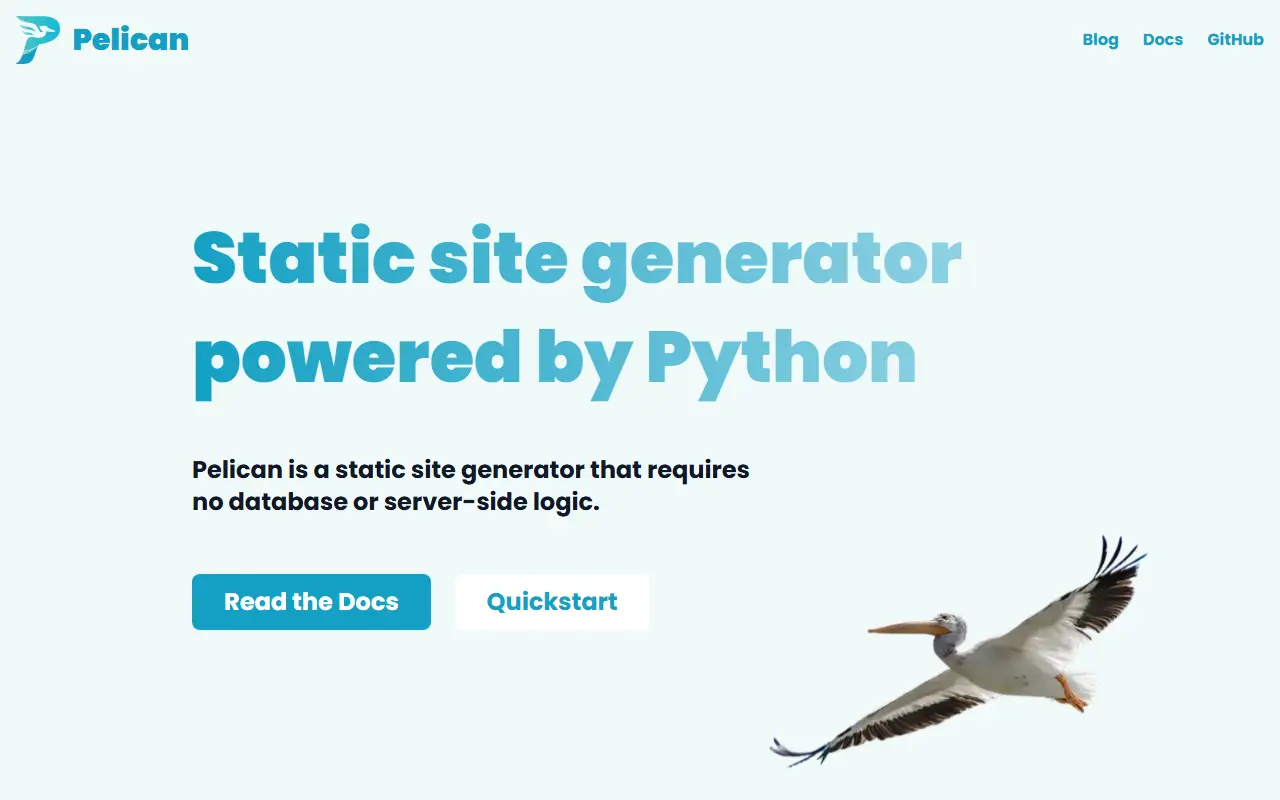
About Pelican
Pelican generates a static website from content files, so there is no database and no server-side code to run. Articles and blog posts are written in reStructuredText or Markdown, and static pages are supported alongside chronological content.
Sites are themed with Jinja2 templates, and Pelican can publish articles in multiple languages, generate Atom and RSS feeds and highlight code with Pygments. Existing content can be imported from WordPress, Dotclear or RSS feeds. Rebuilds are fast because Pelican caches content and writes only the output that changed.
Setup is done with pip: install pelican with Markdown, run pelican-quickstart in a new project folder, add a Markdown article with a title, date and category, and preview the site on localhost port 8000 using pelican -r -l. A plugin ecosystem extends it, and the project is supported through donations and contributions.
Key features
- Static output with no database or server-side logic
- Write content in reStructuredText or Markdown
- Multiple languages, Atom and RSS feeds, and syntax highlighting
- Imports content from WordPress, Dotclear or RSS
- Extensible through a plugin ecosystem
Good fit for
- Personal blogs
- Documentation-style static sites
- Moving a WordPress blog to static pages
Pelican: questions and answers
- What is Pelican used for?
- Pelican is a Python static site generator that builds sites from Markdown or reStructuredText content with no database or server-side logic. It is a good fit for personal blogs, documentation-style static sites and moving a WordPress blog to static pages.
- Is Pelican open source?
- Yes. Pelican is open source under the AGPL-3.0 licence. Its source code is on GitHub at getpelican/pelican and is written mainly in Python.
- Is Pelican free?
- Yes. Pelican is open source, so the software itself is free to use.
- Can I self-host Pelican?
- Yes. Pelican can be self-hosted on your own server or infrastructure.
- What is Pelican an alternative to?
- Pelican is an open-source alternative to Blogger. Other open-source alternatives to Blogger include Hugo, Jekyllrb and Hexo.
- Is Pelican actively maintained?
- Yes. The most recent commit to Pelican was on 9 November 2026, and the latest release is 4.12.0, published on 20 April 2026. The project has 13k stars on GitHub, with 20 added in the last 30 days.
Open-source alternatives to Pelican
See all
Hugo
CMS
The world’s fastest framework for building websites.
Apache-2.0vs Squarespace★ 90k
Jekyllrb
CMS
:globe_with_meridians: Jekyll is a blog-aware static site generator in Ruby
MITvs Squarespace★ 52k
Hexo
CMS
A fast, simple & powerful blog framework, powered by Node.js.
MITvs Hashnode★ 42k
Bludit
CMS
Simple, Fast, Secure, Flat-File CMS
MITvs Blogger★ 1.5k
HTMLy
CMS
Simple and fast databaseless PHP blogging platform, and Flat-File CMS
GPL-2.0vs Medium★ 1.4k
Halo
CMS
Halo 是一款强大易用的开源建站工具,从个人博客、知识库,到企业官网、在线商城,Halo 都能助您轻松实现,一站式满足您的多样化建站需求。
GPL-3.0vs Jimdo★ 40k