
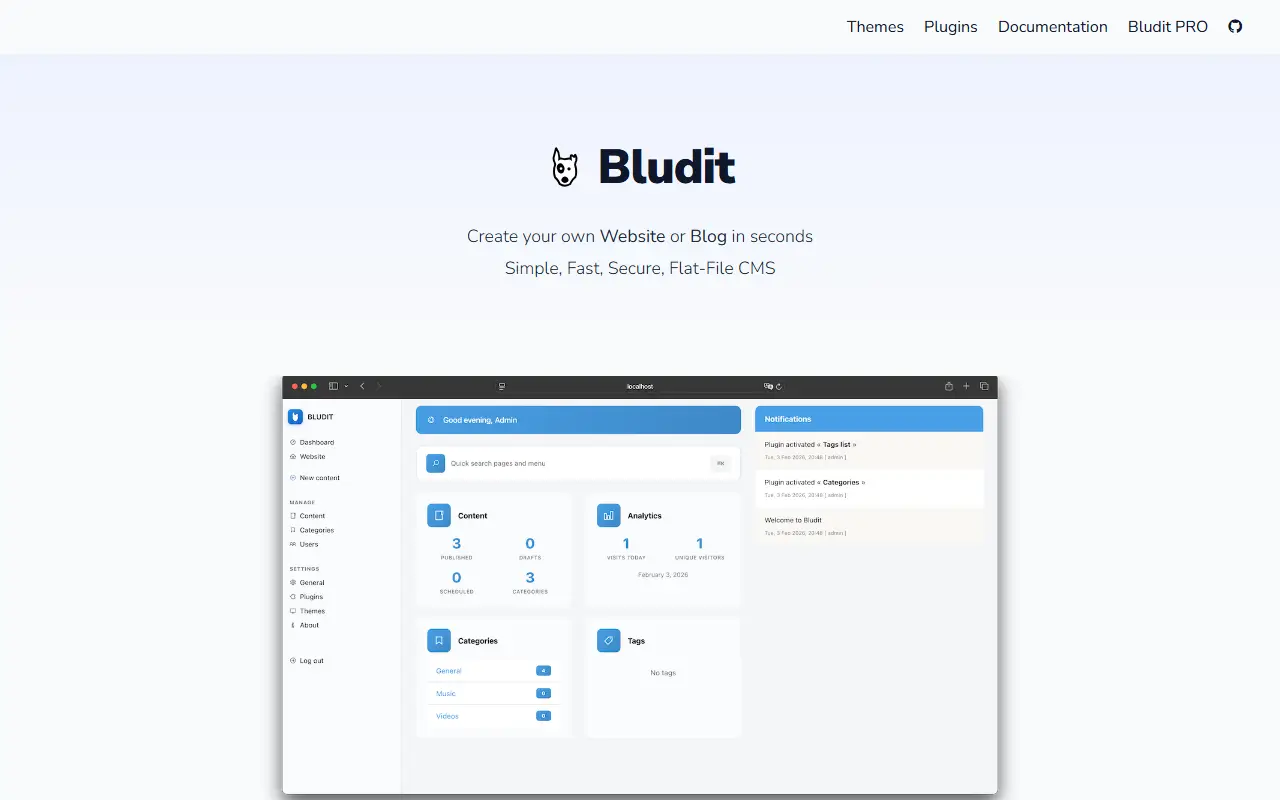
About Bludit
Bludit is a flat-file content management system for building websites and blogs. It stores content as JSON files on disk instead of in a database, so installation does not involve setting up MySQL or similar, and all you need is a web server with PHP support.
Content can be written in Markdown or HTML, and the system is extended through plugins and themes. Requirements listed in the README are PHP 8.0 or newer with the mbstring, gd, dom and json modules. Installation means downloading the release, uploading it to a web server and following the installer. The README also explains how to configure reverse proxies correctly so client IP addresses are read properly for login protection and statistics.
Bludit is released under the MIT licence and written in PHP, and a Docker image is available according to its topics. Documentation, a forum, Discord and plugin and theme directories support the community. It suits individuals, bloggers and small organizations that want a quick, self-hosted site without database administration.
Key features
- Flat-file storage using JSON
- Markdown and HTML content
- Plugins and themes
- Installer-based setup
- Login brute-force protection
- Docker image available
Good fit for
- →Running a small blog without a database
- →Quickly launching a simple company website
- →Hosting a lightweight CMS on shared PHP hosting
- Built with
- PHP
- Tags
- cms
- flat-file
- php
- blog
- markdown
- json
- plugins
- themes
- self-hosted
Bludit: questions and answers
- What is Bludit used for?
- Bludit is a flat-file CMS written in PHP that stores content as JSON files, supports Markdown and HTML, and needs no database to run. It is a good fit for running a small blog without a database, quickly launching a simple company website and hosting a lightweight CMS on shared PHP hosting.
- Is Bludit open source?
- Yes. Bludit is open source under the MIT licence. Its source code is on GitHub at bludit/bludit and is written mainly in PHP.
- Is Bludit free?
- Yes. Bludit is open source, so the software itself is free to use.
- Can I self-host Bludit?
- Yes. Bludit can be self-hosted on your own server or infrastructure; there is no official hosted version.
- What is Bludit an alternative to?
- Bludit is an open-source alternative to Blogger. Other open-source alternatives to Blogger include HTMLy, Halo and WordPress.
- Is Bludit actively maintained?
- Yes. The most recent commit to Bludit was on 22 September 2026, and the latest release is 3.22.0, published on 11 May 2026. The project has 1.5k stars on GitHub.
Open-source alternatives to Bludit
See all
HTMLy
CMS
Simple and fast databaseless PHP blogging platform, and Flat-File CMS
GPL-2.0vs Medium★ 1.4k
Halo
CMS
Halo 是一款强大易用的开源建站工具,从个人博客、知识库,到企业官网、在线商城,Halo 都能助您轻松实现,一站式满足您的多样化建站需求。
GPL-3.0vs Jimdo★ 40k
WordPress
CMS
WordPress, Git-ified. This repository is just a mirror of the WordPress subversion reposit
OSSvs Wix★ 21k
Blogifier
CMS
Blogifier is an open-source publishing platform Written in ASP.NET and Blazor WebAssembly.
MITvs Blogger★ 1.3k
Ghost
CMS
Independent technology for modern publishing, memberships, subscriptions and newsletters.
MITvs Substack★ 55k
WriteFreely
CMS
A clean, Markdown-based publishing platform made for writers. Write together and build a c
AGPL-3.0vs Medium★ 5.3k
SaaS alternatives to Bludit
See all
Blogger
CMS
Google's free blog publishing service
SaaS
Blogsitefy
CMS
Create SEO-optimized blogs on your own domain without relying on a third-party platform
SaaS
Hashnode
CMS
Developer blogging platform with custom domains and a community feed
SaaS
Articulos.io
CMS
Publishing platform for Spanish-speaking writers, bloggers and marketers
SaaS
Micro.blog
CMS
Blog hosting service for short posts, long essays, photos and podcasts with ActivityPub support
SaaS
Medium
CMS
Medium is a publishing platform where writers post articles and readers follow topics and authors, with an optional membership for paid content.
SaaS