
 Perfecto
 Kobiton
 HeadSpin
 SmartBear TestComplete
 Ranorex
 Testsigma
 AWS Device Farm
 Firebase Test Lab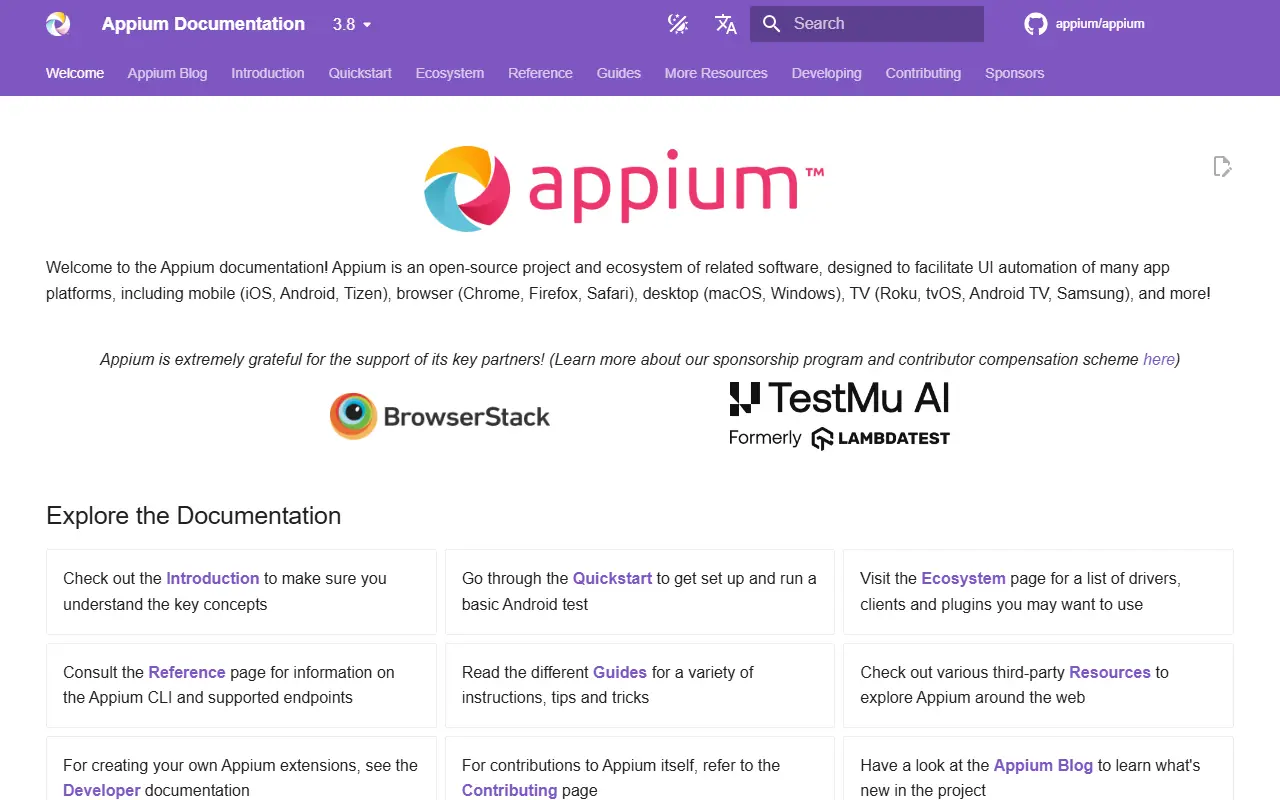
About Appium
Appium is an open-source framework for automating apps on mobile, desktop and IoT platforms. It builds on the W3C WebDriver protocol, which means tests are written against a standard interface and can drive native apps, hybrid apps, mobile web and desktop software on Android, iOS, Windows, macOS and more.
Its architecture is modular and extensible. Drivers add support for automating particular platforms, clients let you write tests in the programming language of your choice, and plugins extend the core behavior. That gives rise to a broad ecosystem of related software around the core server. Appium is installed with npm, and the documentation covers system requirements for each platform.
The team supports only the latest version, so anyone on an older major release is directed to migration guides covering the v1 to v2 and v2 to v3 transitions. Appium is written in TypeScript under the Apache-2.0 license and runs on your own machines, build servers or device farms. It is a standard choice for QA engineers and developers who need cross-platform mobile test automation.
Key features
- Automates native, hybrid and mobile web apps
- Desktop and IoT platform support
- Built on the W3C WebDriver protocol
- Drivers for individual platforms
- Test clients in multiple languages
- Plugin system for extending behavior
Good fit for
- →Automated UI tests for Android and iOS apps
- →Cross-platform regression testing
- →Driving device farms from CI
- Built with
- TypeScript
- Tags
- test-automation
- mobile-testing
- webdriver
- android
- ios
- appium
- typescript
- qa
Appium: questions and answers
- What is Appium used for?
- Appium is a modular, WebDriver-based automation framework for testing native, hybrid, mobile web and desktop apps across platforms, extended through drivers, clients and plugins. It is a good fit for automated UI tests for Android and iOS apps, cross-platform regression testing, and driving device farms from CI.
- Is Appium open source?
- Yes. Appium is open source under the Apache-2.0 licence. Its source code is on GitHub at appium/appium and is written mainly in TypeScript.
- Is Appium free?
- Yes. Appium is open source, so the software itself is free to use.
- What is Appium an alternative to?
- Appium is an open-source alternative to BrowserStack, Sauce Labs, Katalon and TestMu AI (LambdaTest). Other open-source alternatives to BrowserStack include WebdriverIO and Playwright.
- Is Appium actively maintained?
- Yes. The most recent commit to Appium was on 2 October 2026. The project has 22k stars on GitHub.
Open-source alternatives to Appium
See all
WebdriverIO
Testing & QA
Next-gen browser and mobile automation test framework for Node.js
MITvs BrowserStack★ 9.8k
Playwright
Testing & QA
Playwright is a framework for Web Testing and Automation. It allows testing Chromium, Fire
Apache-2.0vs BrowserStack★ 97k
Robot Framework
Testing & QA
Generic automation framework for acceptance testing and RPA
Apache-2.0vs Katalon★ 12k
Crusher
Testing & QA
🧙♀️ Fast low-code testing — create, run tests and get alerts ⏱️ Create test in <60 secs
MITvs Katalon★ 588
Airtest
Testing & QA
UI Automation Framework for Games and Apps
Apache-2.0vs Kobiton★ 9.6k
Shortest
Testing & QA
QA via natural language AI tests
MITvs mabl★ 5.7k
SaaS alternatives to Appium
See all
BrowserStack
Testing & QA
Cloud platform for testing websites and mobile apps on real browsers and devices
SaaS
Sauce Labs
Testing & QA
Cloud testing platform for automated web and mobile tests across devices
SaaS
Katalon
Testing & QA
Test automation platform for web, API, mobile and desktop applications
SaaS
TestMu AI (LambdaTest)
Testing & QA
Cloud testing platform for browser, mobile and AI-native test automation formerly LambdaTest
SaaS
mabl
Testing & QA
AI-native test automation platform for web, mobile and API testing
SaaS
Testim
Testing & QA
AI-based test automation for web and mobile apps from Tricentis
SaaS