
 Perfecto
 Kobiton
 Ghost Inspector
 SmartBear TestComplete
 Ranorex
 AWS Device Farm
 Firebase Test Lab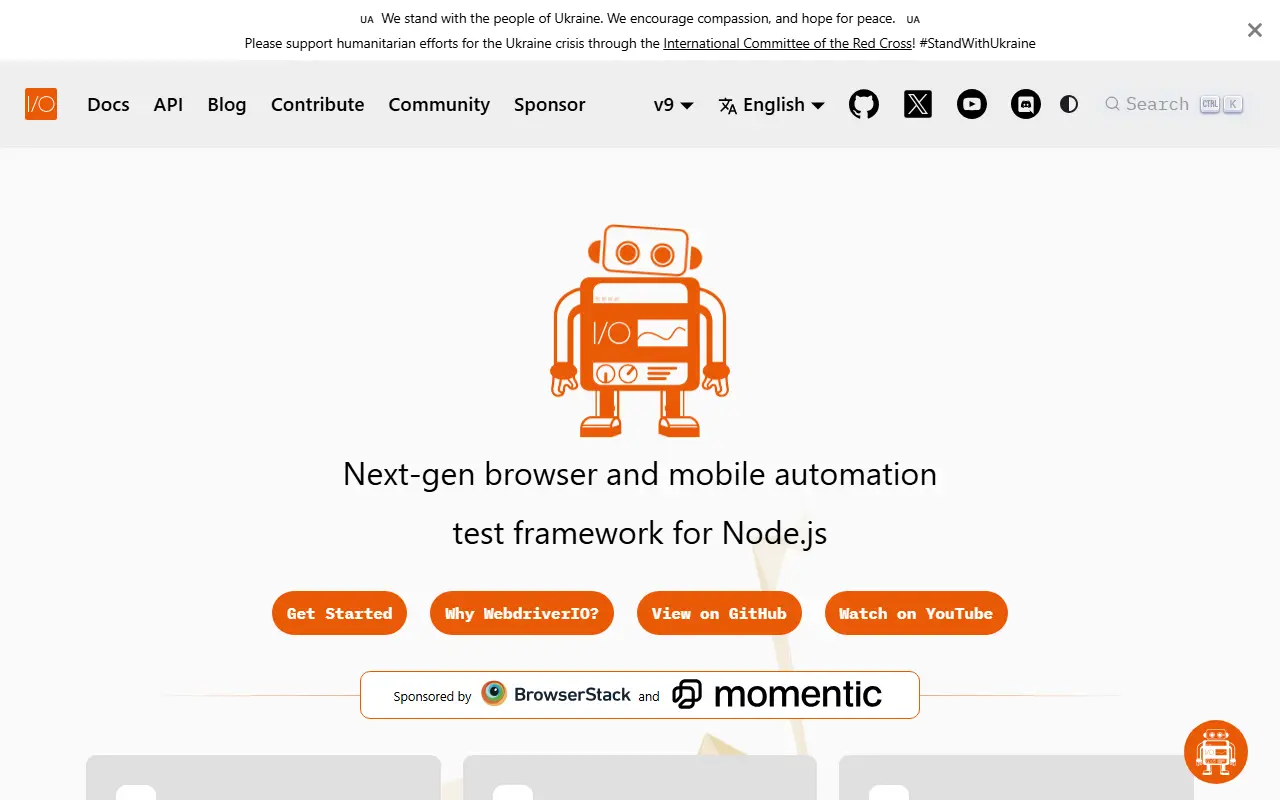
About WebdriverIO
This entry covers WebdriverIO, a modern test automation framework that drives browsers and mobile apps from Node.js. It is used for end-to-end tests as well as unit and component tests in the browser, and runs tests based on the WebDriver and WebDriver BiDi protocols and on Appium automation technology.
It works with popular test frameworks for BDD and TDD, such as Mocha, Jasmine and Cucumber, and can run tests locally or in the cloud on services including Sauce Labs, BrowserStack, TestingBot and TestMu AI, formerly LambdaTest. The project provides a developer guide, API reference, changelog and roadmap, and contributors can start in a prepared dev container using GitHub Codespaces or Gitpod.
WebdriverIO is written in TypeScript and licensed under MIT. It is installed as a development dependency in a JavaScript or TypeScript project, so there is nothing to host. Commercial support is available through a Tidelift subscription. It suits QA engineers and front-end teams who want one framework for web and mobile test automation.
Key features
- End-to-end, unit and component testing
- WebDriver and WebDriver BiDi support
- Appium integration for mobile apps
- Works with Mocha, Jasmine and Cucumber
- Local runs or cloud device providers
- Written in TypeScript for Node.js
Good fit for
- →Cross-browser end-to-end testing
- →Mobile app test automation with Appium
- →Running tests on BrowserStack or Sauce Labs
- Tags
- test-automation
- webdriver
- e2e-testing
- appium
- nodejs
- browser-testing
- mobile-testing
- typescript
WebdriverIO: questions and answers
- What is WebdriverIO used for?
- WebdriverIO is a Node.js test automation framework for browser and mobile apps, supporting end-to-end, unit and component tests via WebDriver, BiDi and Appium. It is a good fit for cross-browser end-to-end testing, mobile app test automation with Appium and running tests on BrowserStack or Sauce Labs.
- Is WebdriverIO open source?
- Yes. WebdriverIO is open source under the MIT licence. Its source code is on GitHub at webdriverio/webdriverio and is written mainly in TypeScript.
- Is WebdriverIO free?
- Yes. WebdriverIO is open source, so the software itself is free to use.
- What is WebdriverIO an alternative to?
- WebdriverIO is an open-source alternative to BrowserStack, Sauce Labs, Katalon and TestMu AI (LambdaTest). Other open-source alternatives to BrowserStack include Appium and Playwright.
- Is WebdriverIO actively maintained?
- Yes. The most recent commit to WebdriverIO was on 2 October 2026, and the latest release is v9.32.0, published on 20 September 2026. The project has 9.8k stars on GitHub.
Open-source alternatives to WebdriverIO
See all
Appium
Testing & QA
Cross-platform automation framework for all kinds of apps, built on top of the W3C WebDriv
Apache-2.0vs BrowserStack★ 22k
Playwright
Testing & QA
Playwright is a framework for Web Testing and Automation. It allows testing Chromium, Fire
Apache-2.0vs BrowserStack★ 97k
Crusher
Testing & QA
🧙♀️ Fast low-code testing — create, run tests and get alerts ⏱️ Create test in <60 secs
MITvs Katalon★ 588
Airtest
Testing & QA
UI Automation Framework for Games and Apps
Apache-2.0vs Kobiton★ 9.6k
Robot Framework
Testing & QA
Generic automation framework for acceptance testing and RPA
Apache-2.0vs Katalon★ 12k
Magnitude
Testing & QA
Open-source, vision-first browser agent
Apache-2.0vs Browserbase★ 4.1k
SaaS alternatives to WebdriverIO
See all
BrowserStack
Testing & QA
Cloud platform for testing websites and mobile apps on real browsers and devices
SaaS
Sauce Labs
Testing & QA
Cloud testing platform for automated web and mobile tests across devices
SaaS
Katalon
Testing & QA
Test automation platform for web, API, mobile and desktop applications
SaaS
TestMu AI (LambdaTest)
Testing & QA
Cloud testing platform for browser, mobile and AI-native test automation formerly LambdaTest
SaaS
mabl
Testing & QA
AI-native test automation platform for web, mobile and API testing
SaaS
Testim
Testing & QA
AI-based test automation for web and mobile apps from Tricentis
SaaS