#1
A framework from Microsoft for end-to-end web testing and browser automation across Chromium, Firefox and WebKit using one API.
- GitHub stars
- 100k
- Last commit
- today
- Latest release
- v1.65.0
- Licence
- Apache-2.0
- Self-hosted
- Yes
playwright.dev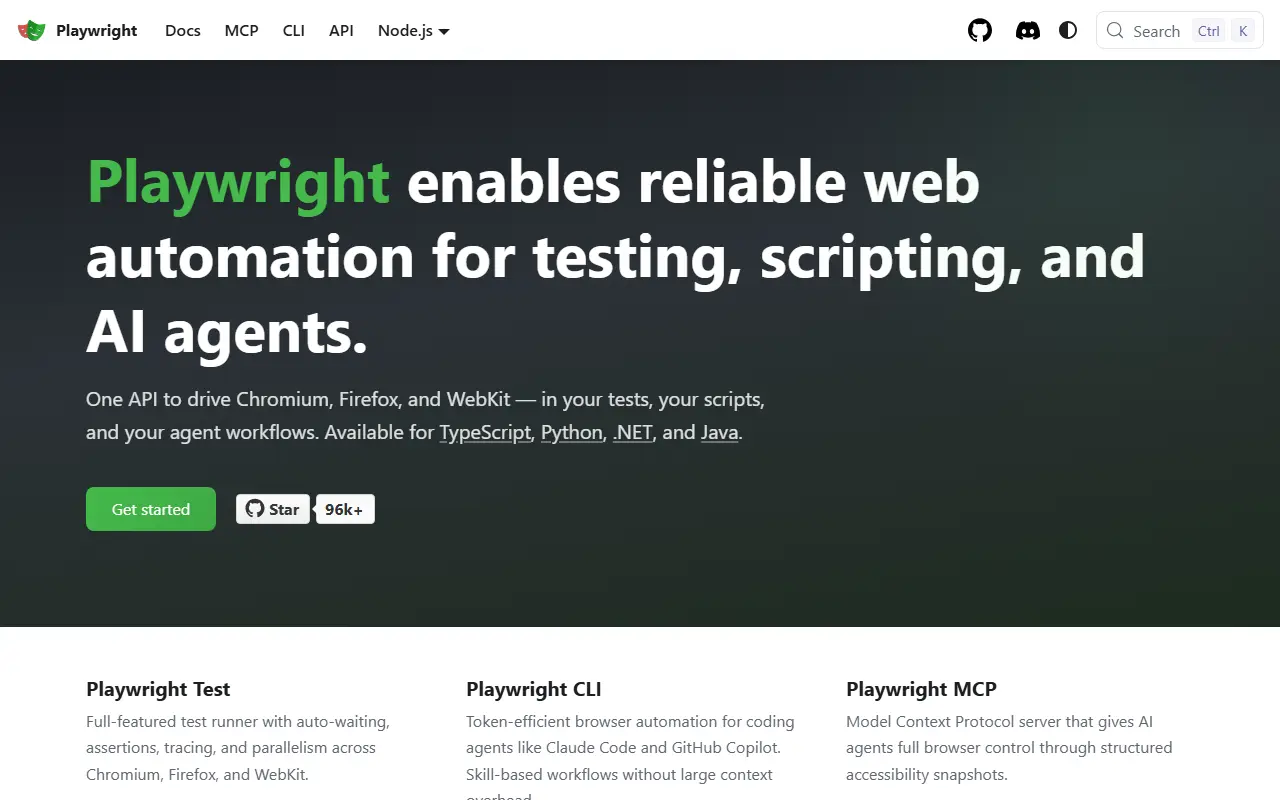
Playwright is an open-source framework for testing and automating web applications. A single API drives Chromium, Firefox and WebKit, so the same script or test can cover all three engines. It is used for end-to-end testing, for scripted browser tasks and, increasingly, as a tool that AI agents call to operate a browser.
The bundled Playwright Test runner executes tests in parallel with a fresh browser context per test, which gives isolation without the cost of launching a new browser. Locators mirror how users see the page, actions wait automatically until elements are ready, and assertions retry until they pass. Failures can be investigated with traces that capture screenshots, DOM snapshots, network requests and console output in a Trace Viewer.
Beyond the test runner there is a standalone library for scripts, a CLI aimed at coding agents, an MCP server for LLM-driven automation and a VS Code extension. The code is Apache-2.0 licensed and runs on your own machines and CI servers, with no hosted service required.
Key features
- One API for Chromium, Firefox and WebKit
- Auto-waiting actions and retrying assertions
- Parallel tests with isolated browser contexts
- Trace Viewer with DOM snapshots and network logs
- Locators that mirror how users see pages
- MCP server and CLI for AI agents
- VS Code extension for authoring tests
Pricing: Free and open source under the Apache-2.0 license.
#2
A modular, WebDriver-based automation framework for testing native, hybrid, mobile web and desktop apps across platforms, extended through drivers, clients and plugins.
- GitHub stars
- 22k
- Last commit
- yesterday
- Latest release
- @appium/opencv@5.0.2
- Licence
- Apache-2.0
- Self-hosted
- Yes
appium.io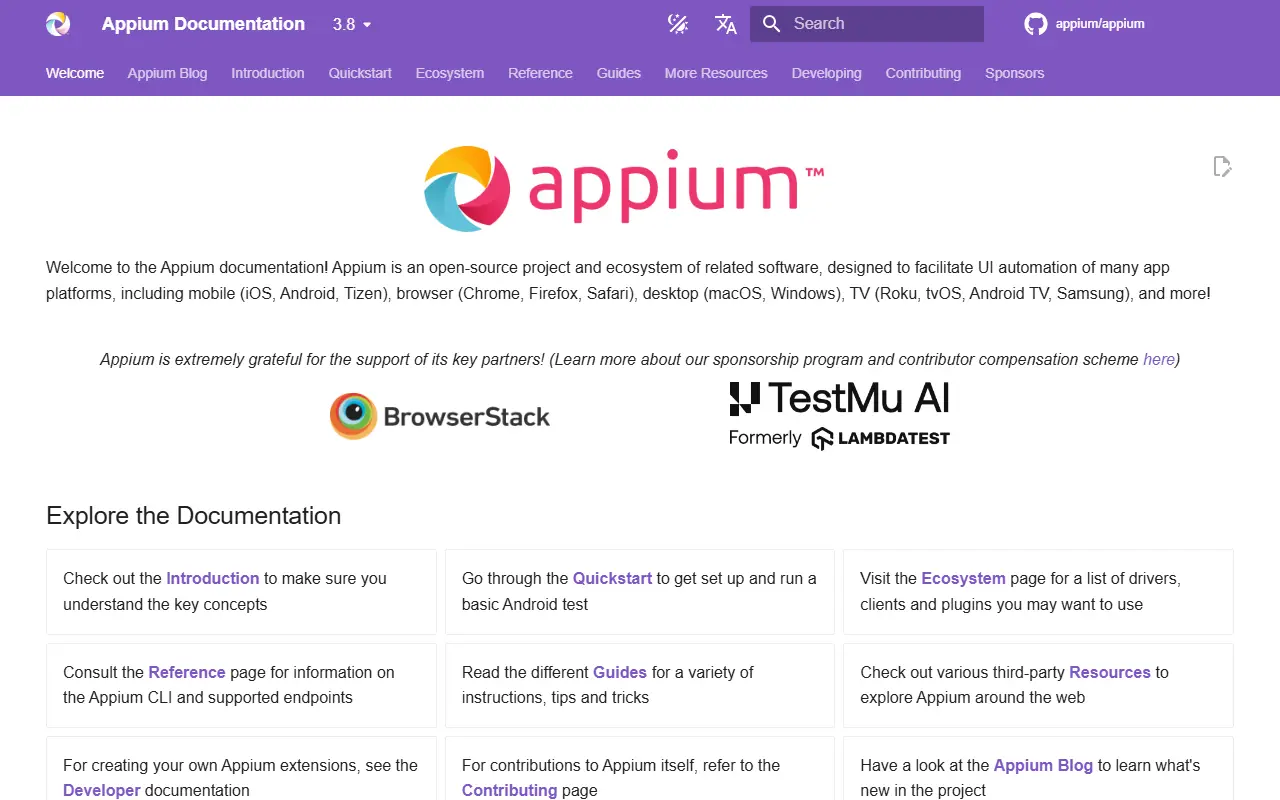
Appium is an open-source framework for automating apps on mobile, desktop and IoT platforms. It builds on the W3C WebDriver protocol, which means tests are written against a standard interface and can drive native apps, hybrid apps, mobile web and desktop software on Android, iOS, Windows, macOS and more.
Its architecture is modular and extensible. Drivers add support for automating particular platforms, clients let you write tests in the programming language of your choice, and plugins extend the core behavior. That gives rise to a broad ecosystem of related software around the core server. Appium is installed with npm, and the documentation covers system requirements for each platform.
The team supports only the latest version, so anyone on an older major release is directed to migration guides covering the v1 to v2 and v2 to v3 transitions. Appium is written in TypeScript under the Apache-2.0 license and runs on your own machines, build servers or device farms. It is a standard choice for QA engineers and developers who need cross-platform mobile test automation.
Key features
- Automates native, hybrid and mobile web apps
- Desktop and IoT platform support
- Built on the W3C WebDriver protocol
- Drivers for individual platforms
- Test clients in multiple languages
- Plugin system for extending behavior
Pricing: Free and open source under the Apache-2.0 license.
#3
An open-source automation framework for acceptance testing and robotic process automation, using human-readable keyword syntax that can be extended in Python or Java.
- GitHub stars
- 12k
- Last commit
- 2 days ago
- Latest release
- v7.5.1
- Licence
- Apache-2.0
robotframework.org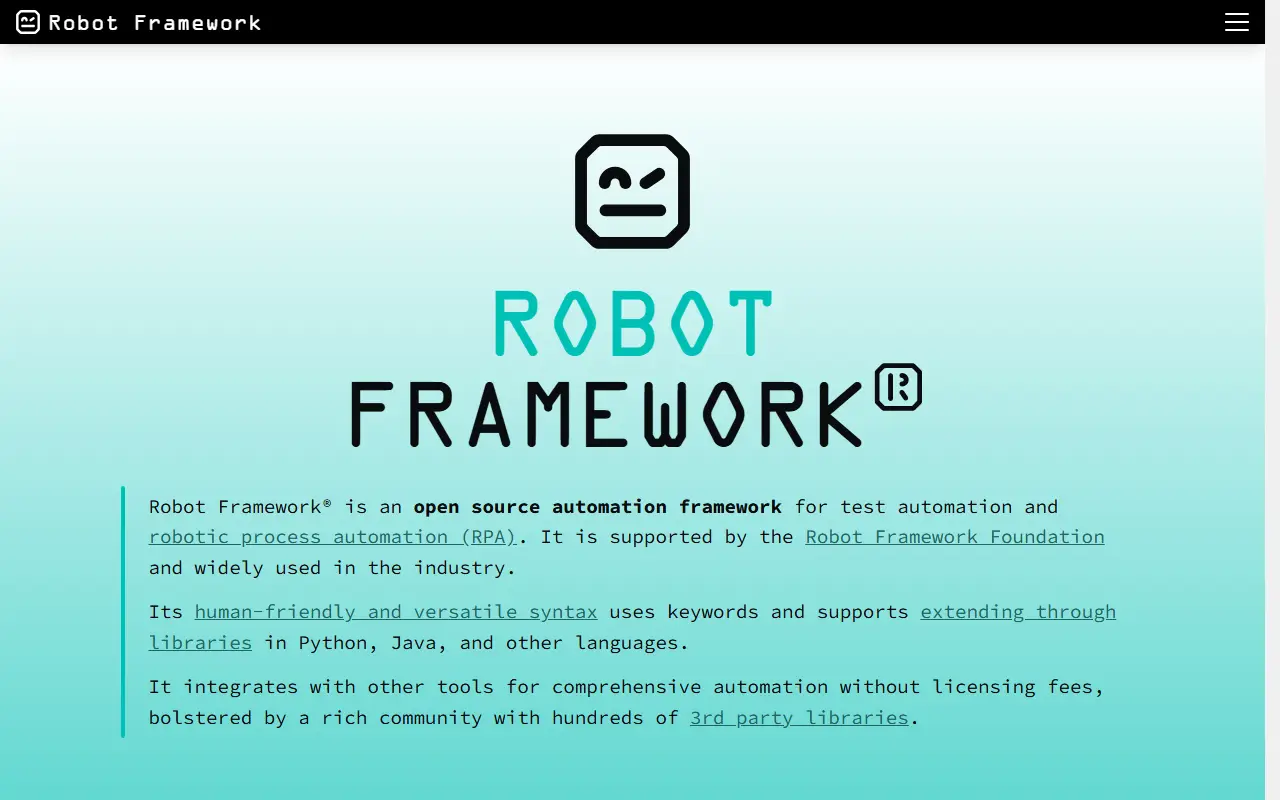
Robot Framework is a generic open-source framework for test automation and robotic process automation. Test cases and tasks are written with readable, keyword-based syntax, so people who are not programmers can follow what an automated scenario does, and the same approach covers acceptance testing and RPA.
Functionality is extended through libraries written in Python, Java and other languages, and a rich ecosystem of hundreds of third-party libraries covers web, API, mobile and other automation needs. The Robot Framework Foundation supports the project, and the website provides a user guide, standard library documentation, community events, workshops and a certification program.
The framework is released under the Apache-2.0 licence, written in Python, and used without licensing fees. You install it into your own Python environment and run it locally or in CI, so there is no server to host. It suits QA teams practicing acceptance test-driven or behavior-driven development and teams automating repetitive business processes.
Key features
- Human-readable keyword-driven syntax
- Acceptance testing and RPA in one tool
- Extensible with Python and Java libraries
- Standard library of common keywords
- Hundreds of third-party libraries
- Reports and logs for test runs
Pricing: Free and open source under the Apache-2.0 licence, with no licensing fees.
#4
Detox, maintained by Wix, is a mobile end-to-end testing and automation tool using a gray-box approach, aimed mainly at React Native apps on Android and iOS.
- GitHub stars
- 12k
- Last commit
- 11 days ago
- Latest release
- 20.51.3
- Licence
- MIT
wix.github.io
This entry covers Detox, the open-source mobile testing framework from Wix. Detox runs end-to-end tests against an app while it is running on a real device or simulator, driving it the way a person would, with the aim of replacing much of the manual QA that slows down continuous integration.
Its answer to flaky end-to-end tests is gray-box testing: it monitors the app's asynchronous operations and synchronizes with them automatically rather than relying on arbitrary waits. Tests are written in JavaScript with an async-await API that supports breakpoints, and the framework works with any test runner, with Jest integration provided out of the box. It targets React Native projects on Android and iOS and is designed to run in CI systems such as Jenkins, Travis CI and Circle CI.
Detox is MIT licensed and used as a development dependency in your own repository, so there is nothing to host. The README notes that support for running on real iOS devices is not yet available. It suits mobile teams that want reliable, repeatable end-to-end tests inside their delivery pipeline.
Key features
- Gray-box end-to-end mobile testing
- Automatic synchronization with async operations
- Tests written in JavaScript with async-await
- Runs on devices and simulators
- Test runner agnostic with Jest integration
- Runs smoothly in CI pipelines
- Cross-platform React Native support
Pricing: Free and open source under the MIT licence.
#5
WebdriverIO is a Node.js test automation framework for browser and mobile apps, supporting end-to-end, unit and component tests via WebDriver, BiDi and Appium.
- GitHub stars
- 9.9k
- Last commit
- yesterday
- Latest release
- v10.2.0
- Licence
- MIT
webdriver.io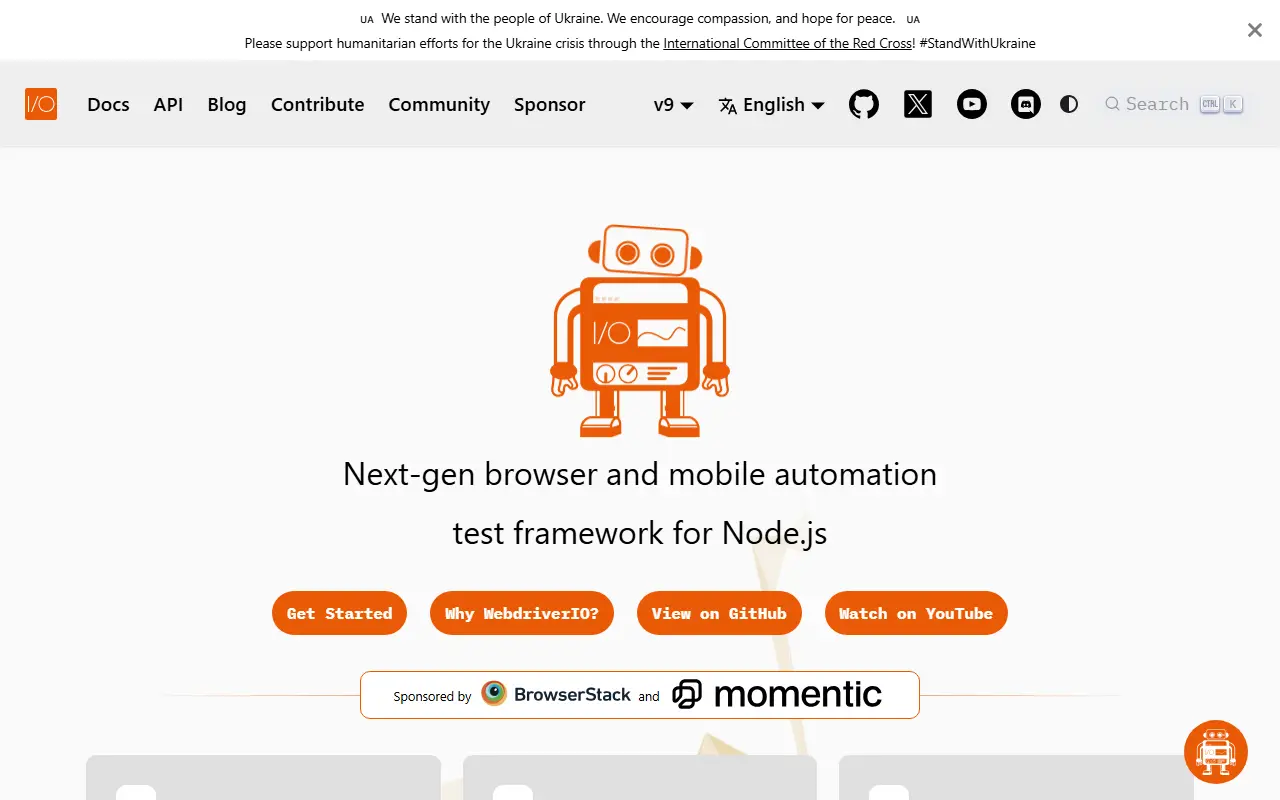
This entry covers WebdriverIO, a modern test automation framework that drives browsers and mobile apps from Node.js. It is used for end-to-end tests as well as unit and component tests in the browser, and runs tests based on the WebDriver and WebDriver BiDi protocols and on Appium automation technology.
It works with popular test frameworks for BDD and TDD, such as Mocha, Jasmine and Cucumber, and can run tests locally or in the cloud on services including Sauce Labs, BrowserStack, TestingBot and TestMu AI, formerly LambdaTest. The project provides a developer guide, API reference, changelog and roadmap, and contributors can start in a prepared dev container using GitHub Codespaces or Gitpod.
WebdriverIO is written in TypeScript and licensed under MIT. It is installed as a development dependency in a JavaScript or TypeScript project, so there is nothing to host. Commercial support is available through a Tidelift subscription. It suits QA engineers and front-end teams who want one framework for web and mobile test automation.
Key features
- End-to-end, unit and component testing
- WebDriver and WebDriver BiDi support
- Appium integration for mobile apps
- Works with Mocha, Jasmine and Cucumber
- Local runs or cloud device providers
- Written in TypeScript for Node.js
Pricing: Free and open source under the MIT licence; commercial support is available through Tidelift.
#6
TestCafe is a free, open-source end-to-end testing framework that runs JavaScript and TypeScript tests in real browsers.
- GitHub stars
- 9.9k
- Last commit
- 2 days ago
- Latest release
- v3.7.7
- Licence
- MIT
testcafe.io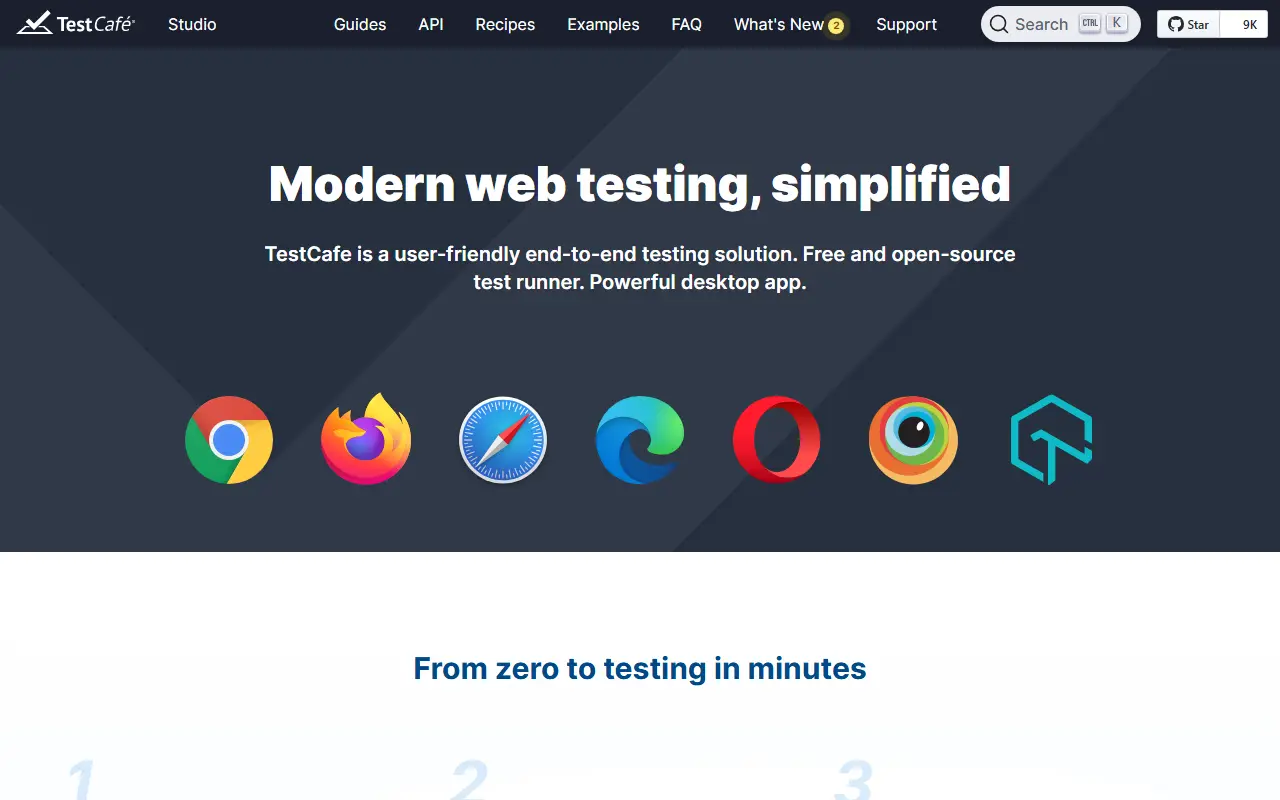
TestCafe is an end-to-end testing solution installed as a single npm package. Tests are written in JavaScript or TypeScript, either by hand or recorded in the browser, and can simulate complex page interactions and multi-window scenarios.
Tests run in any modern browser, local or remote, and can run concurrently to speed things up. A Docker image is available for CI/CD pipelines, and results can be stored as reports in several formats. Running a test is a single command such as testcafe chrome test.js.
The open-source library covers creating, running and reviewing tests. Paid products sit alongside it: TestCafe Studio, a desktop application that speeds up test creation, and subscription plans that add run logs, flaky test detection, parallelization and screenshot and video storage.
Key features
- Installs as one npm package
- Runs in common browsers out of the box
- Docker image for CI/CD pipelines
- JavaScript and TypeScript tests for complex interactions
- Write tests by hand or record them
- Concurrent test runs
- Reports in several formats
Pricing: Personal is $20 /month (first 60 days free) with 3 users and 7,500 test runs. Team is $50 /month (first 60 days free) with 20 users and 50,000 test runs. Enterprise is priced by contacting the vendor.
#7
Maestro is Netflix's open-source workflow orchestrator, a scalable and extensible engine for scheduling data, ML and engineering workflows.
- GitHub stars
- 3.9k
- Last commit
- 6 days ago
- Licence
- Apache-2.0
- Self-hosted
- Yes
maestro-doc.github.io
Maestro is a general-purpose workflow orchestrator from Netflix. Internally it works as a fully managed workflow-as-a-service for data platform users, a community that includes data scientists and engineers, machine learning and software engineers, content producers and business analysts.
According to the README, it schedules hundreds of thousands of workflows and millions of jobs each day and operates under a strict service level objective even during traffic spikes. It is described as highly scalable and extensible, supporting existing and new use cases with an emphasis on usability. Repository topics mention DAGs, ETL and ELT, MLOps, batch processing, data pipelines and agentic workflows. The engine is written in Java.
Maestro is licensed under Apache-2.0 and is run on your own infrastructure; there is no hosted version from the maintainers. It suits data and platform engineering teams that need an orchestrator built for very large-scale scheduling.
Key features
- Managed workflow-as-a-service orchestration
- Scheduling at very large scale
- Extensible for new use cases
- DAG-based workflow definitions
- Suited to ETL and MLOps pipelines
- Written in Java
Pricing: Free and open source under the Apache-2.0 license.
#8
An integrated end-to-end testing framework written in Node.js using the W3C Webdriver API.
- GitHub stars
- 12k
- Last commit
- 5 mo ago
- Latest release
- v3.16.0
- Licence
- MIT
nightwatchjs.org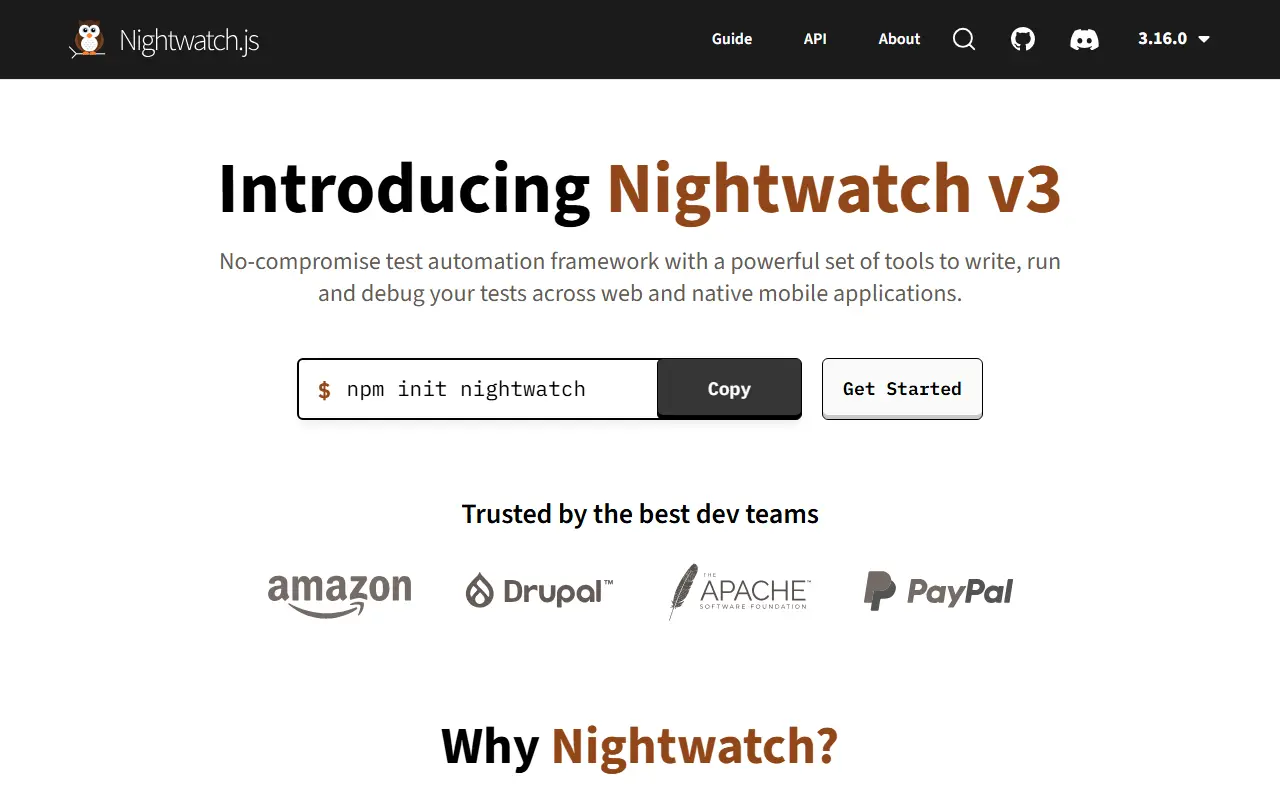
Nightwatch is an end-to-end testing framework built with Node.js that uses the W3C WebDriver API. It supports testing across web and native mobile applications, including real desktop browsers, mobile web, and native iOS and Android apps.
The framework provides debugging tools such as a built-in HTML reporter with test statuses and HTTP logs, DOM history before and after commands, and a REPL interface for pausing and debugging. It also offers default parallelization, cloud grid support, and the ability to handle complex gestures and interactions.
Key features
- Supports web, mobile web, and native mobile testing
- Built-in HTML reporter with test statuses and HTTP logs
- DOM history before and after every command
- REPL interface for pausing and debugging
- Default parallelization and orchestration
- Cloud grid support with third-party grids like BrowserStack
TestMu AI (LambdaTest) alternatives: questions
- What is the best open-source alternative to TestMu AI (LambdaTest)?
- Playwright is the top-ranked open-source alternative to TestMu AI (LambdaTest) on Enlisted: A framework from Microsoft for end-to-end web testing and browser automation across Chromium, Firefox and WebKit using one API. Other strong options are Appium, Robot Framework, Detox and WebdriverIO.
- What are the best commercial alternatives to TestMu AI (LambdaTest)?
- Perfecto, AWS Device Farm, Kobiton, HeadSpin and mabl are among the hosted, closed-source alternatives to TestMu AI (LambdaTest) listed on Enlisted, which lists 17 in total. Compare their pricing and features on each tool page.
- Are these TestMu AI (LambdaTest) alternatives free?
- All 8 are open source, so the code is free to use under its licence, and all of them can be self-hosted on your own server or computer.
- How is this list of TestMu AI (LambdaTest) alternatives ranked?
- By a score built from GitHub stars, star growth over the last 30 days and how recently the code changed. 7 of these projects shipped code in the last 30 days. Data is refreshed daily, and nobody can pay to move up.
 TrackMedia
 TrackRev