7,363 open-source and SaaS tools, with GitHub stats refreshed every day.

5 alternatives ranked by real activity

Open-source Parasoft alternatives

A curated, ranked list of the 5 best open-source alternatives to Parasoft.

The best open-source alternative to Parasoft is Playwright. If that doesn't suit you, other good options are Robot Framework, Karate, Zerocode and Step CI.

Parasoft alternatives are mainly testing & QA tools. 4 of them shipped code in the last 30 days, 5 can be self-hosted, and 5 use a permissive licence.

Last updated October 3, 2026 · ranked by GitHub stars, growth and recent commits

Playwright

A framework from Microsoft for end-to-end web testing and browser automation across Chromium, Firefox and WebKit using one API.

GitHub stars
97k
Last commit
yesterday
Latest release
v1.63.0
Licence
Apache-2.0
Self-hosted
Yes
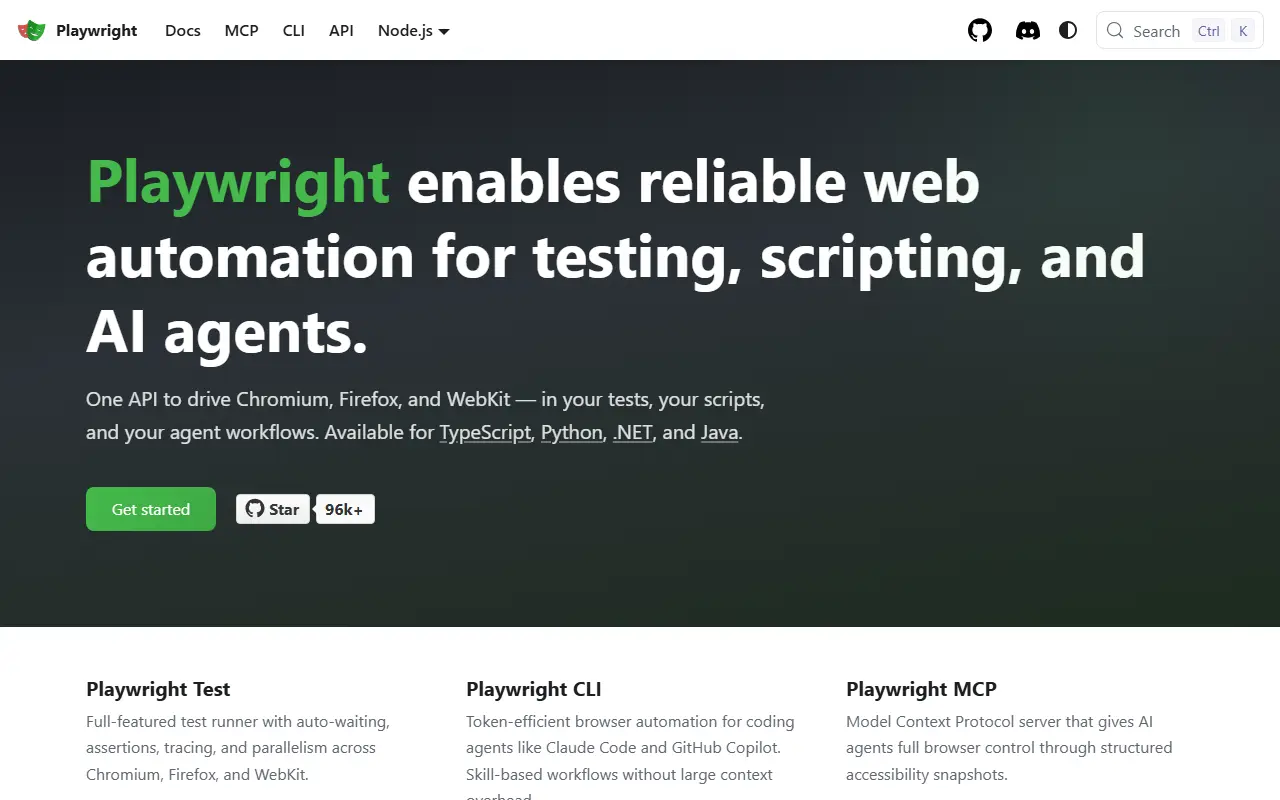
playwright.devPlaywright homepage screenshot

Playwright is an open-source framework for testing and automating web applications. A single API drives Chromium, Firefox and WebKit, so the same script or test can cover all three engines. It is used for end-to-end testing, for scripted browser tasks and, increasingly, as a tool that AI agents call to operate a browser.

The bundled Playwright Test runner executes tests in parallel with a fresh browser context per test, which gives isolation without the cost of launching a new browser. Locators mirror how users see the page, actions wait automatically until elements are ready, and assertions retry until they pass. Failures can be investigated with traces that capture screenshots, DOM snapshots, network requests and console output in a Trace Viewer.

Beyond the test runner there is a standalone library for scripts, a CLI aimed at coding agents, an MCP server for LLM-driven automation and a VS Code extension. The code is Apache-2.0 licensed and runs on your own machines and CI servers, with no hosted service required.

Key features

  • One API for Chromium, Firefox and WebKit
  • Auto-waiting actions and retrying assertions
  • Parallel tests with isolated browser contexts
  • Trace Viewer with DOM snapshots and network logs
  • Locators that mirror how users see pages
  • MCP server and CLI for AI agents
  • VS Code extension for authoring tests

Pricing: Free and open source under the Apache-2.0 license.

Robot Framework

An open-source automation framework for acceptance testing and robotic process automation, using human-readable keyword syntax that can be extended in Python or Java.

GitHub stars
12k
Last commit
yesterday
Latest release
v7.5
Licence
Apache-2.0
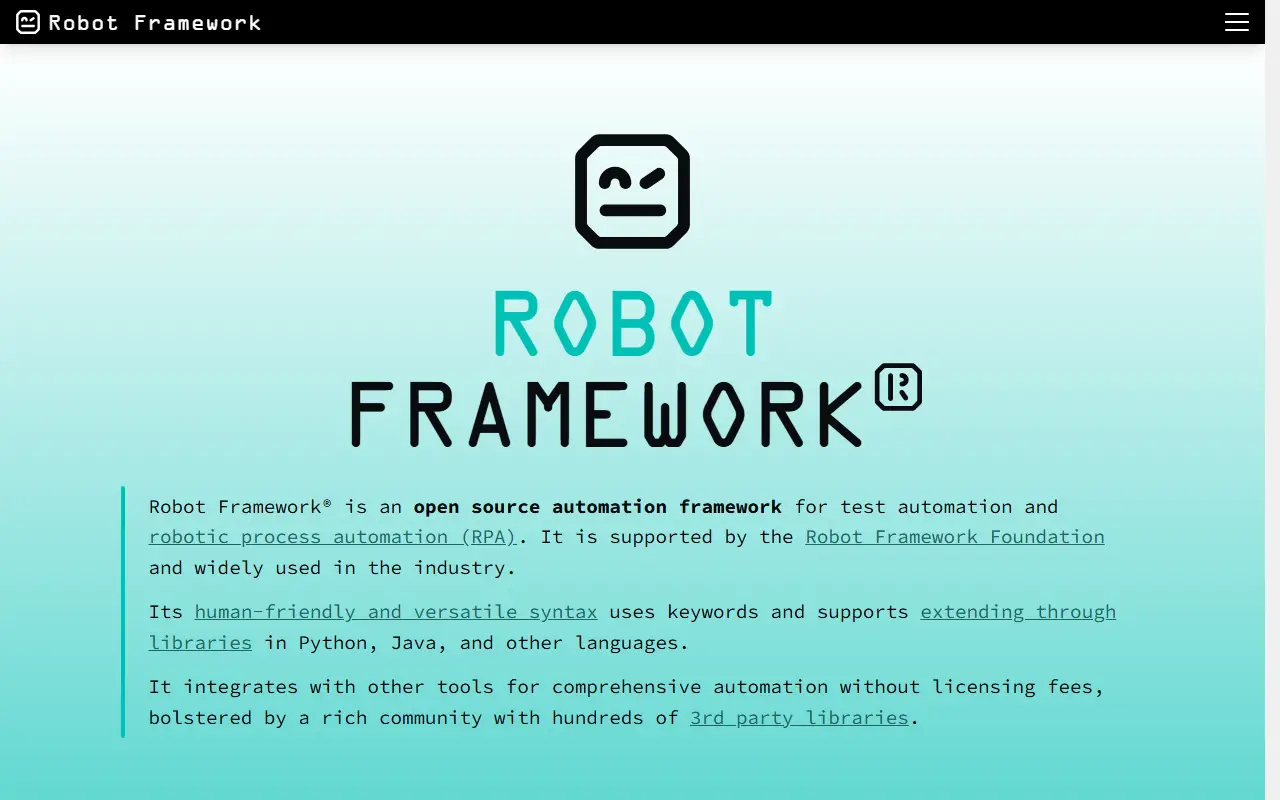
robotframework.orgRobot Framework homepage screenshot

Robot Framework is a generic open-source framework for test automation and robotic process automation. Test cases and tasks are written with readable, keyword-based syntax, so people who are not programmers can follow what an automated scenario does, and the same approach covers acceptance testing and RPA.

Functionality is extended through libraries written in Python, Java and other languages, and a rich ecosystem of hundreds of third-party libraries covers web, API, mobile and other automation needs. The Robot Framework Foundation supports the project, and the website provides a user guide, standard library documentation, community events, workshops and a certification program.

The framework is released under the Apache-2.0 licence, written in Python, and used without licensing fees. You install it into your own Python environment and run it locally or in CI, so there is no server to host. It suits QA teams practicing acceptance test-driven or behavior-driven development and teams automating repetitive business processes.

Key features

  • Human-readable keyword-driven syntax
  • Acceptance testing and RPA in one tool
  • Extensible with Python and Java libraries
  • Standard library of common keywords
  • Hundreds of third-party libraries
  • Reports and logs for test runs

Pricing: Free and open source under the Apache-2.0 licence, with no licensing fees.

Karate

An open-source framework for test automation that brings API checks, mocks, performance tests and UI automation together under one readable syntax.

GitHub stars
9k
Last commit
yesterday
Latest release
v2.1.3
Licence
MIT
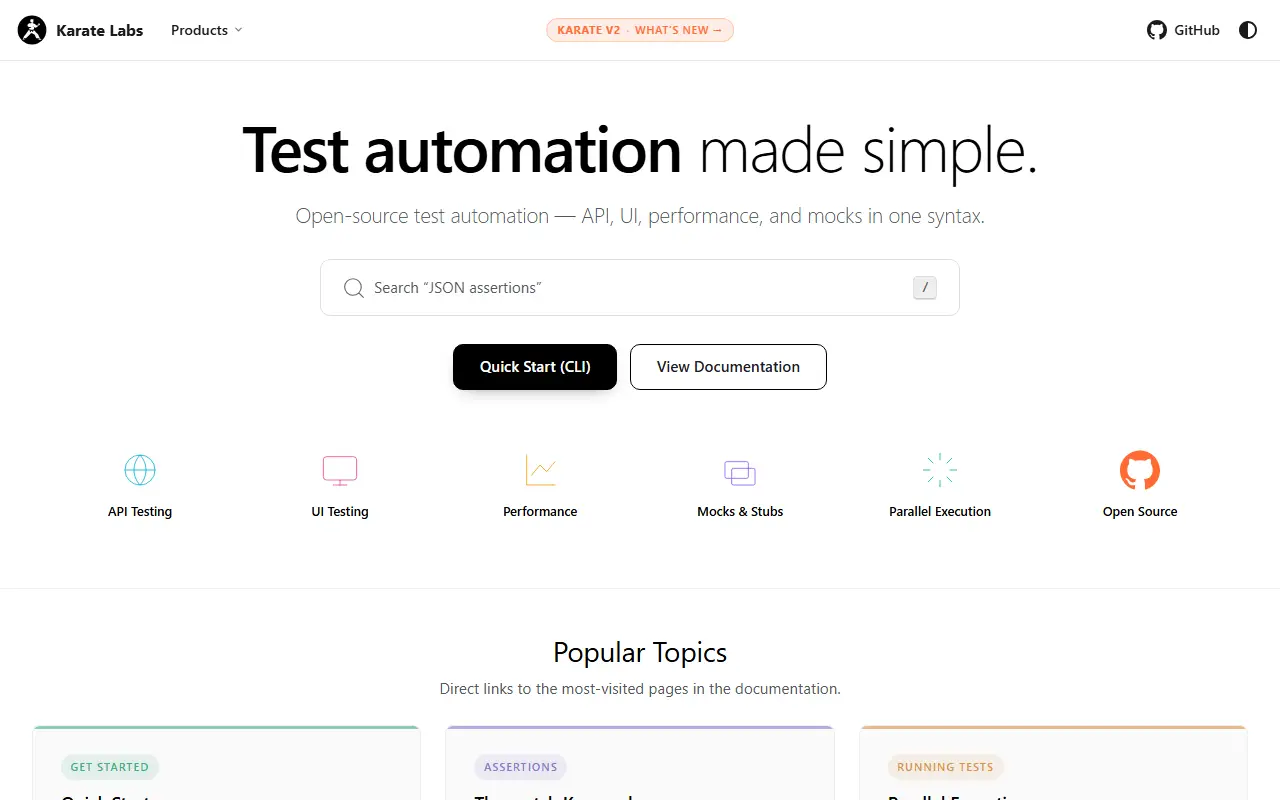
docs.karatelabs.ioKarate homepage screenshot

Karate is an open-source tool that unifies API testing, mocks, performance testing and UI automation in one framework with a single readable syntax. Tests are written as feature files, so people who are not Java developers can read and write them, and the project is written in Java.

Its documentation highlights the match keyword for validating complete responses, headers and arrays, parallel execution of features, scenarios and example rows, reusable flows by calling one feature from another, and test doubles that stand up HTTP, gRPC and message-queue mocks from a feature file. Karate v2 adds virtual threads, a single-binary CLI, JavaScript debugging and soft assertions. There are extensions for VS Code and IntelliJ, plus Karate Agent and Karate Xplorer products.

Tests can be run through JUnit, the command line or CI/CD pipelines. Karate is licensed under MIT, and topics mention BDD, Cucumber, contract testing, load testing and WebDriver. It suits QA engineers and developers who want one tool for API-level and UI-level checks.

Key features

  • API testing in readable feature files
  • Built-in HTTP, gRPC and queue mocks
  • Performance testing from the same tests
  • UI automation with a browser driver
  • Parallel test execution
  • JUnit, CLI and CI/CD runners
  • VS Code and IntelliJ extensions

Pricing: The open-source framework is free. Pro is $64 per user per month ($640 per user per year) and IDE Plus is $100 per user per year; Enterprise is custom. Everything runs self-hosted.

Zerocode

Zerocode is a Java automated testing framework that defines API, Kafka, database and load tests in simple JSON or YAML with no coding.

GitHub stars
1k
Last commit
11 days ago
Latest release
1.4.4
Licence
Apache-2.0
Self-hosted
Yes
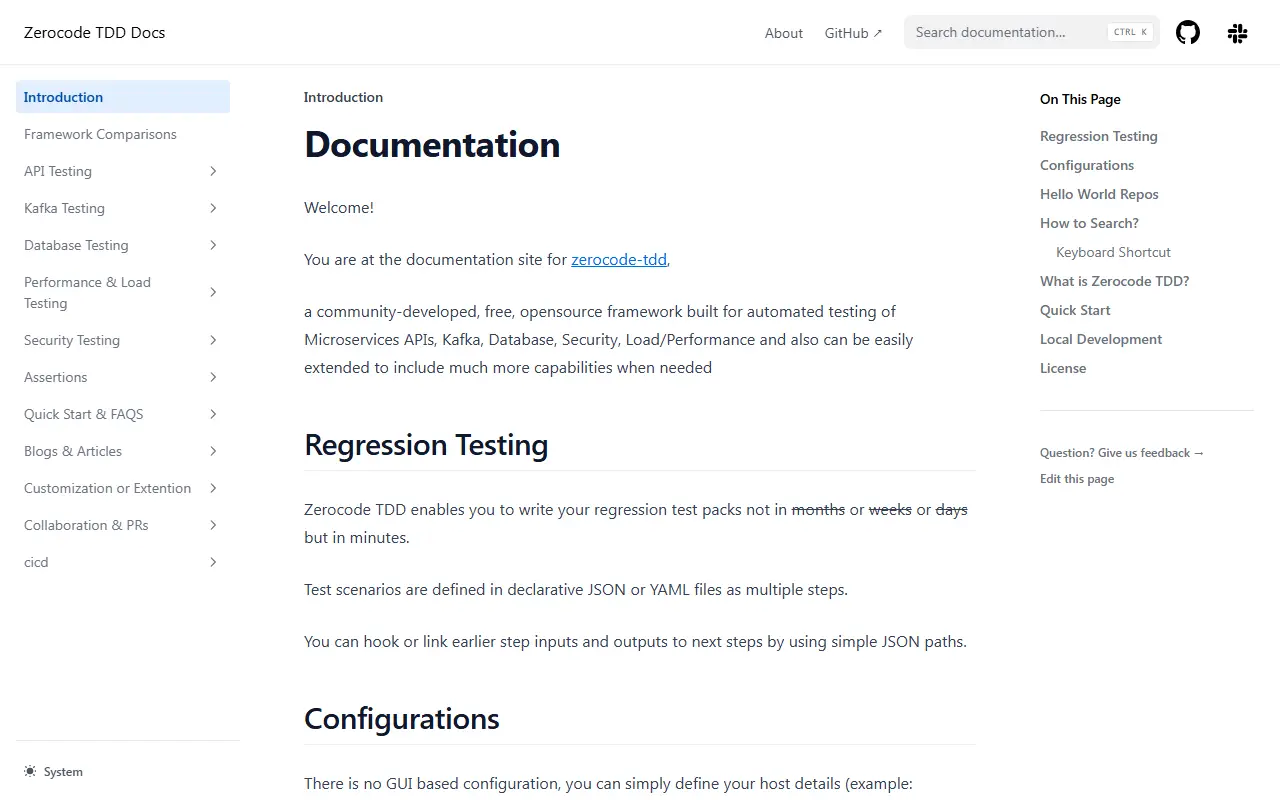
zerocode-tdd.tddfy.comZerocode homepage screenshot

Zerocode, also called zerocode-tdd, is a community-developed open-source testing framework for REST and SOAP APIs, microservices, Kafka data streams, databases and ETL or data pipelines. Test scenarios are written in JSON or YAML, so testers can create and maintain automated checks with very little code.

The framework handles response validation, invoking target APIs, load and stress testing and security testing through straightforward steps. A command-line companion called Steply lets you run tests directly from a terminal, and Zerocode is also available as a Maven dependency for Java projects. Documentation is indexed and searchable, and a Slack channel and mailing list support users. The README gives an example of validating a REST GET request against an expected payload and status code.

Zerocode is written in Java and licensed under Apache-2.0, and runs in your own build or CI environment. It suits developers and QA engineers who want declarative API and Kafka tests that non-programmers can read and maintain.

Key features

  • Tests defined in JSON or YAML
  • REST, SOAP, and Kafka testing
  • Database and ETL pipeline testing
  • Load and stress test scenarios
  • Steply command-line runner
  • Maven dependency for Java projects

Pricing: Free and open source under the Apache-2.0 licence.

Step CI

Step CI is a free, open-source, self-hosted API quality assurance framework for testing REST, GraphQL, gRPC, tRPC and SOAP APIs with YAML, JSON or JavaScript workflows.

GitHub stars
1.9k
Last commit
2 yr ago
Latest release
2.8.2
Licence
MPL-2.0
Self-hosted
Yes
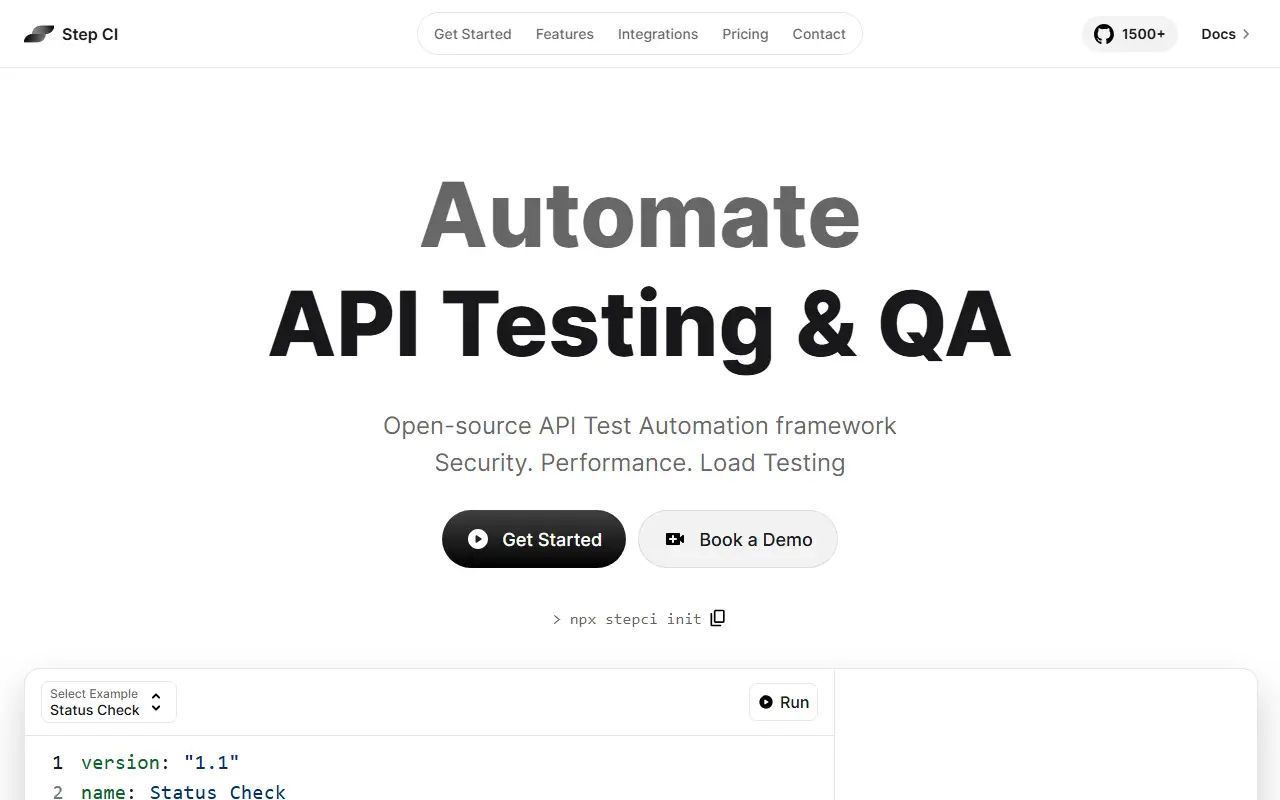
stepci.comStep CI homepage screenshot

Step CI is an API quality assurance framework aimed at developers who need to test several different API styles within the same test workflow, rather than using separate tools for REST, GraphQL and other protocols. It is language-agnostic, letting workflows be configured in YAML, JSON or JavaScript.

It supports testing REST, GraphQL, gRPC, tRPC and SOAP APIs, can run self-hosted on a local network, locally, or inside a CI/CD pipeline, and integrates with other tooling such as GitHub Actions. The README specifically calls out migration guidance for users coming from Postman and Insomnia, and an online playground is available to try workflows without installing anything.

The CLI can be installed via Node.js or Homebrew, and by default collects anonymous usage data, including a unique user ID, OS name, Node version and which commands are run, which can be disabled with an environment variable. Step CI is written in TypeScript and released under the Mozilla Public License 2.0, with a separate paid support plan offering SLA-backed support, onboarding and prioritized feature requests on top of the free core.

Key features

  • Tests REST, GraphQL, gRPC, tRPC and SOAP APIs
  • YAML, JSON or JavaScript workflow configuration
  • Self-hosted or CI/CD-integrated testing
  • Online playground for trying workflows
  • Optional anonymous usage analytics (can be disabled)

Pricing: Free and open source under the Mozilla Public License 2.0; a paid support plan with SLA and prioritized support is available separately.

Parasoft alternatives: questions

What is the best open-source alternative to Parasoft?
Playwright is the top-ranked open-source alternative to Parasoft on Enlisted: A framework from Microsoft for end-to-end web testing and browser automation across Chromium, Firefox and WebKit using one API. Other strong options are Robot Framework, Karate, Zerocode and Step CI.
Are these Parasoft alternatives free?
All 5 are open source, so the code is free to use under its licence, and all of them can be self-hosted on your own server or computer.
How is this list of Parasoft alternatives ranked?
By a score built from GitHub stars, star growth over the last 30 days and how recently the code changed. 4 of these projects shipped code in the last 30 days. Data is refreshed daily, and nobody can pay to move up.

People also look for alternatives to…

View all