7,363 open-source and SaaS tools, with GitHub stats refreshed every day.

5 alternatives ranked by real activity

Open-source Leapwork alternatives

A curated, ranked list of the 5 best open-source alternatives to Leapwork.

The best open-source alternative to Leapwork is Robot Framework. If that doesn't suit you, other good options are Shortest, Airtest, Magnitude and Crusher.

Leapwork alternatives are mainly testing & QA tools. 1 of them shipped code in the last 30 days, 5 can be self-hosted, and 5 use a permissive licence.

Last updated October 3, 2026 · ranked by GitHub stars, growth and recent commits

Robot Framework

An open-source automation framework for acceptance testing and robotic process automation, using human-readable keyword syntax that can be extended in Python or Java.

GitHub stars
12k
Last commit
2 days ago
Latest release
v7.5
Licence
Apache-2.0
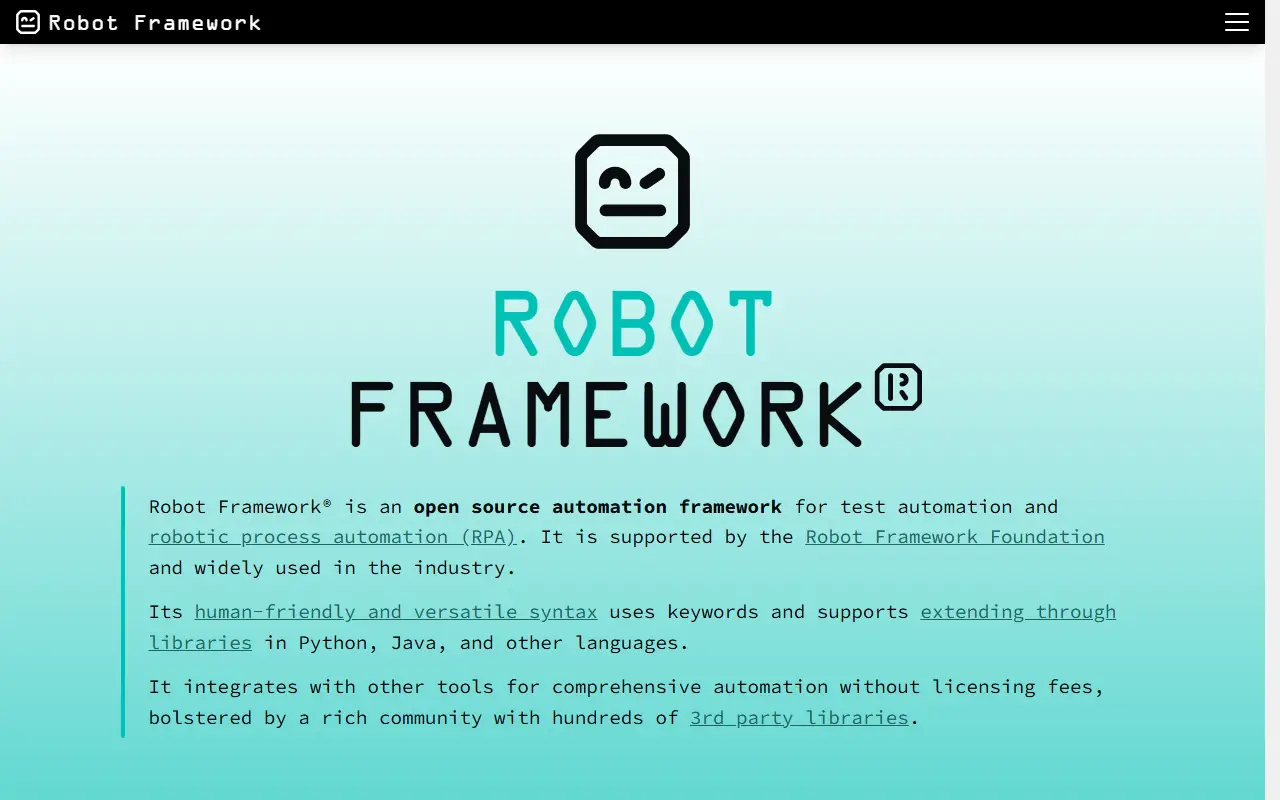
robotframework.orgRobot Framework homepage screenshot

Robot Framework is a generic open-source framework for test automation and robotic process automation. Test cases and tasks are written with readable, keyword-based syntax, so people who are not programmers can follow what an automated scenario does, and the same approach covers acceptance testing and RPA.

Functionality is extended through libraries written in Python, Java and other languages, and a rich ecosystem of hundreds of third-party libraries covers web, API, mobile and other automation needs. The Robot Framework Foundation supports the project, and the website provides a user guide, standard library documentation, community events, workshops and a certification program.

The framework is released under the Apache-2.0 licence, written in Python, and used without licensing fees. You install it into your own Python environment and run it locally or in CI, so there is no server to host. It suits QA teams practicing acceptance test-driven or behavior-driven development and teams automating repetitive business processes.

Key features

  • Human-readable keyword-driven syntax
  • Acceptance testing and RPA in one tool
  • Extensible with Python and Java libraries
  • Standard library of common keywords
  • Hundreds of third-party libraries
  • Reports and logs for test runs

Pricing: Free and open source under the Apache-2.0 licence, with no licensing fees.

Shortest

Natural-language end-to-end testing framework built on Playwright that uses the Anthropic Claude API to run tests written in plain English.

GitHub stars
5.7k
Last commit
1 mo ago
Latest release
v0.4.9
Licence
MIT
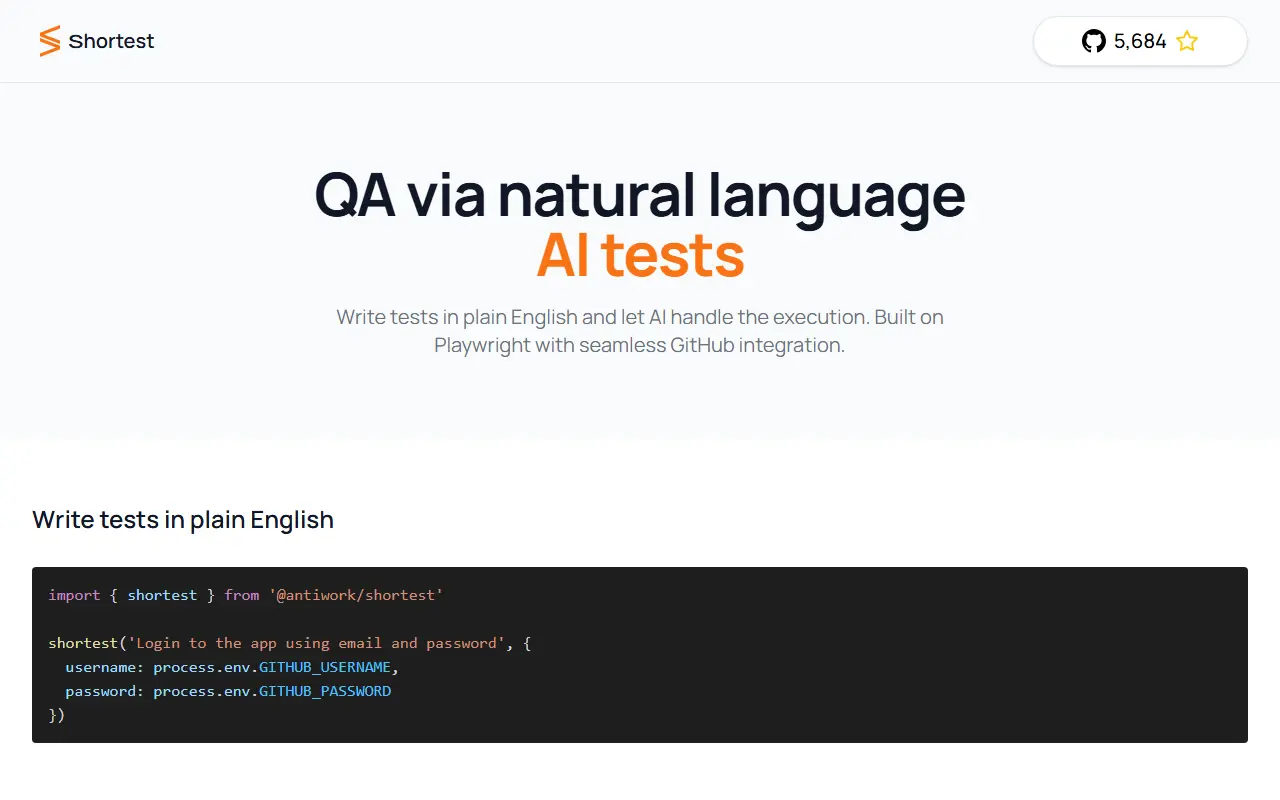
shortest.comShortest homepage screenshot

Shortest is an AI-powered end-to-end testing framework in which tests are written in natural language. Test execution is handled by the Anthropic Claude API, and the browser automation underneath is Playwright. It is released under the MIT license and maintained by the Antiwork team.

The project adds integrations for common testing hurdles, including GitHub login with two-factor authentication and email validation with Mailosaur. A shortest init command streamlines setup in a new or existing project by installing the package as a development dependency, creating a default shortest.config.ts file, and generating a .env.local file.

Shortest is written in TypeScript and works in Next.js and other JavaScript projects. It suits development teams who want to describe user flows in plain language rather than maintain brittle selectors, and who accept the cost and variability of calling a language model API during test runs.

Key features

  • Tests written in plain English
  • AI-driven execution with the Claude API
  • Built on Playwright
  • GitHub login with 2FA support
  • Email validation through Mailosaur
  • Setup command that generates config files

Pricing: Standard costs $10 per user per month after a 14-day free trial; Enterprise is quoted through sales.

Airtest

A cross-platform UI automation framework from NetEase that uses image recognition to test games and apps on Android, iOS and Windows.

GitHub stars
9.6k
Last commit
6 mo ago
Latest release
v1.4.3
Licence
Apache-2.0
Self-hosted
Yes
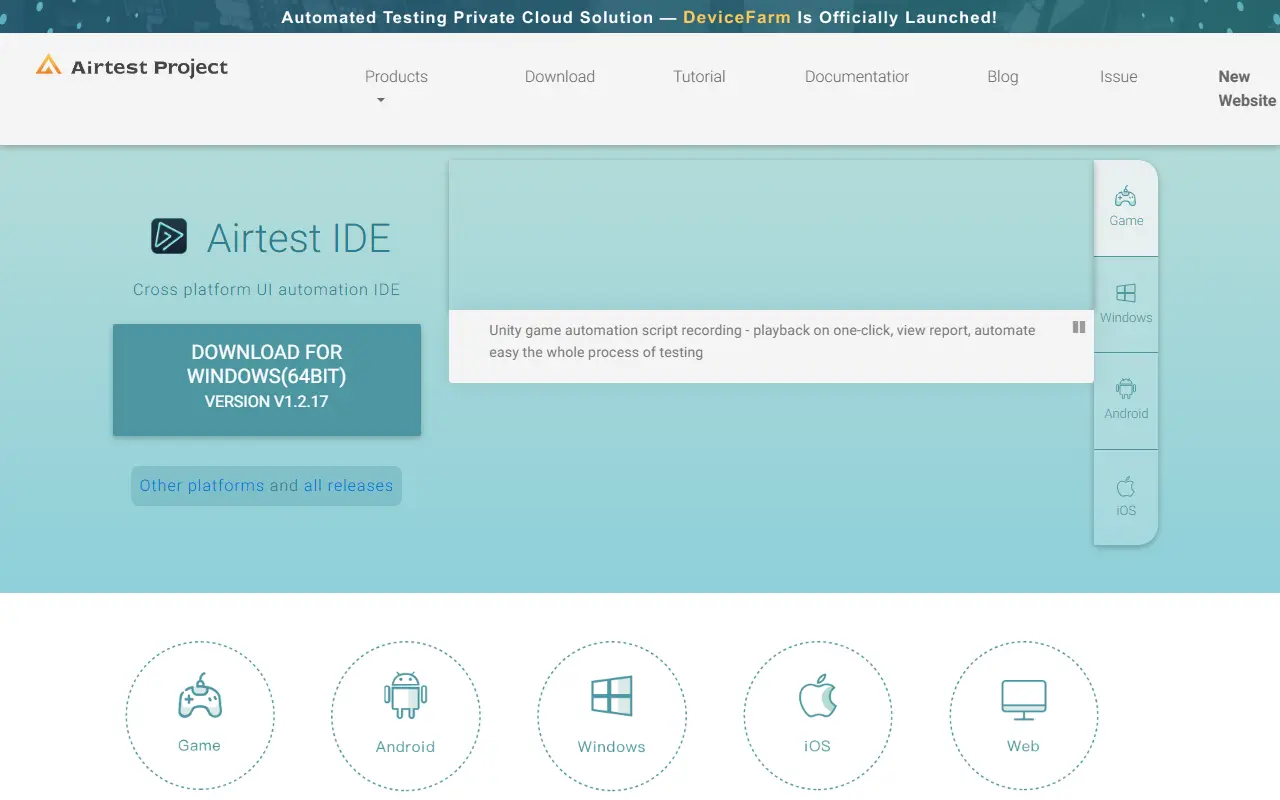
airtest.netease.comAirtest homepage screenshot

Airtest is a Python UI automation framework for testing games and apps. It provides cross-platform APIs for installing apps, simulating input and making assertions, and it locates interface elements using image recognition, so it can automate games and apps without injecting any code into them.

Test cases can run on many devices using the command line or the Python API, and HTML reports with screen recordings help pinpoint where a run failed. AirtestIDE offers a graphical environment for creating, running and reporting on cases, and the related Poco library adds direct access to UI widget hierarchies across major platforms and game engines such as Unity3D, allowing more advanced scripts.

Airtest is installed with pip, is licensed under Apache-2.0 and runs on your own computers and device farms. The project was developed at NetEase, which also builds a device cloud called Airlab on top of it. It suits QA engineers and game developers who need one scripting approach across Android, iOS and Windows targets.

Key features

  • Image-recognition-based UI automation
  • Cross-platform APIs for Android, iOS, Windows
  • HTML reports with screen recording
  • AirtestIDE graphical tool
  • Poco for widget-hierarchy access
  • Command line and Python API execution

Pricing: Free and open source; available for download on multiple platforms.

Magnitude

Magnitude is an open-source, vision-first browser agent that controls web pages from natural language and includes a test runner with visual assertions.

GitHub stars
4.1k
Last commit
7 mo ago
Latest release
magnitude-core@0.3.1
Licence
Apache-2.0
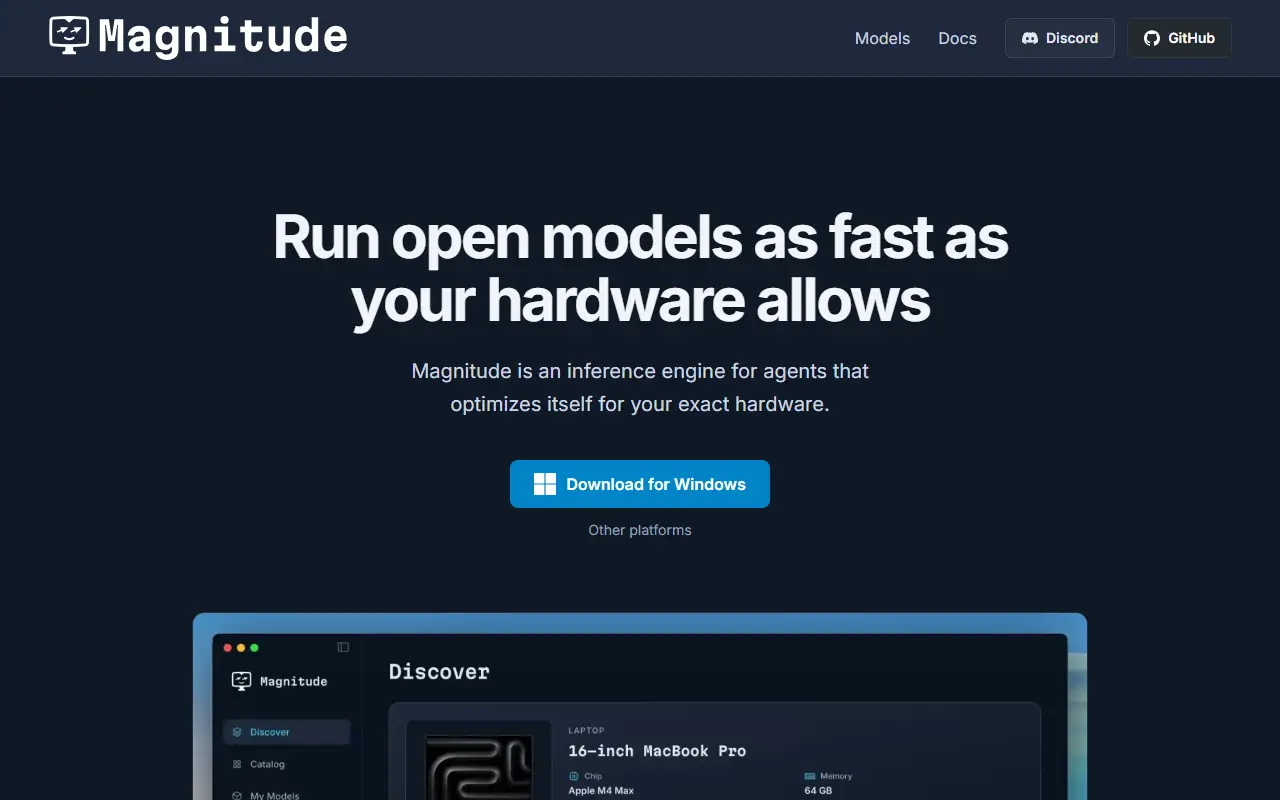
magnitude.runMagnitude homepage screenshot

Magnitude is a browser agent that uses vision AI so you can control a browser with natural language. It navigates by looking at the interface and planning actions, interacts with precise mouse and keyboard actions, extracts structured data, and verifies results with a built-in test runner that supports visual assertions.

Rather than drawing numbered boxes around page elements, which the authors say generalizes poorly on complex modern sites, it has a visually grounded model give pixel coordinates, making it independent of the page's DOM structure and extendable to desktop apps or virtual machines. It can be used to automate web tasks, integrate apps that have no APIs, extract data, test web apps or build other browser agents. The README reports a 94% score on the WebVoyager benchmark.

Magnitude needs a large visually grounded model; Claude Sonnet 4 is recommended and Qwen-2.5VL 72B is also compatible. A setup command creates a project with an example script, and the test runner adds a tests directory with a configuration file and example test. It is written in TypeScript and licensed under Apache-2.0.

Key features

  • Natural-language browser control
  • Vision-first element targeting by coordinates
  • Structured data extraction
  • Test runner with visual assertions
  • Setup command with example script
  • Works with Claude and Qwen vision models

Pricing: Free and open source under the Apache-2.0 license; requires access to a vision-capable model.

Crusher

Crusher is a low-code, Playwright-based testing framework for recording and running end-to-end browser tests, with a recorder, SDK and reporting dashboard.

GitHub stars
588
Last commit
1 yr ago
Latest release
v0.5.10
Licence
MIT
Self-hosted
Yes

Crusher is a testing framework that takes a low-code first approach to end-to-end web testing. You create tests by browsing your website with a Chromium-based recorder and adding assertions when needed, or by writing code, or a mix of both. The project describes itself as an alternative to Selenium, Cypress and Puppeteer.

It is built as an all-in-one tool with a recorder, an SDK and test infrastructure included. Code tests use Playwright APIs for finer control, execution runs on Playwright for speed and browser coverage including Chromium, Firefox and Safari, and results feed a central reporting dashboard with alerts and easy integration into existing projects.

Use cases include testing end-to-end user flows, testing UI changes and running tests locally. Crusher is MIT licensed and was in beta at v0.5 according to its README, with a v1.0 stable release anticipated. You can start by running an npx command in your git repository or by downloading a binary.

Key features

  • Chromium-based test recorder
  • Code tests with Playwright APIs
  • Chromium, Firefox and Safari support
  • Central reporting dashboard
  • Alerts and project integrations
  • Start with npx in a git repo

Pricing: Free and open source under the MIT license.

Leapwork alternatives: questions

What is the best open-source alternative to Leapwork?
Robot Framework is the top-ranked open-source alternative to Leapwork on Enlisted: An open-source automation framework for acceptance testing and robotic process automation, using human-readable keyword syntax that can be extended in Python or Java. Other strong options are Shortest, Airtest, Magnitude and Crusher.
Are these Leapwork alternatives free?
All 5 are open source, so the code is free to use under its licence, and all of them can be self-hosted on your own server or computer.
How is this list of Leapwork alternatives ranked?
By a score built from GitHub stars, star growth over the last 30 days and how recently the code changed. 1 of these projects shipped code in the last 30 days. Data is refreshed daily, and nobody can pay to move up.

People also look for alternatives to…

View all