
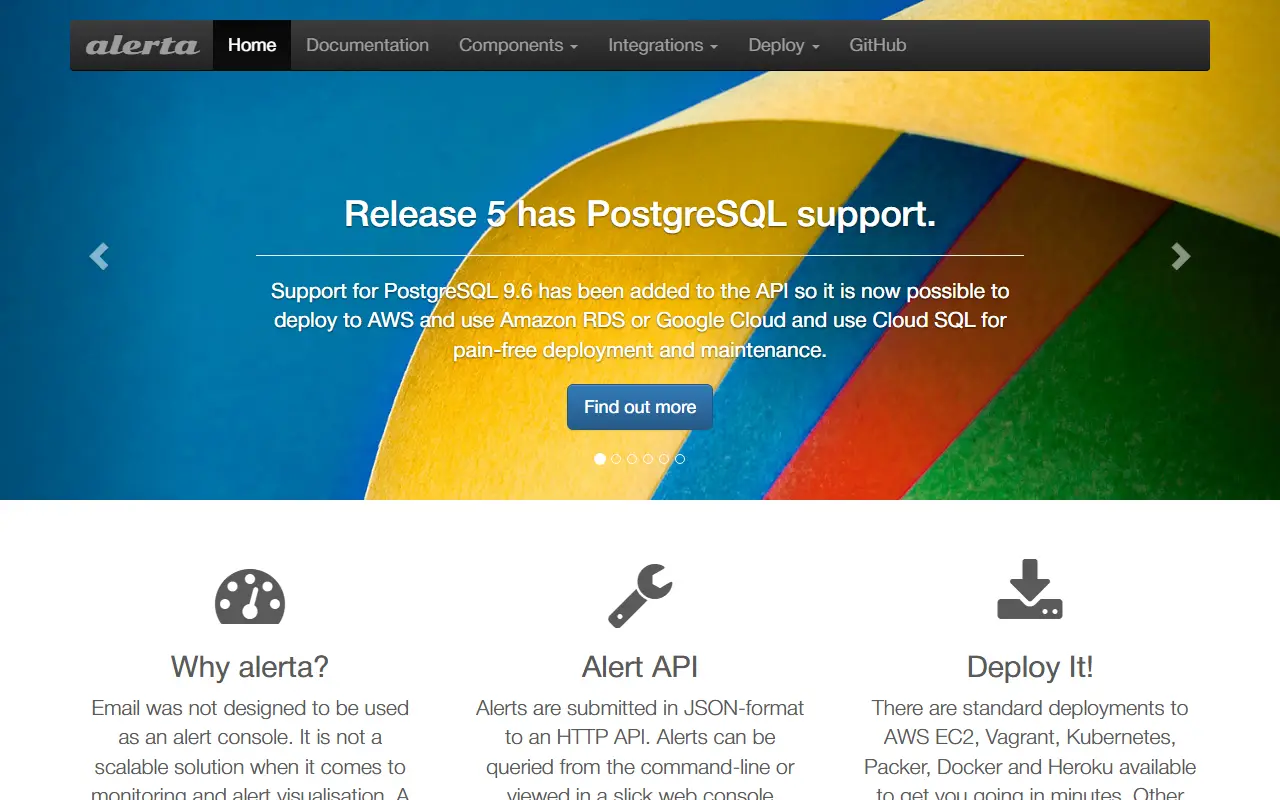
About Alerta
Alerta is an alert aggregation and monitoring system. Its design goals are to be distributed and decoupled so it scales, to need minimal configuration while accepting alerts from any source, and to give a quick visual overview with the option to drill down into detail.
The server is a Python application that needs MongoDB or PostgreSQL as its only mandatory dependency; release 9 requires Python 3.9 or newer, PostgreSQL 13 or better, or MongoDB 6.0 or better. You install the server and command-line client with pip and start it with alertad, then add the web console from a release archive. Settings are overridden in a config file or through an environment variable, and Docker images are provided in a separate repository.
Alerta exposes an API server, which is how monitoring tools feed alerts in and how the web console and client read them. The project has been developed since 2012 and is licensed under Apache-2.0.
Key features
- Alert intake from any monitoring source
- Web console with drill-down detail
- MongoDB or PostgreSQL storage
- Python API server with command-line client
- Docker images
- Simple file or environment variable configuration
Good fit for
- →Consolidating alerts from several monitoring tools
- →Operations teams wanting one alert dashboard
- Tags
- monitoring
- alerting
- python
- mongodb
- postgresql
- api-server
- observability
- operations
Alerta: questions and answers
- What is Alerta used for?
- Alerta is a monitoring tool that consolidates alerts from any source into one scalable server with a web console for at-a-glance views and drill-down. It is a good fit for consolidating alerts from several monitoring tools and operations teams wanting one alert dashboard.
- Is Alerta open source?
- Yes. Alerta is open source under the Apache-2.0 licence. Its source code is on GitHub at alerta/alerta and is written mainly in Python.
- Is Alerta free?
- Yes. Alerta is open source, so the software itself is free to use.
- Can I self-host Alerta?
- Yes. Alerta can be self-hosted on your own server or infrastructure.
- What is Alerta an alternative to?
- Alerta is an open-source alternative to BigPanda, PagerDuty and xMatters. Other open-source alternatives to BigPanda include Keep.
- Is Alerta actively maintained?
- The most recent commit to Alerta was on 19 June 2026, and the latest release is v9.1.0, published on 28 March 2026. The project has 2.5k stars on GitHub.
Open-source alternatives to Alerta
See all
Keep
Monitoring & Observability
The open-source AIOps and alert management platform
OSSvs BigPanda★ 12k
OneUptime
Monitoring & Observability
Complete open-source monitoring and observability platform.
OSSvs Datadog★ 7.7k
LinkedIn Oncall
Monitoring & Observability
Oncall is a calendar tool designed for scheduling and managing on-call shifts. It can be u
BSD-2-Clausevs incident.io★ 1.3k
Alertmanager
Monitoring & Observability
Prometheus Alertmanager
Apache-2.0vs xMatters★ 8.6k
Checkmk
Monitoring & Observability
Checkmk - Best-in-class infrastructure & application monitoring
GPL-2.0vs Datadog★ 2.4k
Netdata
Monitoring & Observability
The fastest path to AI-powered full stack observability, even for lean teams.
GPL-3.0vs Datadog★ 81k
SaaS alternatives to Alerta
See all
BigPanda
Monitoring & Observability
AIOps platform that correlates alerts from many tools into incidents
SaaS
PagerDuty
Monitoring & Observability
Incident response and on-call management platform with alerting and runbooks
SaaS
xMatters
Monitoring & Observability
Incident response and service reliability platform for alerting and workflow automation
SaaS
Amazon CloudWatch
Monitoring & Observability
AWS service for metrics, logs, alarms and dashboards
SaaS
AppDynamics
Monitoring & Observability
Cisco application performance monitoring that maps technical metrics to business impact
SaaS
AppSignal
Monitoring & Observability
Application monitoring for Ruby, Elixir, Node.js and Python with errors and metrics
SaaS