
About Adobe Experience Manager
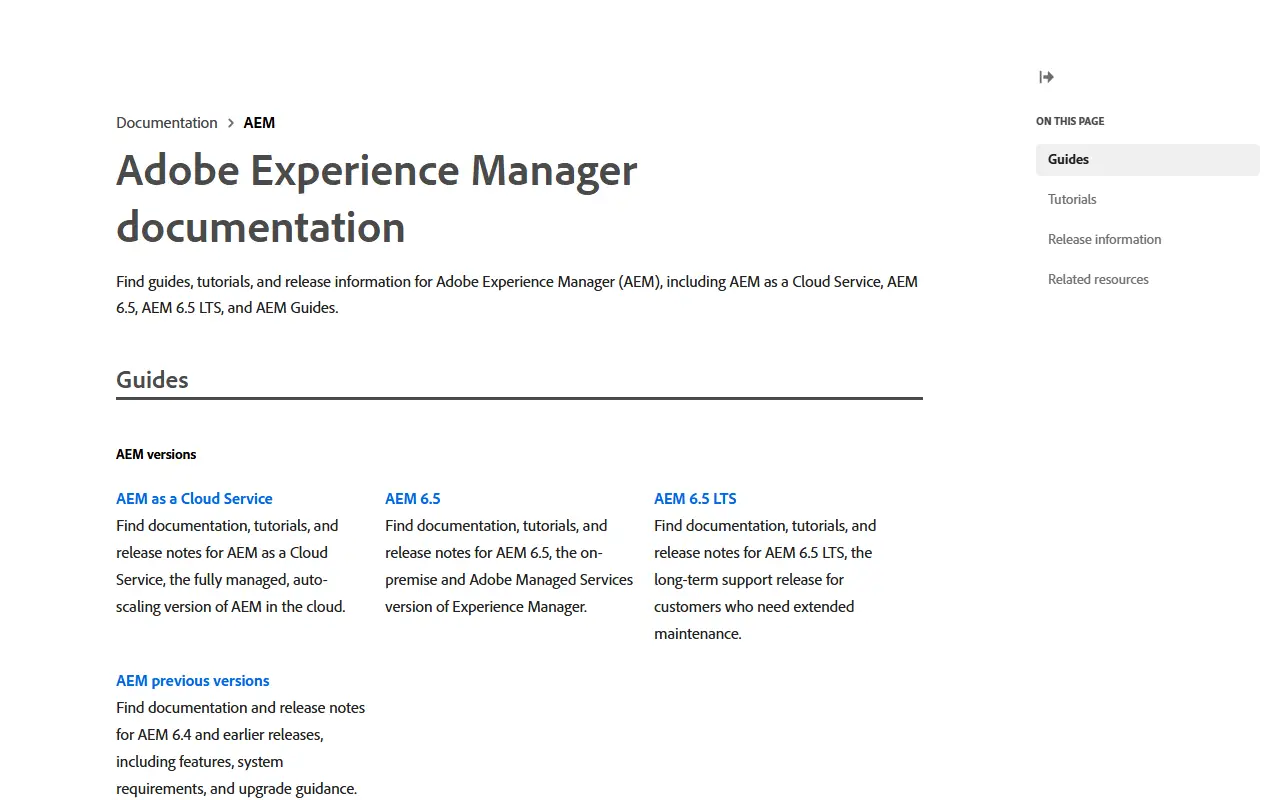
Adobe Experience Manager, often shortened to AEM, is an enterprise content management and digital asset management product from Adobe. Organizations use it to build and run websites and to manage brand content and assets across channels. The entry points to Adobe's documentation, which is organized by product version.
AEM is available in several forms. AEM as a Cloud Service is the fully managed, auto-scaling cloud version. AEM 6.5 is described as the on-premise and Adobe Managed Services version, and AEM 6.5 LTS is a long-term support release for customers who need extended maintenance. AEM Guides covers documentation authoring. Supporting documentation covers Cloud Manager for building, testing and deploying code, Dispatcher for caching, load balancing and security, Experience Hub for onboarding and administration, and the AEM Desktop App.
AEM is proprietary commercial software sold by Adobe, with deployment options both on-premise and in the cloud. Licensing details are handled directly with the vendor.
Key features
- Web content management for enterprise sites
- Digital asset management
- Fully managed cloud service option
- On-premise and managed services versions
- Cloud Manager for build and deploy pipelines
- Dispatcher for caching and load balancing
Good fit for
- →Running a large multi-site corporate website
- →Managing brand assets and content centrally
- Tags
- cms
- dam
- enterprise
- adobe
- content-management
- digital-asset-management
- web-content
Adobe Experience Manager: questions and answers
- What is Adobe Experience Manager used for?
- Adobe Experience Manager is an enterprise content management and digital asset management system for building websites and managing brand content at scale. It is a good fit for running a large multi-site corporate website, and managing brand assets and content centrally.
- How much does Adobe Experience Manager cost?
- Adobe Experience Manager doesn't publish fixed prices; pricing is quoted on request.
- Is Adobe Experience Manager open source?
- No. Adobe Experience Manager is proprietary (closed-source) software. Open-source alternatives to Adobe Experience Manager include TYPO3, Wagtail and django CMS.
- Can I self-host Adobe Experience Manager?
- Yes. Although Adobe Experience Manager is closed source, it can be self-hosted on your own servers, and the vendor also offers a hosted version.
- What are some alternatives to Adobe Experience Manager?
- Adobe Experience Manager competes with Sitecore, Optimizely and Contentstack. For open-source options, see Enlisted's ranked list of open-source Adobe Experience Manager alternatives.
Open-source alternatives to Adobe Experience Manager
See all
TYPO3
CMS
The TYPO3 Core - Enterprise Content Management System. Synchronized mirror of https://revi
GPL-2.0vs Sitecore★ 1.2k
Wagtail
CMS
A Django content management system focused on flexibility and user experience
BSD-3-Clausevs Sitecore★ 21k
django CMS
CMS
The easy-to-use and developer-friendly enterprise CMS powered by Django
OSSvs Adobe Experience Manager★ 11k
Umbraco CMS
CMS
Umbraco is a free and open source .NET content management system helping you deliver delig
MITvs Sitecore★ 5.3k
Drupal
CMS
Verbatim mirror of the git.drupal.org repository for Drupal core. Please see the https://g
OSSvs WordPress.com★ 4.3k
Sulu
CMS
Core framework that implements the functionality of the Sulu content management system
MITvs Sitecore★ 1.4k
SaaS alternatives to Adobe Experience Manager
See all
Sitecore
CMS
Enterprise digital experience platform with CMS, personalization and commerce
SaaS
Optimizely
CMS
Digital experience platform with CMS, A/B testing and commerce modules
SaaS
Contentstack
CMS
Enterprise headless CMS and digital experience platform
SaaS
Sitefinity
CMS
Enterprise .NET CMS from Progress with personalization and marketing tools
SaaS
Xperience by Kentico
CMS
Enterprise .NET CMS and digital marketing platform from Kentico
SaaS
Brightspot
CMS
Enterprise CMS and digital asset management for media and publishers
SaaS