 TrackMedia
 TrackRev

 HubSpot CMS Hub
 Cosmic
About Wagtail
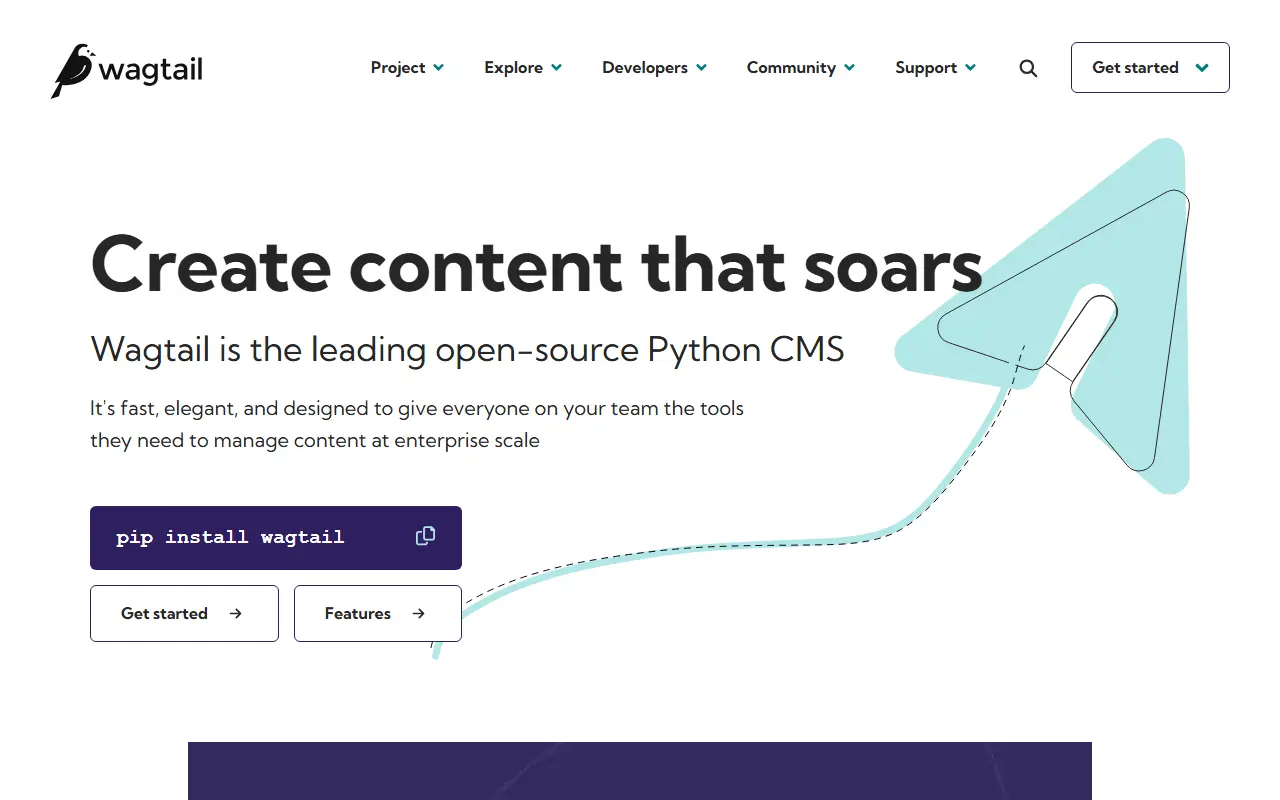
Wagtail is an open-source CMS built on the Python web framework Django. It concentrates on the authoring experience, offering a fast, attractive interface for editors, while developers and designers keep precise control over page structure and front-end templates. The project has a strong community and commercial support options.
Notable capabilities include StreamField, which lets editors assemble flexible content blocks without sacrificing structure, a content API for headless sites with a decoupled front end, integrated search that can use Elasticsearch or PostgreSQL, good handling of images and embedded media, and multi-site and multi-language readiness. The README says it can handle millions of pages and thousands of editors, and it runs anywhere from a Raspberry Pi to a multi-datacenter cloud platform.
Wagtail works with Python 3 on any platform and installs into a virtual environment, with a getting-started tutorial for setup. It is BSD-3-Clause licensed. Because it extends Django, it is a natural choice for Python teams building websites for organizations and publishers that need a customizable, editor-friendly content platform.
Key features
- Editor-friendly admin interface
- StreamField flexible content blocks
- Content API for headless setups
- Search with Elasticsearch or PostgreSQL
- Multi-site and multi-language support
- Image handling and embedded content
Good fit for
- Organization and publisher websites on Django
- Headless content backends
- Multi-language, multi-site content platforms
Wagtail: questions and answers
- What is Wagtail used for?
- Wagtail is a CMS built on Django that gives editors a polished interface and developers full control over structure and front-end design. It is a good fit for organization and publisher websites on Django; headless content backends; and multi-language, multi-site content platforms.
- Is Wagtail open source?
- Yes. Wagtail is open source under the BSD-3-Clause licence. Its source code is on GitHub at wagtail/wagtail and is written mainly in Python.
- Is Wagtail free?
- Yes. Wagtail is open source, so the software itself is free to use.
- Can I self-host Wagtail?
- Yes. Wagtail can be self-hosted on your own server or infrastructure.
- What is Wagtail an alternative to?
- Wagtail is an open-source alternative to Sitecore, Optimizely, Contentstack and Adobe Experience Manager. Other open-source alternatives to Sitecore include Umbraco CMS, TYPO3 and Craft CMS.
- Is Wagtail actively maintained?
- Yes. The most recent commit to Wagtail was on 10 November 2026, and the latest release is v8.1, published on 2 November 2026. The project has 21k stars on GitHub, with 181 added in the last 30 days.
Open-source alternatives to Wagtail
See all
Umbraco CMS
CMS
Umbraco is a free and open source .NET content management system helping you deliver delig
MITvs Sitecore★ 5.3k
TYPO3
CMS
The TYPO3 Core - Enterprise Content Management System. Synchronized mirror of https://revi
GPL-2.0vs Sitecore★ 1.2k
Craft CMS
CMS
Build bespoke content experiences with Craft.
OSSvs Contentstack★ 3.6k
dotCMS
CMS
The Visual Headless Content Management System for Enterprises
OSSvs Contentstack★ 972
Strapi
CMS
🚀 Strapi is the leading open-source headless CMS. It’s 100% JavaScript/TypeScript, fully
OSSvs Contentstack★ 73k
Sanity
CMS
Sanity Studio – Rapidly configure content workspaces powered by structured content
MITvs Contentstack★ 6.4k
SaaS alternatives to Wagtail
See all
Sitecore
CMS
Enterprise digital experience platform with CMS, personalization and commerce
SaaS
Optimizely
CMS
Digital experience platform with CMS, A/B testing and commerce modules
SaaS
Contentstack
CMS
Enterprise headless CMS and digital experience platform
SaaS
Adobe Experience Manager
CMS
Enterprise content management and digital asset management for websites and brand content
SaaS
Brightspot
CMS
Enterprise CMS and digital asset management for media and publishers
SaaS
Squiz
CMS
Australian digital experience platform with CMS and search products
SaaS