7,363 open-source and SaaS tools, with GitHub stats refreshed every day.

11 alternatives ranked by real activity

Open-source Adobe Experience Manager alternatives

A curated, ranked list of the 11 best open-source alternatives to Adobe Experience Manager.

The best open-source alternative to Adobe Experience Manager is Wagtail. If that doesn't suit you, other good options are django CMS, Umbraco CMS, ApostropheCMS and Drupal.

Adobe Experience Manager alternatives are mainly CMS tools, but some are also e-commerce tools. 11 of them shipped code in the last 30 days, 11 can be self-hosted, and 5 use a permissive licence.

Last updated October 2, 2026 · ranked by GitHub stars, growth and recent commits

Wagtail

A CMS built on Django that gives editors a polished interface and developers full control over structure and front-end design.

GitHub stars
21k
Last commit
yesterday
Latest release
v8.0
Licence
BSD-3-Clause
Self-hosted
Yes
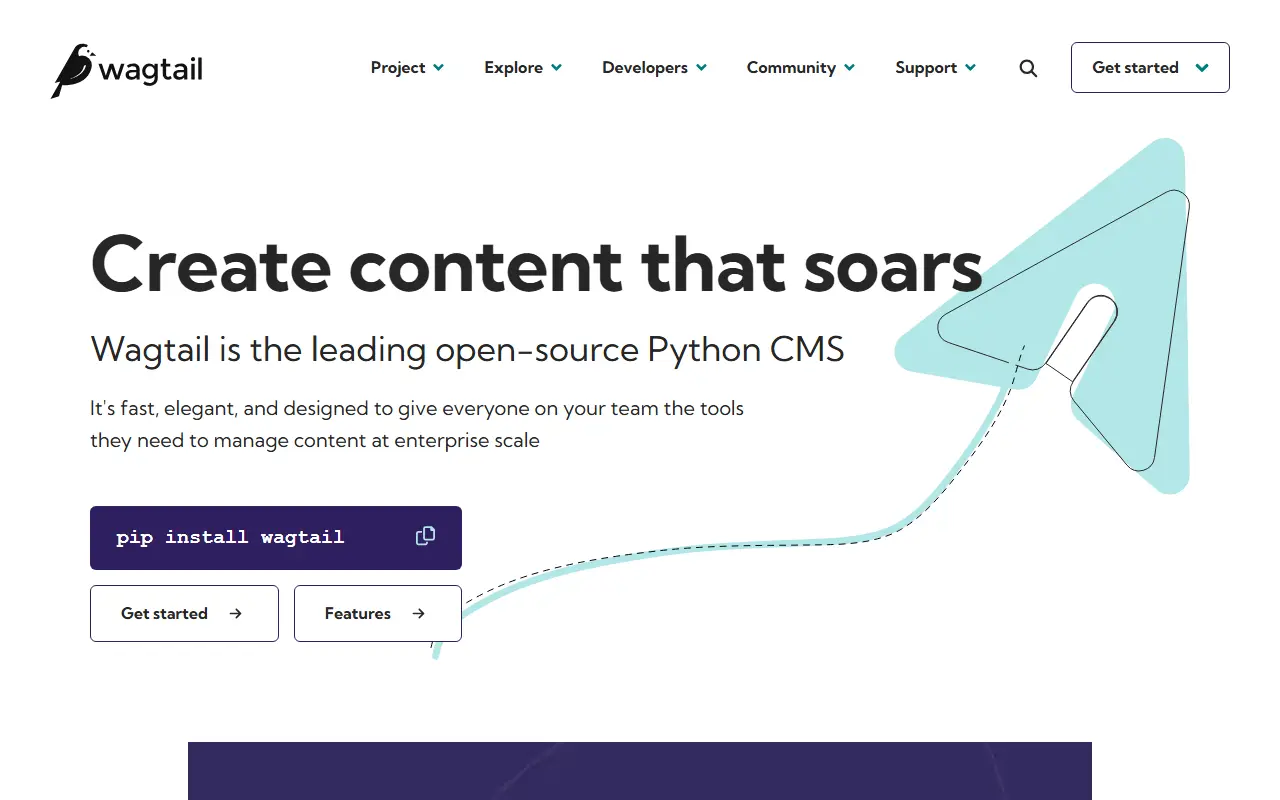
wagtail.orgWagtail homepage screenshot

Wagtail is an open-source CMS built on the Python web framework Django. It concentrates on the authoring experience, offering a fast, attractive interface for editors, while developers and designers keep precise control over page structure and front-end templates. The project has a strong community and commercial support options.

Notable capabilities include StreamField, which lets editors assemble flexible content blocks without sacrificing structure, a content API for headless sites with a decoupled front end, integrated search that can use Elasticsearch or PostgreSQL, good handling of images and embedded media, and multi-site and multi-language readiness. The README says it can handle millions of pages and thousands of editors, and it runs anywhere from a Raspberry Pi to a multi-datacenter cloud platform.

Wagtail works with Python 3 on any platform and installs into a virtual environment, with a getting-started tutorial for setup. It is BSD-3-Clause licensed. Because it extends Django, it is a natural choice for Python teams building websites for organizations and publishers that need a customizable, editor-friendly content platform.

Key features

  • Editor-friendly admin interface
  • StreamField flexible content blocks
  • Content API for headless setups
  • Search with Elasticsearch or PostgreSQL
  • Multi-site and multi-language support
  • Image handling and embedded content

Pricing: Free and open source under the BSD-3-Clause license.

Read more about WagtailWebsite GitHub

django CMS

An enterprise content management system powered by Django, written in Python and aimed at developers who build editable websites.

GitHub stars
11k
Last commit
2 days ago
Latest release
5.1.3
Self-hosted
Yes
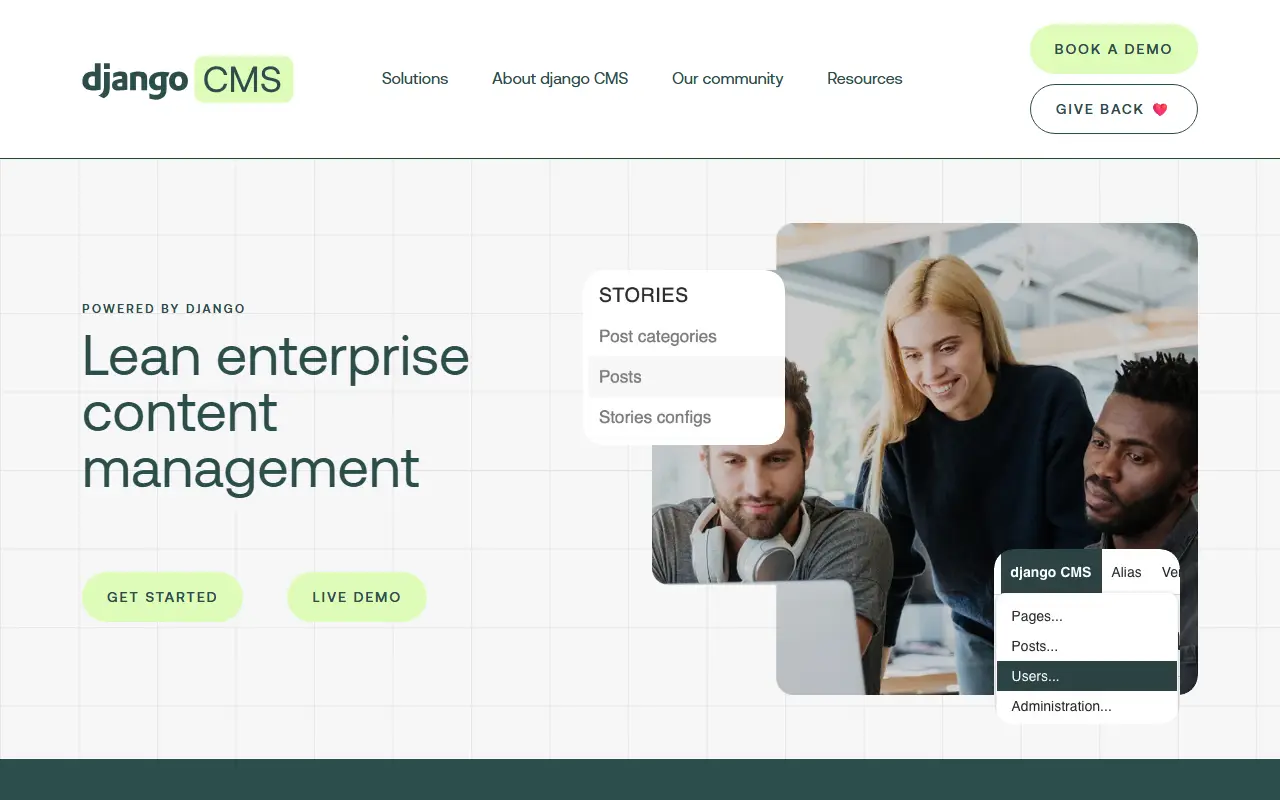
django-cms.orgdjango CMS homepage screenshot

Django CMS is a content management system built on the Django web framework and written in Python. It is described by its maintainers as easy to use and developer friendly, and is aimed at teams that want content editing for websites inside a Django project.

Because it is a Django application, it is installed into a Django project and runs on your own infrastructure, so content editors and developers work against the same codebase. It is open source, and the repository lists its license as Other, so check the licence file for the exact terms. The project website carries documentation and installation guidance.

Key features

  • Content management built on Django
  • Python codebase for Django projects
  • Developer-friendly CMS framework
  • Open-source project with active releases
Read more about django CMSWebsite GitHub

Umbraco CMS

Umbraco is a free, open-source content management system built on .NET and ASP.NET Core, used to build and edit websites and digital experiences.

GitHub stars
5.3k
Last commit
today
Latest release
release-18.2.0
Licence
MIT
Self-hosted
Yes
Hosted version
Available

Umbraco is a free and open-source content management system for the .NET platform. Developers use it to build websites and digital experiences with .NET and ASP.NET Core, while editors manage content through a browser-based back office.

The homepage could not be retrieved when this entry was prepared, so details come from the repository description and metadata. The project is a .NET codebase tagged for .NET Core and ASP.NET Core. The vendor also operates a managed cloud service for hosting Umbraco sites, and an ecosystem of packages extends the core.

Umbraco is licensed under MIT, so you can self-host it on your own web servers or Windows and Linux hosting. It suits agencies and in-house .NET teams that want a flexible, extensible CMS in their existing technology stack.

Key features

  • Open-source .NET content management system
  • ASP.NET Core based architecture
  • Browser-based back office for editors
  • Extensible through packages
  • Self-hosted or managed cloud deployment

Pricing: The CMS is free under the MIT license; the vendor sells managed cloud hosting.

Read more about Umbraco CMSWebsite GitHub

ApostropheCMS

ApostropheCMS is a Node.js and MongoDB content management framework that combines in-context page editing with a headless architecture.

GitHub stars
4.6k
Last commit
yesterday
Self-hosted
Yes
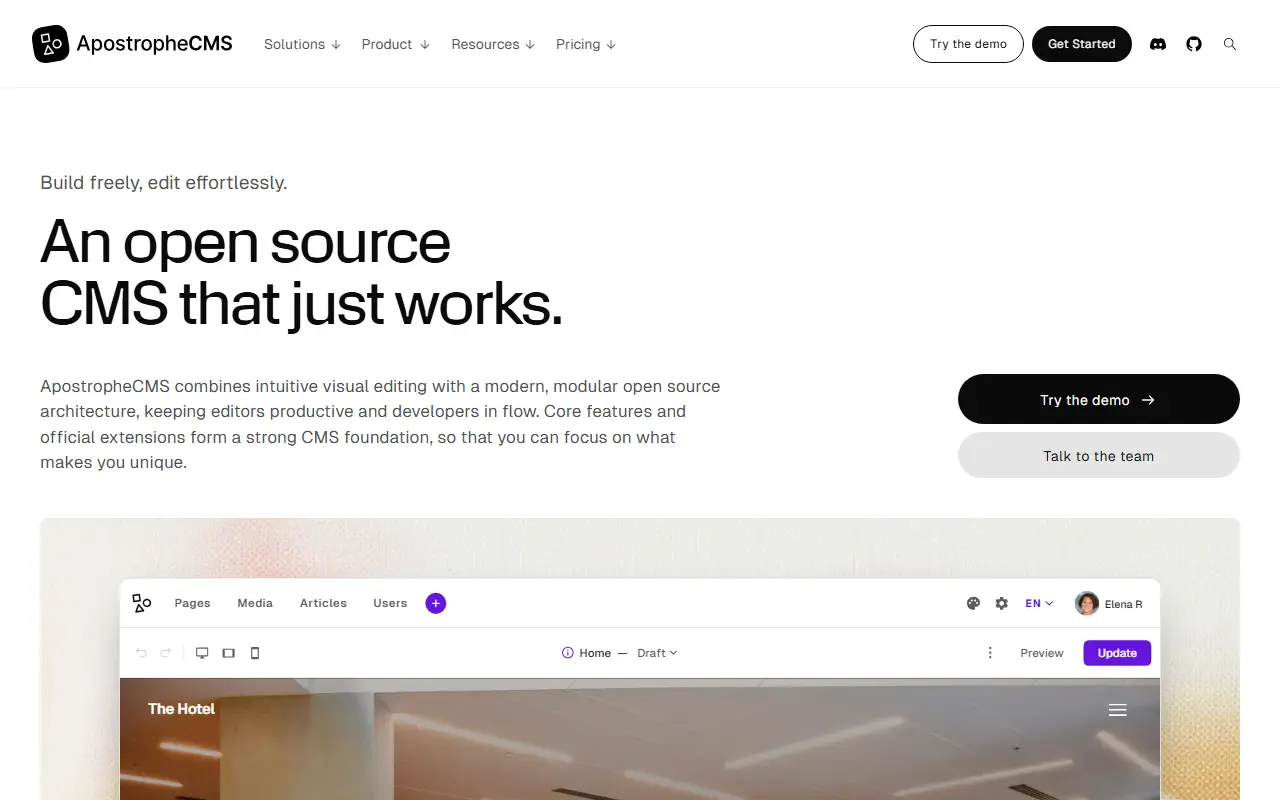
apostrophecms.comApostropheCMS homepage screenshot

ApostropheCMS is a full-stack content management system and framework built on Node.js and MongoDB. Editors change content right on the live page and see results immediately, rather than switching between a separate admin interface and a preview. Developers can work in current JavaScript, or run it as a headless back end behind any front-end framework.

The project describes its key features as in-context editing and headless readiness, so teams can pick between a traditional website approach and a decoupled one. It is positioned for developers and content teams who want a unified JavaScript environment from the database to the browser. Documentation, a demo and a roadmap are linked from the repository, and topics include the Jamstack and website builder keywords.

The repository metadata does not state a license, so check the project terms before adopting it. ApostropheCMS runs on your own Node.js hosting with a MongoDB database. It suits organizations wanting an editor-friendly CMS written in JavaScript.

Key features

  • In-context editing on live pages
  • Ready for headless use
  • Built on Node.js and MongoDB
  • Works with any frontend framework
  • Full-stack JavaScript environment
  • Demo and roadmap available

Pricing: The Community Edition is free and open source. Pro costs $199 per month with 5 editors and Assembly $499 per month with 5 sites; extra editors and sites are billed separately.

Read more about ApostropheCMSWebsite GitHub

Drupal

A mirror of the Drupal core repository, an open-source content management platform used for sites from personal blogs to large community websites.

GitHub stars
4.3k
Last commit
today
Self-hosted
Yes
drupal.orgDrupal homepage screenshot

Drupal is an open-source content management platform that supports websites ranging from personal weblogs to large community-driven sites. This GitHub repository is a verbatim mirror of the Drupal core repository on git.drupal.org, and pull requests are not accepted here.

Development takes place on Drupal.org, which has hosted the international Drupal community since 2001 and provides the GitLab repository, issue queue and documentation. Contributors use issue forks and merge requests. The core feature set can be extended with thousands of free, open-source modules, and many projects can be built mostly by assembling those modules before writing custom code.

Drupal keeps detailed change records covering notable breaking changes and new features since 2011, publishes security advisories through a page and RSS feed, and describes a formal security process. The software is written in PHP, and, as is widely known, it is released under the GPL.

Key features

  • Content management platform
  • Thousands of free community modules
  • Detailed change records
  • Security advisories with RSS feed
  • Issue forks and merge requests workflow

Pricing: Free and open source.

Read more about DrupalWebsite GitHub

Pimcore

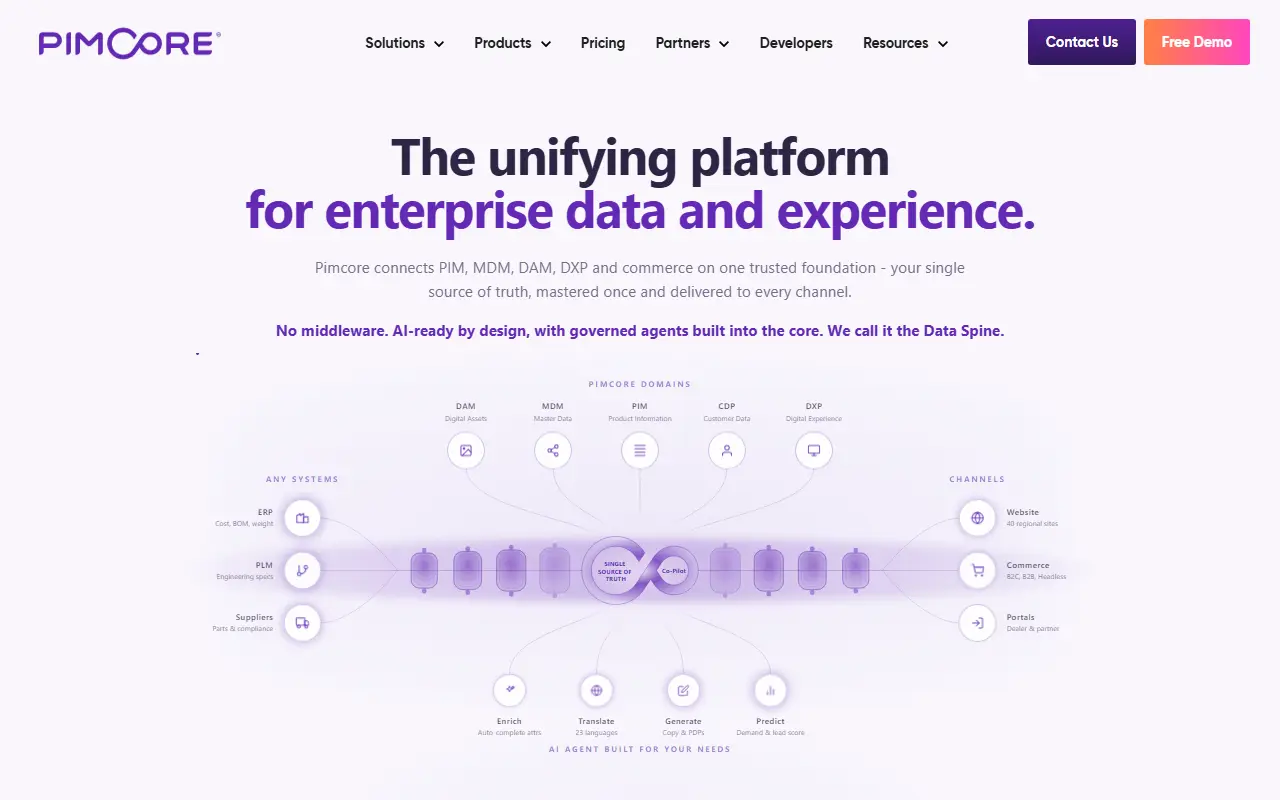
Pimcore is an open core PHP platform for product information, master data, digital assets, customer data, CMS and commerce in one API-driven foundation.

GitHub stars
3.9k
Last commit
today
Latest release
v2026.3.0
Self-hosted
Yes
pimcore.comPimcore homepage screenshot

Pimcore is an open core platform built for Product Experience Management. It offers an API-driven base for handling digital data and the customer experience, pairing a core framework with a modular set of extensions for product information management, master data management, digital asset management, customer data platform, a digital experience platform with CMS, and digital commerce.

A central idea is to keep data separate from any channel and send it to any destination, such as websites, apps, print or marketplaces. The code is PHP, and the project links to documentation, a live demo, a discussion forum and issue tracker. The README states that everything is licensed under the Pimcore Open Core License, shown as 'Other' on GitHub, so read it to see what the free core and extensions include.

Pimcore is self-hosted on your own infrastructure, with commercial support and cloud services available from the vendor. It suits mid-sized and larger organizations that need a single source of truth for product and content data across channels.

Key features

  • Product information management
  • Master data management
  • Digital asset management
  • Customer data platform
  • CMS and digital experience features
  • API-driven core framework

Pricing: The Community Edition is open source. On-premises Professional costs $9,900 per year and Enterprise $29,900 per year; the PaaS edition is priced on request.

Read more about PimcoreWebsite GitHub

Sulu

Sulu is an extensible PHP content management system on Symfony, built for multilingual, multi-portal websites with an intuitive admin interface.

GitHub stars
1.4k
Last commit
today
Latest release
3.0.10
Licence
MIT
Self-hosted
Yes
sulu.ioSulu homepage screenshot

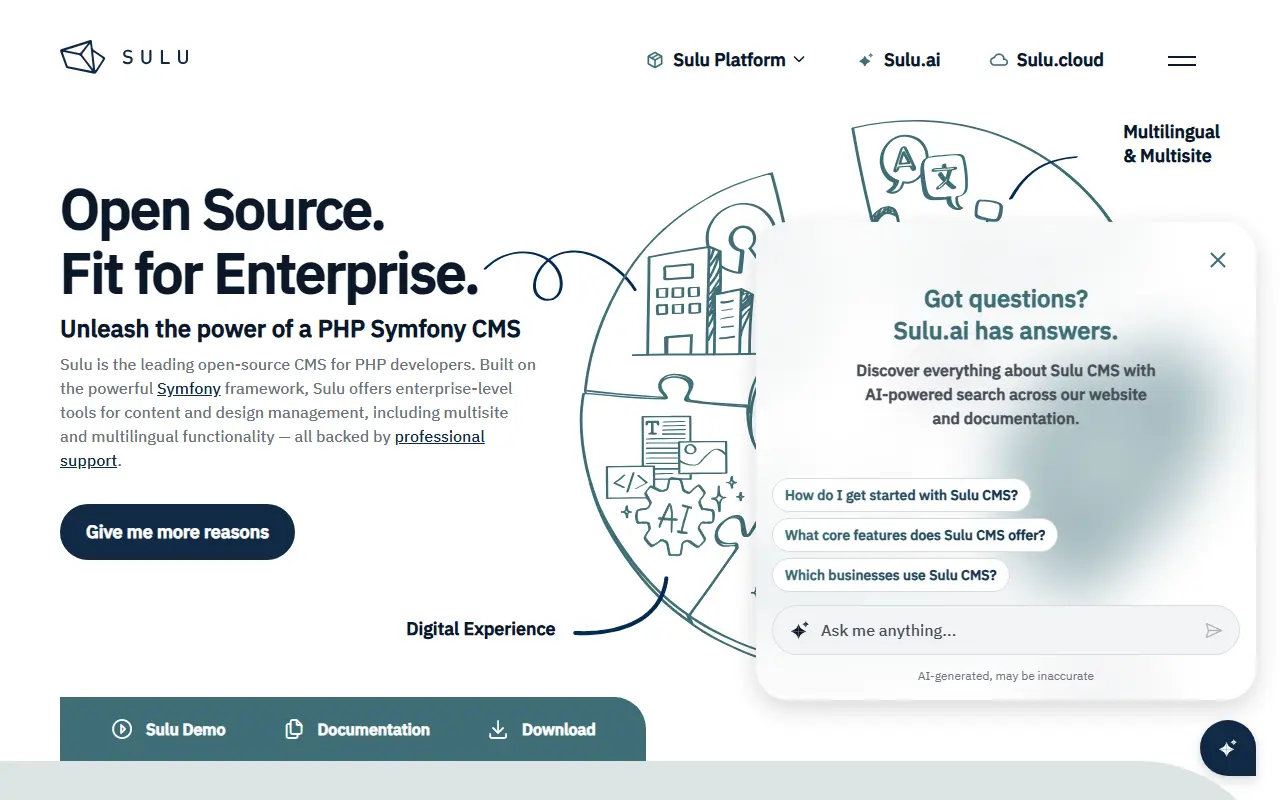
Sulu is an open-source PHP content management system built on the Symfony framework. It is meant for robust multilingual and multi-portal websites, and it provides an administration interface for managing the whole content lifecycle that can be extended by developers.

This repository holds the core framework that implements the CMS functionality and is a dependency of every Sulu project. To start a new site, developers use the sulu/skeleton project template, and the Sulu organization on GitHub lists official bundles for extending existing projects. Documentation covers installation and usage, and community help is offered through Slack and GitHub Discussions.

The project is community-driven and backed by partner companies, with a transparent development process. It is written in PHP, licensed under MIT and runs on your own hosting. It suits PHP and Symfony agencies and teams building custom content-heavy sites that need flexibility beyond what an off-the-shelf blogging CMS gives.

Key features

  • Built on the Symfony framework
  • Multilingual and multi-portal websites
  • Extensible administration interface
  • Project skeleton template for quick start
  • Official bundles for added features
  • Community support through Slack

Pricing: Free and open source under the MIT licence.

Read more about SuluWebsite GitHub

TYPO3

TYPO3 is a mature open-source PHP content management framework with an extension system, used for enterprise websites and published under the GPL.

GitHub stars
1.2k
Last commit
today
Licence
GPL-2.0
Self-hosted
Yes
typo3.orgTYPO3 homepage screenshot

TYPO3 is an open-source, PHP-based content management system released under the GNU GPL. It was created by Kasper Skårhøj and is developed today by a community of contributors and the TYPO3 Core Development Team. This repository is a synchronized mirror of the core packages, which are reviewed on the project's own code review system.

It describes itself as a content management framework, meaning the streamlined core is separated from optional extensions, and an open API lets developers extend both the website frontend and the administration backend. Many ready-made extensions are available, or you can write your own. TYPO3 runs on web servers such as Apache, nginx or IIS, on Linux, Windows, FreeBSD and macOS, and uses a database such as MySQL.

The backend is accessed through a supported browser, and the installation guide explains how to set up a basic installation on your server. TYPO3 is self-hosted, with documentation and community resources linked from the README, and it is aimed at agencies and organizations building large, multilingual and customized sites. The repository lists the GPL-2.0 licence.

Key features

  • Content management framework with extensions
  • Open API for frontend and backend extension
  • Runs on Apache, nginx, or IIS
  • Database-backed with MySQL support
  • Browser-based administration backend
  • Large extension ecosystem

Pricing: Free and open source under the GNU GPL.

Read more about TYPO3Website GitHub

DNN

DNN, formerly DotNetNuke, is an open-source web content management platform for the Microsoft .NET ecosystem, with multi-site support and an extension store.

GitHub stars
1.1k
Last commit
yesterday
Latest release
v10.3.3
Licence
MIT
Self-hosted
Yes
dnncommunity.orgDNN homepage screenshot

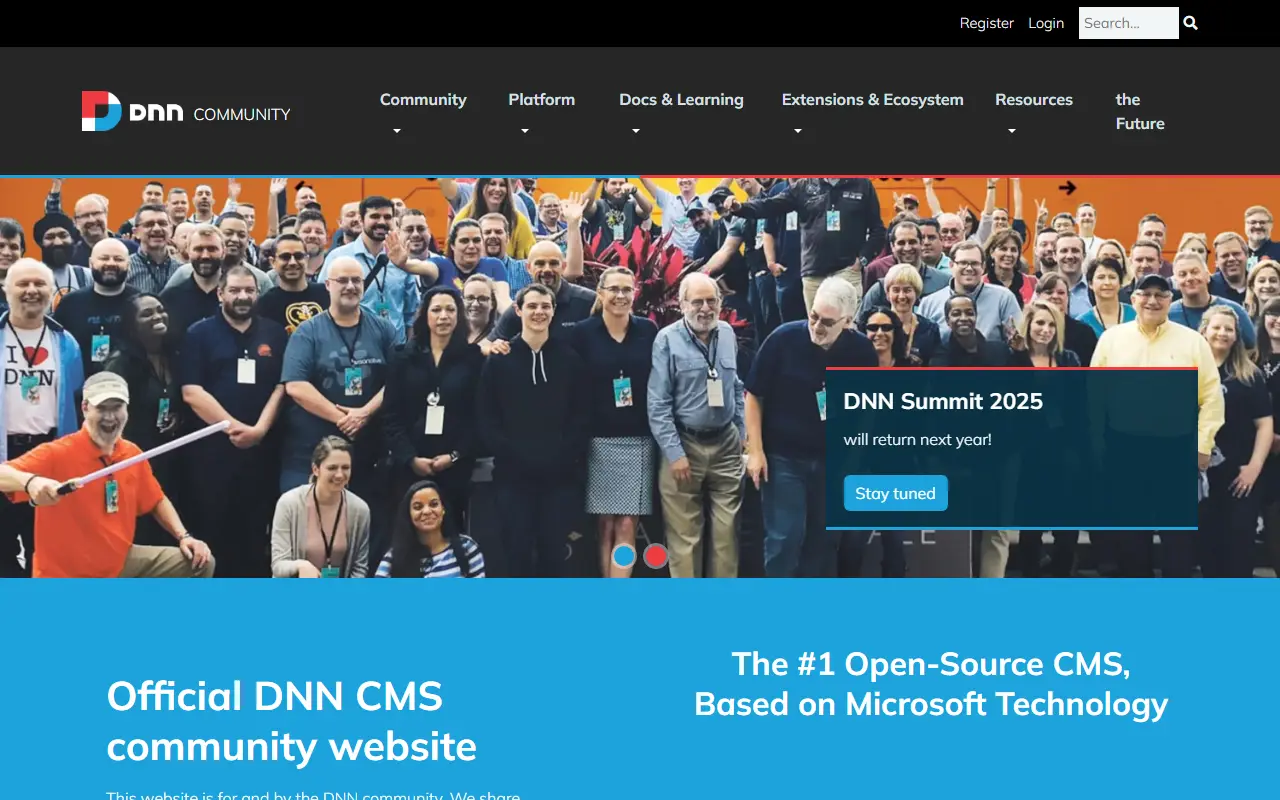
DNN, formerly known as DotNetNuke, is an open-source web content management platform built for the Microsoft ecosystem. It is used to build commercial websites, social intranets, community portals and partner extranets, and handles dynamic content of many types with sites that are straightforward to deploy and update.

Built-in features include a single installation with multi-site capability, file and folder management, localization with six languages out of the box, customizable site templates and themes, Azure compatibility, many REST APIs for site and content management, a drag-and-drop interface with an in-place rich-text editor, and administration tools such as security roles, protected content, SEO, a scheduler, SSL support and taxonomy. It is extensible through custom modules, with third-party extensions and skins available in the DNN Store.

DNN is written in C# and licensed under MIT, and runs on your own Windows and .NET hosting. The project has a community website, forums, documentation and a contribution process with a versioning policy and release schedule. It suits organizations and developers who already work in the Microsoft stack and want a mature open-source CMS.

Key features

  • Multi-site support from one installation
  • Localization with six built-in languages
  • Themes and site templates
  • REST APIs for site and content management
  • Drag-and-drop UI with in-place editing
  • Extensions and skins from the DNN Store

Pricing: Free and open source under the MIT licence; extensions in the DNN Store may be free or commercial.

Read more about DNNWebsite GitHub

dotCMS

dotCMS is a Java-based headless and visual content management system for enterprises, available as Docker images or as a managed cloud product.

GitHub stars
971
Last commit
today
Latest release
v25.07.10_lts_v19
Self-hosted
Yes
Hosted version
Available
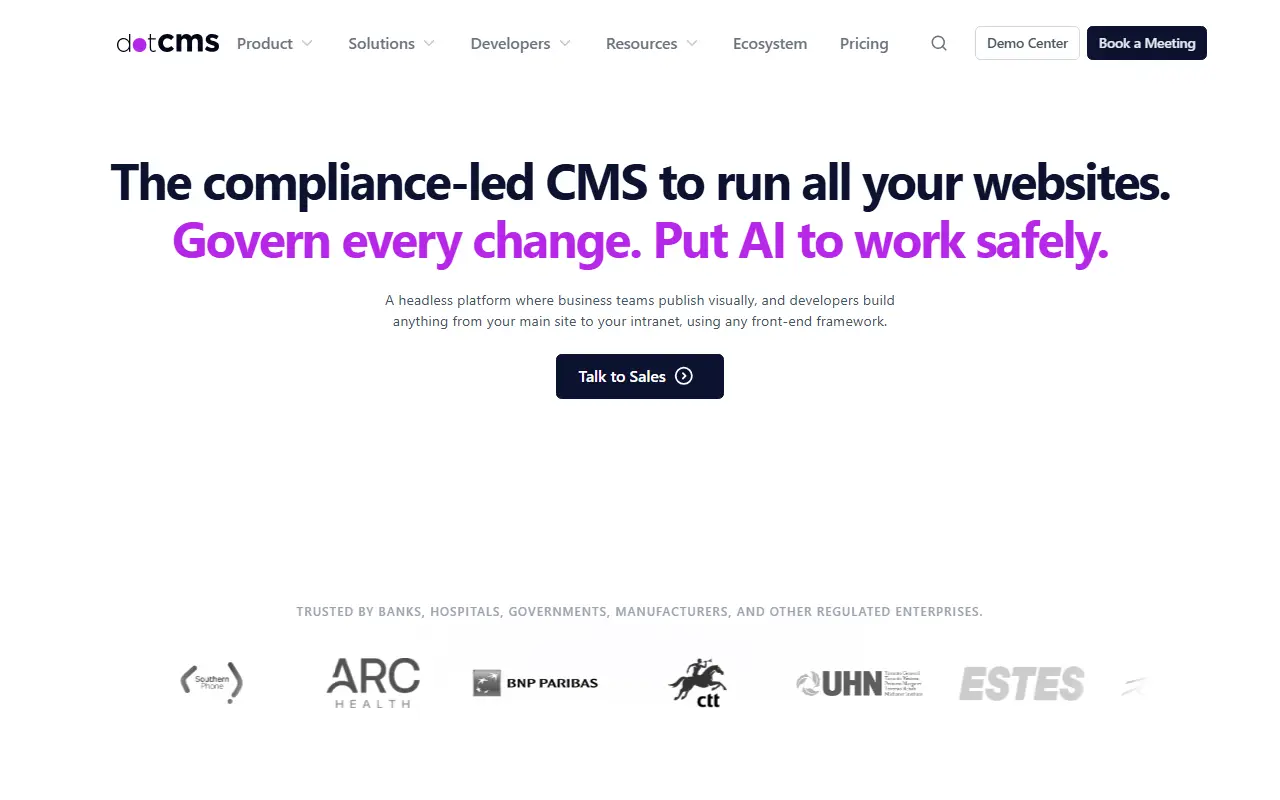
dotcms.comdotCMS homepage screenshot

dotCMS is an enterprise content management system that combines headless delivery with visual page editing. Content teams can edit pages in a visual editor, while developers consume the same content through REST and GraphQL APIs from any front-end stack, including single-page apps and server-rendered sites.

The platform supports multi-tenancy, so one instance can host many sites in many languages, such as microsites, brand sites or intranets. Content and assets are indexed in Elasticsearch for real-time and faceted search, and can also be vectorized for semantic search in AI applications. Marketing features include personalization, rules and A/B testing, plus custom workflows, roles and permissions, push and static publishing, and an OSGi-based plugin architecture.

dotCMS ships as a Docker image for self-hosting and also as dotCMS Cloud, a managed product. The code is public under the Business Source License 1.1, and the README says it is free for organizations with total finances under $5,000,000 USD; larger organizations should read the license terms.

Key features

  • Visual page editing for headless and SSR sites
  • REST and GraphQL content APIs
  • Multi-site, multi-language tenancy
  • Elasticsearch search with optional vector search
  • Personalization, rules and A/B testing
  • Custom content workflows and permissions
  • OSGi-based plugin architecture

Pricing: dotCMS is free under its Business Source License for companies under $5M in revenue. The Starter, Professional, Business and Enterprise plans have no published prices; pricing is requested from the vendor.

Read more about dotCMSWebsite GitHub

1 more Adobe Experience Manager alternative

Adobe Experience Manager alternatives: questions

What is the best open-source alternative to Adobe Experience Manager?
Wagtail is the top-ranked open-source alternative to Adobe Experience Manager on Enlisted: A CMS built on Django that gives editors a polished interface and developers full control over structure and front-end design. Other strong options are django CMS, Umbraco CMS, ApostropheCMS and Drupal.
Are these Adobe Experience Manager alternatives free?
All 11 are open source, so the code is free to use under its licence, and all of them can be self-hosted on your own server or computer. 2 also offer a paid or managed cloud version if you'd rather not host it yourself.
How is this list of Adobe Experience Manager alternatives ranked?
By a score built from GitHub stars, star growth over the last 30 days and how recently the code changed. 11 of these projects shipped code in the last 30 days. Data is refreshed daily, and nobody can pay to move up.

People also look for alternatives to…

View all