
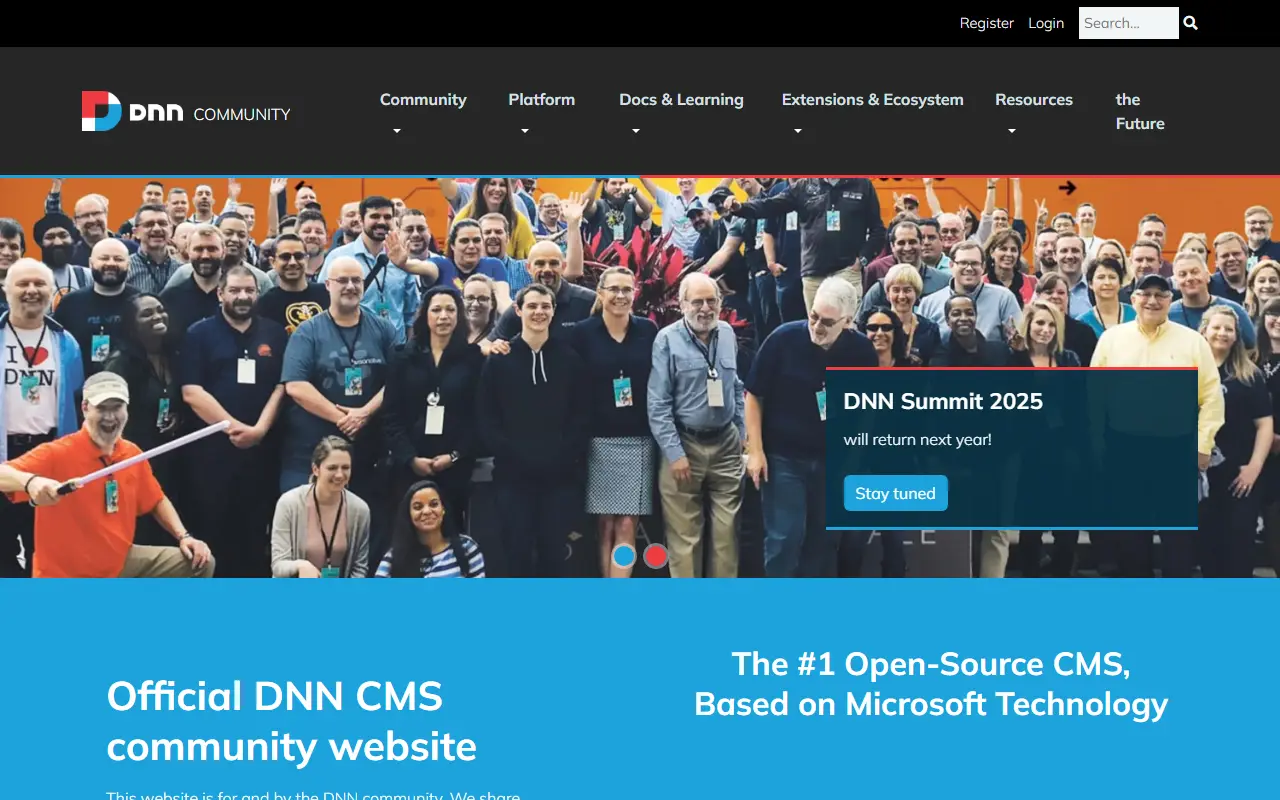
About DNN
DNN, formerly known as DotNetNuke, is an open-source web content management platform built for the Microsoft ecosystem. It is used to build commercial websites, social intranets, community portals and partner extranets, and handles dynamic content of many types with sites that are straightforward to deploy and update.
Built-in features include a single installation with multi-site capability, file and folder management, localization with six languages out of the box, customizable site templates and themes, Azure compatibility, many REST APIs for site and content management, a drag-and-drop interface with an in-place rich-text editor, and administration tools such as security roles, protected content, SEO, a scheduler, SSL support and taxonomy. It is extensible through custom modules, with third-party extensions and skins available in the DNN Store.
DNN is written in C# and licensed under MIT, and runs on your own Windows and .NET hosting. The project has a community website, forums, documentation and a contribution process with a versioning policy and release schedule. It suits organizations and developers who already work in the Microsoft stack and want a mature open-source CMS.
Key features
- Multi-site support from one installation
- Localization with six built-in languages
- Themes and site templates
- REST APIs for site and content management
- Drag-and-drop UI with in-place editing
- Extensions and skins from the DNN Store
Good fit for
- →Building intranets and extranets on .NET
- →Running several websites from one CMS
- →Extending a CMS with custom modules
- Built with
- C#
- Tags
- cms
- dotnet
- dnn
- dotnetnuke
- csharp
- intranet
- content-management
- azure
- self-hosted
DNN: questions and answers
- What is DNN used for?
- DNN, formerly DotNetNuke, is an open-source web content management platform for the Microsoft .NET ecosystem, with multi-site support and an extension store. It is a good fit for building intranets and extranets on .NET, running several websites from one CMS, and extending a CMS with custom modules.
- Is DNN open source?
- Yes. DNN is open source under the MIT licence. Its source code is on GitHub at dnnsoftware/Dnn.Platform and is written mainly in C#.
- Is DNN free?
- Yes. DNN is open source, so the software itself is free to use.
- Can I self-host DNN?
- Yes. DNN can be self-hosted on your own server or infrastructure.
- What is DNN an alternative to?
- DNN is an open-source alternative to Sitefinity, Xperience by Kentico, Sitecore and Adobe Experience Manager. Other open-source alternatives to Sitefinity include Sulu, TYPO3 and Concrete CMS.
- Is DNN actively maintained?
- Yes. The most recent commit to DNN was on 1 October 2026, and the latest release is v10.3.3, published on 23 July 2026. The project has 1.1k stars on GitHub.
Open-source alternatives to DNN
See all
Umbraco CMS
CMS
Umbraco is a free and open source .NET content management system helping you deliver delig
MITvs Sitecore★ 5.3k
Sulu
CMS
Core framework that implements the functionality of the Sulu content management system
MITvs Sitecore★ 1.4k
TYPO3
CMS
The TYPO3 Core - Enterprise Content Management System. Synchronized mirror of https://revi
GPL-2.0vs Sitecore★ 1.2k
Concrete CMS
CMS
Official repository for Concrete CMS development
MITvs Sitefinity★ 852
dotCMS
CMS
The Visual Headless Content Management System for Enterprises
OSSvs Contentstack★ 971
Pimcore
E-commerce
Core Framework for the Open Core Data & Experience Management Platform (PIM, MDM, CDP, DAM
OSSvs Sitecore★ 3.9k
SaaS alternatives to DNN
See all
Sitefinity
CMS
Enterprise .NET CMS from Progress with personalization and marketing tools
SaaS
Xperience by Kentico
CMS
Enterprise .NET CMS and digital marketing platform from Kentico
SaaS
Sitecore
CMS
Enterprise digital experience platform with CMS, personalization and commerce
SaaS
Adobe Experience Manager
CMS
Enterprise content management and digital asset management for websites and brand content
SaaS
Squiz
CMS
Australian digital experience platform with CMS and search products
SaaS
Optimizely
CMS
Digital experience platform with CMS, A/B testing and commerce modules
SaaS