#1
An open-source headless CMS written in JavaScript and TypeScript that generates REST and GraphQL APIs from content models you design.
- GitHub stars
- 73k
- Last commit
- today
- Latest release
- v5.62.0
- Self-hosted
- Yes
- Hosted version
- Available
strapi.io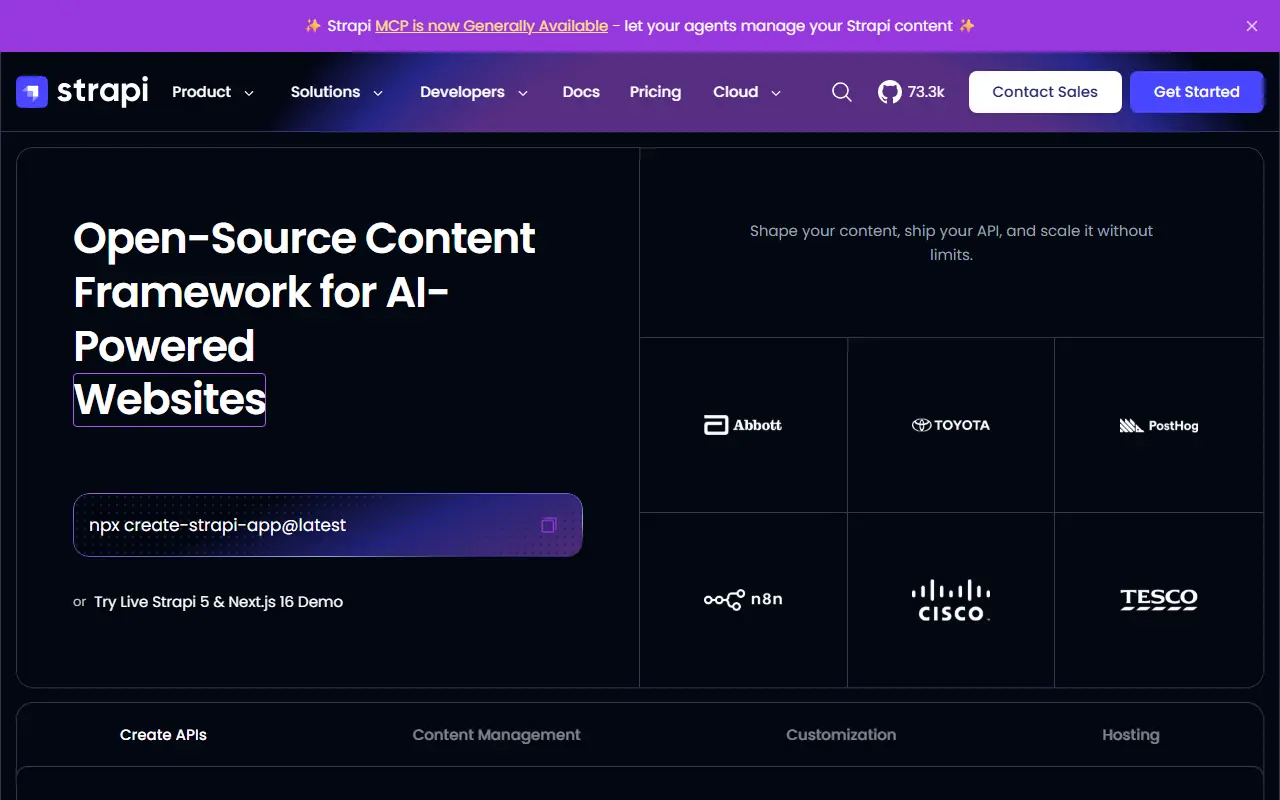
Strapi is a headless content management system. Developers define content models, and Strapi generates a complete API that a website, mobile app or other client can consume, while editors get a friendly admin interface for writing and managing content. It is written entirely in JavaScript and TypeScript on Node.js.
A visual Content-Type Builder lets you design structures without code, and every content type gets REST and GraphQL endpoints automatically. Granular roles and permissions, a media library, internationalization and draft and publish workflows are built in. It works with SQLite, PostgreSQL, MySQL and MariaDB, and offers a plugin system and a customizable admin dashboard. Requests pass through routes, middlewares, controllers and services, which is where backend customization happens. Strapi AI adds help with content modeling, media alt text and translations.
You can self-host Strapi on your own infrastructure or use Strapi Cloud, the managed service. Its license is listed as 'Other' in the repository metadata, so confirm the terms for any enterprise features. It suits teams building Jamstack or multi-channel sites that want a flexible, developer-first backend.
Key features
- Visual Content-Type Builder
- Auto-generated REST and GraphQL APIs
- Granular roles and permissions
- Media library with internationalization
- Draft and publish workflow
- Plugin system and customizable admin panel
- SQLite, PostgreSQL, MySQL and MariaDB support
Pricing: Strapi Cloud has no free tier on this page: Starter is $35, Pro $90 and Business $450 per project per month. Custom limits go through sales.
#2
A self-hostable data platform that wraps any SQL database with instant REST and GraphQL APIs, a no-code admin app, authentication and an MCP server.
- GitHub stars
- 39k
- Last commit
- today
- Latest release
- v12.6.1
- Self-hosted
- Yes
- Hosted version
- Available
directus.com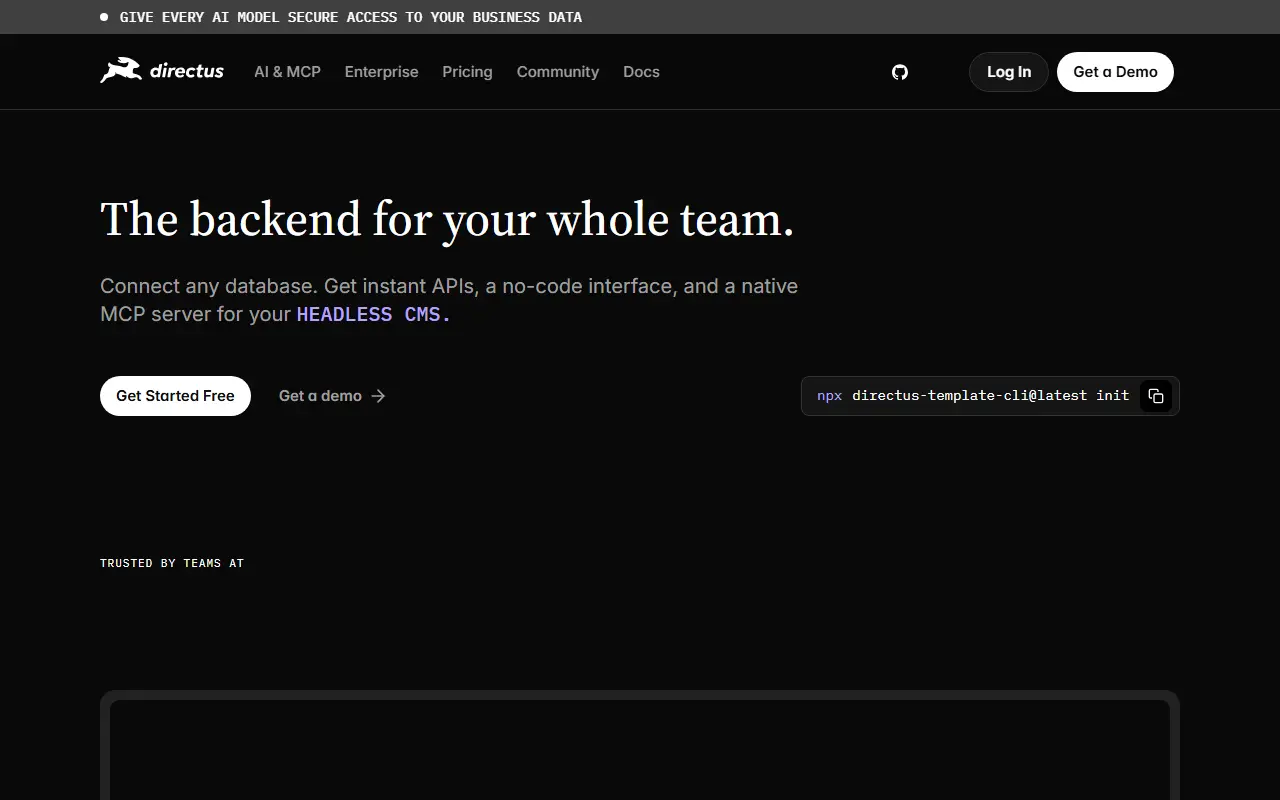
Directus is a collaborative backend and headless CMS that sits on top of an existing SQL database. You connect a database, and it generates production-ready REST and GraphQL APIs, leaving your schema exactly as built, along with a no-code interface where non-developers can manage content and data.
Beyond content management it provides authentication and access control, so the same install can power websites, apps, admin panels and internal tools. A native Model Context Protocol server gives AI assistants such as Claude, ChatGPT and Cursor secure access to business data. Supported databases include SQLite, MySQL, PostgreSQL and SQL Server, and the app is built with TypeScript and Vue. A template CLI, run through npx, can initialize a project quickly.
Directus can be self-hosted on servers you control, or run on the vendor's Directus Cloud. The repository license is listed as 'Other', so review the terms to see which uses are free. It suits teams that want an API and admin layer over data they already have, without writing a custom backend.
Key features
- Instant REST and GraphQL APIs over any SQL database
- No-code data and content interface
- Authentication and role-based access
- Native MCP server for AI assistants
- Works with SQLite, MySQL, PostgreSQL and SQL Server
- Project templates via npx CLI
Pricing: Core is free with 3 seats. Team is $599 per month billed monthly or $499 per month on an annual commitment; Enterprise is custom. Directus Cloud hosting is a $99 per month add-on, with a 14-day cloud trial.
#3
A CMS built on Django that gives editors a polished interface and developers full control over structure and front-end design.
- GitHub stars
- 21k
- Last commit
- 3 days ago
- Latest release
- v8.1
- Licence
- BSD-3-Clause
- Self-hosted
- Yes
wagtail.org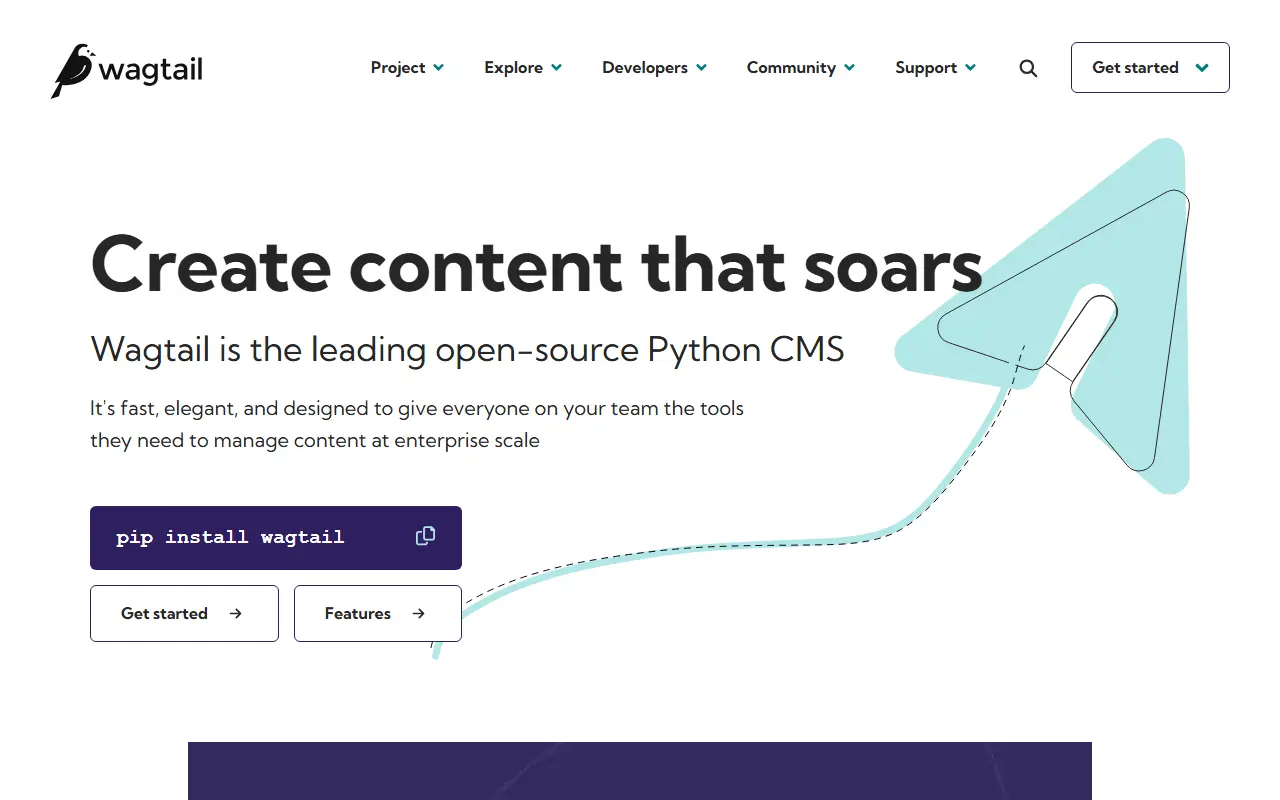
Wagtail is an open-source CMS built on the Python web framework Django. It concentrates on the authoring experience, offering a fast, attractive interface for editors, while developers and designers keep precise control over page structure and front-end templates. The project has a strong community and commercial support options.
Notable capabilities include StreamField, which lets editors assemble flexible content blocks without sacrificing structure, a content API for headless sites with a decoupled front end, integrated search that can use Elasticsearch or PostgreSQL, good handling of images and embedded media, and multi-site and multi-language readiness. The README says it can handle millions of pages and thousands of editors, and it runs anywhere from a Raspberry Pi to a multi-datacenter cloud platform.
Wagtail works with Python 3 on any platform and installs into a virtual environment, with a getting-started tutorial for setup. It is BSD-3-Clause licensed. Because it extends Django, it is a natural choice for Python teams building websites for organizations and publishers that need a customizable, editor-friendly content platform.
Key features
- Editor-friendly admin interface
- StreamField flexible content blocks
- Content API for headless setups
- Search with Elasticsearch or PostgreSQL
- Multi-site and multi-language support
- Image handling and embedded content
Pricing: Free and open source under the BSD-3-Clause license.
#4
Joomla is a long-established open-source PHP content management system for building multilingual websites, with a large extension ecosystem.
- GitHub stars
- 5.2k
- Last commit
- today
- Latest release
- 6.2.0
- Licence
- GPL-2.0
- Self-hosted
- Yes
joomla.org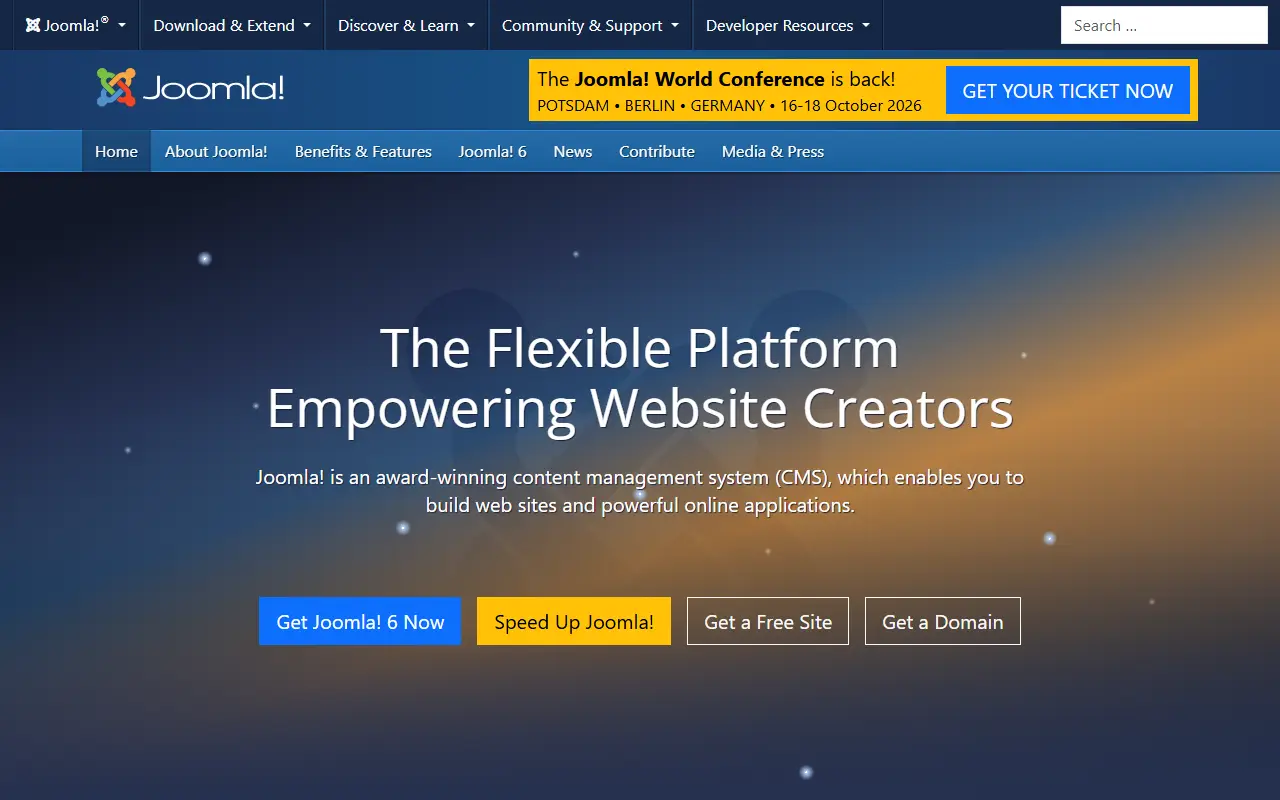
Joomla is a free, open-source content management system written in PHP. It lets site owners and developers build, organize and publish websites and web applications through an administrator interface, and it is tagged as both a CMS and a website builder with multilingual capabilities.
This repository contains the source of the current Joomla CMS, with version history and detailed changelogs published on the project site and continuous integration status shown for PHP and Node. Joomla relies on a large community of extension developers and translators to extend the core, and the project promotes contributions through Hacktoberfest.
Joomla is licensed under GPL-2.0 and installed on your own web hosting with a database. It suits small business sites, community portals, publishers and agencies that want a mature, extensible PHP CMS with built-in support for multiple languages.
Key features
- PHP content management system
- Multilingual website support
- Administrator back end for editors
- Extensions and templates ecosystem
- Published version history and changelogs
- Active community development
Pricing: Free and open source under GPL-2.0.
#5
Umbraco is a free, open-source content management system built on .NET and ASP.NET Core, used to build and edit websites and digital experiences.
- GitHub stars
- 5.3k
- Last commit
- today
- Latest release
- release-18.3.1
- Licence
- MIT
- Self-hosted
- Yes
- Hosted version
- Available
Umbraco is a free and open-source content management system for the .NET platform. Developers use it to build websites and digital experiences with .NET and ASP.NET Core, while editors manage content through a browser-based back office.
The homepage could not be retrieved when this entry was prepared, so details come from the repository description and metadata. The project is a .NET codebase tagged for .NET Core and ASP.NET Core. The vendor also operates a managed cloud service for hosting Umbraco sites, and an ecosystem of packages extends the core.
Umbraco is licensed under MIT, so you can self-host it on your own web servers or Windows and Linux hosting. It suits agencies and in-house .NET teams that want a flexible, extensible CMS in their existing technology stack.
Key features
- Open-source .NET content management system
- ASP.NET Core based architecture
- Browser-based back office for editors
- Extensible through packages
- Self-hosted or managed cloud deployment
Pricing: The CMS is free under the MIT license; the vendor sells managed cloud hosting.
#6
A mirror of the Drupal core repository, an open-source content management platform used for sites from personal blogs to large community websites.
- GitHub stars
- 4.3k
- Last commit
- yesterday
- Self-hosted
- Yes
drupal.org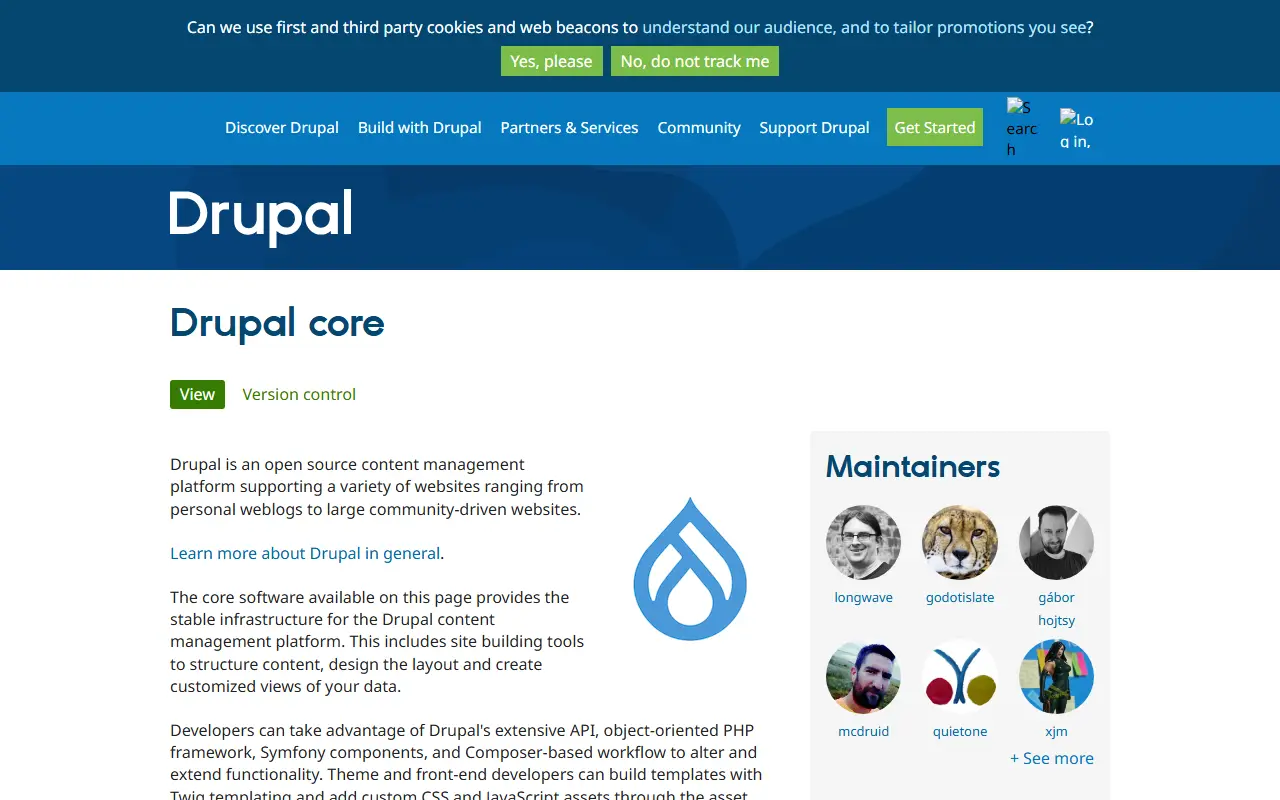
Drupal is an open-source content management platform that supports websites ranging from personal weblogs to large community-driven sites. This GitHub repository is a verbatim mirror of the Drupal core repository on git.drupal.org, and pull requests are not accepted here.
Development takes place on Drupal.org, which has hosted the international Drupal community since 2001 and provides the GitLab repository, issue queue and documentation. Contributors use issue forks and merge requests. The core feature set can be extended with thousands of free, open-source modules, and many projects can be built mostly by assembling those modules before writing custom code.
Drupal keeps detailed change records covering notable breaking changes and new features since 2011, publishes security advisories through a page and RSS feed, and describes a formal security process. The software is written in PHP, and, as is widely known, it is released under the GPL.
Key features
- Content management platform
- Thousands of free community modules
- Detailed change records
- Security advisories with RSS feed
- Issue forks and merge requests workflow
Pricing: Free and open source.
#7
Pimcore is an open core PHP platform for product information, master data, digital assets, customer data, CMS and commerce in one API-driven foundation.
- GitHub stars
- 3.9k
- Last commit
- yesterday
- Latest release
- v2026.3.5
- Self-hosted
- Yes
pimcore.com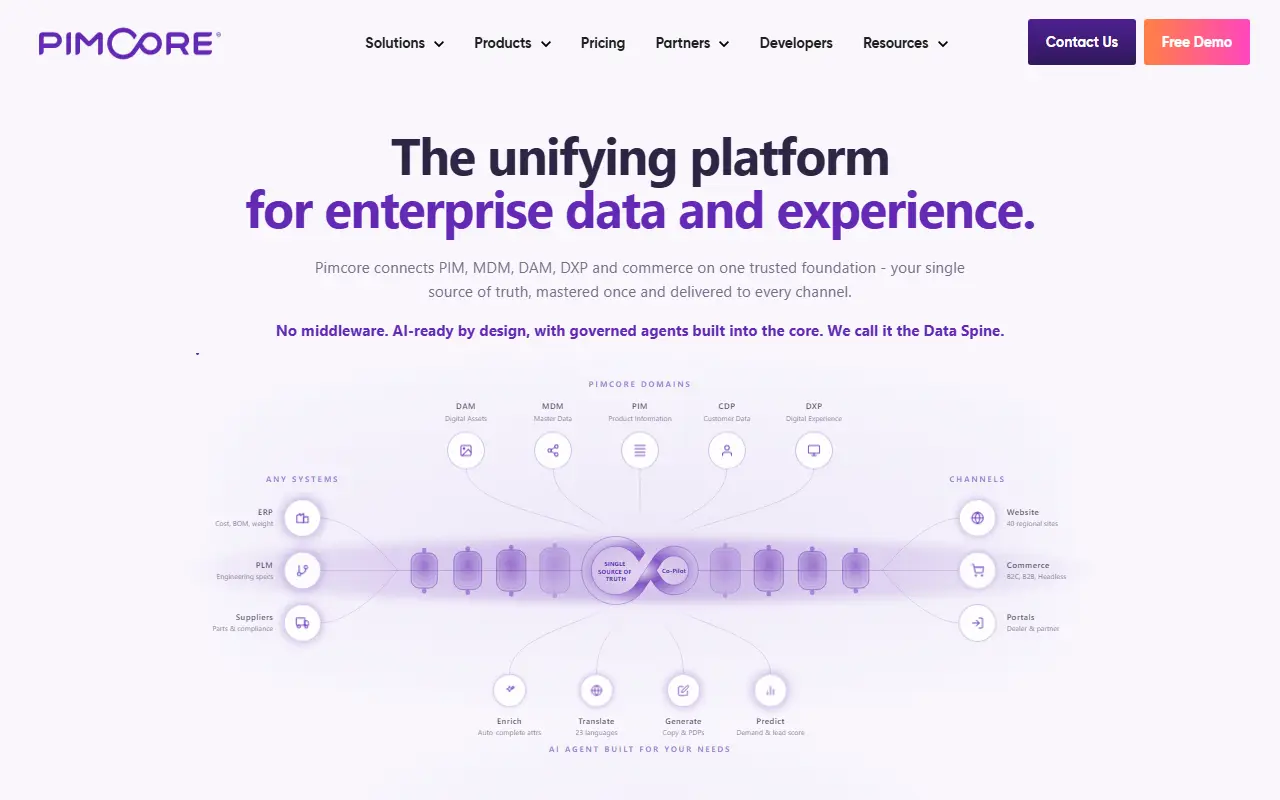
Pimcore is an open core platform built for Product Experience Management. It offers an API-driven base for handling digital data and the customer experience, pairing a core framework with a modular set of extensions for product information management, master data management, digital asset management, customer data platform, a digital experience platform with CMS, and digital commerce.
A central idea is to keep data separate from any channel and send it to any destination, such as websites, apps, print or marketplaces. The code is PHP, and the project links to documentation, a live demo, a discussion forum and issue tracker. The README states that everything is licensed under the Pimcore Open Core License, shown as 'Other' on GitHub, so read it to see what the free core and extensions include.
Pimcore is self-hosted on your own infrastructure, with commercial support and cloud services available from the vendor. It suits mid-sized and larger organizations that need a single source of truth for product and content data across channels.
Key features
- Product information management
- Master data management
- Digital asset management
- Customer data platform
- CMS and digital experience features
- API-driven core framework
Pricing: The Community Edition is open source. On-premises Professional costs $9,900 per year and Enterprise $29,900 per year; the PaaS edition is priced on request.
#8
Craft CMS is a flexible PHP content management system with clean-slate content modeling, Twig templates, a GraphQL API and optional ecommerce.
- GitHub stars
- 3.6k
- Last commit
- today
- Latest release
- 5.12.1
- Self-hosted
- Yes
craftcms.com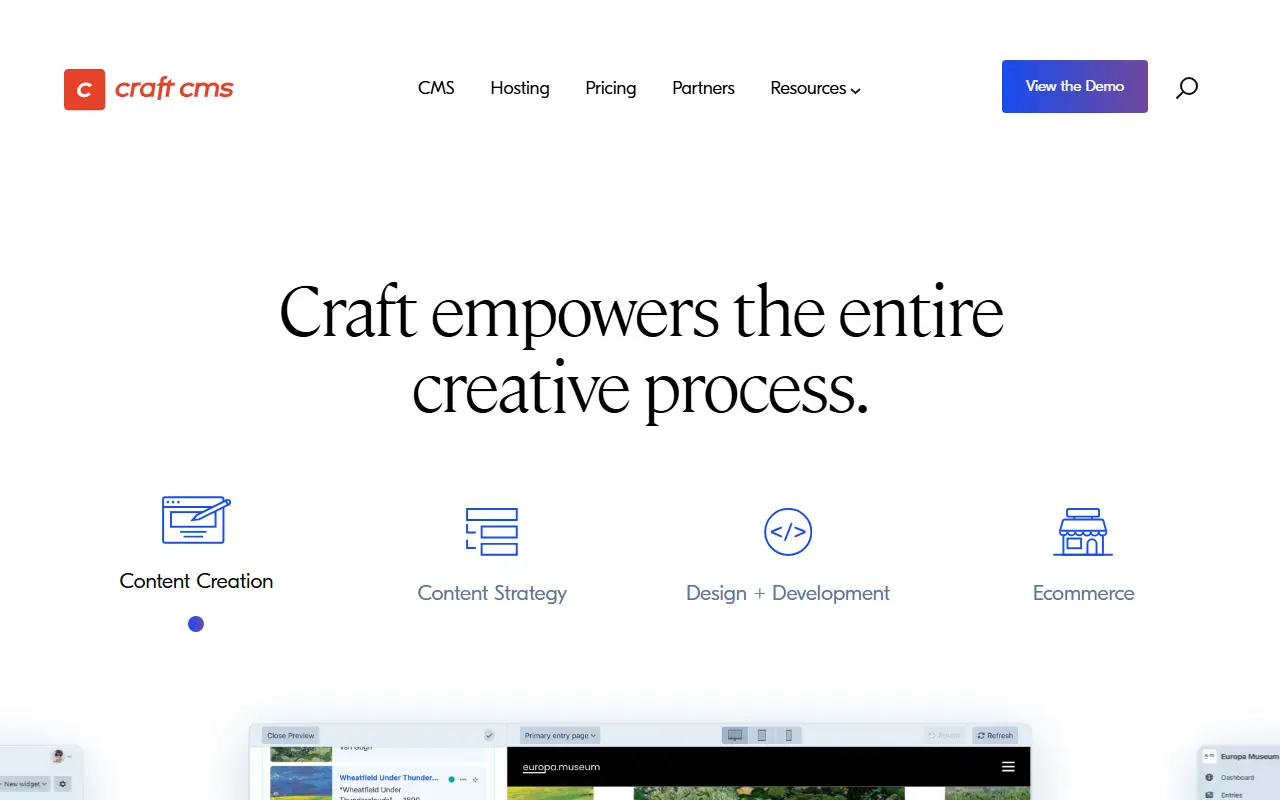
Craft is a flexible, easy-to-use content management system for building bespoke digital experiences, online and elsewhere. It offers an intuitive control panel for content creation and administration, and a clean-slate approach to content modeling that makes no assumptions about what you manage.
Developers build front ends with Twig templates, or go headless using the auto-generated GraphQL API. The platform also supports a full ecommerce solution for bespoke online stores, a Plugin Store inside the control panel offering hundreds of plugins, both free and paid, and an extension framework based on Yii2 for advanced customization. Repository topics list Twig, GraphQL, PHP 8 and several major Craft versions.
The code is source-available, and GitHub shows the license as 'Other' because Craft uses its own license, with free and paid editions offered by the vendor. Craft is self-hosted on your PHP server, and the vendor provides support and cloud hosting options. It suits agencies and in-house teams building tailored sites.
Key features
- Intuitive control panel for editors
- Flexible content modeling
- Twig templating system
- Auto-generated GraphQL API
- Ecommerce add-on for bespoke stores
- Plugin Store with free and paid plugins
Pricing: Solo is free to self-host. Team costs $279 and Pro $399 per project, including a year of updates and then $99 per year; Enterprise has a custom license.
#9
Liferay is a headless, composable digital experience platform covering content management, portals, digital asset management and commerce.
- GitHub stars
- 2.3k
- Last commit
- yesterday
- Latest release
- 7.4.3.132-ga132
liferay.com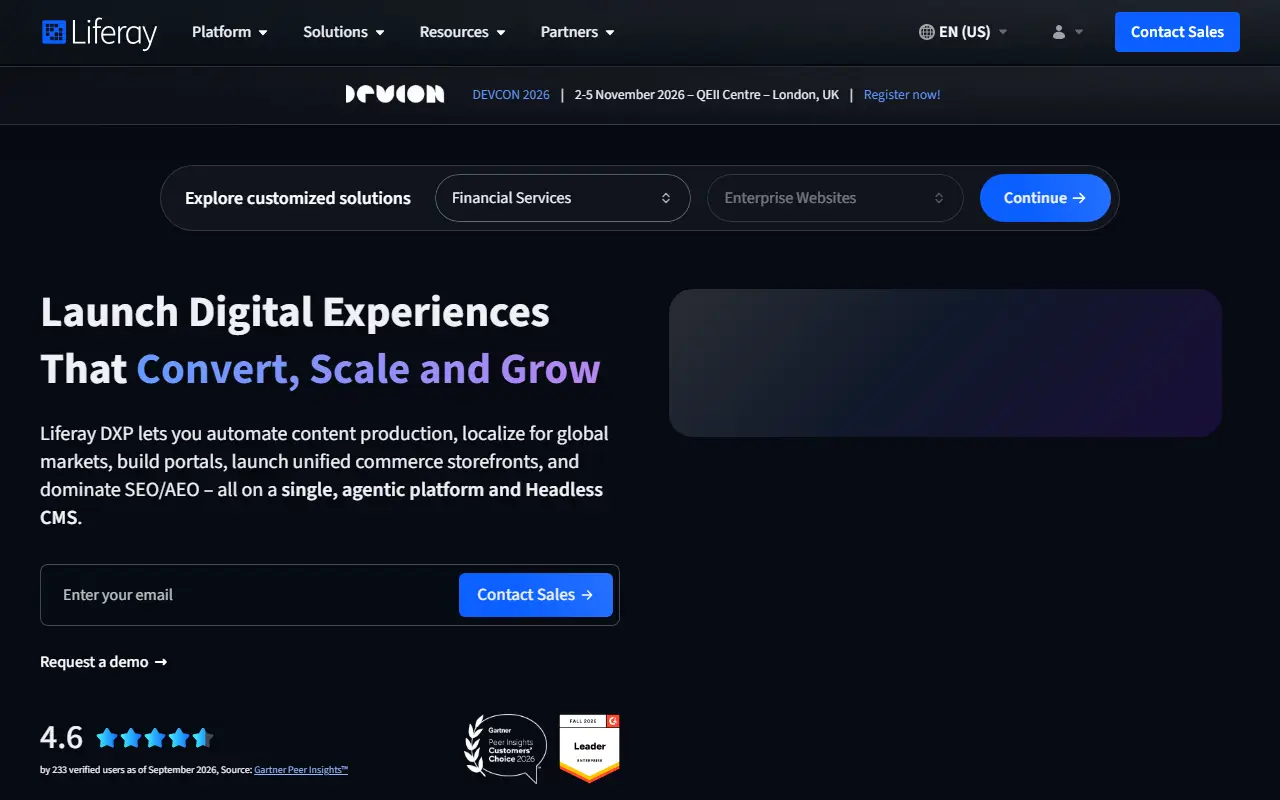
Liferay positions its product as a headless and composable digital experience platform. Its site groups the platform into digital experience, content management and digital commerce, with portals, sites, digital asset management, personalization and analytics as separate areas.
For content, it lists enterprise CMS, headless delivery of content through APIs, an intranet offering and an open-source option described as API-first and built to scale. Portal products are aimed at customers, partners and suppliers, and commerce spans B2B, storefronts, PIM and headless commerce.
Newer capabilities named on the site include an AI agent builder, MCP for connecting to LLMs, low-code tooling, a CDN and an SEO studio for AI search, technical SEO, multilingual content and audits. The page is largely navigation and marketing copy, so licence and deployment details are not stated on it.
Key features
- Headless and composable platform for CMS, DAM, portals and commerce
- Portals for customers, partners and suppliers
- AI agent builder and MCP connection to LLMs
- Headless content delivery through APIs
- B2B and composable commerce options
- SEO tools for technical fixes, languages and audits

TYPO3 is a mature open-source PHP content management framework with an extension system, used for enterprise websites and published under the GPL.
- GitHub stars
- 1.2k
- Last commit
- yesterday
- Licence
- GPL-2.0
- Self-hosted
- Yes
typo3.org
TYPO3 is an open-source, PHP-based content management system released under the GNU GPL. It was created by Kasper Skårhøj and is developed today by a community of contributors and the TYPO3 Core Development Team. This repository is a synchronized mirror of the core packages, which are reviewed on the project's own code review system.
It describes itself as a content management framework, meaning the streamlined core is separated from optional extensions, and an open API lets developers extend both the website frontend and the administration backend. Many ready-made extensions are available, or you can write your own. TYPO3 runs on web servers such as Apache, nginx or IIS, on Linux, Windows, FreeBSD and macOS, and uses a database such as MySQL.
The backend is accessed through a supported browser, and the installation guide explains how to set up a basic installation on your server. TYPO3 is self-hosted, with documentation and community resources linked from the README, and it is aimed at agencies and organizations building large, multilingual and customized sites. The repository lists the GPL-2.0 licence.
Key features
- Content management framework with extensions
- Open API for frontend and backend extension
- Runs on Apache, nginx, or IIS
- Database-backed with MySQL support
- Browser-based administration backend
- Large extension ecosystem
Pricing: Free and open source under the GNU GPL.
3 more Squiz alternatives
Commercial Squiz alternatives
Hosted, closed-source products that compete with Squiz.
Squiz alternatives: questions
- What is the best open-source alternative to Squiz?
- Strapi is the top-ranked open-source alternative to Squiz on Enlisted: An open-source headless CMS written in JavaScript and TypeScript that generates REST and GraphQL APIs from content models you design. Other strong options are Directus, Wagtail, Joomla and Umbraco CMS.
- What are the best commercial alternatives to Squiz?
- Sitecore, Brightspot, Sitefinity, Xperience by Kentico and Optimizely are among the hosted, closed-source alternatives to Squiz listed on Enlisted, which lists 12 in total. Compare their pricing and features on each tool page.
- Are these Squiz alternatives free?
- All 13 are open source, so the code is free to use under its licence, and all of them can be self-hosted on your own server or computer. 4 also offer a paid or managed cloud version if you'd rather not host it yourself.
- How is this list of Squiz alternatives ranked?
- By a score built from GitHub stars, star growth over the last 30 days and how recently the code changed. 13 of these projects shipped code in the last 30 days. Data is refreshed daily, and nobody can pay to move up.
 TrackMedia
 TrackRev