6 open-source alternatives ranked by real activity

Open-source Veracode alternatives

A curated, ranked list of the 6 best open-source alternatives to Veracode.

The best open-source alternative to Veracode is Trivy. If that doesn't suit you, other good options are Semgrep, Dependency-Track, GitLab Community Edition and SonarQube.

Commercial alternatives to Veracode include Checkmarx, Snyk, Aikido Security and Mend. See all 24.

Veracode alternatives are mainly security tools, but some are also CI/CD & DevOps tools and developer tools. 6 of them shipped code in the last 30 days, 6 can be self-hosted, and 4 use a permissive licence.

Last updated November 13, 2026 · ranked by GitHub stars, growth and recent commits

Trivy

A security scanner that finds vulnerabilities, misconfigurations, secrets and license issues in container images, filesystems, Git repositories and Kubernetes.

GitHub stars
39k
Last commit
yesterday
Latest release
v0.76.2
Licence
Apache-2.0
trivy.devTrivy homepage screenshot

Trivy is a security scanner from Aquasec, written in Go and released under the Apache-2.0 license. It has scanners that look for different security issues and targets where those issues can be found. The README describes it as comprehensive and versatile, and it covers the major programming languages, operating systems and platforms.

Targets include container images, filesystems, remote Git repositories, virtual machine images and Kubernetes. Scanners look for OS packages and software dependencies in use, which produces an SBOM, known vulnerabilities (CVEs), infrastructure-as-code issues and misconfigurations, sensitive information and secrets, and software licenses. Its topics reference DevSecOps and vulnerability scanning.

Trivy is available through most common channels, including Homebrew, a Docker image and downloadable binaries, and integrates with platforms such as GitHub Actions, a Kubernetes operator and a VS Code plugin. Canary builds are produced with each push to the main branch. It suits developers, platform teams and security engineers who want to scan images and code in CI pipelines.

Key features

  • Scans container images and filesystems
  • Scans Git repositories and Kubernetes
  • Known vulnerability (CVE) detection
  • IaC misconfiguration and secret detection
  • SBOM generation and license scanning
  • GitHub Actions and VS Code integrations

Pricing: Free and open source under the Apache-2.0 license.

Read more about TrivyWebsiteGitHub#1 Veracode alternative

Semgrep

Semgrep is a fast, open-source static analysis tool that finds bugs and enforces security and coding standards across 30+ languages.

GitHub stars
18k
Last commit
2 days ago
Latest release
v1.185.0
Licence
LGPL-2.1
Self-hosted
Yes
Hosted version
Available
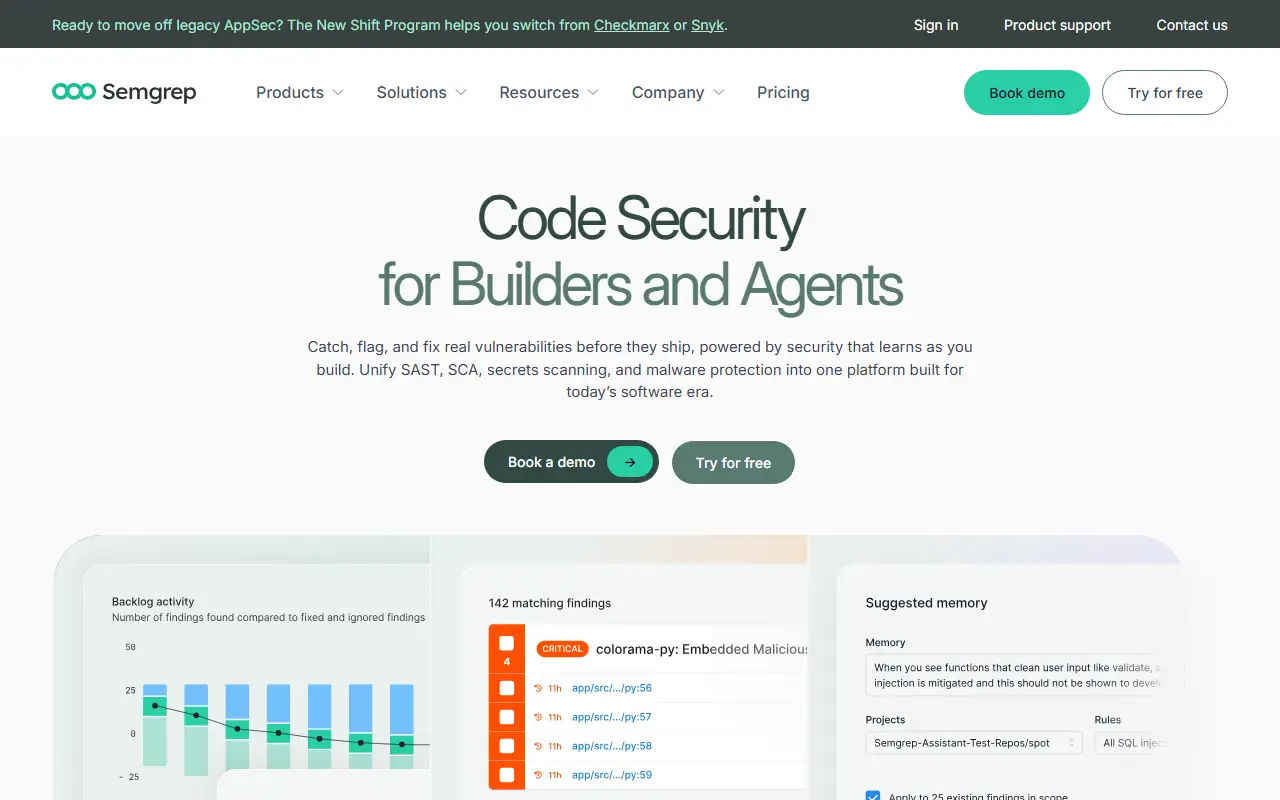
semgrep.devSemgrep homepage screenshot

Semgrep is a lightweight static analysis tool that searches code, finds bugs and enforces secure guardrails and coding standards. It supports more than 30 languages and can run in an IDE, as a pre-commit check or inside CI/CD workflows. The core engine is released under the LGPL-2.1 license.

It works like a semantic grep for code. Rules are written to look like the source code developers already write, so matching a pattern does not require abstract syntax trees, regular expressions or a separate query language, and a search for a value can match code that computes it. The aim is to find variants of a known bug quickly.

The Community Edition analyzes code within a single function or file, which the maintainers note means it will miss many true positives for security work. For SAST, software composition analysis and secrets scanning they recommend the commercial Semgrep AppSec Platform, which adds cross-file and data-flow analysis, AI-assisted triage and managed rule sets.

Key features

  • Pattern-based code search that looks like code
  • Support for 30+ programming languages
  • Runs in IDEs, pre-commit hooks and CI/CD
  • Custom rules without ASTs or regex
  • SAST, SCA and secrets scanning via AppSec Platform

Pricing: Free for up to 10 contributors. Teams starts at $30 per contributor per month (Secrets $15); Enterprise is custom.

Dependency-Track

An OWASP component analysis platform that uses SBOMs to identify and reduce risk in the software supply chain, with vulnerability tracking across projects.

GitHub stars
4.4k
Last commit
2 days ago
Latest release
5.2.1
Licence
Apache-2.0
Self-hosted
Yes
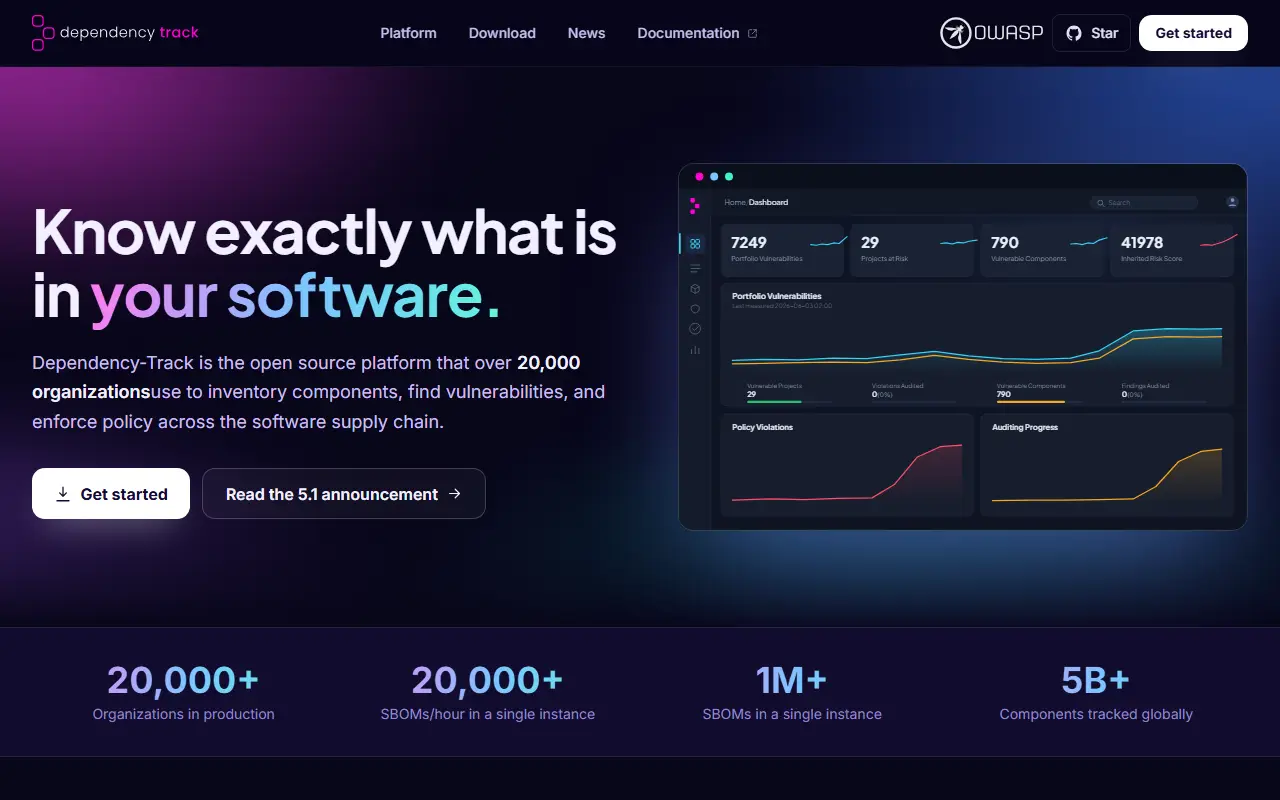
dependencytrack.orgDependency-Track homepage screenshot

Dependency-Track is a component analysis platform from the OWASP community that helps organizations identify and reduce risk in their software supply chain. It takes an approach built on the Software Bill of Materials (SBOM), analyzing the components listed for each project.

Repository topics show how it works with CycloneDX SBOMs, Package URLs, the National Vulnerability Database and OSS Index to detect known vulnerabilities in components, supporting software composition analysis, DevSecOps and security automation. A Docker Compose quickstart lets you get a local instance running in a few minutes.

Version 5 is the current line, while version 4 is in maintenance mode on the 4.14.x branch and reaches end-of-life in December 2026, with a migration guide provided. The frontend, documentation and Helm charts live in separate repositories, a monthly community meeting is open to users, and the project is written in Java under the Apache-2.0 license.

Key features

  • SBOM-based component analysis
  • CycloneDX and Package URL support
  • Vulnerability data from NVD and OSS Index
  • Software supply chain risk tracking
  • Docker Compose quickstart
  • Helm charts for deployment

Pricing: Free and open source under the Apache-2.0 licence.

GitLab Community Edition

GitLab is a web platform for Git repositories, code review, CI/CD pipelines and issue tracking; this repository is its Community Edition mirror.

GitHub stars
25k
Last commit
21 days ago
Licence
MIT
Self-hosted
Yes
Hosted version
Available
about.gitlab.comGitLab Community Edition homepage screenshot

GitLab is a platform for collaborating on code. This GitHub repository is a mirror of the Community Edition, written in Ruby on Rails, while the canonical source and all development take place on GitLab.com. Issues should be opened on the GitLab.com tracker rather than here. The platform manages Git repositories with fine-grained access controls, merge requests for code review, and per-project issue trackers, boards and wikis.

GitLab includes continuous integration and delivery pipelines to build, test and deploy applications. It follows an open-core model: most of the code is MIT-licensed, while files in the ee directory are proprietary but source-available. Three editions exist: Community Edition, free under the MIT Expat license; Enterprise Edition, with extra features aimed at organizations with more than 100 users and sold by subscription; and JiHu Edition for the Chinese market. A free trial of the Ultimate tier is available.

Key features

  • Git repository hosting with access controls
  • Merge requests for code review
  • Built-in CI/CD pipelines
  • Issue tracker, boards and wiki per project
  • Community Edition under the MIT Expat license
  • Enterprise Edition with subscription support

Pricing: Free for personal projects with usage limits. Premium costs $29 per user per month billed annually; Ultimate and the single-tenant Dedicated offering are quoted. Free trials are offered for paid tiers.

SonarQube

Static code analysis platform that finds bugs, vulnerabilities and maintainability problems in code, in IDEs, pull requests and CI.

GitHub stars
11k
Last commit
yesterday
Latest release
26.11.0.134175
Licence
LGPL-3.0
Self-hosted
Yes
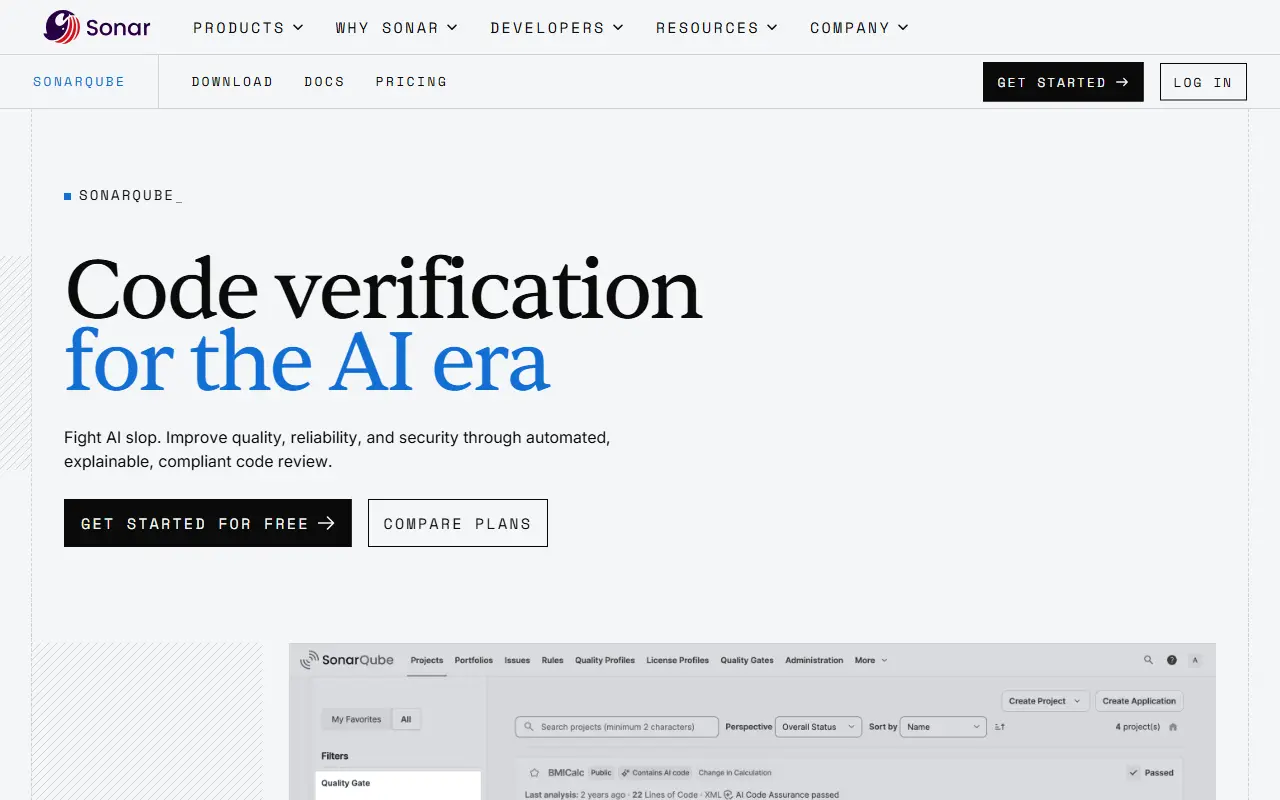
sonarqube.orgSonarQube homepage screenshot

SonarQube is a code quality and security platform. Its static analysis uses techniques such as symbolic execution and data and control flow analysis to inspect source code, find bugs and vulnerabilities, and explain what to fix and why. Results appear in the IDE, in pull requests and in CI pipelines.

This repository holds the source of the SonarQube Community Build, the free, open-source edition that shares the analysis used across the product line. It reports reliability bugs, security vulnerabilities and security hotspots, maintainability and structural issues, and coverage on new code. More than 40 programming languages and frameworks are covered, and the same code always produces the same findings.

The project positions itself as a verification step for code written by people or by AI agents before it merges. SonarQube is written in Java and licensed under LGPL-3.0. Commercial editions from SonarSource add further features, while the Community Build can be run on your own servers.

Key features

  • Static analysis for bugs and vulnerabilities
  • Security hotspot review guidance
  • Maintainability and structural issue detection
  • Coverage tracking on new code
  • Support for 40+ languages and frameworks
  • Feedback in IDE, pull requests and CI

Pricing: A free tier covers private projects up to 50k lines of code and an open-source Community Build is available. The Team plan starts at $34 a month for up to 100k lines of code; Enterprise is quoted.

Horusec

Open-source static analysis tool that scans a project for security flaws and leaked secrets across many languages from one CLI command.

GitHub stars
1.3k
Last commit
2 days ago
Latest release
v2.8.0
Licence
Apache-2.0
Self-hosted
Yes

Horusec is an open-source security tool written in Go. It performs static code analysis during development to find security flaws, and can also search for leaked keys in a project's files and in its Git history. Developers run it through the CLI, and DevSecOps teams can run it in CI/CD pipelines.

A scan starts with `horusec start -p .`, which creates a .horusec folder so your code is not changed. The README lists many target languages, including Java, Kotlin, Python, Ruby, Go, Terraform, JavaScript, TypeScript, Kubernetes, PHP, Dart, Elixir and shell. It says Horusec runs 20 security tools at once, which is why Docker is expected.

Installation is by script on Mac and Linux, or a downloaded binary on Windows (amd64 and arm64). There is also a Docker image, a Visual Studio Code extension and a web application with a dashboard for managing vulnerabilities and false positives. The licence is Apache 2.0.

Key features

  • Runs many security tools across 18 languages at once
  • Searches Git history for exposed secrets
  • Usable by developers via CLI and in CI/CD pipelines
  • Visual Studio Code extension for analysis
  • Web application with vulnerability dashboard and false-positive control
  • Official Docker image for running scans

Commercial Veracode alternatives

Hosted, closed-source products that compete with Veracode. Showing 12 of 24.

See every Veracode alternative on its tool page

Veracode alternatives: questions

What is the best open-source alternative to Veracode?
Trivy is the top-ranked open-source alternative to Veracode on Enlisted: A security scanner that finds vulnerabilities, misconfigurations, secrets and license issues in container images, filesystems, Git repositories and Kubernetes. Other strong options are Semgrep, Dependency-Track, GitLab Community Edition and SonarQube.
What are the best commercial alternatives to Veracode?
Checkmarx, Snyk, Aikido Security, Mend and Black Duck are among the hosted, closed-source alternatives to Veracode listed on Enlisted, which lists 24 in total. Compare their pricing and features on each tool page.
Are these Veracode alternatives free?
All 6 are open source, so the code is free to use under its licence, and all of them can be self-hosted on your own server or computer. 2 also offer a paid or managed cloud version if you'd rather not host it yourself.
How is this list of Veracode alternatives ranked?
By a score built from GitHub stars, star growth over the last 30 days and how recently the code changed. 6 of these projects shipped code in the last 30 days. Data is refreshed daily, and nobody can pay to move up.

People also look for alternatives to…

View all