7,363 open-source and SaaS tools, with GitHub stats refreshed every day.

10 alternatives ranked by real activity

Open-source TickTick alternatives

A curated, ranked list of the 10 best open-source alternatives to TickTick.

The best open-source alternative to TickTick is Super Productivity. If that doesn't suit you, other good options are Habitica, Taskwarrior, Vikunja and Tududi.

TickTick alternatives are mainly productivity tools, but some are also project management tools and note-taking tools. 8 of them shipped code in the last 30 days, 10 can be self-hosted, and 3 use a permissive licence.

Last updated October 3, 2026 · ranked by GitHub stars, growth and recent commits

Super Productivity

Super Productivity is a local-first to-do app with timeboxing, time tracking and integrations with Jira, GitHub, GitLab and more.

GitHub stars
22k
Last commit
today
Latest release
v19.1.0
Licence
MIT
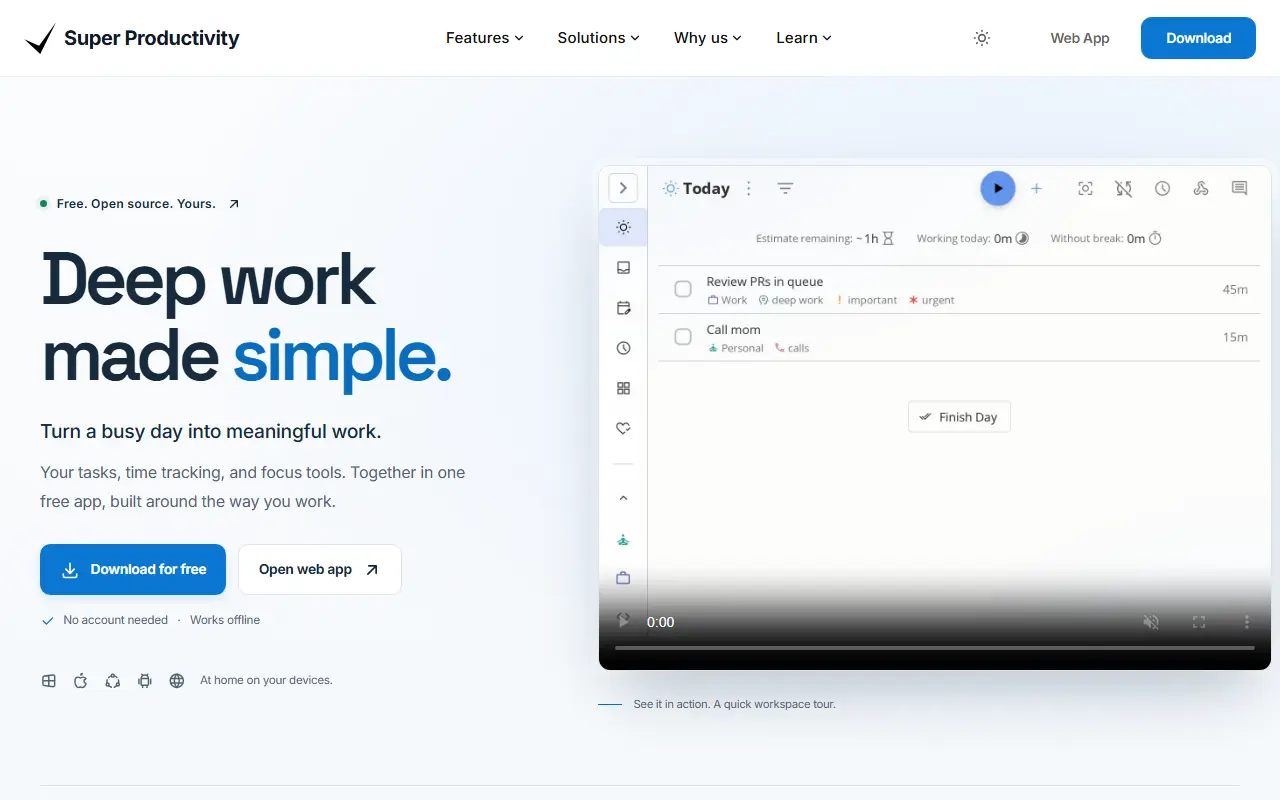
super-productivity.comSuper Productivity homepage screenshot

Super Productivity is a to-do list application that adds timeboxing and time tracking to everyday task planning. Tasks can be organized with sub-tasks, projects and color-coded tags, and viewed in a planner with a schedule timeline next to calendar events. Visual boards, including Kanban and Eisenhower Matrix layouts, help you sort work. It is written in TypeScript, released under the MIT license and tagged as local-first and privacy-friendly.

Time tracking produces time sheets and work summaries that can be exported to a company's tracking system. Habit tools include break reminders, an anti-procrastination feature and a focus mode with Pomodoro, Flowtime and countdown sessions, plus personal metrics. Integrations include Jira, Trello, GitHub, GitLab, Gitea and Linear, plus ClickUp, Redmine and Azure DevOps, importing assigned tasks and creating work logs automatically. It is available as a web app and as apps for Windows, macOS, Linux, Android and iOS.

Key features

  • Tasks with sub-tasks, projects and tags
  • Timeboxing and time tracking with exportable time sheets
  • Kanban and Eisenhower Matrix boards
  • Pomodoro, Flowtime and countdown focus sessions
  • Integrations with Jira, GitHub, GitLab and others
  • Web, desktop and mobile apps

Pricing: Completely free and open source with no premium tiers; development is supported by optional GitHub Sponsors donations.

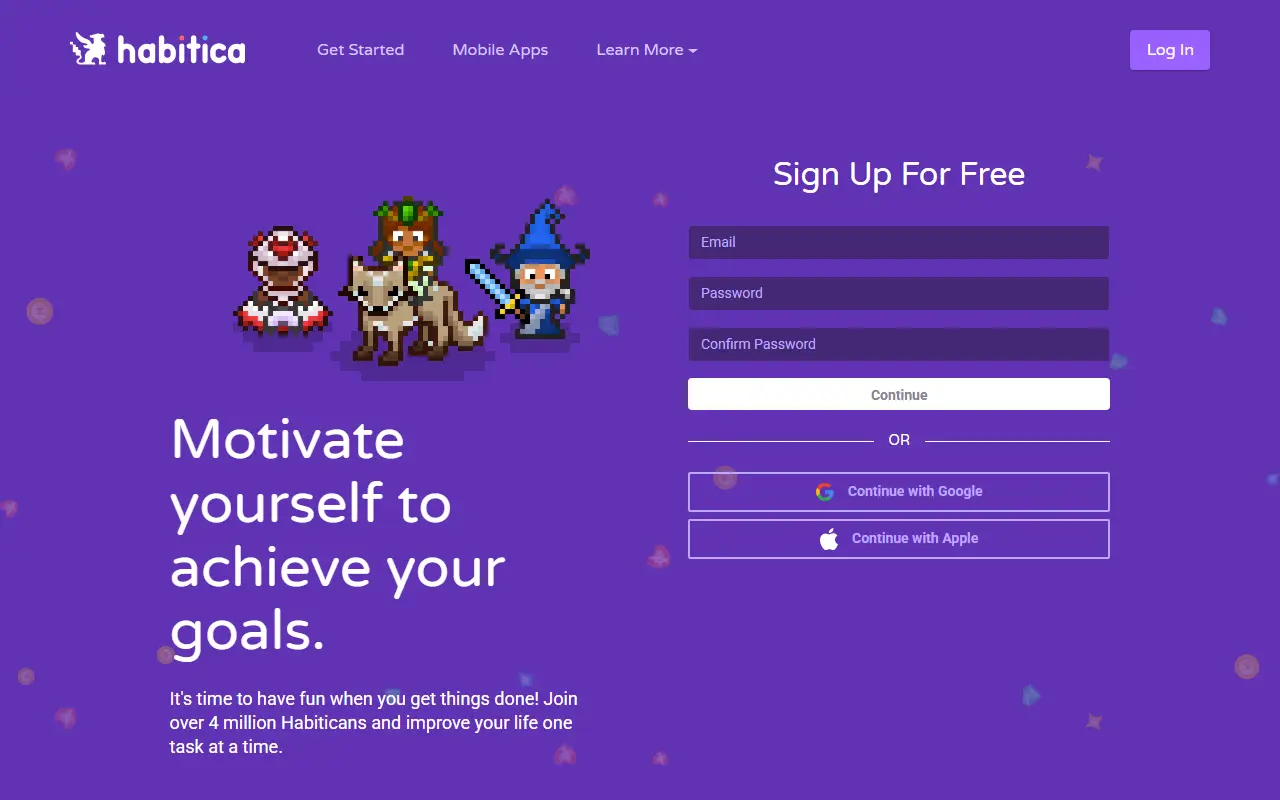
Habitica

Habit and task tracker that gamifies daily goals with RPG-style levels, gold and gear, for people who stay motivated through game mechanics.

GitHub stars
14k
Last commit
yesterday
Latest release
v5.50.6
Hosted version
Available
habitica.comHabitica homepage screenshot

Habitica is an open-source habit-building app that turns personal goals and daily tasks into a role-playing game. Completing tasks earns experience and gold, while missed ones cost health points, which gives everyday routines a built-in reward and penalty loop. It is aimed at people who find plain to-do lists dull and respond better to game mechanics.

Players level up a character, collect weapons and armor, and spend the gold they earn on in-game gear. The web application is a JavaScript project built on Node.js and Express with a MongoDB database and a Vue front end, and the same service is reachable through separate Android and iOS apps maintained in their own repositories.

The source code is publicly visible under a custom license described in the repository rather than a standard SPDX license. The maintainers have paused outside code contributions and do not accept AI-generated code, but the codebase stays open. Developers who want a local copy can follow the project's wiki guide for setting up Habitica locally.

Key features

  • Habits, dailies and to-do tracking
  • Character leveling with experience and health points
  • Gold rewards for buying in-game weapons and armor
  • Web app plus native Android and iOS apps
  • Open codebase on Node.js, MongoDB and Vue

Pricing: The source code is open; the hosted service at habitica.com can be used for free, with optional paid extras.

Taskwarrior

Taskwarrior is a command-line task list manager with an ecosystem of tools, hooks and extensions, available for Linux, Unix, macOS and Windows.

GitHub stars
6.1k
Last commit
6 days ago
Latest release
v3.5.0
Licence
MIT
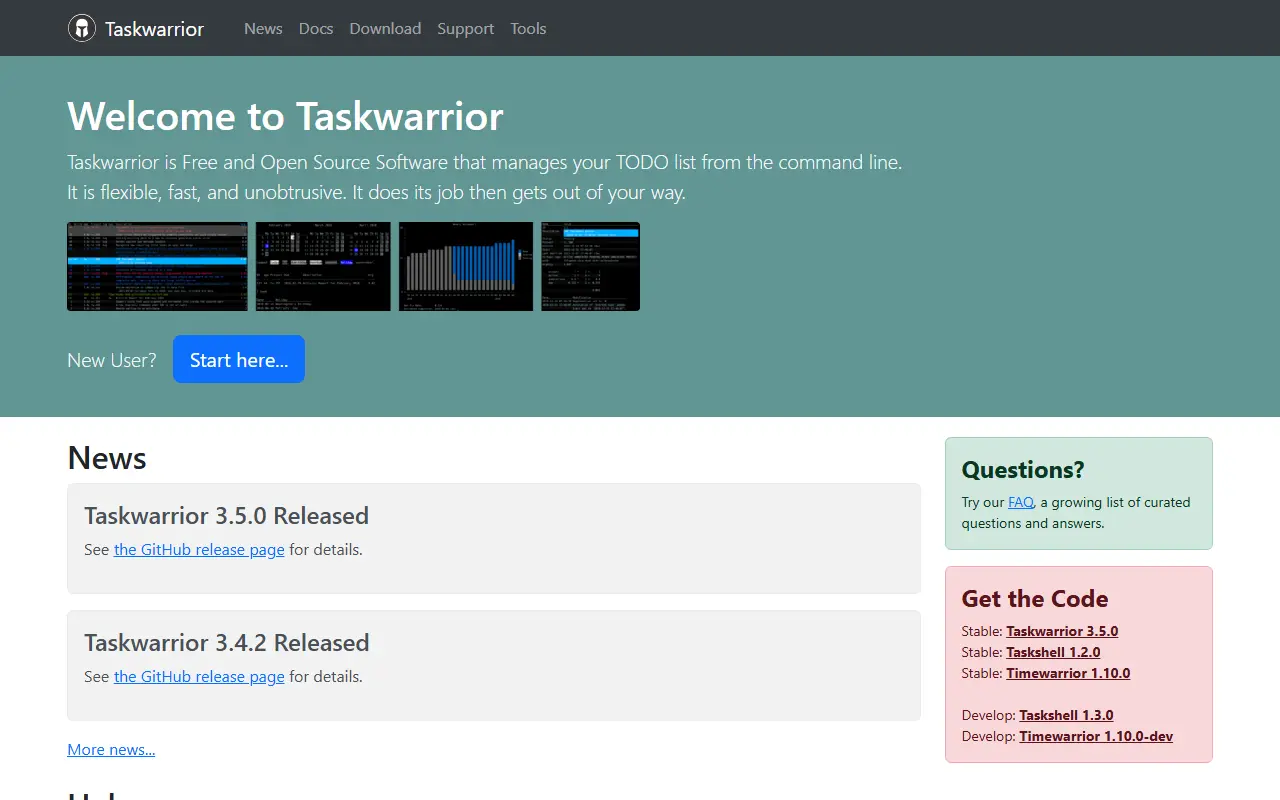
taskwarrior.orgTaskwarrior homepage screenshot

Taskwarrior is a utility for managing task lists from the command line. It is developed as a portable open-source project, and it is surrounded by an ecosystem of tools, hooks and extensions that adapt it to different workflows. Repository topics place it in the to-do list and GTD space.

It is packaged for a wide range of Linux and Unix systems, macOS and Windows, with packages tracked on Repology, and it can also be built from source. The project website holds the online documentation, downloads and news, while the GitHub discussions forum is the recommended place for questions. Contributions of all kinds are welcome, including code patches, ideas, bug reports and discussion.

Taskwarrior is written in C++ and released under the MIT licence. It has been developed since 2006, mostly by a small group of volunteers, and the maintainers invite users to sponsor the project through GitHub Sponsors so that core developers can devote more hours.

Key features

  • Command-line task management
  • Hooks and extensions ecosystem
  • Packages for Linux, Unix, macOS and Windows
  • Online documentation and community forum
  • Open source under the MIT licence

Pricing: Free and open source under the MIT licence; sponsorship is welcome.

Vikunja

Vikunja is an open-source, self-hostable task and project manager with a Go backend and Vue front end, also offered as a hosted service.

GitHub stars
5.6k
Last commit
yesterday
Latest release
v2.6.0
Licence
AGPL-3.0
Self-hosted
Yes
Hosted version
Available
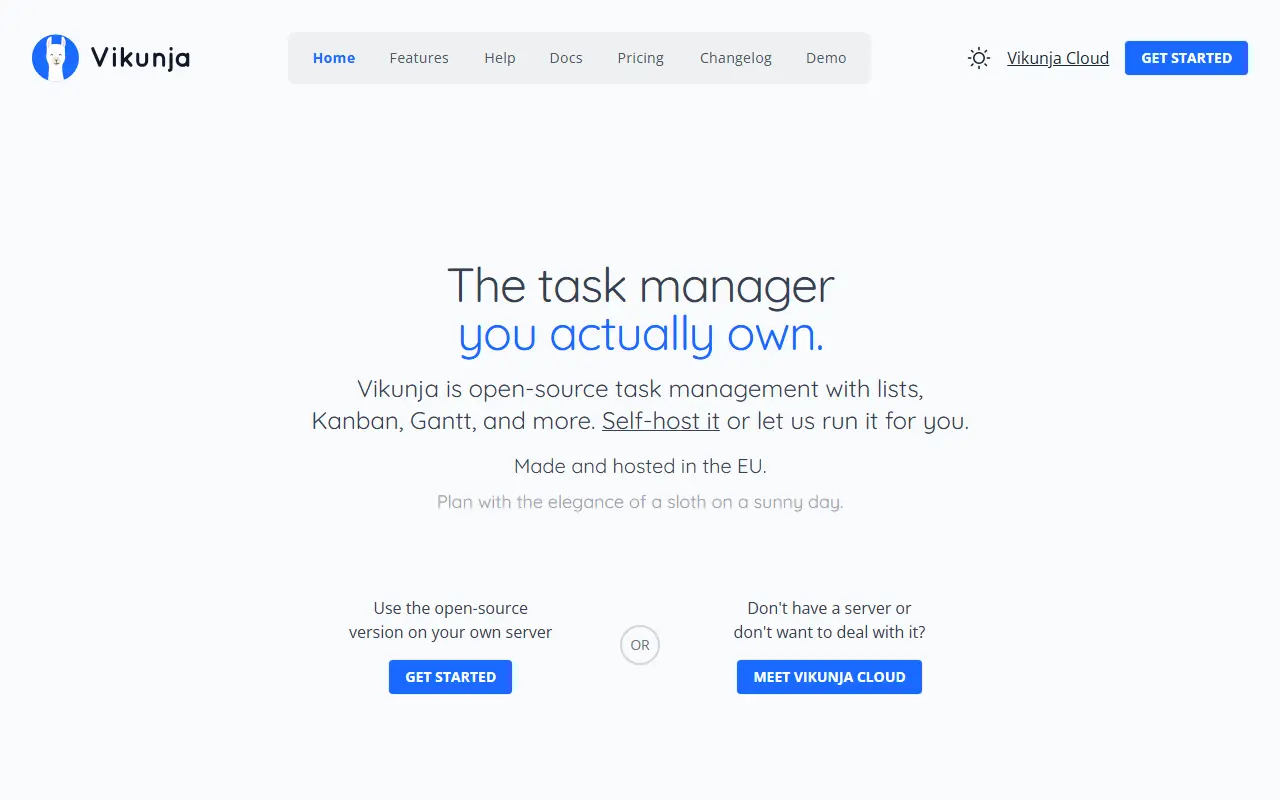
vikunja.ioVikunja homepage screenshot

Vikunja is a task manager that you can host and control yourself. It covers to-do lists and broader project management, and exposes an API so it can be connected to other tools. Its backend is written in Go and the web front end in Vue. The tagline stresses ownership: a task manager whose data and hosting you decide.

The README mentions an optional hosted version for people who want a hassle-free setup for themselves or a team, and a Vikunja Pro tier that adds an admin panel, audit logs and time tracking. The maintainers also note that they use LLM-assisted coding tools in parts of the codebase. The repository has documentation, a roadmap and contribution guidelines.

Vikunja is licensed under AGPL-3.0. The community version is free to self-host, which suits individuals, families and small teams who want an open alternative to hosted to-do and project apps. Support comes from donations, sponsorship and paid hosting or Pro plans.

Key features

  • To-do lists and project management
  • REST API for integrations
  • Go backend with Vue web interface
  • Self-hosted or vendor-hosted option
  • Pro tier with admin panel and audit logs
  • Time tracking in the Pro edition

Pricing: Self-hosting is free. Vikunja Cloud costs €4 per month for Personal, €10 for Family (up to 5 users) and €5 per user for Organization, each with a 14-day trial and yearly discounts.

Tududi

Self-hostable task and project manager that organizes tasks, projects, areas, notes, and tags, with recurring tasks and Telegram integration.

GitHub stars
3.4k
Last commit
yesterday
Latest release
v1.6.11
Licence
MIT
Self-hosted
Yes
Hosted version
Available
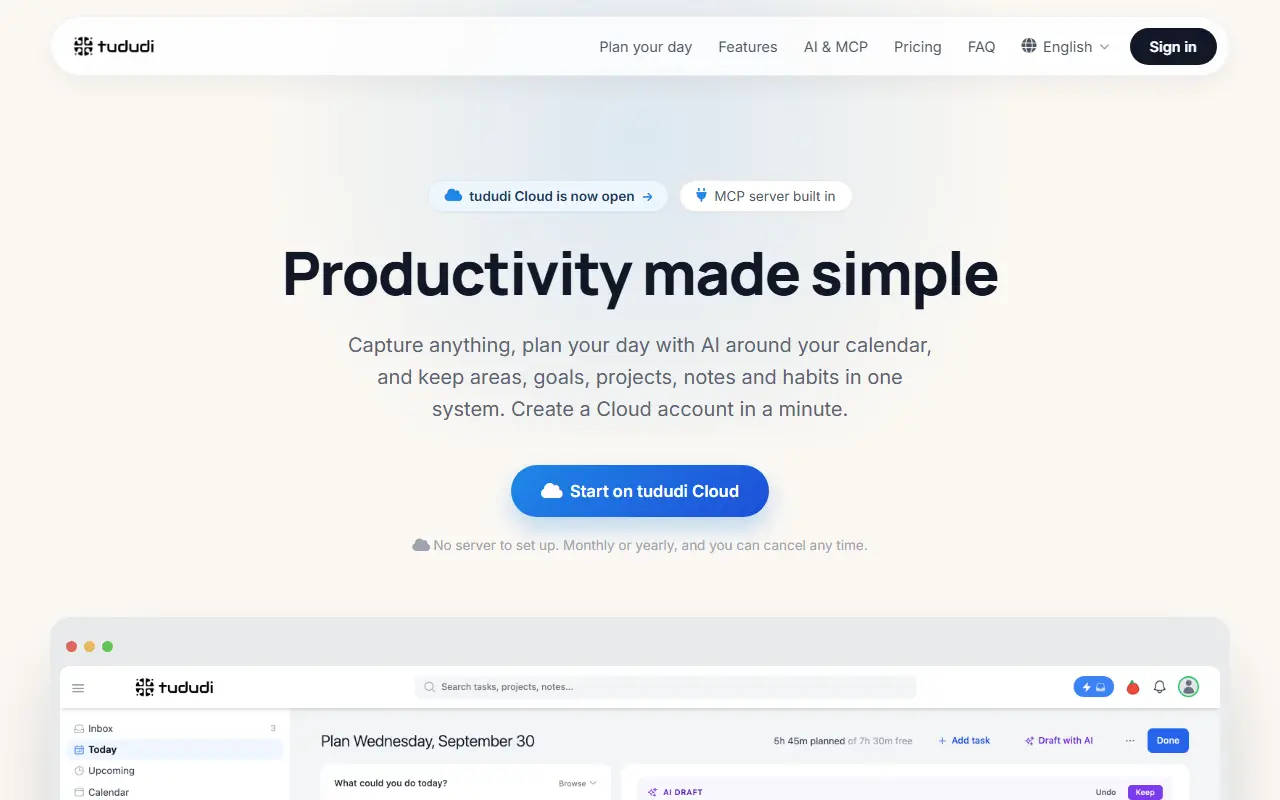
tududi.comTududi homepage screenshot

Tududi is an open-source system for organizing personal and work tasks in a hierarchy. Tasks belong to projects, projects can be grouped into areas, and notes and tags can be attached across the structure, which suits people who follow a getting-things-done style of planning. It is released under the MIT license.

Tasks can be filtered into views such as Today, Upcoming, and Someday and sorted by name, due date, creation date, or priority. It supports subtasks with progress tracking and a recurring-task system with daily, weekly, and monthly patterns, including monthly on specific weekdays. A Telegram integration lets you capture and manage items from chat, and your data stays under your control when self-hosted.

The application is built with React and Node.js with Express, and you can run it on your own server or buy a hosted subscription from the maintainer for a managed setup. It suits individuals and small teams who want a calm, privacy-minded alternative to hosted to-do and project apps.

Key features

  • Tasks with subtasks and progress tracking
  • Recurring tasks with flexible patterns
  • Projects grouped into areas
  • Notes and tags across tasks and projects
  • Today, Upcoming, and Someday task views
  • Telegram integration

Pricing: Self-hosting is free. Hosted Cloud costs €5 per month or €50 per year, with no free tier or trial but a 14-day money-back guarantee.

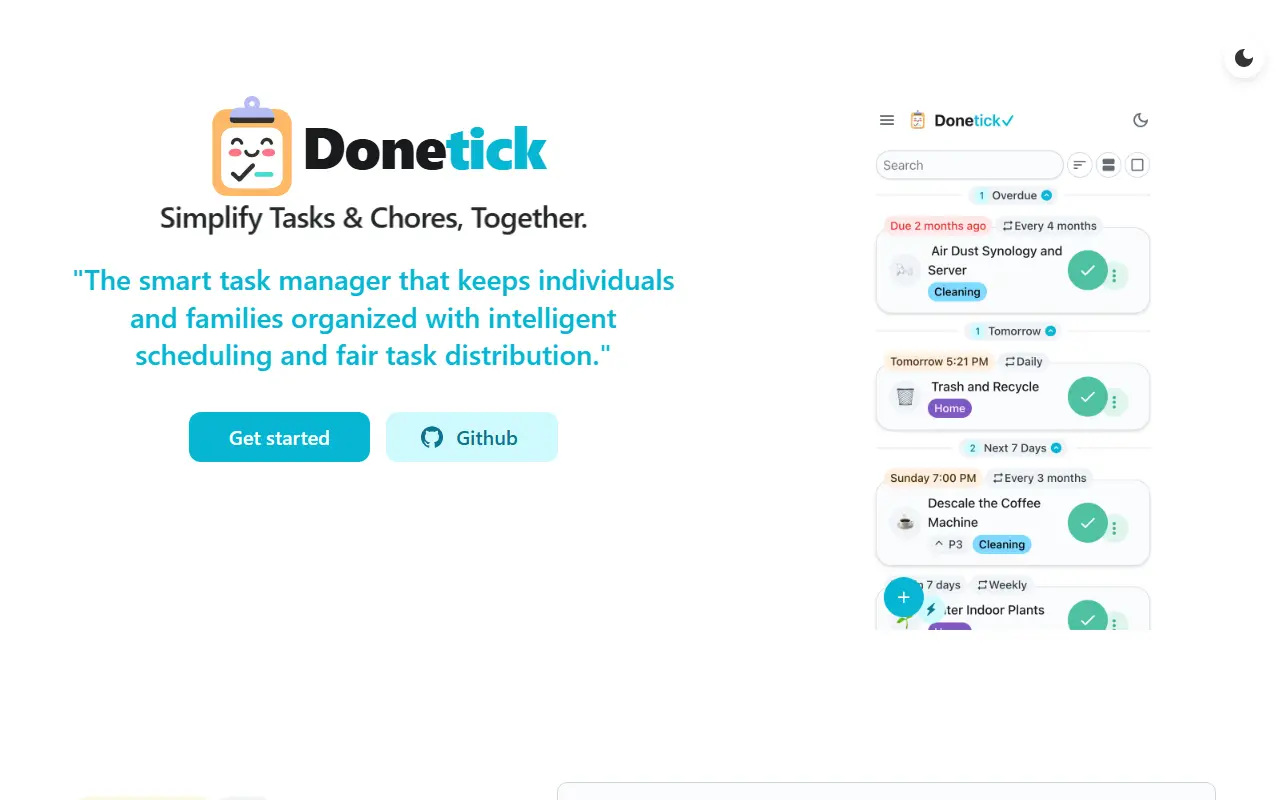
Donetick

Self-hosted task and chore manager for individuals and households with natural language entry, flexible recurring schedules, and shared groups.

GitHub stars
2.6k
Last commit
yesterday
Latest release
v0.1.79
Licence
AGPL-3.0
Self-hosted
Yes
donetick.comDonetick homepage screenshot

Donetick is an open-source app for organizing tasks and chores, either alone or together with family and friends. Groups can be created so that tasks are shared or assigned between members, which makes it popular for households. It is built with Go and React, ships a Docker image, and is released under the AGPL-3.0 license.

Tasks can be created in plain English: the app extracts dates, times, and recurrence from phrases such as every six months or every Monday and Tuesday at a set time. Scheduling is flexible, with daily, weekly, monthly, and yearly patterns, specific months or weekdays, and adaptive scheduling that learns from past completions. Recurrence can be based on the due date or on the actual completion date.

Other features include assignee rotation by fewest completed tasks, random choice, or round-robin, time tracking with session insights, and subtasks with smart reset. It suits families, roommates, and small teams who want a private, self-hosted way to share recurring responsibilities.

Key features

  • Shared groups for household tasks
  • Natural language task creation
  • Flexible and adaptive recurring schedules
  • Due-date or completion-date based recurrence
  • Assignee rotation options
  • Time tracking and subtasks

Pricing: Free and open source under the AGPL-3.0 license.

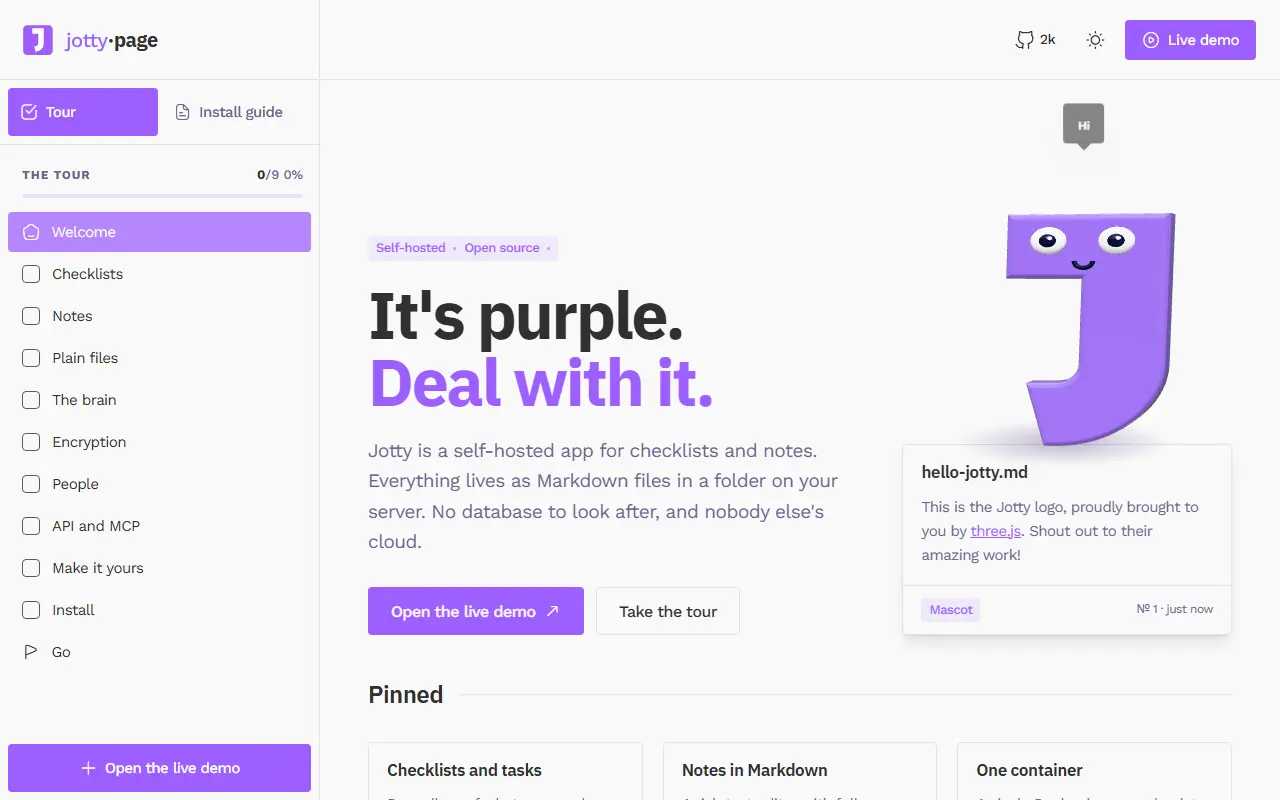
Jotty

Lightweight self-hosted app for checklists and notes that stores data as files on your own server, with optional note encryption, OIDC single sign-on, and MFA.

GitHub stars
2k
Last commit
yesterday
Latest release
1.28.0
Licence
AGPL-3.0
Self-hosted
Yes
jotty.pageJotty homepage screenshot

Jotty is a self-hosted application for managing personal checklists and notes. It is easy to deploy, keeps all data on your own server, and can encrypt and decrypt notes for extra privacy. It was previously known as rwMarkable and is released under the AGPL-3.0 license.

The interface offers task lists with drag-and-drop ordering, a rich text editor for notes, keyboard shortcuts, translations, and custom themes and emojis. Data is stored as files rather than in a database, which keeps backups simple. For access control it supports single sign-on through OIDC and multi-factor authentication, and it exposes an API.

Docker Compose is the recommended way to install it, and the documentation covers initial setup, data storage, the versioning scheme, and encryption. Jotty suits homelab users and individuals who want a simple, private alternative to cloud to-do and note apps.

Key features

  • Checklists with drag-and-drop ordering
  • Rich text note editor
  • Optional note encryption
  • File-based data storage
  • OIDC single sign-on and MFA
  • API and custom themes

Pricing: Free and open source under the AGPL-3.0 license.

Manage My Damn Life

Manage My Damn Life is a self-hosted web front end for CalDAV tasks and calendars with list, Gantt and calendar views, currently in beta.

GitHub stars
641
Last commit
20 days ago
Latest release
v0.10.0
Licence
GPL-3.0
Self-hosted
Yes
intri.inManage My Damn Life homepage screenshot

Manage My Damn Life (MMDL) is a self-hosted front end for managing CalDAV tasks and calendars. It is a web app, built with Next.js, that talks to your existing CalDAV server, so your tasks and events stay on the server you already run. The project is in beta, so caution is advised with production data.

It supports subtasks and many task fields such as due date, status, description and recurrence, calendar event management, multiple CalDAV accounts and multiple user accounts. Tasks can be viewed as a list, in a Gantt view or on a calendar, and you can create task filters to see them as you prefer. It has OAuth support for CalDAV accounts, with Google Calendar supported, and a desktop-first, somewhat responsive layout. Planned features include full RFC 5545 field support, drag and drop, customizable views and plugins.

MMDL has been tested with Nextcloud, Radicale and Baikal and should work with servers supported by the tsdav library. It is licensed under GPL-3.0 and uses Weblate for translations.

Key features

  • CalDAV task management with subtasks
  • Calendar event management
  • List, Gantt and calendar views
  • Custom task filters
  • Multiple CalDAV and user accounts
  • OAuth for Google Calendar accounts

Pricing: Free and open source under the GPL-3.0 license.

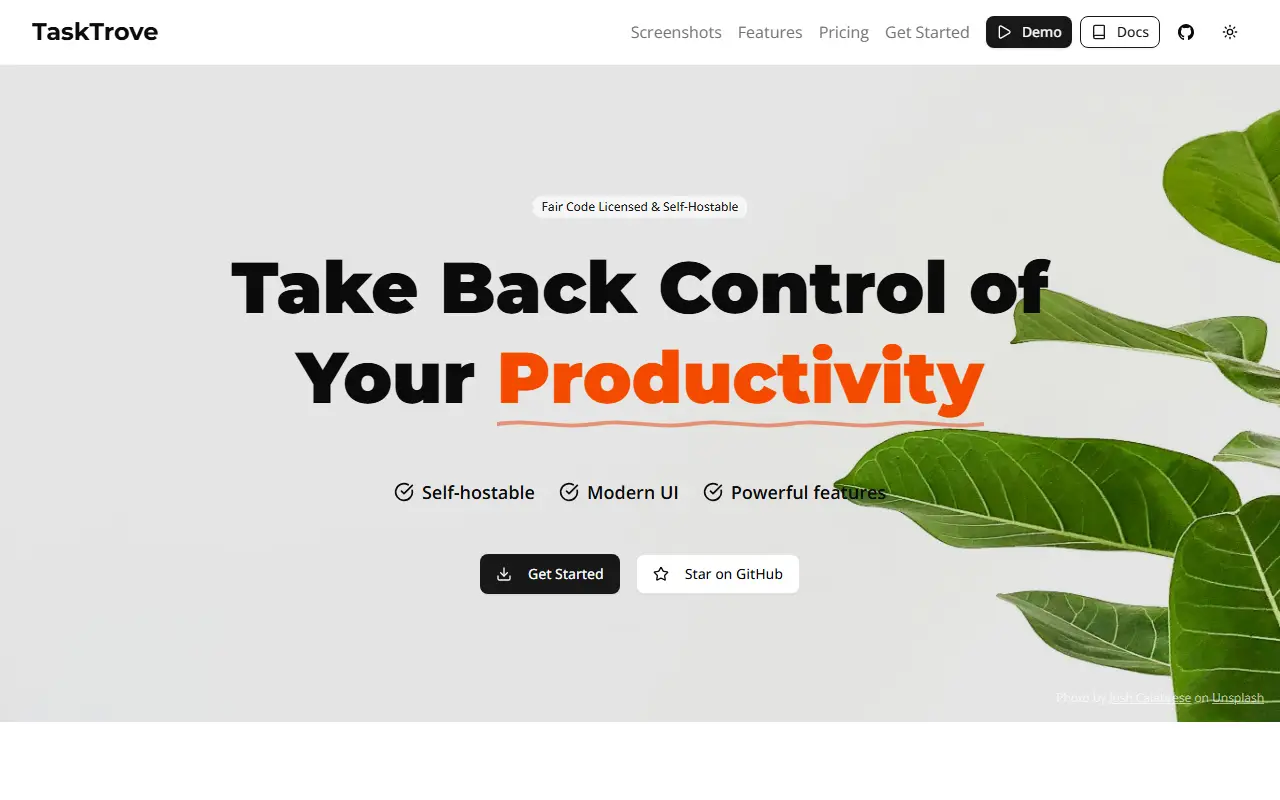
TaskTrove

Self-hosted to-do manager with natural-language task entry, recurring tasks, projects, and list, kanban and calendar views stored as JSON files.

GitHub stars
1.1k
Last commit
8 mo ago
Latest release
v0.12.4
Self-hosted
Yes
tasktrove.ioTaskTrove homepage screenshot

TaskTrove is a modern to-do manager that you host yourself. The project stresses privacy: it runs on your infrastructure with no tracking or data collection. Tasks can be created in natural language, for example by typing a phrase like tomorrow at 2pm, and can have unlimited subtasks, priorities, due dates, comments and file attachments. It is aimed at individuals and small groups who want a capable task app without a hosted account.

Recurring tasks can follow daily, weekly, monthly or custom patterns with automatic scheduling. Tasks can be grouped into projects with sections and color-coded labels, and viewed as a list, a kanban board or a calendar. The interface has light and dark themes, is mobile friendly and offers keyboard shortcuts such as a quick-add key and a search key.

Data is stored in JSON files, which makes backups and transfers simple. The recommended installation is Docker, with Docker Compose and manual setup also described. TaskTrove is built with TypeScript and React, and the repository metadata lists the license as Other, so check the license file for terms.

Key features

  • Natural-language task creation
  • Unlimited subtasks and rich details
  • Recurring tasks with custom patterns
  • List, kanban and calendar views
  • Projects with sections and color-coded labels
  • JSON file storage for easy backup
  • Keyboard shortcuts

Pricing: Self-hosted use is free forever. Pro is a one-time $129 license with a year of updates, and the Hosted plan is $5 per user per month ($4 annually); both Pro and Hosted are on waitlists.

Liubai

Local-first notes, schedule and to-do app with AI assistants, WeChat integration and collaboration, built with Vue 3 as a progressive web app.

GitHub stars
863
Last commit
3 mo ago
Latest release
v0.34.3
Licence
AGPL-3.0
Hosted version
Available
my.liubai.ccLiubai homepage screenshot

Liubai is a combined notes, schedule, to-do and task app with AI features, documented mainly in Chinese. Each item is an atomic card that can hold text, images, multi-level tags, status and files, and cards can be synced to the cloud. It is aimed at individuals and small groups who want personal note-taking and light collaboration in one place, and it works in layouts from phone to desktop widths.

The README lists integration with large language models such as DeepSeek, Kimi, MiniMax, Stepfun and Zhipu, which are made available inside WeChat through the official customer-service message API. For privacy, each card can be set to stay local only or to refuse AI reading. The app is local first, using a PWA service worker so it works offline on the web, and it supports light and dark modes, Chinese and English, a rich text editor with light Markdown, and a VS Code extension for quick notes. WeChat integration covers schedule reminders and picking collaborators from contacts.

The repository is split into a Laf-based back end with cloud functions, VitePress documentation, a Vue 3 front end using Vite, Dexie.js and TipTap, a WeChat mini program and the VS Code extension. A hosted instance is available at my.liubai.cc, and the project is licensed under AGPL-3.0.

Key features

  • Atomic cards with text, images, tags and files
  • Cloud sync with local-first offline use
  • AI assistants inside WeChat
  • Per-card local-only and no-AI settings
  • Schedule reminders through WeChat
  • VS Code extension for quick notes
  • Responsive progressive web app

TickTick alternatives: questions

What is the best open-source alternative to TickTick?
Super Productivity is the top-ranked open-source alternative to TickTick on Enlisted: Super Productivity is a local-first to-do app with timeboxing, time tracking and integrations with Jira, GitHub, GitLab and more. Other strong options are Habitica, Taskwarrior, Vikunja and Tududi.
Are these TickTick alternatives free?
All 10 are open source, so the code is free to use under its licence, and all of them can be self-hosted on your own server or computer. 4 also offer a paid or managed cloud version if you'd rather not host it yourself.
How is this list of TickTick alternatives ranked?
By a score built from GitHub stars, star growth over the last 30 days and how recently the code changed. 8 of these projects shipped code in the last 30 days. Data is refreshed daily, and nobody can pay to move up.

People also look for alternatives to…

View all