#1
A self-hosted newsletter and mailing list manager shipped as a single Go binary with PostgreSQL storage, a web dashboard and campaign management.
- GitHub stars
- 24k
- Last commit
- yesterday
- Latest release
- v7.0.0-beta.2
- Licence
- AGPL-3.0
- Self-hosted
- Yes
listmonk.app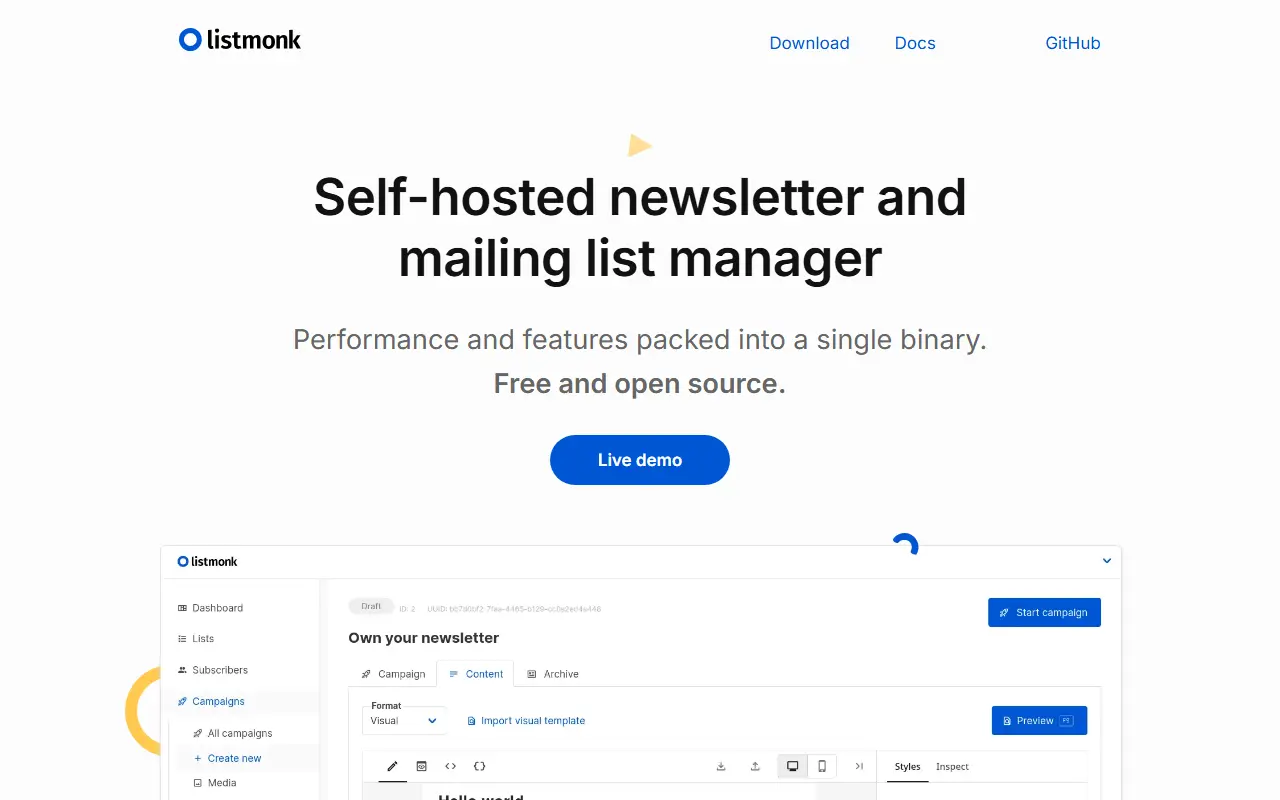
listmonk is a self-hosted application for managing newsletters and mailing lists. It is distributed as a single binary, backed by a PostgreSQL database, and gives you a modern web dashboard for managing subscribers, lists and email campaigns. A live demo and documentation on listmonk.app let you look around before installing.
Topics show the scope: email marketing, newsletter management, campaign management, SMTP delivery, transactional emails and SMS gateway use. Installation is straightforward. With Docker you use the published image and a sample compose file and then visit port 9000. With the binary you generate a config file, run the install step to set up the database, or run an idempotent upgrade, and start the server.
Its server side is Go, while the interface is built with Vue and the Buefy component library. The project is free software under the AGPL-3.0 license, and a developer setup guide helps contributors. It suits creators, organizations and developers who want to send newsletters through their own SMTP provider without per-subscriber fees from a hosted email service.
Key features
- Newsletter and campaign management
- Subscriber and list management
- Single-binary Go application
- PostgreSQL data store
- SMTP delivery and transactional email support
- Docker and binary installation
Pricing: Free and open source under the AGPL-3.0 license; you host it yourself.
#2
Open-source marketing automation platform for email campaigns, segmentation and multi-channel marketing that you can host yourself.
- GitHub stars
- 11k
- Last commit
- 2 days ago
- Latest release
- 7.2.2
- Self-hosted
- Yes
- Hosted version
- Available
mautic.org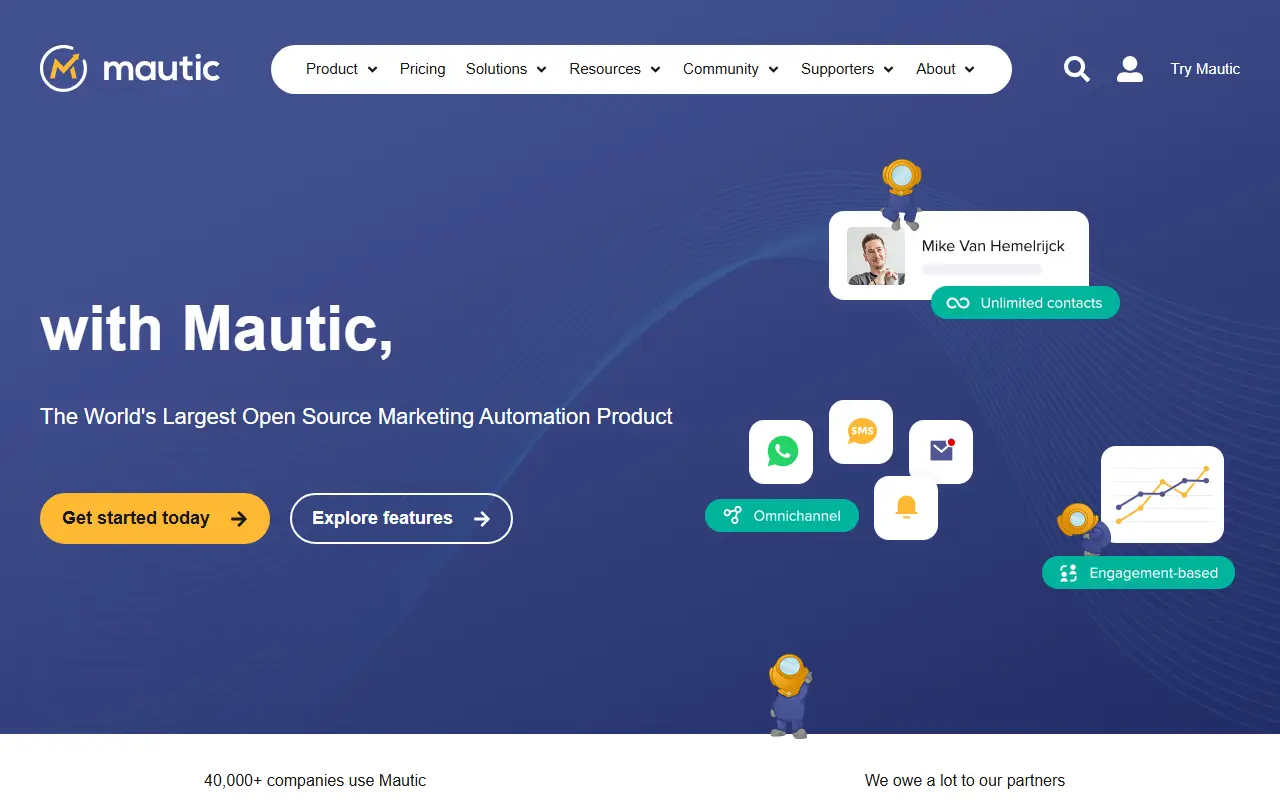
Mautic is open-source marketing automation software. It lets businesses and organizations build integrated marketing campaigns, including email marketing, while keeping control of their own data. The project is supported by a worldwide community of contributors and presents privacy and extensibility as core goals.
The README highlights several advantages over conventional hosted tools: it is free to use, you can run it on your own infrastructure with your own database, there is no vendor lock-in, integrations can be built as needed, and both the frontend and backend are customizable. It also describes multi-channel marketing without extra cost and unlimited segmentation and automation.
Mautic is written in PHP. It can be downloaded and self-hosted, or you can request a trial of a hosted option, and community channels and a blog share news, releases and strategy. Its license is stated in the repository. It suits marketing teams that want automation without relying entirely on a third-party SaaS provider.
Key features
- Email marketing and campaign automation
- Contact segmentation
- Multi-channel marketing
- Customizable frontend and backend
- Custom integrations
- Own your data in your own database
Pricing: Managed Mautic hosting through a partner starts from 275 euros a month billed quarterly (247.50 on annual billing) for Essential and from 1,237 euros a month for Professional; Enterprise is custom.
#3
Self-hosted mail server, newsletter, and email marketing platform built on Postfix, Dovecot, and Rspamd, without monthly sending fees.
- GitHub stars
- 16k
- Last commit
- 5 mo ago
- Latest release
- v4.9
- Licence
- AGPL-3.0
- Self-hosted
- Yes
billionmail.com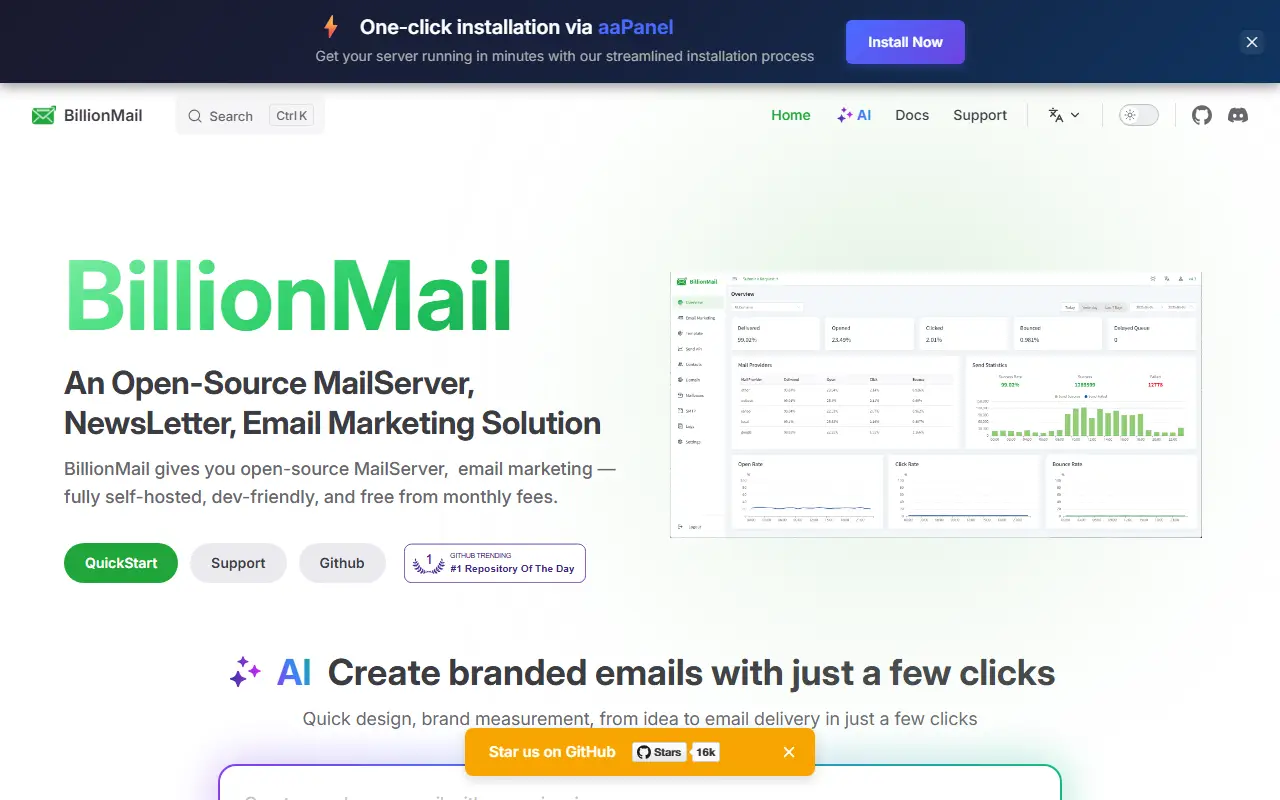
BillionMail is an open-source platform that combines a mail server with newsletter and email marketing tools. It is meant for businesses and individuals who want to send newsletters, promotional email, or transactional messages themselves instead of paying monthly fees to a marketing service. It is written in Go and released under the AGPL-3.0 license.
Under the hood it relies on established components, with topics naming Postfix, Dovecot, Rspamd, and SMTP. The product adds campaign creation and sending, advanced analytics, and customer management on top, and the README promotes a quick three-step setup. Documentation is available in several languages and there is a Discord community.
Running your own mail infrastructure involves deliverability work such as DNS records and sender reputation, which the README does not detail. It suits developers, small businesses, and communities that want control over their email lists and sending, and that are willing to host and maintain the server.
Key features
- Self-hosted mail server
- Newsletter and campaign sending
- Analytics for email campaigns
- Customer and list management
- Built on Postfix, Dovecot, and Rspamd
- Transactional email support
Pricing: Free and open source under the AGPL-3.0 license, with no monthly fees according to the project.
#4
Self-hosted newsletter, email marketing, and transactional email platform with a visual MJML editor, Liquid templating, automations, and seven sending providers.
- GitHub stars
- 2.3k
- Last commit
- today
- Latest release
- v43.0
- Self-hosted
- Yes
- Hosted version
- Available
notifuse.com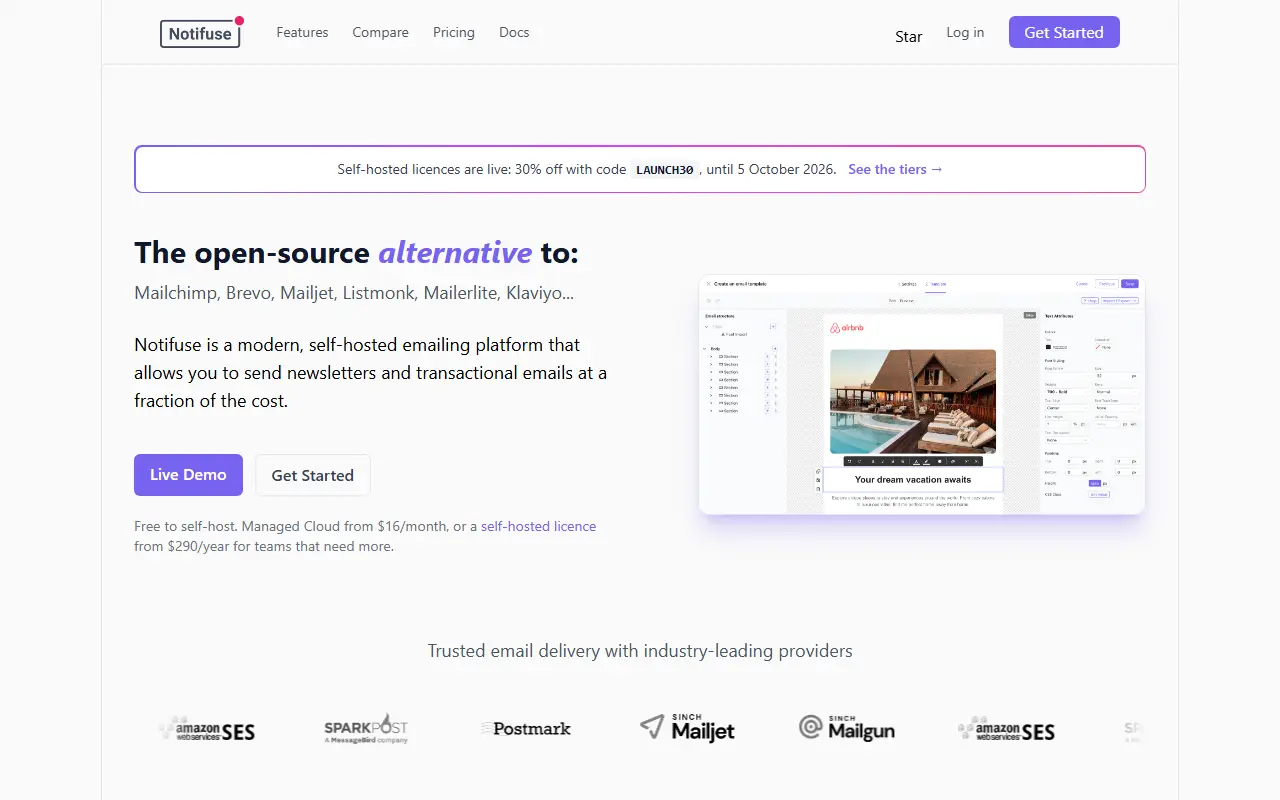
Notifuse is a modern, self-hosted emailing platform for sending newsletters and transactional email at a fraction of the cost of hosted services. It is built with Go and React and presented as an open-source alternative to Mailchimp, Brevo, Mailjet, Listmonk, MailerLite, and Klaviyo. The input lists its license only as other.
Email marketing features include a drag-and-drop visual builder with MJML components and live preview, campaign scheduling, A/B testing of subject lines, content, and send times, list segmentation, and contact profiles with custom fields. Automations use a visual canvas with nodes for delays, emails, branches, filters, list changes, A/B tests, and webhooks, and Liquid templating personalizes messages. Messages are sent through seven providers, with topics naming Amazon SES, Mailgun, Postmark, and SendGrid.
For people who prefer not to run it themselves, Notifuse Cloud offers managed hosting, which the README says starts at 16 dollars per month, and a live demo is available. It suits marketers and developers who want lower costs and control over subscriber data.
Key features
- Visual MJML email builder
- Campaign scheduling and A/B testing
- Visual automation flow builder
- Liquid templating
- Seven sending providers including Amazon SES
- Transactional email API
Pricing: Self-hosting is free, with yearly licences from $290 for extra capabilities. Managed Notifuse Cloud starts at $16 per month with no per-email or per-seat charges.
#5
Keila is an open source newsletter tool with a block, Markdown and MJML editor, segmentation and forms, available self-hosted or as EU-hosted cloud.
- GitHub stars
- 2.3k
- Last commit
- 3 days ago
- Latest release
- 0.40.2
- Licence
- AGPL-3.0
- Self-hosted
- Yes
- Hosted version
- Available
keila.io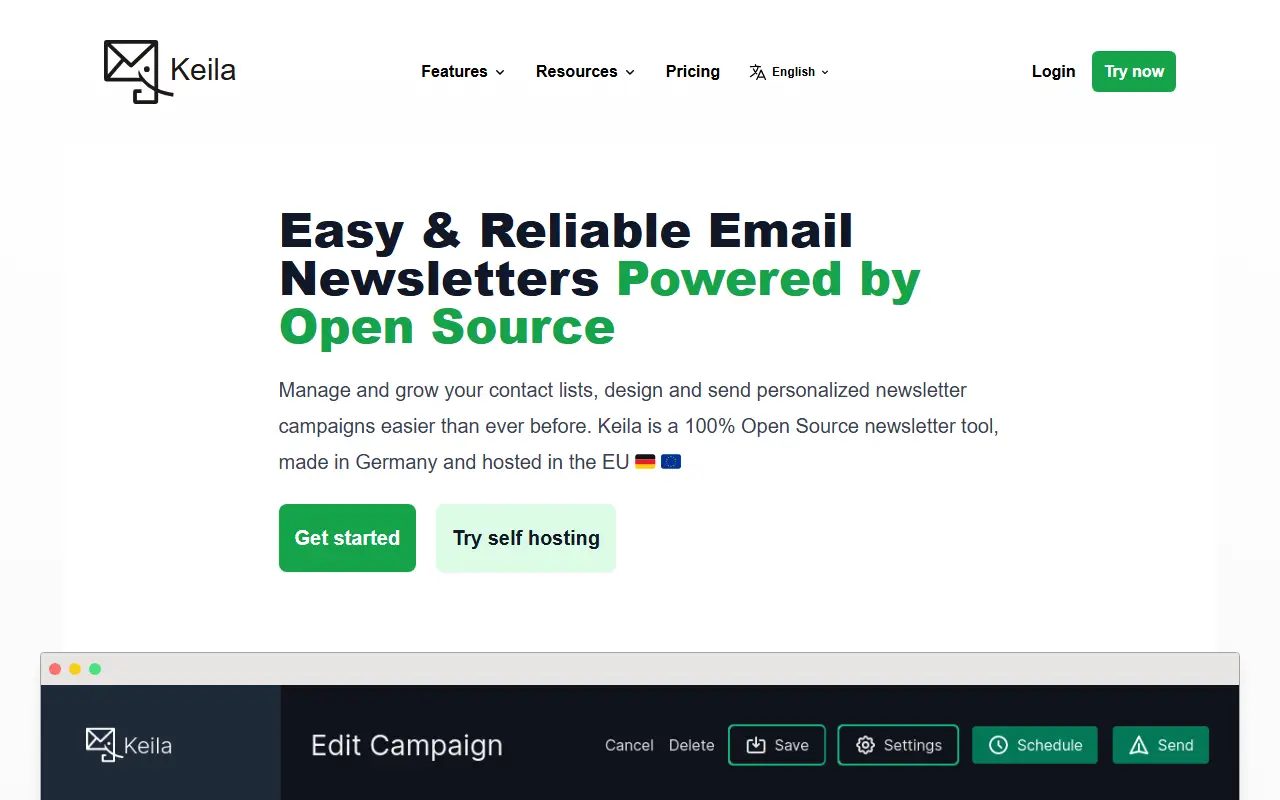
Keila is an AGPLv3-licensed newsletter tool for managing contact lists and sending personalised campaigns. Emails can be written in a visual block editor, in Markdown or a Markdown-based WYSIWYG, in MJML, or as plain text, and the base templates are meant to render properly in Gmail, Outlook and Thunderbird.
Contacts can be grouped into segments by data and behaviour. A form builder creates sign-up forms with extra fields such as checkboxes and dropdowns, protected by a captcha and double opt-in, and campaigns can be personalised with custom data and Liquid templates. Analytics can be switched off with a single click.
You can self-host Keila or use Keila Cloud, which the site says is made in Germany and hosted in the EU. Cloud plans run from XS to XL, priced monthly by email volume, all with unlimited contacts and projects, and you can send through Keila or bring your own email server.
Key features
- Visual editor, Markdown or plain text newsletters
- Segments built from user data and behaviour
- Form builder with captcha and double opt-in
- Emails can be built with MJML
- Tracking can be turned off entirely
- Personalisation with custom data and Liquid
Pricing: Keila Cloud, per month incl. tax: XS €8 for 2,000 emails, S €16 for 5,000, M €32 for 15,000, L €64 for 50,000, XL €128 for 100,000. Every plan has unlimited contacts and projects, and you can send with Keila or bring your own email server.
#6
SendPortal is a self-hosted, open source email marketing application for managing newsletters, subscribers and campaigns.
- GitHub stars
- 2.2k
- Last commit
- 22 days ago
- Latest release
- v4.0.0.1
- Licence
- MIT
- Self-hosted
- Yes
sendportal.io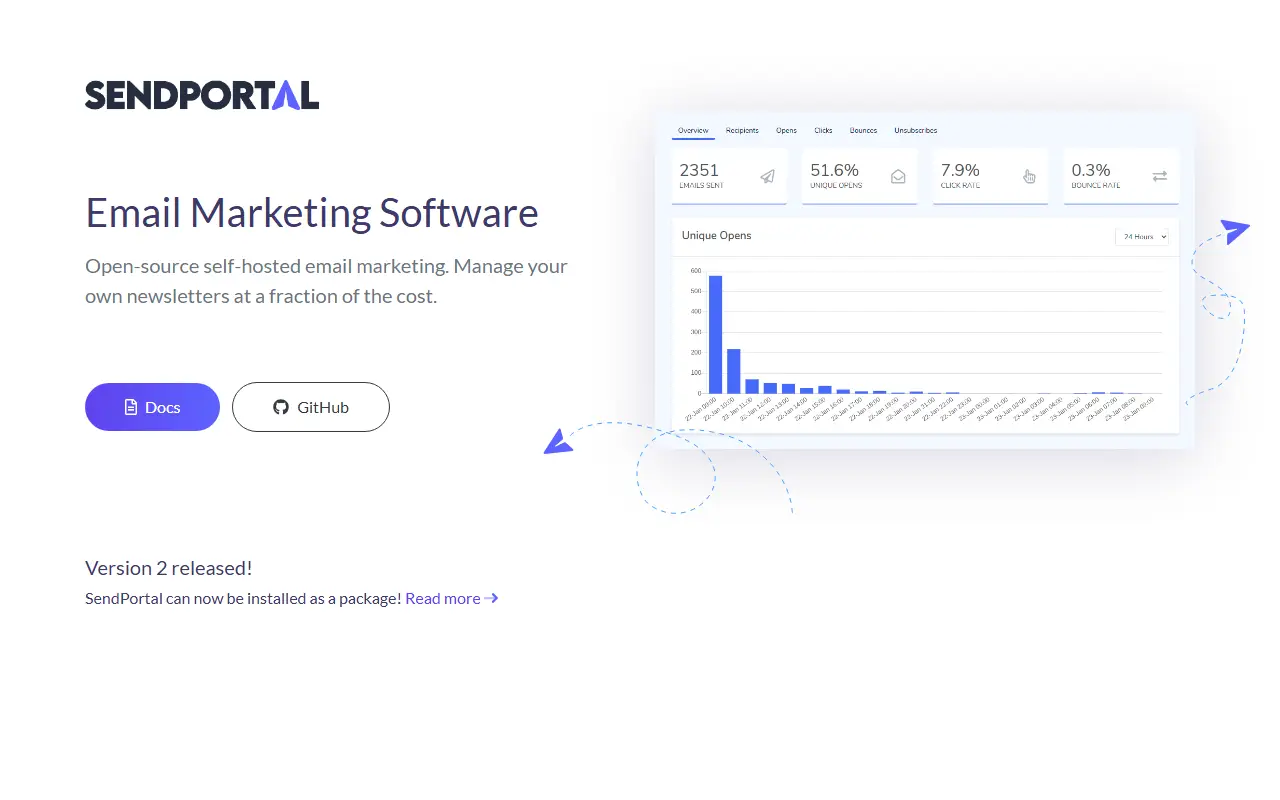
SendPortal is an email marketing application that you host yourself, so newsletter and subscriber data stays on infrastructure you control. It is released under the MIT licence and comes out of the Laravel community. Its stated pitch is to let you manage your own newsletters at a lower cost than hosted services such as Mailchimp or Campaign Monitor.
Subscribers can be imported or updated through the API or a CSV upload, then split into custom-defined segments. Campaigns go to everyone or to a segment, using templates you build yourself, and SendPortal tracks sending, opens, clicks, bounces and unsubscribes for each campaign. A REST API and support for several workspaces or teams in one interface complete the picture.
Key features
- Self-hosted newsletter management
- Import or update subscribers by API or CSV
- Send campaigns to everyone or to segments, with own templates
- Tracking of sends, opens, clicks, bounces, unsubscribes
- Multiple workspaces or teams in one interface
- REST API for integration

phpList is open-source email marketing software for building, sending, integrating and analyzing newsletters and campaigns, self-hosted or hosted.
- GitHub stars
- 883
- Last commit
- 11 days ago
- Latest release
- v3.6.17
- Licence
- AGPL-3.0
- Self-hosted
- Yes
- Hosted version
- Available
phplist.org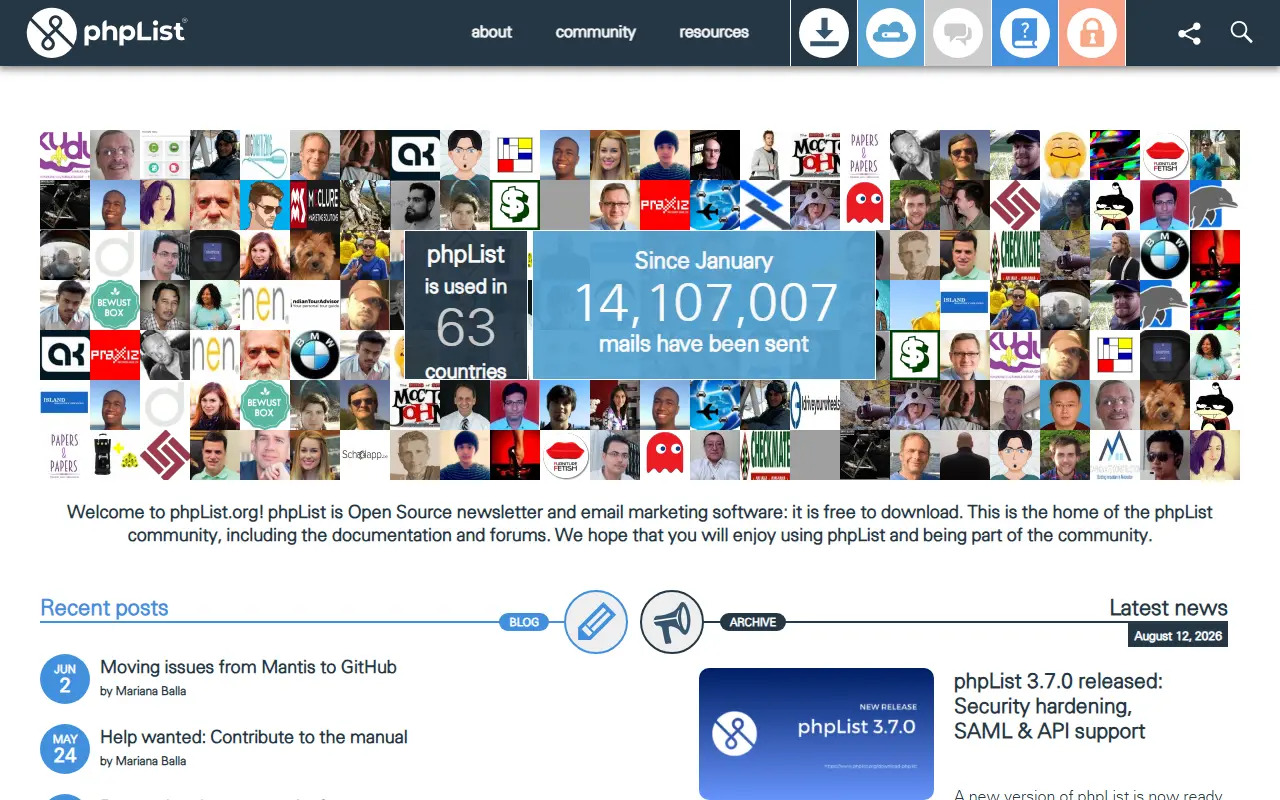
phpList is an email marketing manager for creating, sending and analyzing email campaigns and newsletters. Organizations use it to manage subscriber lists, personalize messages and track results from a web or command-line interface, rather than relying on a third-party newsletter platform.
Capabilities include real-time analytics on message responses and subscriber behavior, segmentation, content personalization based on subscriber attributes, message-queue management with throttling across accounts and campaigns, and automated bounce processing with policy and regex rules. You can schedule, pause, resume, repeat and requeue campaigns, import and export subscribers by CSV or Excel, attach files, and send web pages or RSS feed contents. Amazon SES is supported, and the plugin architecture and APIs allow integration.
phpList is written in PHP and licensed under AGPL-3.0. You can deploy it on your own server, or sign up for a hosted account at phplist.com, which the README describes as free to start with. A demo and a community are linked from the repository.
Key features
- Real-time campaign analytics
- Subscriber segmentation and personalization
- Queue management with domain-based throttling
- Automated bounce processing
- CSV and Excel subscriber import
- Built-in Amazon SES support
- Plugin architecture and APIs
Pricing: Open source under AGPL-3.0; phpList Hosted at phplist.com is described as free to get started.
#8
Mailtrain is a self-hosted newsletter application on Node.js and MySQL or MariaDB, with lists, segments, templates, automation and a built-in mail server.
- GitHub stars
- 5.8k
- Last commit
- 1 yr ago
- Latest release
- v2.20210609.0
- Licence
- GPL-3.0
- Self-hosted
- Yes
Mailtrain is a self-hosted newsletter application built on Node.js (v14+) and MySQL (v8+) or MariaDB (v10+). This README covers version 2, a complete rewrite of version 1, so it has to be installed from scratch; the database from v1 can be backed up and upgraded to the new schema.
Features include subscriber lists, segmentation, custom fields, email templates including MJML-based ones, custom reports, and automation with triggered and RSS campaigns. Multiple users can work with granular permissions and sharing, and hierarchical namespaces target enterprise setups. A built-in Zone-MTA means mail delivery needs close to zero setup.
Mailtrain exposes three URL endpoints: trusted for logged-in users, sandbox for the WYSIWYG template editors, and public for subscribers. The recommended deployment points three DNS entries at one IP address. An install script for CentOS 7 or Ubuntu 18.04 also obtains a Let's Encrypt certificate. Recommended minimum hardware is 2 vCPU and 4096 MB RAM.
Key features
- Subscriber lists, segmentation and custom fields
- Triggered and RSS campaign automation
- Hierarchical namespaces for enterprise use
- Built-in Zone-MTA for mail delivery
- Separate trusted, sandbox and public endpoints
- Install script obtains a Let's Encrypt certificate
Sendy alternatives: questions
- What is the best open-source alternative to Sendy?
- Listmonk is the top-ranked open-source alternative to Sendy on Enlisted: A self-hosted newsletter and mailing list manager shipped as a single Go binary with PostgreSQL storage, a web dashboard and campaign management. Other strong options are Mautic, BillionMail, Notifuse and Keila.
- What are the best commercial alternatives to Sendy?
- EmailOctopus, Sender, AWeber, Moosend and Campaign Monitor are among the hosted, closed-source alternatives to Sendy listed on Enlisted, which lists 20 in total. Compare their pricing and features on each tool page.
- Are these Sendy alternatives free?
- All 8 are open source, so the code is free to use under its licence, and all of them can be self-hosted on your own server or computer. 4 also offer a paid or managed cloud version if you'd rather not host it yourself.
- How is this list of Sendy alternatives ranked?
- By a score built from GitHub stars, star growth over the last 30 days and how recently the code changed. 6 of these projects shipped code in the last 30 days. Data is refreshed daily, and nobody can pay to move up.
 TrackMedia
 TrackRev