7,363 open-source and SaaS tools, with GitHub stats refreshed every day.

5 alternatives ranked by real activity

Open-source Lokalise alternatives

A curated, ranked list of the 5 best open-source alternatives to Lokalise.

The best open-source alternative to Lokalise is Weblate. If that doesn't suit you, other good options are Lingo.dev, Tolgee, Pontoon and Intlayer.

Lokalise alternatives are mainly localization tools. 5 of them shipped code in the last 30 days, 5 can be self-hosted, and 3 use a permissive licence.

Last updated October 2, 2026 · ranked by GitHub stars, growth and recent commits

Weblate

Weblate is an open-source, web-based localization platform with tight version control integration for translating software with teams and communities.

GitHub stars
6.1k
Last commit
today
Latest release
weblate-2026.10
Licence
GPL-3.0
Self-hosted
Yes
Hosted version
Available
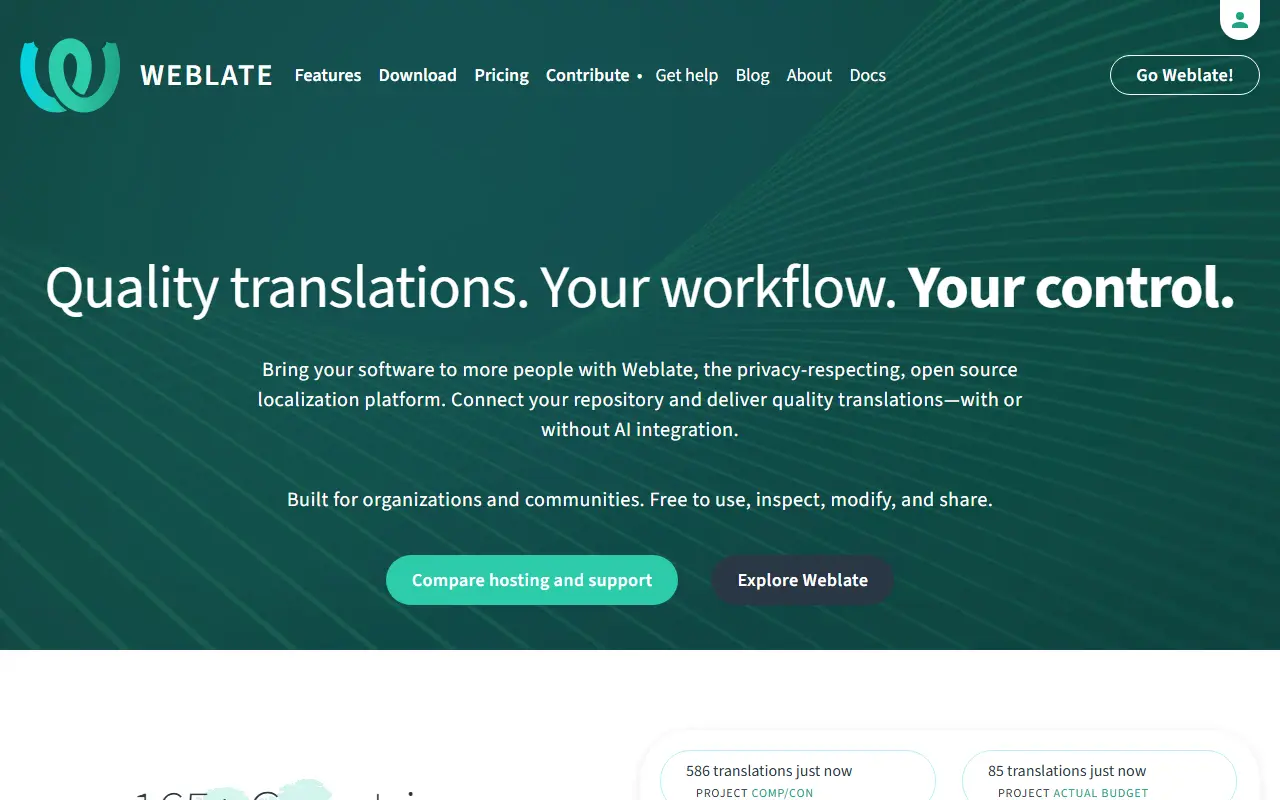
weblate.orgWeblate homepage screenshot

Weblate is a localization tool you use in the browser, closely integrated with version control. You connect your repository, translators work in the browser, and new strings and finished translations flow between the repository and Weblate so localization keeps pace with development.

The project website emphasizes quality and control. Translators get context, shared terminology and quality checks, and teams can work exclusively with people or add AI and machine translation. Repository topics reference gettext, continuous localization and crowdsourcing. It is used by both community projects and commercial products, and the Weblate project itself, along with many open-source applications, are translated on its hosted service.

Weblate is written in Python with Django and licensed under GPL-3.0. The homepage describes it as free to use, inspect, modify and share, suitable for organizations and communities. You can run it yourself or choose hosting and support options, which are compared on the vendor's hosting page.

Key features

  • Version control integration for repositories
  • Browser-based translation workspace
  • Shared terminology and quality checks
  • Optional AI and machine translation
  • Support for gettext and other formats
  • Crowdsourced and team translation workflows

Pricing: Self-hosting is free, with optional support at €53 or €106 per month. Hosted Weblate is priced by string count from €47 per month, with a 14-day trial; excludes VAT.

Lingo.dev

Open-source localization tools and a platform for translating apps with LLMs, tuned with glossaries and brand voice, for teams shipping multilingual products.

GitHub stars
5.4k
Last commit
today
Latest release
@lingo.dev/compiler@0.4.14
Licence
Apache-2.0
Hosted version
Available
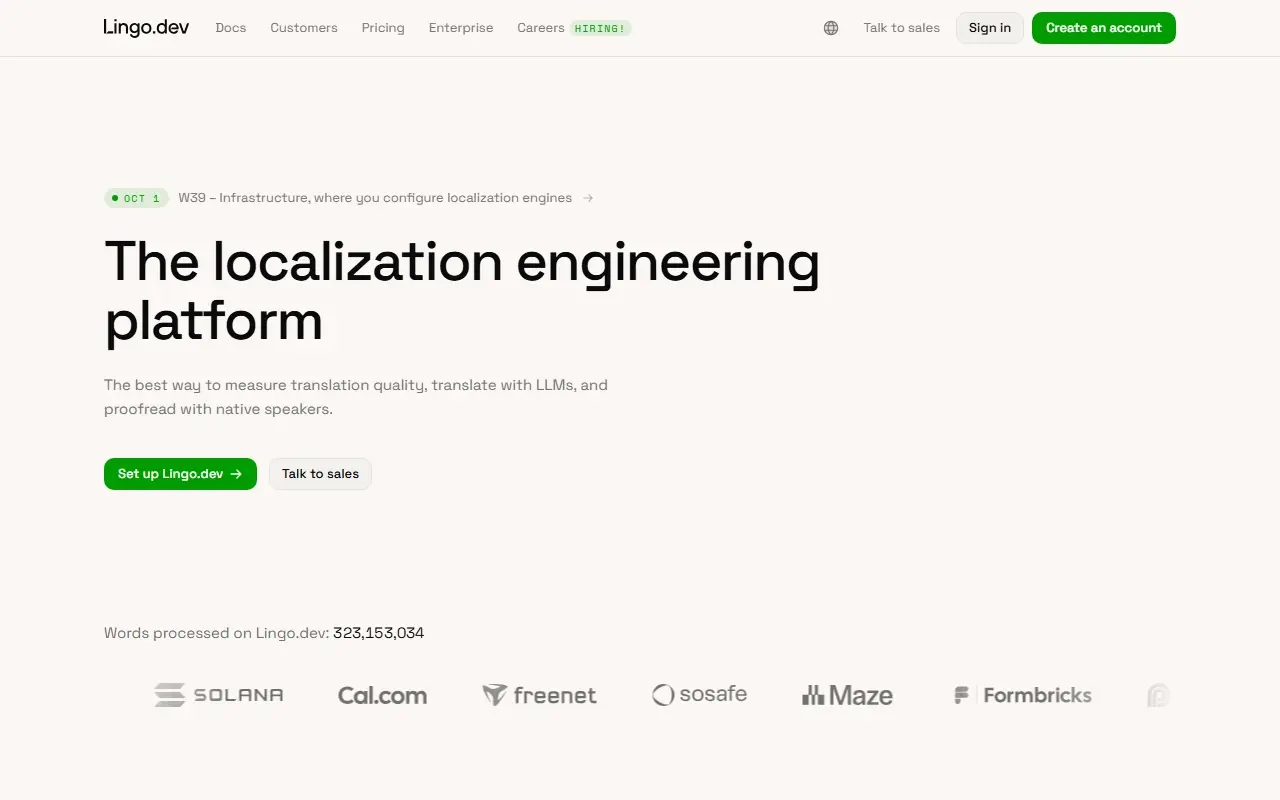
lingo.devLingo.dev homepage screenshot

Lingo.dev is a set of open-source localization engineering tools that connect to the Lingo.dev platform. It is aimed at product teams that translate their software into multiple languages and want that work to be consistent, measurable and automated, instead of passing strings around by hand.

On the platform, teams configure localization engines with glossaries, brand voice and per-locale chains of language models, and call them from code, the command line, CI/CD pipelines or MCP. Quality criteria that teams define in plain words are used to score translations from LLMs and from native speakers, so low-scoring languages can be found and traced back to a model, a rule or a missing glossary term.

The open-source repository, written in TypeScript and licensed under Apache-2.0, includes a command-line tool and a compiler package, and its topics point to React and React Native projects. A hosted platform with sign-in, pricing and enterprise options sits alongside it.

Key features

  • LLM-based translation with glossaries
  • Configurable brand voice per locale
  • Per-language model selection with fallbacks
  • Quality scoring with custom criteria
  • Proofreading by native speakers
  • CLI, CI/CD and MCP access

Pricing: Start in the Sandbox at $0 per month with pay-as-you-go usage. Production adds a $99 per month base fee; LLM costs pass through at no markup. Enterprise is custom.

Tolgee

An open-source web-based localization platform with in-context translation, SDKs and machine translation, positioned as an alternative to Crowdin, Phrase and Lokalise.

GitHub stars
4.1k
Last commit
today
Latest release
v3.224.11
Self-hosted
Yes
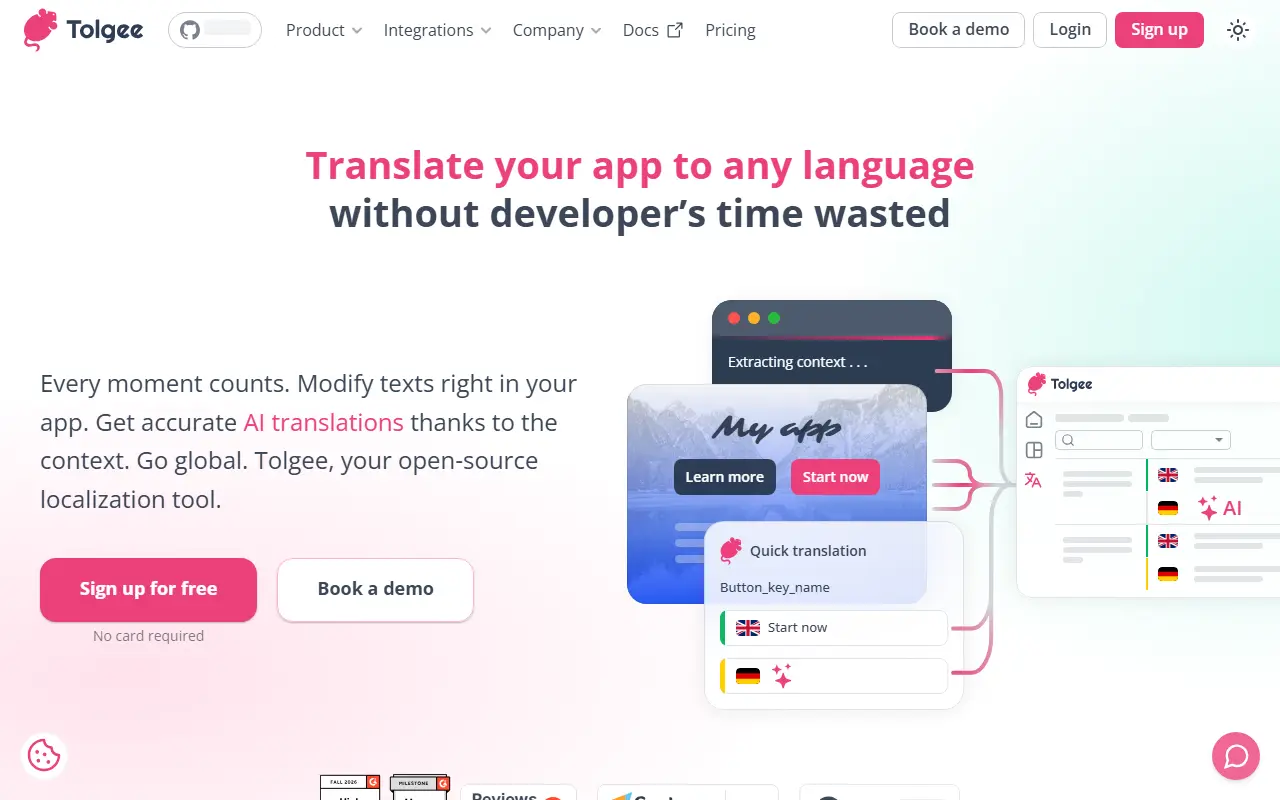
tolgee.ioTolgee homepage screenshot

Tolgee is an open-source, web-based localization platform made to be friendly to both developers and translators. It is presented as an alternative to Crowdin, Phrase and Lokalise, with the aim of saving the time that localization tasks usually take.

Its distinctive feature is in-context translation: holding the Alt or Option key and clicking a text in your running app opens a dialog for editing the string, without digging through JSON or PO files. A one-click screenshot feature captures the page with the phrases highlighted, and translation works in production using the Tolgee Tools Chrome plugin with an API key, so non-developers can contribute.

Instead of only syncing files with a backend, Tolgee integrates into the app through SDKs for frameworks such as React, Angular, Vue and Svelte. Machine translation is available through DeepL, Google Translate, AWS Translate and Azure Translator, which speeds up the work of translators. The platform is written mainly in TypeScript.

Key features

  • In-context translation via Alt-click
  • One-click screenshots of translated strings
  • Translate in production with a Chrome plugin
  • SDKs for React, Angular, Vue and Svelte
  • Machine translation with DeepL and Google
  • Translation management API

Pricing: A free cloud plan covers 30 000 words and 3 seats. Paid plans cost €58 (Translate), €133 (Optimise) and €373 (Manage) per month billed annually; Enterprise and on-premises licences are quoted.

Pontoon

Mozilla's open-source translation management system for community-driven localization, built on Django and storing translations in version control.

GitHub stars
1.7k
Last commit
6 days ago
Latest release
v2026.09.23
Licence
BSD-3-Clause
Self-hosted
Yes
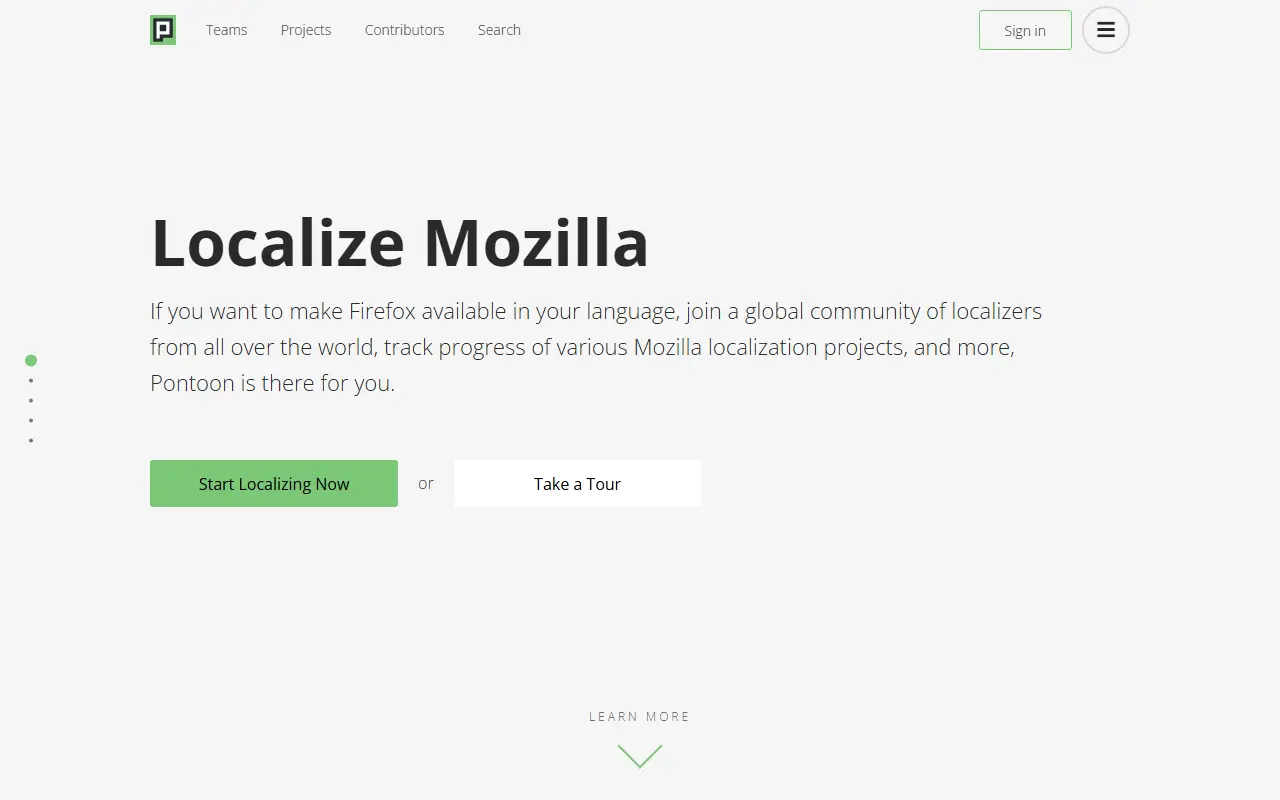
pontoon.mozilla.orgPontoon homepage screenshot

Pontoon is a translation management system developed and used by the Mozilla localization community. It is built to support open-source localization that is driven by volunteers, and it works with version control systems for storing translations so that work done in the web interface flows back to project repositories.

Users translate strings in a browser-based translation app, while teams and project managers use dashboards to track progress across locales. Mozilla runs staging and production servers of its own, and the documentation explains how Mozilla deploys Pontoon as a Docker image on Google Cloud Platform, noting that other platforms may need adaptation. A separate developer setup is provided for local testing but is not suitable for production.

The software is written in Python and JavaScript on the Django framework and is licensed under the New BSD licence. Organizations can host their own instance, and GitHub Discussions is where feedback, support and third-party deployments are discussed. It suits open-source projects and communities that want to organize volunteer translators without paying for a commercial localization platform.

Key features

  • Browser-based translation interface
  • Team dashboards for locale progress
  • Version control integration for translations
  • Community-driven localization workflow
  • Docker-based deployment documentation
  • Django and Python codebase

Pricing: Free and open source under the BSD-3-Clause licence.

Intlayer

Intlayer is a per-component internationalization solution for JavaScript apps with typed content, AI-assisted translation, a visual editor and a CMS.

GitHub stars
844
Last commit
yesterday
Latest release
v9.6.0
Licence
Apache-2.0
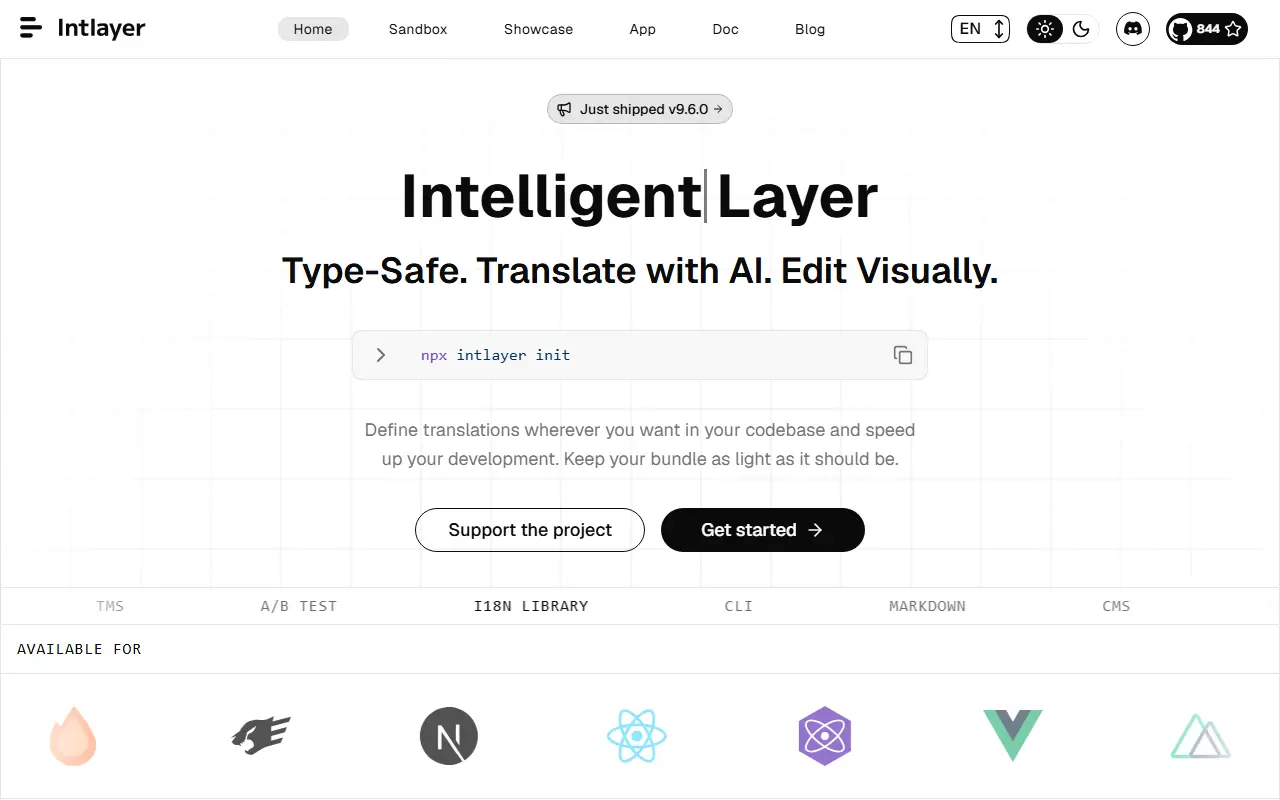
intlayer.orgIntlayer homepage screenshot

Intlayer is an internationalization (i18n) solution for web and mobile JavaScript applications. Instead of one large translation file, content is declared per component in per-locale files, which keeps translations next to the code that uses them and gives TypeScript autocompletion.

It is framework-agnostic, with support for Next.js, React, Vite, Vue, Nuxt, Preact, Express and React Native. Dictionaries are tree-shakable, CI/CD integration is available, and AI-powered translation can fill in locales. A free CMS and visual editor let non-developers manage multilingual content without touching code.

The project positions itself as a modern alternative to i18n libraries it considers too complex or too rigid. It is written in TypeScript, licensed under Apache-2.0, and documented with guides for Next.js and React with Vite, plus a Discord community.

Key features

  • Per-component, per-locale content files
  • TypeScript autocompletion for translations
  • Tree-shakable dictionaries
  • AI-powered translation
  • Visual editor and multilingual CMS
  • Support for many JavaScript frameworks

Lokalise alternatives: questions

What is the best open-source alternative to Lokalise?
Weblate is the top-ranked open-source alternative to Lokalise on Enlisted: Weblate is an open-source, web-based localization platform with tight version control integration for translating software with teams and communities. Other strong options are Lingo.dev, Tolgee, Pontoon and Intlayer.
Are these Lokalise alternatives free?
All 5 are open source, so the code is free to use under its licence, and all of them can be self-hosted on your own server or computer. 2 also offer a paid or managed cloud version if you'd rather not host it yourself.
How is this list of Lokalise alternatives ranked?
By a score built from GitHub stars, star growth over the last 30 days and how recently the code changed. 5 of these projects shipped code in the last 30 days. Data is refreshed daily, and nobody can pay to move up.

People also look for alternatives to…

View all