
 Localazy
 Lingohub
 Locize
 Smartcat
 XTM Cloud
 memoQ
memoQ Lilt
Lilt TransPerfect
 Gridly
 Wordbee
 TextUnited
 Translated
 Applanga
 OneSky
 Loco
Loco SimpleLocalize
 Localizely
 i18nexus
 BabelEdit
 Poedit
 Matecat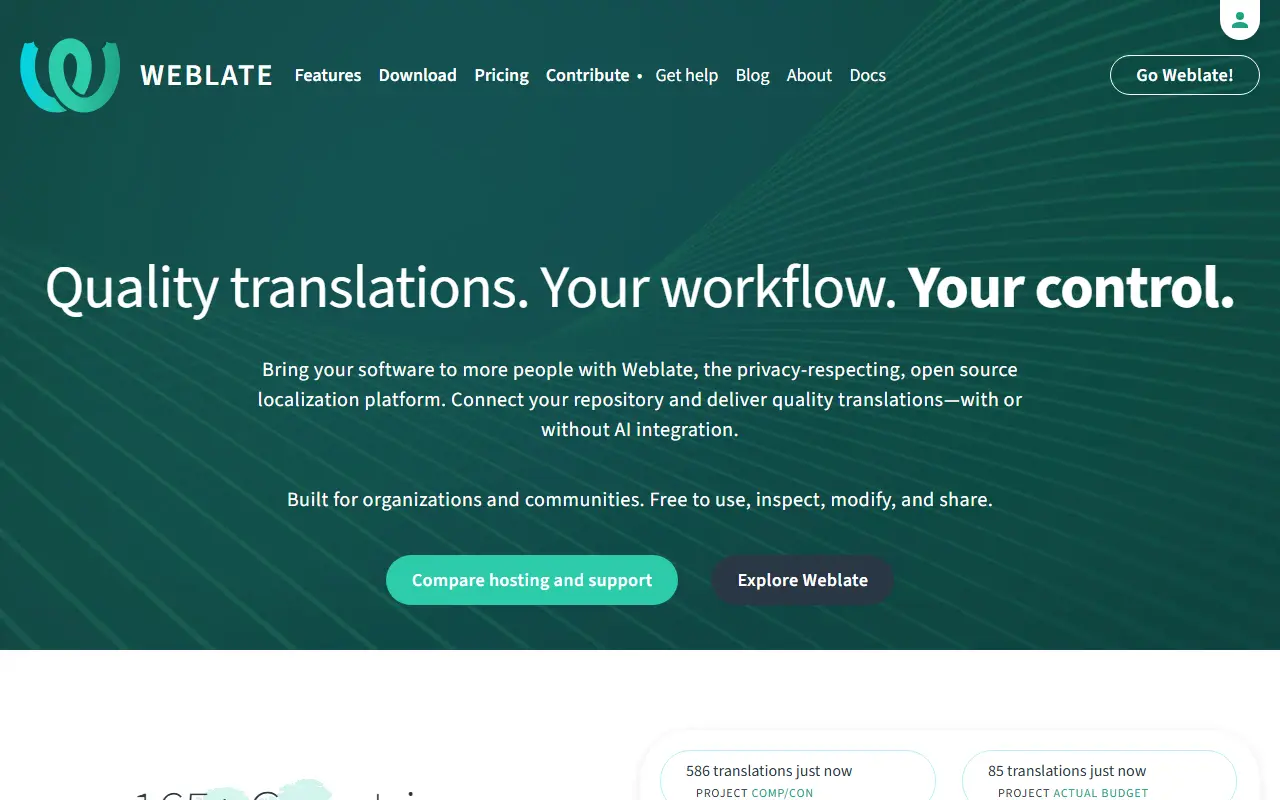
About Weblate
Weblate is a localization tool you use in the browser, closely integrated with version control. You connect your repository, translators work in the browser, and new strings and finished translations flow between the repository and Weblate so localization keeps pace with development.
The project website emphasizes quality and control. Translators get context, shared terminology and quality checks, and teams can work exclusively with people or add AI and machine translation. Repository topics reference gettext, continuous localization and crowdsourcing. It is used by both community projects and commercial products, and the Weblate project itself, along with many open-source applications, are translated on its hosted service.
Weblate is written in Python with Django and licensed under GPL-3.0. The homepage describes it as free to use, inspect, modify and share, suitable for organizations and communities. You can run it yourself or choose hosting and support options, which are compared on the vendor's hosting page.
Key features
- Version control integration for repositories
- Browser-based translation workspace
- Shared terminology and quality checks
- Optional AI and machine translation
- Support for gettext and other formats
- Crowdsourced and team translation workflows
Good fit for
- →Localizing an open-source project with volunteers
- →Continuous localization for a commercial product
- Tags
- localization
- translation
- i18n
- l10n
- gettext
- django
- continuous-localization
- self-hosted
Weblate: questions and answers
- What is Weblate used for?
- Weblate is an open-source, web-based localization platform with tight version control integration for translating software with teams and communities. It is a good fit for localizing an open-source project with volunteers and continuous localization for a commercial product.
- Is Weblate open source?
- Yes. Weblate is open source under the GPL-3.0 licence. Its source code is on GitHub at WeblateOrg/weblate and is written mainly in Python.
- Is Weblate free?
- Yes. Weblate is open source, so the software itself is free to use. A managed cloud version is also available, with paid plans from €47 per month.
- Can I self-host Weblate?
- Yes. Weblate can be self-hosted on your own server or infrastructure.
- What is Weblate an alternative to?
- Weblate is an open-source alternative to Crowdin, Lokalise, Transifex and Phrase. Other open-source alternatives to Crowdin include Pontoon, Tolgee and Lingo.dev.
- Is Weblate actively maintained?
- Yes. The most recent commit to Weblate was on 2 October 2026. The project has 6.1k stars on GitHub.
Open-source alternatives to Weblate
See all
Pontoon
Localization
Mozilla's Localization Platform
BSD-3-Clausevs Transifex★ 1.7k
Tolgee
Localization
Developer & translator friendly web-based localization platform
OSSvs Crowdin★ 4.1k
Lingo.dev
Localization
Open-source localization engineering tools. Connects to Lingo.dev localization engineering
Apache-2.0vs Lokalise★ 5.4k
Intlayer
Localization
Per-component Internationalisation solution for JS application. Type-Safe. Translate with
Apache-2.0vs Locize★ 844
LibreTranslate
Localization
Free and Open Source Machine Translation API. Self-hosted, offline capable and easy to set
AGPL-3.0vs Google Translate★ 17kArgos Translate
Localization
Open-source offline translation library written in Python
MITvs Google Translate★ 6.5k
SaaS alternatives to Weblate
See all
Crowdin
Localization
Localization management platform for software, documentation and games
SaaS
Lokalise
Localization
Translation management system for apps, websites and marketing content
SaaS
Transifex
Localization
Localization platform for software and apps with continuous delivery
SaaS
Phrase
Localization
Translation management and string localization suite for software teams
SaaS
POEditor
Localization
Web-based translation management for apps and websites
SaaS
Smartling
Localization
Enterprise translation management with AI and human workflows
SaaS