#1
A simple open-source Markdown editor for Linux, macOS and Windows with real-time preview, several editing modes and HTML and PDF export.
- GitHub stars
- 64k
- Last commit
- 2 days ago
- Latest release
- v0.23.0
- Licence
- MIT
marktext.me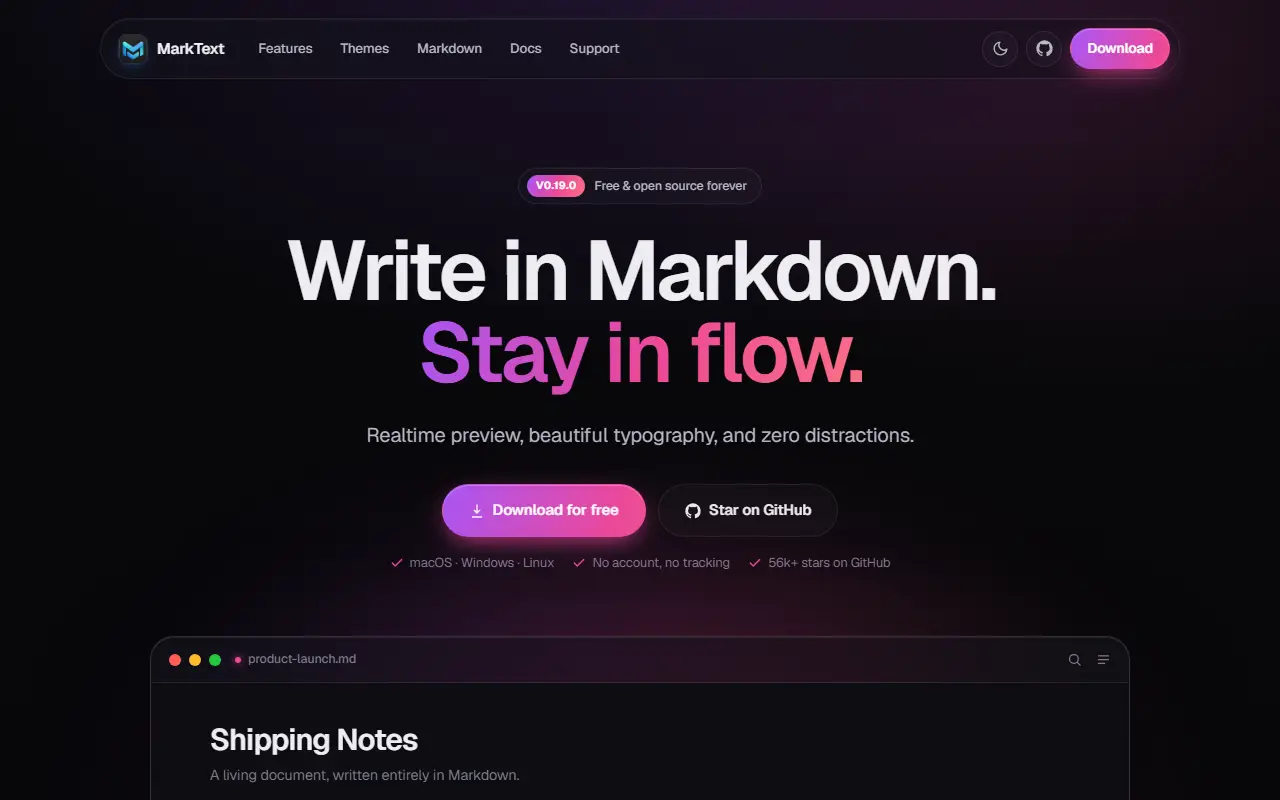
MarkText is an open-source Markdown editor that prioritizes speed and ease of use, and it runs on Linux, macOS and Windows. It offers a realtime WYSIWYG-style preview in a clean interface meant to reduce distractions while writing. It is built with TypeScript, Electron and Vue and released under the MIT license.
It follows the CommonMark and GitHub Flavored Markdown specs with selective Pandoc support, and adds extensions such as math expressions via KaTeX, front matter and emojis. Paragraph and inline-style shortcuts speed up writing, images can be pasted straight from the clipboard, and documents can be exported as HTML or PDF. Themes such as Cadmium Light and Material Dark are included.
Writers can switch between Source Code, Typewriter and Focus editing modes depending on how they like to work. The project is funded by community sponsorship and accepts contributions and translations. It suits writers, developers and note-takers who want a local Markdown editor without a separate preview pane.
Key features
- Realtime WYSIWYG-style Markdown preview
- CommonMark and GitHub Flavored Markdown support
- Math expressions with KaTeX
- Export to HTML and PDF
- Source code, typewriter and focus modes
- Paste images from the clipboard
- Light and dark themes
Pricing: Free and open source under the MIT license.
#2
SoloMD is a local-first Markdown editor with an MCP server and bring-your-own-key AI chat, so tools like Claude Code and Cursor can work on your notes folder.
- GitHub stars
- 1.6k
- Last commit
- yesterday
- Latest release
- v5.0.21
- Licence
- MIT
- Self-hosted
- Yes
solomd.app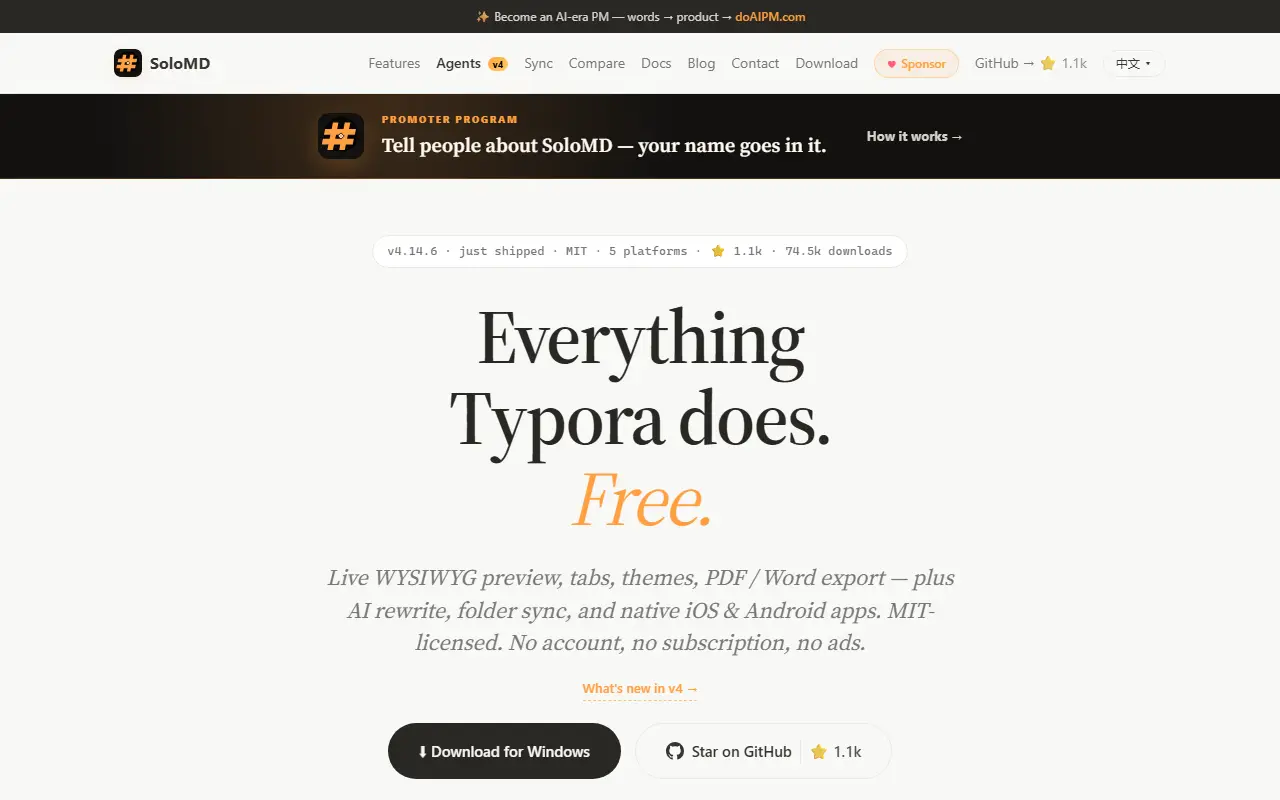
SoloMD is a Markdown editor built around a plain folder of .md files. The same notes can be edited in the app, queried through an in-editor AI chat, or driven from outside by MCP clients such as Claude Code, Codex and Cursor, using a bundled MCP server. It positions itself as an alternative to Obsidian and Typora.
Features include wikilinks, a properties inspector for YAML frontmatter, automatic Git commits, a whiteboard based on tldraw, scheduled recipes that run while you are away, and support for many AI providers with your own keys. The app is built with Tauri 2, Vue 3 and CodeMirror 6, targets desktop and mobile platforms, and stores notes, API keys, embeddings and Git history on your own machine with no SoloMD-hosted servers.
SoloMD is licensed under MIT and is free with no subscription. The README discloses that the code, releases and issue replies are produced largely by Claude Code under a human maintainer who sets direction, and it invites readers to inspect the code and correct mistakes. It suits people who keep their notes in Markdown and want AI assistance without a cloud service.
Key features
- Markdown editing in a plain folder
- Bundled MCP server for AI agents
- AI chat with bring-your-own keys
- Wikilinks and properties inspector
- Whiteboard based on tldraw
- Automatic Git history of notes
Pricing: Fully free and open source under the MIT license, with no paid tier, subscription, in-app purchase or ads; the developer accepts sponsorship.
#3
A free, open-source, offline-first note-taking and to-do app with Markdown notes, end-to-end encrypted sync, plugins and apps for desktop and mobile.
- GitHub stars
- 57k
- Last commit
- today
- Latest release
- v3.7.22
- Self-hosted
- Yes
- Hosted version
- Available
joplinapp.org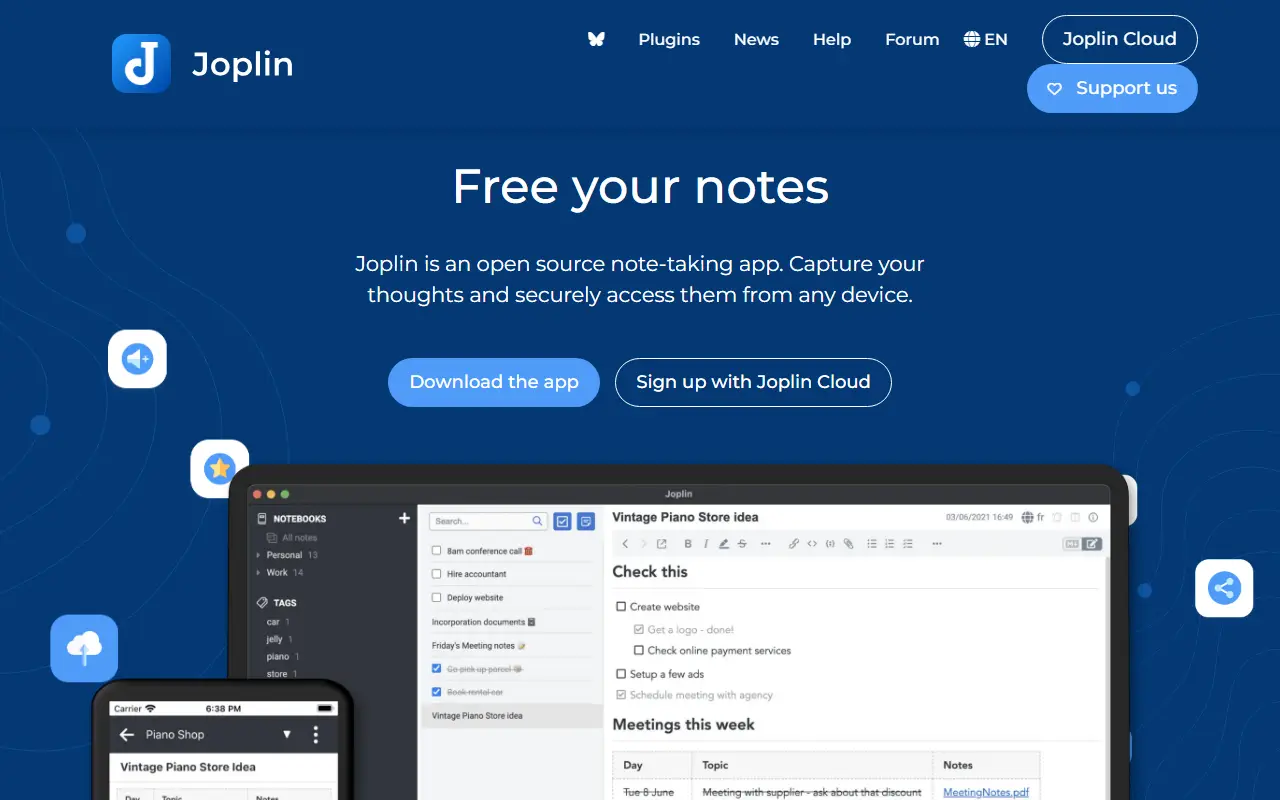
Joplin is a note-taking and to-do application, free and open source, that can manage large collections of notes organized into notebooks. Notes are written in Markdown, are searchable, can be tagged, and can be edited either in the app or in your own text editor. Apps are available for Windows, macOS, Linux, Android and iOS.
The app is offline first, so all your data lives on your phone or computer and stays accessible without a connection. Notes can be synchronized with end-to-end encryption through services such as Nextcloud, Dropbox, OneDrive and Joplin Cloud, and topics also mention WebDAV. Full-text search is available on every platform, and plugins and themes let you customize the app. A web clipper saves pages, and notes exported from Evernote can be imported with formatting, attachments and metadata intact; plain Markdown files can be imported as well.
The repository license is listed as 'Other', so check its terms if you plan to redistribute. Joplin is a popular choice for people who want an Evernote replacement that keeps data local or on storage they already control.
Key features
- Markdown notes organized into notebooks
- Offline-first storage on your own devices
- End-to-end encrypted sync via Nextcloud, Dropbox or OneDrive
- Evernote import with attachments and metadata
- Plugins and themes
- Web clipper for saving pages
- Apps for desktop and mobile
Pricing: Joplin Cloud costs 2.99€ (Basic), 5.99€ (Pro) or 9.99€ (Pro 100 GB) per month, and Teams 7.99€ per user per month. Self-hosted Server Business is 3.33€ per user per month; 14-day trial.
#4
A privacy-first, local-first knowledge management app built around linked, outliner-style notes in Markdown or Org-mode, with a graph view and plugin support.
- GitHub stars
- 46k
- Last commit
- today
- Latest release
- 2.0.2
- Licence
- AGPL-3.0
- Self-hosted
- Yes
logseq.com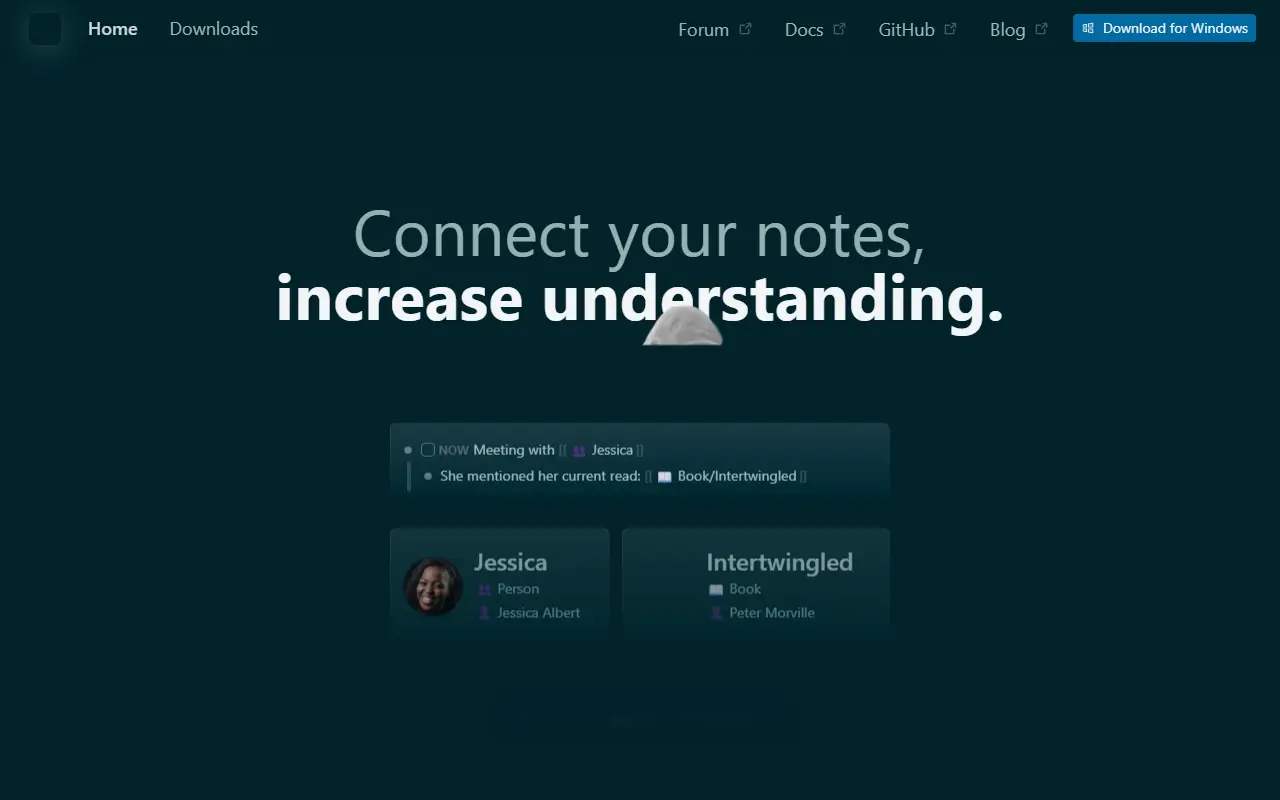
Logseq is an open-source platform for knowledge management and collaboration that puts privacy and local storage first. Notes are organized as linked blocks in an outliner, forming a knowledge graph, and topics show it works with both Markdown and Org-mode files and can be backed by Git.
The project is moving toward a database-backed version that introduces DB graphs. That version is in beta, comes with a new iOS mobile app in alpha and a Real Time Collaboration approach to syncing graphs across devices or working with others, also in alpha. Because data loss is possible while these features mature, the maintainers recommend automated backups. A plugin API, themes and a public roadmap round out the ecosystem.
Logseq is written in Clojure and ClojureScript under the AGPL-3.0 license, and desktop builds are available from the releases page. It appeals to researchers, students and knowledge workers who want a personal wiki with bidirectional links and full ownership of their files.
Key features
- Outliner-style linked notes
- Markdown and Org-mode support
- Knowledge graph of connected pages
- Local-first storage with Git compatibility
- Plugin API and themes
- Real Time Collaboration sync in alpha
Pricing: Free and open source under the AGPL-3.0 license.
#5
Markdown editor for researchers and writers with citation management, Pandoc exports and Zettelkasten-style note linking.
- GitHub stars
- 14k
- Last commit
- 2 days ago
- Latest release
- v4.9.0
- Licence
- GPL-3.0
zettlr.com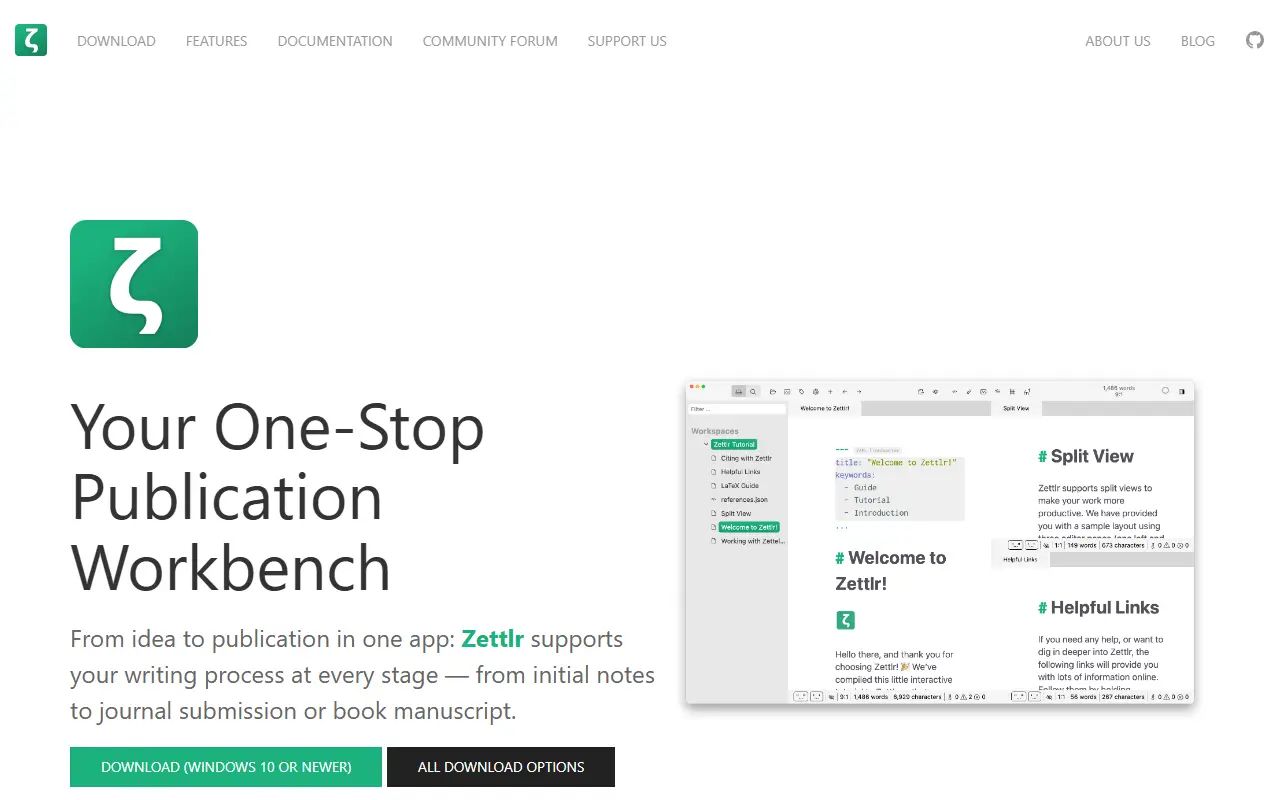
Zettlr is a desktop Markdown editor aimed at academic and long-form writing. It presents itself as a publication workbench, combining note-taking, drafting, reference management and export in one application, with a focus on keeping your notes private and stored as ordinary files on your own computer.
Citations integrate with reference managers such as Zotero and JabRef, and exports rely on Pandoc, LaTeX and Textbundle, with support for LaTeX and Word templates. Other capabilities include snippets for boilerplate text, themes with dark modes and custom CSS, code highlighting, full-text search, and techniques from the Zettelkasten knowledge management method. The interface is translated into over a dozen languages.
Zettlr is built with TypeScript, Electron and Node.js and released under GPL-3.0. Installers are provided for macOS, Windows and most Linux distributions, and the repository documents building from source, command-line switches and contribution workflows. The project is also reachable through a community forum, Discord and Mastodon.
Key features
- Markdown editor with a distraction-free writing focus
- Citation support for Zotero and JabRef
- Export via Pandoc, LaTeX and Textbundle
- Zettelkasten-style linking and full-text search
- Snippets, themes and custom CSS
- Installers for macOS, Windows and Linux
Pricing: Free and open source under the GPL-3.0 license.
#6
Markdown presentation ecosystem: write slides as Markdown and export to HTML, PDF or PowerPoint, with a VS Code extension and a command-line tool.
- GitHub stars
- 13k
- Last commit
- 6 days ago
- Licence
- MIT
marp.app
Marp lets you write slide decks in Markdown. Pages are split by a horizontal rule, and the format is based on CommonMark, so anyone who writes Markdown already knows most of it. Extra directives and syntax cover image handling, math typesetting and auto-scaling.
The core engine ships three built-in themes called default, gaia and uncover, and themes can be customised or written from plain CSS. Finished decks convert to HTML, PDF and PowerPoint files. Official tools include Marp for VS Code, which previews slides inside the editor, and Marp CLI for converting from the command line.
Marp is built on the Marpit framework, which has a plugin architecture so developers can extend it. All tools and libraries from the Marp team are MIT-licensed.
Key features
- Slide decks written in Markdown
- Exports to HTML, PDF and PowerPoint
- Three built-in themes plus custom CSS themes
- Slide preview inside VS Code
- Command-line converter with watch and server modes
- Built on the Marpit framework

A free, Qt-based note-taking application written in C++ that focuses on Markdown editing and note management on Linux, Windows and macOS.
- GitHub stars
- 13k
- Last commit
- yesterday
- Latest release
- v4.14.4
- Licence
- LGPL-3.0
docs.vnote.fun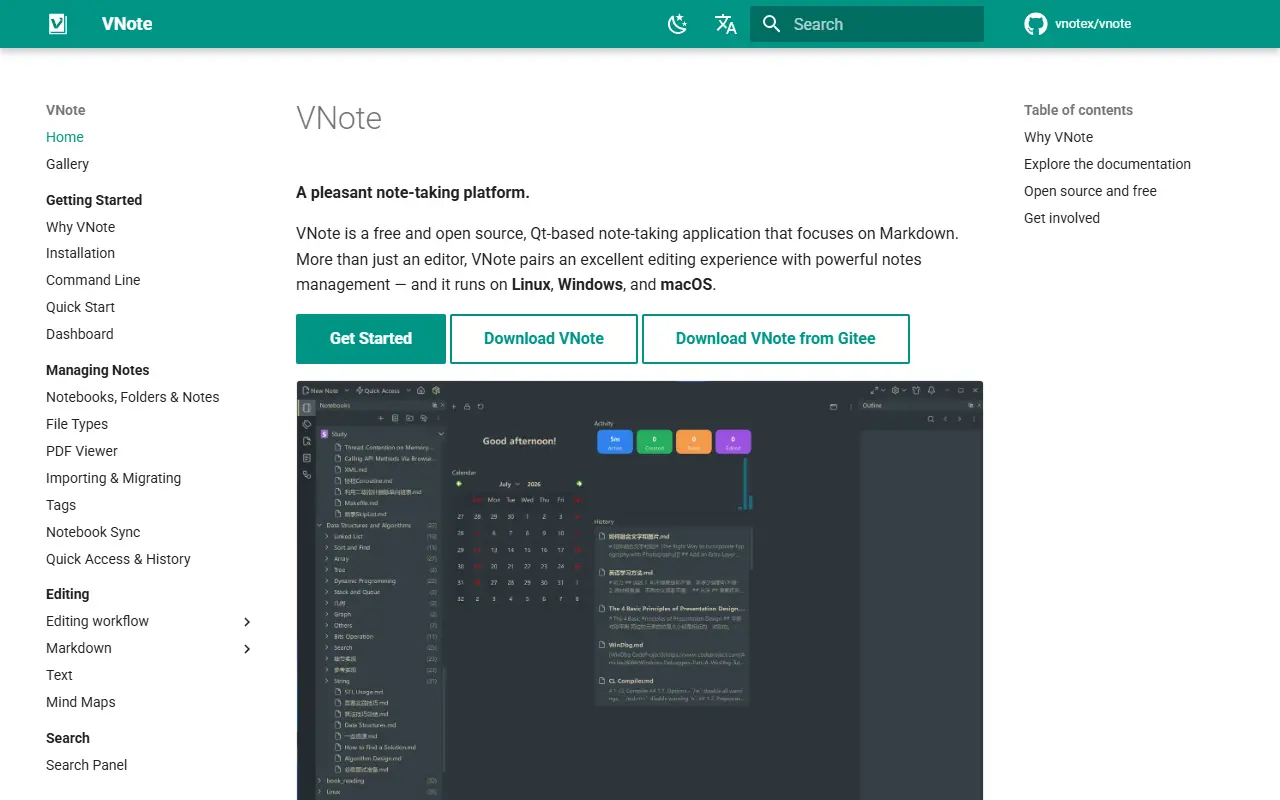
VNote is a free, open-source note-taking application built with Qt and written in native C++. It currently focuses on Markdown, and aims to offer a pleasant editing experience while also providing notes management, so it is more than a simple Markdown editor.
Because it uses Qt, the same application runs on Linux, Windows and macOS. The project topics reference Vim-style editing, UML diagrams and MathJax math rendering, and the maintainers say that formats beyond Markdown are planned. Continuous builds from the master branch and stable releases are published on GitHub and Gitee.
VNote is licensed under LGPL-3.0, with bundled third-party icon sets recorded in a separate notices file. It is a desktop application that runs locally rather than a hosted service. It suits people who want local Markdown notes organized in notebooks, and developers who prefer a native editor over an Electron-based one.
Key features
- Native C++ and Qt desktop application
- Markdown editing focus
- Notes management and notebooks
- Vim mode support
- UML and MathJax rendering
- Runs on Linux, Windows and macOS
Pricing: Free and open source under the LGPL-3.0 licence.
#8
A fast, native Markdown notes app for macOS and iOS that keeps every note as a plain Markdown or text file, with tags, wiki-style links and encryption.
- GitHub stars
- 7.6k
- Last commit
- 5 days ago
- Latest release
- v7.5.1
- Licence
- MIT
fsnot.es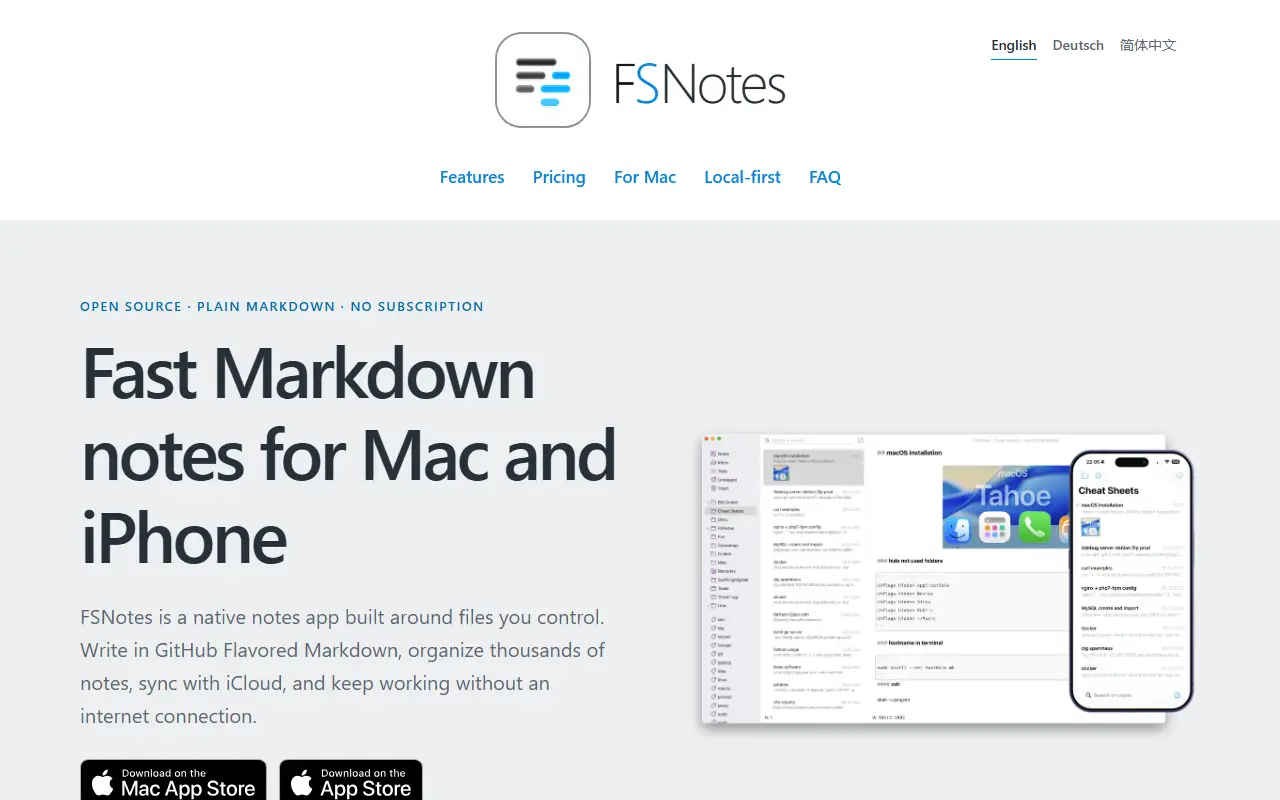
FSNotes is a native notes app for macOS and iOS built around the idea of owning your notes. Each note is stored as a portable Markdown or plain-text file rather than in a proprietary database, so the notes can be opened with any compatible app now or years later.
The app focuses on writing and quick retrieval. It handles several folders, external editors, sync through iCloud Drive or Dropbox, and Git backups if you want them, and connects ideas with tags and double-bracket links. Private notes can be protected with AES-256 encryption, and it renders code blocks, Mermaid diagrams and MathJax math. Search and navigation are designed to stay smooth across large note collections.
FSNotes is written in Swift and released under the MIT licence. The apps are sold through the App Store, and those purchases support continued development, while the source code is open. It suits Apple users who want local Markdown notes with sync through their own storage service.
Key features
- Notes stored as Markdown or text files
- Tags and wiki-style note links
- AES-256 encryption for private notes
- iCloud Drive, Dropbox and Git backups
- Mermaid diagrams and MathJax rendering
- Native macOS and iOS apps
Pricing: Source code is MIT licensed; App Store purchases support development.
#9
QOwnNotes is an open-source desktop notepad and to-do manager that stores Markdown plain-text files and syncs through Nextcloud or ownCloud.
- GitHub stars
- 6k
- Last commit
- today
- Latest release
- v26.11.8
- Licence
- GPL-2.0
- Self-hosted
- Yes
qownnotes.org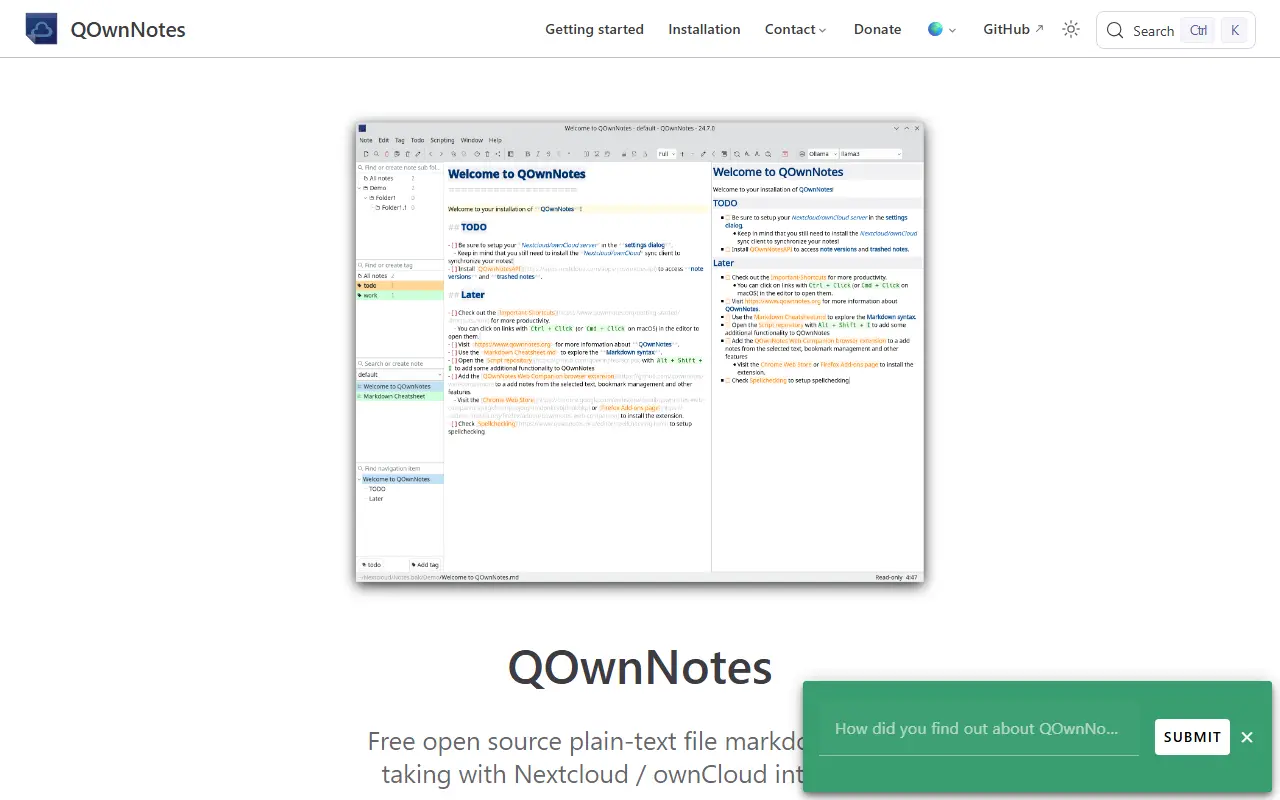
QOwnNotes is a notepad and to-do list manager for GNU/Linux, macOS and Windows. Notes are kept as plain-text Markdown files, so they stay readable and portable, and the app works together with Nextcloud Notes and ownCloud Notes so the same notes can be reached from other devices.
Around the desktop application the project offers an Android companion app, a web app, and web companion extensions for Firefox and Chrome. Repository topics point to CalDAV task support, bookmark handling, personal knowledge management and local-first design. The program is built with Qt in C++ and the project links to community channels including Matrix, Telegram and IRC.
QOwnNotes is licensed under GPL-2.0 and runs locally on your computer, so there is no server to host unless you choose to use Nextcloud or ownCloud for syncing. It suits people who want a local-first Markdown notes app that works with their own cloud storage.
Key features
- Notes stored as plain Markdown files
- Nextcloud and ownCloud Notes integration
- To-do list manager
- Desktop apps for Linux, macOS and Windows
- Android app and browser companion extensions
- Qt-based native interface
Pricing: Free and open source under GPL-2.0.
#10
An end-to-end encrypted note-taking app with sync across devices and a self-hostable server, available on web, desktop and mobile.
- GitHub stars
- 6.7k
- Last commit
- today
- Latest release
- @standardnotes/desktop@3.202.11
- Licence
- AGPL-3.0
- Self-hosted
- Yes
- Hosted version
- Available
standardnotes.com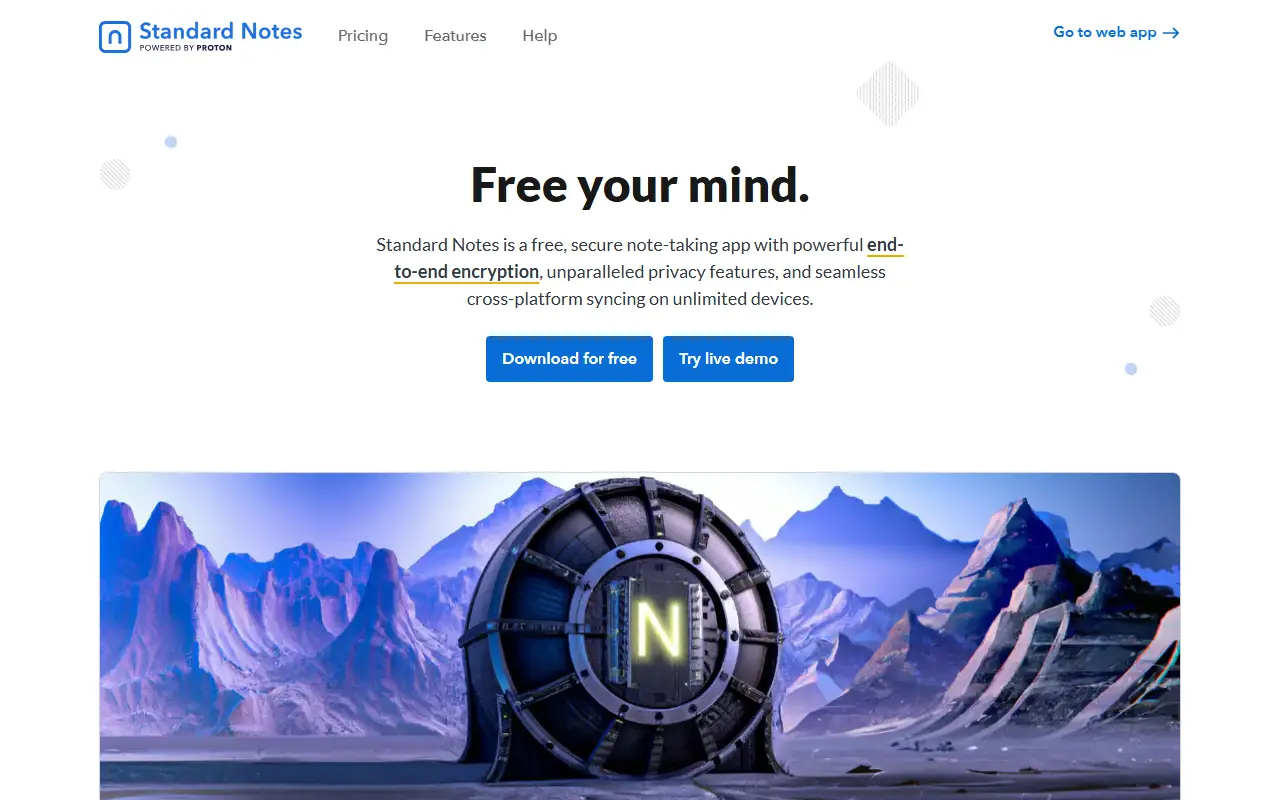
Standard Notes is a note-taking app with end-to-end encryption, built for digitalists and professionals, aiming to keep notes, files and life's work in one secure place. Only the user can read their notes, and sync across devices is encrypted by default.
You register for an account on the web app and install clients for Mac, Windows, Linux, iOS and Android. The README highlights fast, free and encrypted sync on an unlimited number of devices, public source code, the option of hosting your own server with a few steps, and a focus on longevity and sustainability. A companion service called Listed turns notes into an online publication with email newsletters, and developers can build and publish extensions.
The web app compiles to static HTML, JavaScript and CSS files that can be served from any web server, and the README includes build and development instructions. Standard Notes is written in TypeScript and licensed under AGPL-3.0, with a forum and help pages for support. It suits privacy-minded users who want encrypted notes with the option to host their own backend.
Key features
- End-to-end encrypted notes and files
- Sync across unlimited devices
- Apps for web, desktop and mobile
- Self-hostable sync server
- Listed publishing and newsletters
- Extensions published by developers
Pricing: Free Standard plan includes end-to-end encryption and device sync. Productivity costs $90 and Professional $120 per year; there is no trial, but refunds are offered.
iA Writer alternatives: questions
- What is the best open-source alternative to iA Writer?
- MarkText is the top-ranked open-source alternative to iA Writer on Enlisted: A simple open-source Markdown editor for Linux, macOS and Windows with real-time preview, several editing modes and HTML and PDF export. Other strong options are SoloMD, Joplin, Logseq and Zettlr.
- What are the best commercial alternatives to iA Writer?
- Ulysses, Bear, Typora, Drafts and Scrivener are among the hosted, closed-source alternatives to iA Writer listed on Enlisted, which lists 20 in total. Compare their pricing and features on each tool page.
- Are these iA Writer alternatives free?
- All 15 are open source, so the code is free to use under its licence, and 14 of them can be self-hosted on your own server or computer. 3 also offer a paid or managed cloud version if you'd rather not host it yourself.
- How is this list of iA Writer alternatives ranked?
- By a score built from GitHub stars, star growth over the last 30 days and how recently the code changed. 14 of these projects shipped code in the last 30 days. Data is refreshed daily, and nobody can pay to move up.
 TrackMedia
 TrackRev