7,363 open-source and SaaS tools, with GitHub stats refreshed every day.

4 alternatives ranked by real activity

Open-source HEY alternatives

A curated, ranked list of the 4 best open-source alternatives to HEY.

The best open-source alternative to HEY is Inbox Zero. If that doesn't suit you, other good options are Tuta, Forward Email and UnInbox.

HEY alternatives are mainly email clients & servers. 3 of them shipped code in the last 30 days, 3 can be self-hosted, and none uses a permissive licence.

Last updated October 2, 2026 · ranked by GitHub stars, growth and recent commits

Inbox Zero

Open-source AI email assistant that sorts your inbox, pre-drafts replies, blocks cold email and bulk-unsubscribes from unwanted senders.

GitHub stars
12k
Last commit
today
Latest release
desktop-v0.1.16
Self-hosted
Yes
Hosted version
Available
getinboxzero.comInbox Zero homepage screenshot

Inbox Zero is an AI assistant for email, built to cut the time people spend in their inbox. It organizes messages, pre-drafts replies in the user's tone and style, manages the calendar and files attachments. It can also be chatted with from Slack or Telegram, and it is positioned as an open-source alternative to Fyxer that is more customizable and secure.

Its feature set includes AI rules written in plain English, Reply Zero to track emails awaiting a response, a bulk unsubscriber and bulk archiver, a cold email blocker, email analytics and meeting briefs that pull context from email and calendar. Smart filing saves attachments to Google Drive or OneDrive, and the project topics point to Gmail integration.

The app is built with Next.js, Tailwind CSS, shadcn/ui, Prisma and PostgreSQL in a Turborepo monorepo, with Upstash used for supporting services. A hosted version runs at getinboxzero.com, and the repository includes instructions for self-hosting. Feature requests go through GitHub issues or Discord, and the license is specified in the repository.

Key features

  • AI assistant that pre-drafts replies
  • Plain-English AI rules for inbox handling
  • Reply Zero tracking of pending responses
  • Bulk unsubscribe and bulk archive tools
  • Cold email blocker and email analytics
  • Slack and Telegram chat integration

Pricing: Starter is $20, Plus $35 and Professional $50 per user per month, each with a 7-day free trial; Enterprise is quoted by sales.

Tuta

Tuta Mail is an encrypted email, contacts and calendar service with open-source clients for web, desktop and mobile devices, focused on privacy.

GitHub stars
8k
Last commit
today
Latest release
tuta-calendar-android-release-361.260929.0
Licence
GPL-3.0
Self-hosted
No
Hosted version
Available
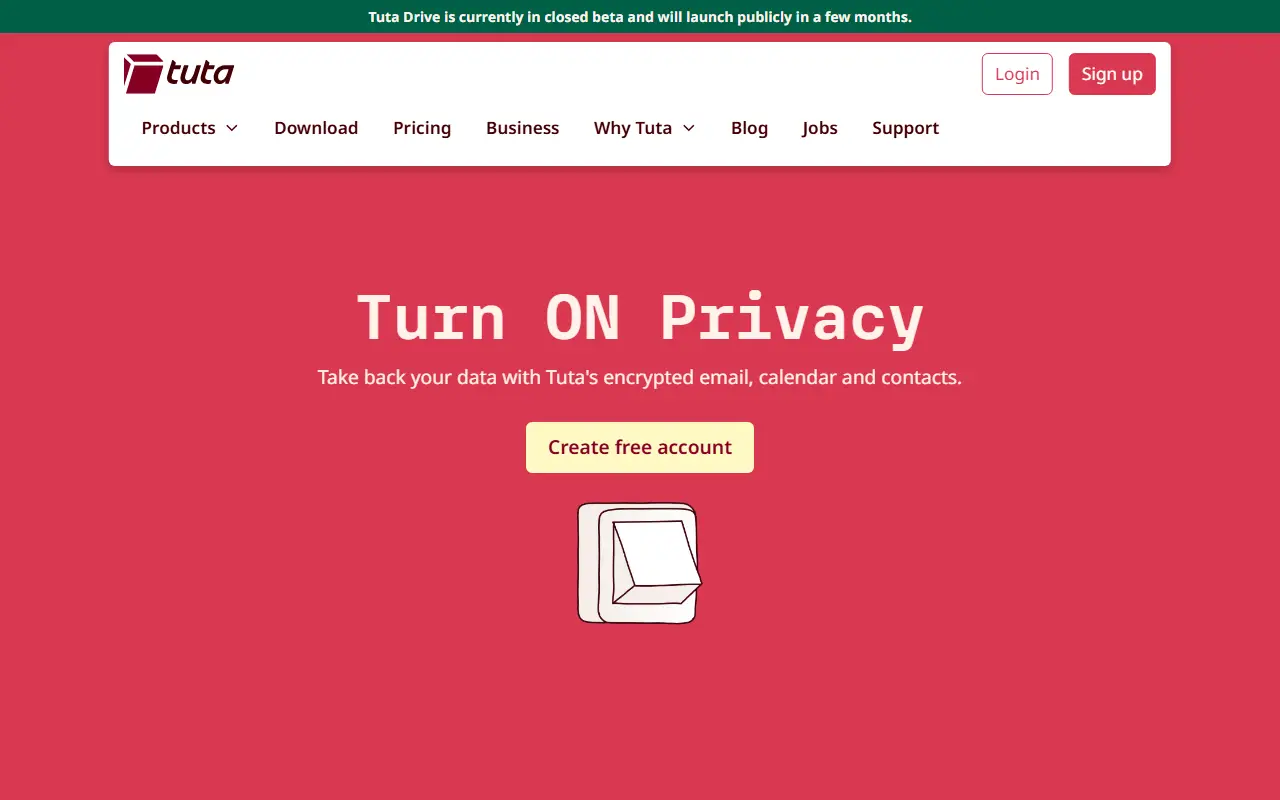
tuta.comTuta homepage screenshot

Tuta, formerly known as Tutanota, is an email service built around security and privacy. It uses built-in end-to-end encryption to protect emails, contacts and calendar entries across devices, and it lets users communicate securely with other people regardless of what provider they use.

The open-source repository contains the client applications, which include a web client, an iOS app and a desktop client, along with separate calendar releases for mobile platforms. The code is written in TypeScript and JavaScript on top of the Mithril framework and is licensed under GPL-3.0. Build, translation and development instructions are provided in dedicated files, and the roadmap and feature requests are handled through Reddit and the vendor website.

Tuta is a hosted service operated by the vendor rather than a product you install on your own server. The repository states that it does not accept contributions or bug reports produced with the help of large language models, and maintainers close such submissions without explanation.

Key features

  • End-to-end encrypted email
  • Encrypted contacts and calendar entries
  • Web, desktop and iOS clients
  • Open-source client code
  • Community translations

Pricing: Free plan with 1 GB of storage, plus paid Revolutionary (20 GB) and Legend (500 GB) plans. Plan prices were not visible on the page, so check the vendor site.

Forward Email

An open-source, privacy-focused email service offering encrypted mailboxes, custom-domain forwarding and sending, positioned against Gmail and Mailchimp.

GitHub stars
1.7k
Last commit
yesterday
Latest release
v2.17.0
Self-hosted
Yes
Hosted version
Available
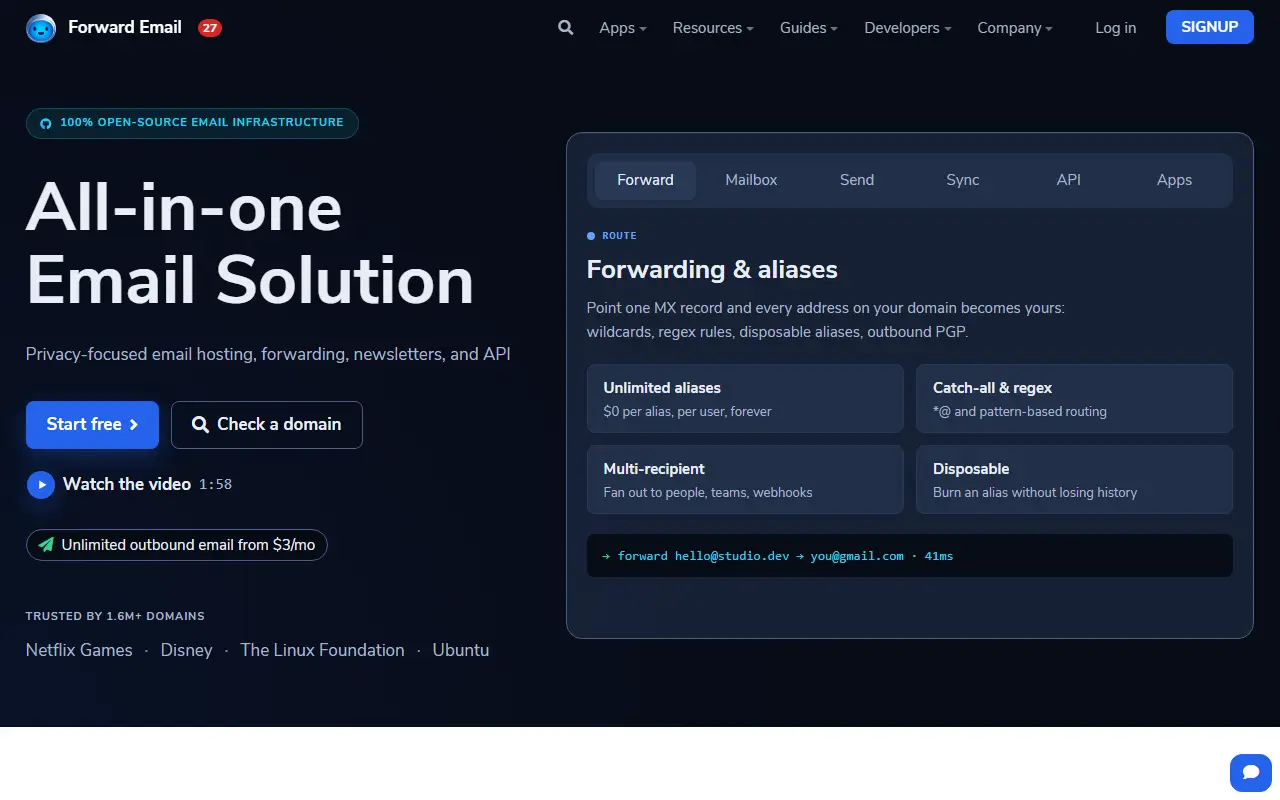
forwardemail.netForward Email homepage screenshot

Forward Email is an open-source email service focused on privacy. It handles custom-domain email forwarding and also provides mailboxes accessible over IMAP, POP and SMTP, with encryption using algorithms such as AES-256 and ChaCha20, and it positions itself as an all-in-one alternative to Gmail, Mailchimp and Sendgrid.

Its topics and documentation point to features such as sending mail, newsletters, SQLite-based storage, push notifications, and calendar and contact support through CalDAV and CardDAV, plus autodiscovery records and Domain Connect integration for setting up DNS. The README includes a local development guide and detailed notes on server infrastructure, load balancing, provisioning and deployment, including automated setup with Ansible.

The code is JavaScript and the project says it is fully open source, so the service can be inspected and, with the published infrastructure guidance, run on your own servers. Most consumers simply use the hosted service at forwardemail.net. It suits individuals and small organizations that want private email on their own domain and developers interested in how such a stack is built.

Key features

  • Custom-domain email forwarding
  • Encrypted mailboxes over IMAP, POP, and SMTP
  • Outbound sending and newsletter support
  • CalDAV and CardDAV support
  • Email autodiscovery and Domain Connect setup
  • Ansible-based deployment guidance

Pricing: Free email forwarding for unlimited domains. Enhanced Protection costs $3, Team $9 and Enterprise $250 per month for unlimited domains; extra storage is $3 per month per 10 GB.

UnInbox

Email platform for teams that adds shared conversations, notes and a new-sender screener on top of existing email, positioned as an alternative to Hey, Front and Missive.

GitHub stars
1.8k
Last commit
7 mo ago
Hosted version
Available
uninbox.comUnInbox homepage screenshot

UnInbox is an open-source communication platform that reimagines email for teams and professionals. Its README argues that email has changed little since the late 1970s while volume and noise have grown, so it builds a modern layer on top of email rather than trying to replace it. The project lists Hey, Front and Missive as products it is an alternative to.

Features described as native include team collaboration, conversation notes and a new-sender screener. It is built to work with your current email infrastructure or to replace it entirely, and the maintainers say email is only the start of a broader communication infrastructure. A hosted app is live at app.uninbox.com, and the team asks users to join its Discord for updates and feedback.

The stack is TypeScript with Next.js and React for the web app, Hono for the public API, Tailwind CSS and tRPC for type-safe APIs. The repository metadata lists the license as Other, so check the license file for the exact terms. It is positioned as open communication infrastructure that teams can build on.

Key features

  • Shared team conversations over email
  • Conversation notes for collaboration
  • New sender screener
  • Works with existing email infrastructure
  • Public API built with Hono
  • Type-safe tRPC architecture

HEY alternatives: questions

What is the best open-source alternative to HEY?
Inbox Zero is the top-ranked open-source alternative to HEY on Enlisted: Open-source AI email assistant that sorts your inbox, pre-drafts replies, blocks cold email and bulk-unsubscribes from unwanted senders. Other strong options are Tuta, Forward Email and UnInbox.
Are these HEY alternatives free?
All 4 are open source, so the code is free to use under its licence, and 3 of them can be self-hosted on your own server or computer. 4 also offer a paid or managed cloud version if you'd rather not host it yourself.
How is this list of HEY alternatives ranked?
By a score built from GitHub stars, star growth over the last 30 days and how recently the code changed. 3 of these projects shipped code in the last 30 days. Data is refreshed daily, and nobody can pay to move up.

People also look for alternatives to…

View all