7,363 open-source and SaaS tools, with GitHub stats refreshed every day.

18 alternatives ranked by real activity

Open-source Discord alternatives

A curated, ranked list of the 18 best open-source alternatives to Discord.

The best open-source alternative to Discord is Element. If that doesn't suit you, other good options are Mumble, Cinny, Element Android and Stoat.

Discord alternatives are mainly team chat tools, but some are also customer support tools. 15 of them shipped code in the last 30 days, 18 can be self-hosted, and 3 use a permissive licence.

Last updated October 2, 2026 · ranked by GitHub stars, growth and recent commits

Element

Web and desktop client for the Matrix network, offering encrypted chat, rooms and collaboration built on the Matrix JS SDK.

GitHub stars
14k
Last commit
today
Latest release
v1.12.30
Licence
AGPL-3.0
Self-hosted
Yes
Hosted version
Available
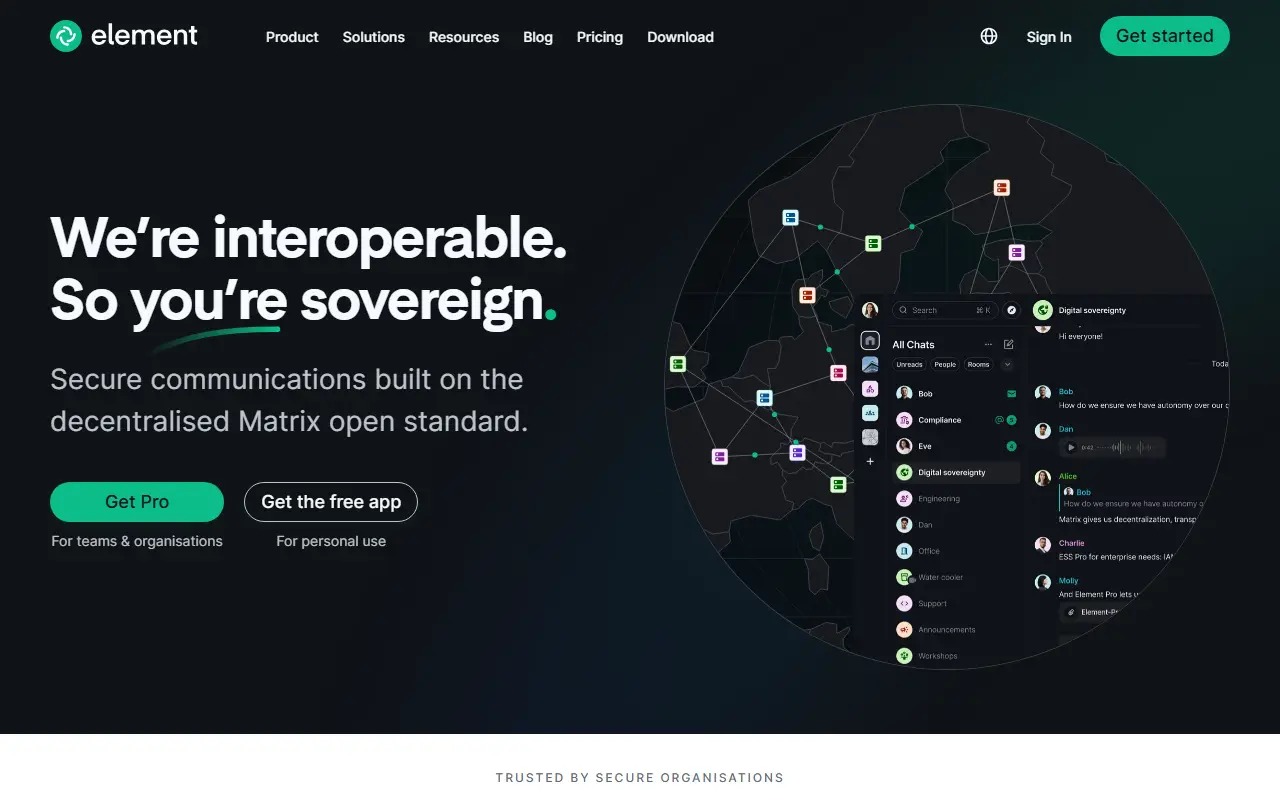
element.ioElement homepage screenshot

Element Web is a client for Matrix, the open protocol for decentralized messaging. It is the web and desktop application formerly known as Vector and Riot, and it lets people join rooms, chat in teams and communities, and collaborate across Matrix servers rather than inside a single vendor's network.

The client is built with TypeScript on top of the Matrix JS SDK. The README defines support tiers for browsers, covering recent versions of Chrome, Firefox, Edge and Safari on desktop, best-effort handling for ESR and extended-stable releases, and community support for mobile web. For phones and tablets the maintainers recommend the native Element X apps for Android and iOS.

It is released under the AGPL-3.0 license and is typically served from your own web host or used through the hosted app from the vendor, Element. Related products such as Element Call and the Enterprise Server Suite are mentioned as part of the wider Element offering. Changes are tracked on GitHub with regular release cycles.

Key features

  • Matrix web client for rooms and chat
  • Desktop app built from the same code
  • Built on the Matrix JS SDK
  • Documented browser support tiers
  • Works alongside Element X mobile apps

Pricing: Element Enterprise is priced per seat per month and Sovereign per deployment, but no prices are published; buyers are directed to talk to an expert.

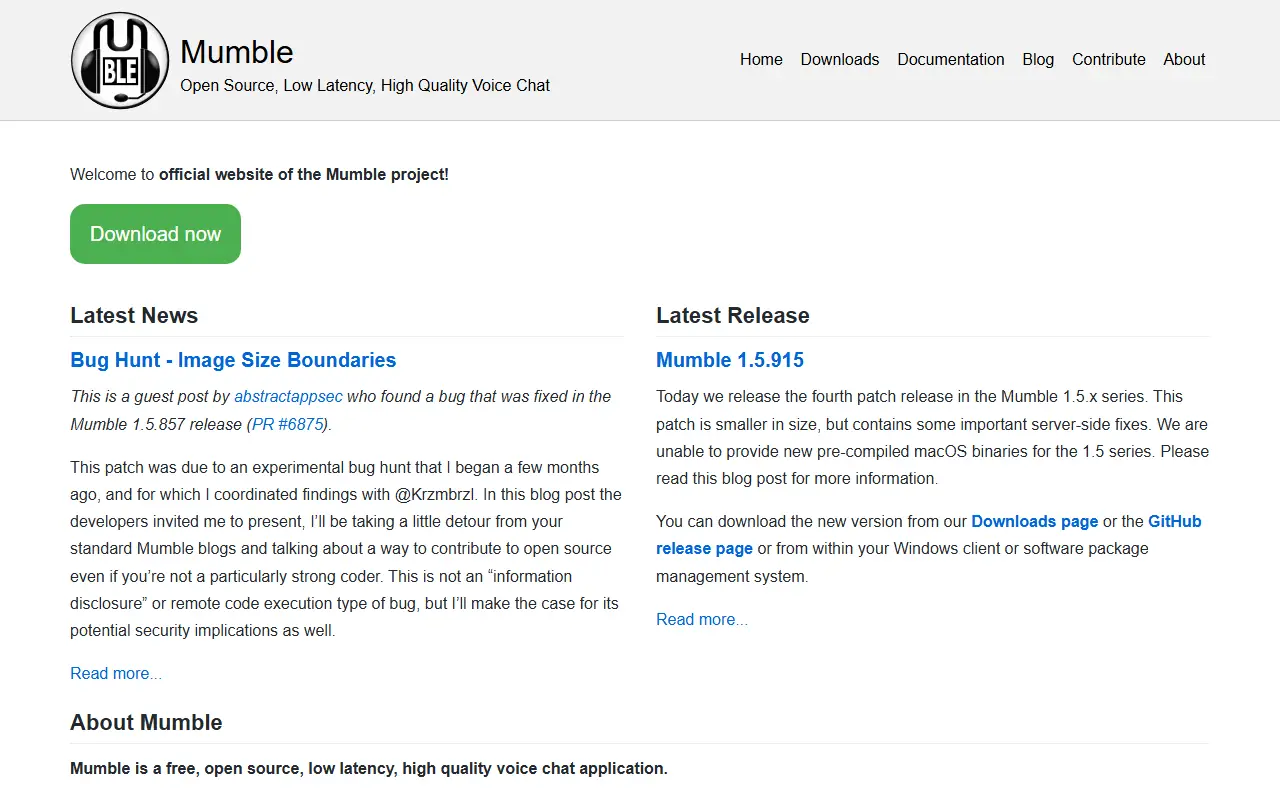
Mumble

Mumble is an open-source, low-latency voice chat program with a client and server built on Qt and Opus, popular with gaming groups and communities.

GitHub stars
8.3k
Last commit
today
Latest release
v1.5.915
Self-hosted
Yes
mumble.infoMumble homepage screenshot

Mumble is an open-source voice chat program designed for low latency and high audio quality. It is written on top of Qt and Opus and is used by groups, including gaming communities, that want to talk in real time on a server they control.

The software has two parts: the client, called mumble, and the server, called mumble-server, which was formerly known as murmur. The client is available for Windows, Linux, FreeBSD, OpenBSD and macOS, and the server is expected to run anywhere Qt can be installed. General-purpose plugins can add functionality that is not built into the main application, and the interface is translated through the Weblate platform.

Mumble is written in C++, and its licence is listed as non-standard on GitHub, so check the repository for details. Documentation lives on the project website, and the README gives build instructions that vary by branch, with the master branch holding unstable code for a future release.

Key features

  • Low-latency voice chat
  • Opus audio codec
  • Separate client and server programs
  • Clients for Windows, Linux, macOS and BSD
  • Plugin support
  • Community translations via Weblate

Cinny

A Matrix client with a simple, elegant interface, available as a web app and desktop app and self-hostable via a tarball or Docker image.

GitHub stars
3.9k
Last commit
4 days ago
Latest release
v4.12.7
Licence
AGPL-3.0
Self-hosted
Yes
Hosted version
Available
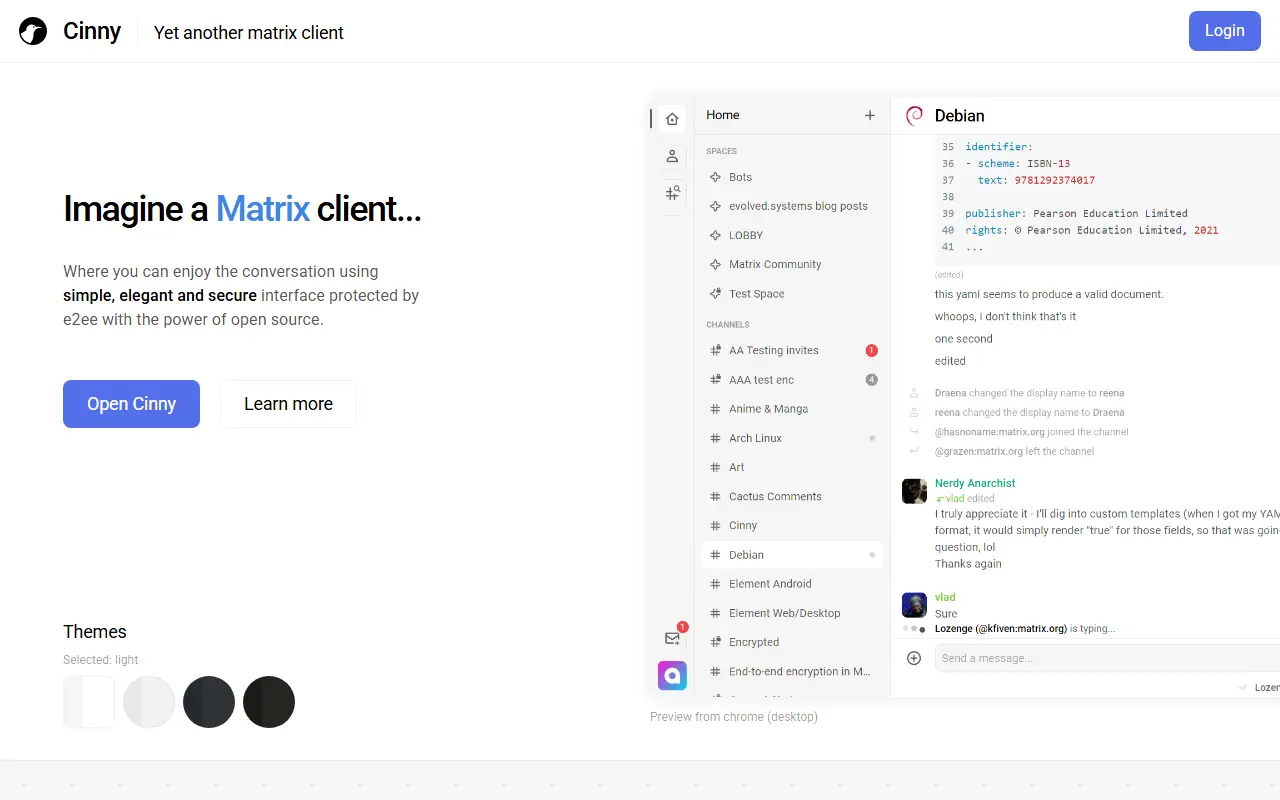
cinny.inCinny homepage screenshot

Cinny is a client for the Matrix chat network that focuses on a simple, elegant and secure interface. The stated aim is an instant messaging application that is easy on people and has a modern look.

The web app is available at app.cinny.in and is updated on every release, while the dev branch is continuously deployed to a separate address that may be unstable. A desktop app is distributed from the cinny-desktop repository. The maintainers are currently replacing matrix-js-sdk with their own SDK and are not accepting pull requests until further notice.

To self-host Cinny, download the release tarball and serve the dist directory with any web server, or pull the Docker image from Docker Hub or the GitHub Container Registry. Default homeservers and explore pages are set in config.json, redirects need to be configured for assets, and hash routing is available as a fallback. Cinny is written in TypeScript and licensed under AGPL-3.0.

Key features

  • Matrix chat client
  • Web app and desktop app
  • Self-hosting via tarball or Docker
  • Configurable default homeservers
  • Hash routing option for easy hosting

Pricing: Free and open source under the AGPL-3.0 licence.

Element Android

Element Classic, the previous-generation Matrix client for Android, which still receives security updates while Element X is recommended for new use.

GitHub stars
3.7k
Last commit
7 days ago
Latest release
v1.6.66
Licence
AGPL-3.0
element.ioElement Android homepage screenshot

Element Android, also called Element Classic, is a previous-generation Matrix collaboration client for Android provided by Element. It runs on Android devices with Lollipop (API 21) or newer. The README says this client is still supported and receives security updates, but no new features or usability improvements are being made, and it recommends the next-generation Element X app instead. The code is written in Kotlin and licensed under AGPL-3.0.

The project is built on a new Android SDK written entirely in Kotlin, which shares the repository with the app during early development. At each release the SDK module is copied to the matrix-android-sdk2 repository so that third-party apps can use it as a regular Gradle dependency. The README also explains the delay between a GitHub release and its appearance on Google Play and F-Droid, which includes beta periods and store reviews.

Key features

  • Matrix client for Android
  • Supports Android 5.0 (API 21) and newer
  • Security updates continue
  • Kotlin Matrix SDK module
  • Releases through Google Play and F-Droid

Pricing: Free and open source under the AGPL-3.0 licence.

Stoat

Developers is the Rust backend codebase behind Stoat, formerly Revolt, an open-source chat service built on MongoDB and Redis.

GitHub stars
3.4k
Last commit
yesterday
Latest release
v0.15.7
Hosted version
Available

This repository contains the services and libraries that power the Stoat chat service, whose earlier name Revolt still appears in the project's topics. It is a backend codebase written in Rust, using MongoDB for storage and Redis alongside it. The linked developer site documents the public API for people building on the platform.

The code is organized into core crates and server crates. The core crates cover configuration, the database implementation, file handling with S3 storage and encryption, API models, permission logic, user presence, shared result and error types, and a request coalescing service. On top of these sit a REST API server called delta and a WebSocket events server called bonfire.

Key features

  • REST API server for the chat service
  • WebSocket events server for real-time updates
  • Permission logic as a separate crate
  • S3 file storage with encryption helpers
  • User presence tracking

FluffyChat

FluffyChat is an open-source Matrix client written in Flutter, offering encrypted chats, group rooms, calls and spaces on many platforms.

GitHub stars
3.2k
Last commit
today
Latest release
v2.10.0
Licence
AGPL-3.0
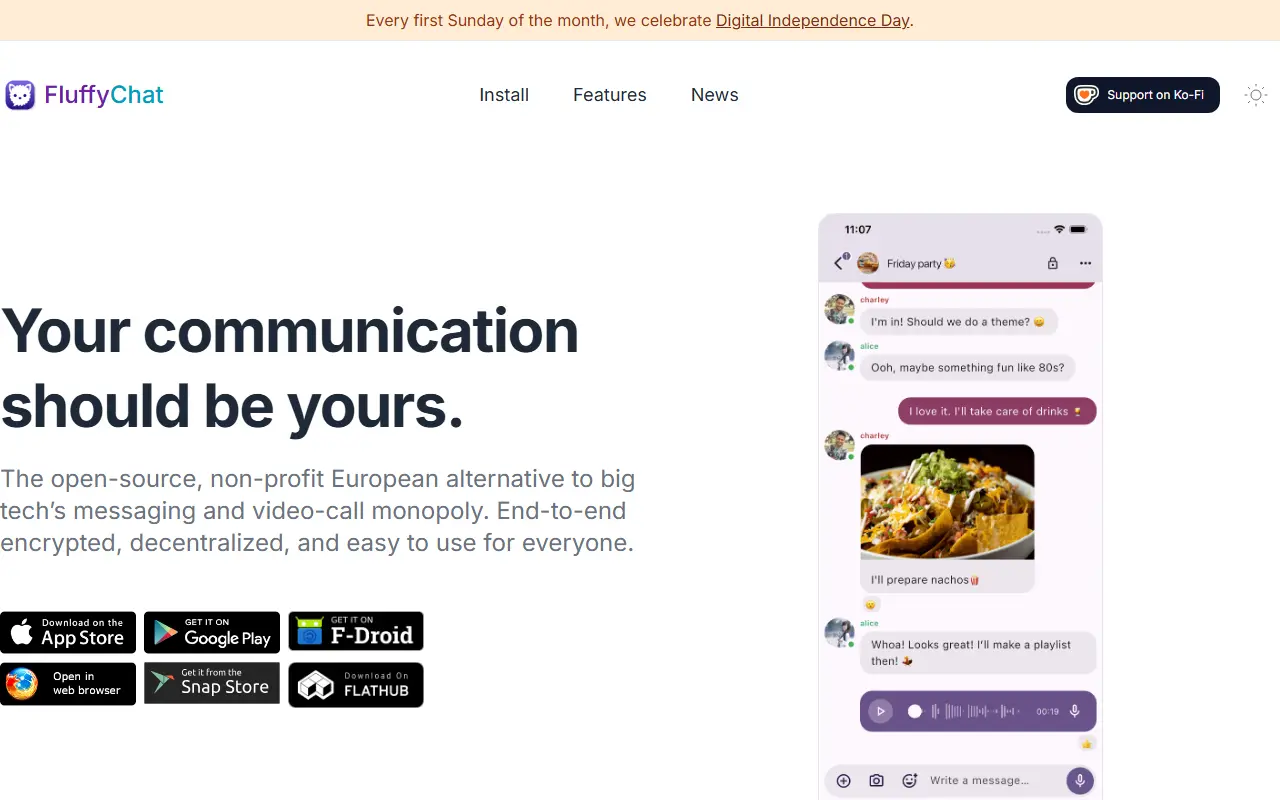
fluffychat.imFluffyChat homepage screenshot

FluffyChat is a nonprofit, open-source client for the Matrix network, written in Flutter. Its goal is to be an easy-to-use instant messenger that is open source and accessible to everyone. Because it speaks the Matrix protocol, it works with Matrix accounts and servers rather than a proprietary service of its own.

Users can send all kinds of messages, images and files, record voice messages, share locations and take part in video calls with Matrix RTC. It supports push notifications, unlimited private and public group chats, public channels, spaces, custom emotes and stickers, and moderation tools covering the Matrix feature set. Privacy features include end-to-end encryption, encrypted chat backup, emoji verification and cross-signing, and it follows Material You design.

For organizations, configuration can be pushed to Android and iOS devices through mobile device management since version 2.10.0, and on the web through a config.json file. Building from source requires Flutter and Rust. It is licensed under AGPL-3.0, with translations handled through Weblate and installation instructions on the project website.

Key features

  • Matrix client with end-to-end encryption
  • Video calls using Matrix RTC
  • Voice messages and location sharing
  • Group chats, public channels and spaces
  • Custom emotes and stickers
  • MDM configuration on Android and iOS
  • Encrypted chat backup and cross-signing

Pricing: Free and open source under AGPL-3.0; development is funded by donations.

Chatto

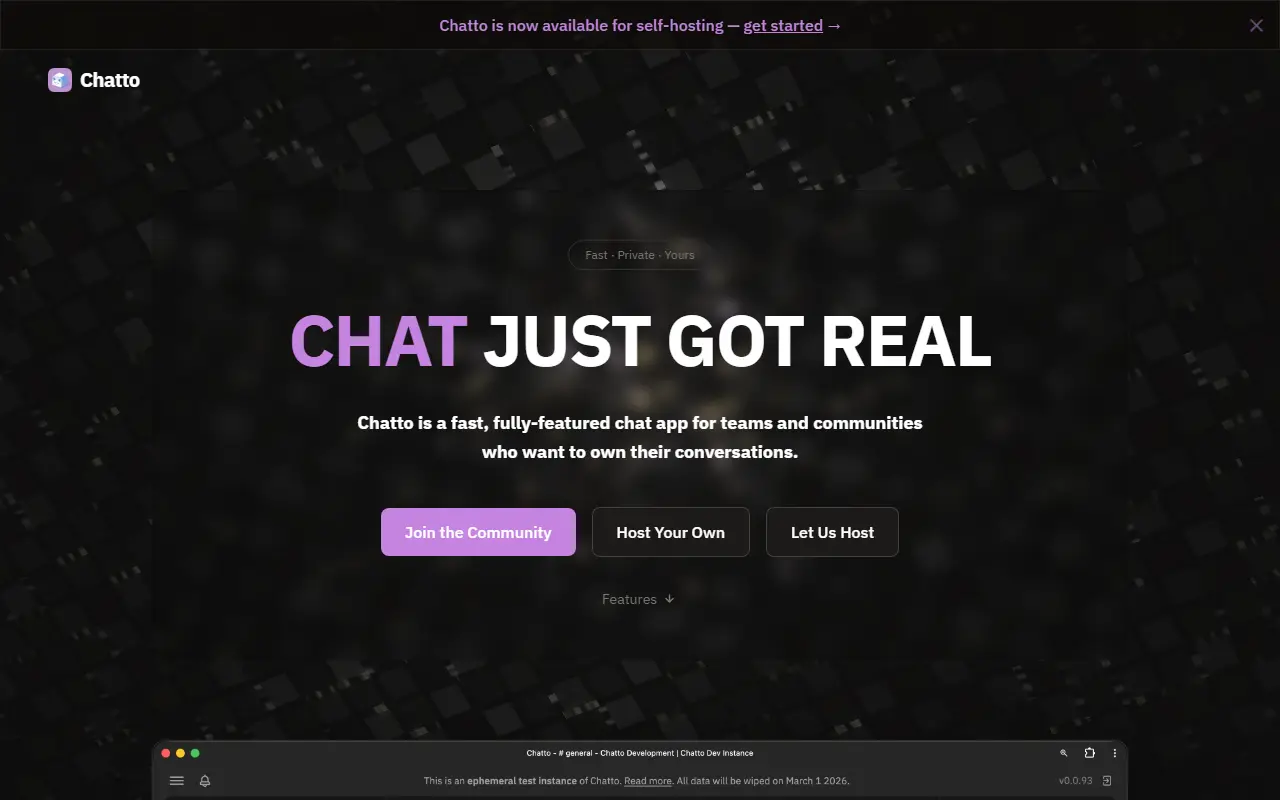
Self-hostable team and community chat application with channels, voice and video calls, and screen sharing, built with a privacy-first approach.

GitHub stars
2.8k
Last commit
today
Latest release
v0.4.24
Licence
AGPL-3.0
Self-hosted
Yes
chatto.runChatto homepage screenshot

Chatto is an open-source chat application for teams and communities that is meant to be free and easy to self-host. The repository contains the chat server, a command-line tool, and a bundled web front end, and the project describes itself as fully featured. It is released under the AGPL-3.0 license.

The topics describe a privacy-first design that is GDPR-compliant, and the application includes voice calls, video calls, and screen sharing in addition to text chat. The repository also hosts related components, including Runling, an independent workflow and agent orchestrator published on npm, and Authling, an identity provider that is expected to move to its own repository.

The README says cloud hosting will be available soon, so self-hosting is the supported route today, with a documentation site and releases for installation. The authors note that Chatto is built with the help of coding agents. It is a young project created in 2026 and suits teams that want an alternative to hosted workplace chat tools.

Key features

  • Team and community text chat
  • Voice and video calls
  • Screen sharing
  • Bundled web front end and CLI
  • Privacy-first, GDPR-oriented design
  • Self-hosting documentation and releases

Pricing: Free and open source under the AGPL-3.0 license; the project says cloud hosting is coming.

Quiet

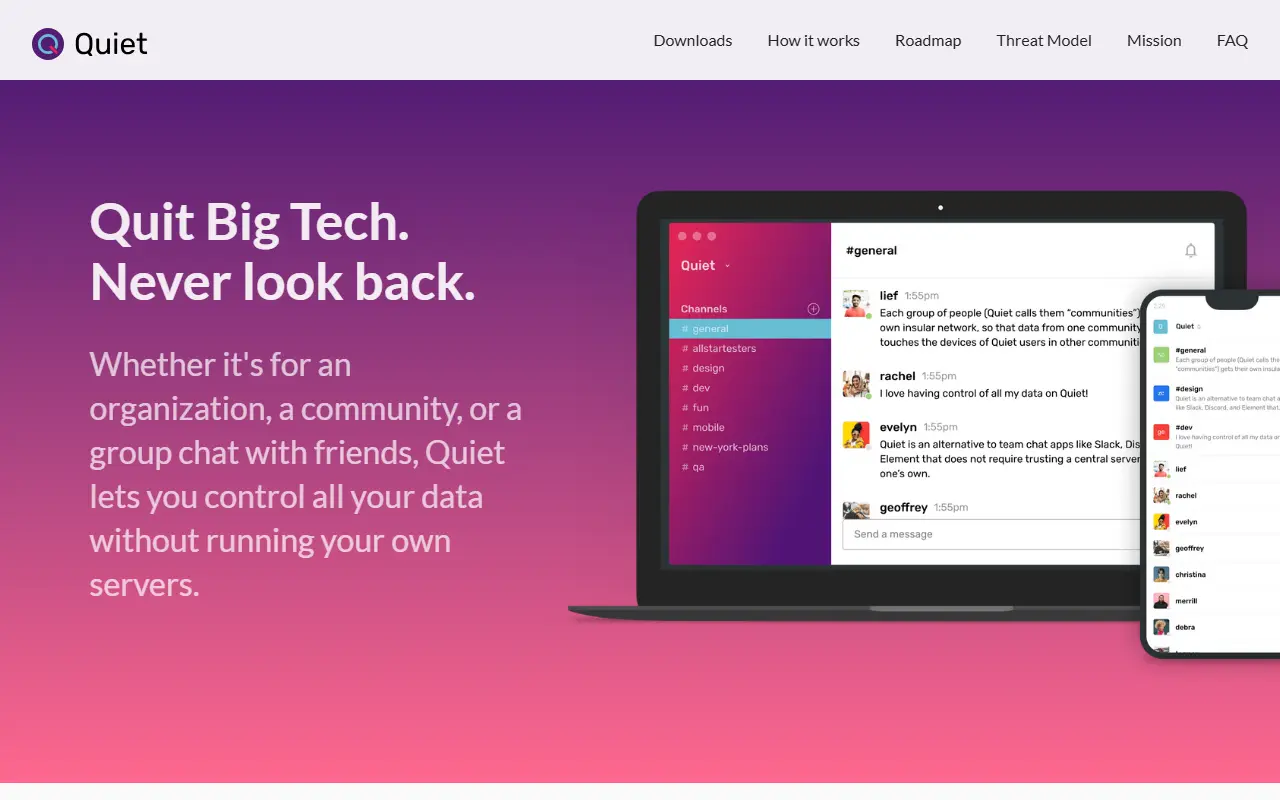
Peer-to-peer team chat that syncs encrypted messages directly between devices over Tor with no central server, offered as an alternative to Slack and Discord.

GitHub stars
2.7k
Last commit
4 days ago
Latest release
@quiet/mobile@11.3.0
Licence
GPL-3.0
tryquiet.orgQuiet homepage screenshot

Quiet is an encrypted team chat application that requires neither trusting a central server nor running one yourself. Instead, messages sync directly between a team's devices over Tor, and each group, called a community, has its own isolated network so data never reaches users in other communities. It is released under the GPL-3.0 license.

The project positions itself as an alternative to Slack, Discord, and Element. Message syncing uses OrbitDB, described as a mix of Git and a gossip protocol, on top of IPFS. The app is mostly TypeScript, with Electron for desktop and React Native for mobile.

The README is candid about its limits: Quiet has not been audited and should not be used where privacy and security are critical, and it lacks basic features, so it may not yet replace a mainstream chat tool. The developers say they use it daily. It appeals to fans of decentralization and local-first software who want to experiment with server-free collaboration.

Key features

  • Serverless peer-to-peer messaging over Tor
  • Isolated networks per community
  • Message sync built on OrbitDB and IPFS
  • Desktop apps and a React Native mobile app
  • Encrypted communication

Pricing: Free and open source under the GPL-3.0 license.

Tuwunel

High-performance Matrix homeserver written in Rust, offered as a Synapse alternative and the official successor to conduwuit.

GitHub stars
2.6k
Last commit
today
Latest release
v1.9.3
Licence
Apache-2.0
Self-hosted
Yes
tuwunel.chatTuwunel homepage screenshot

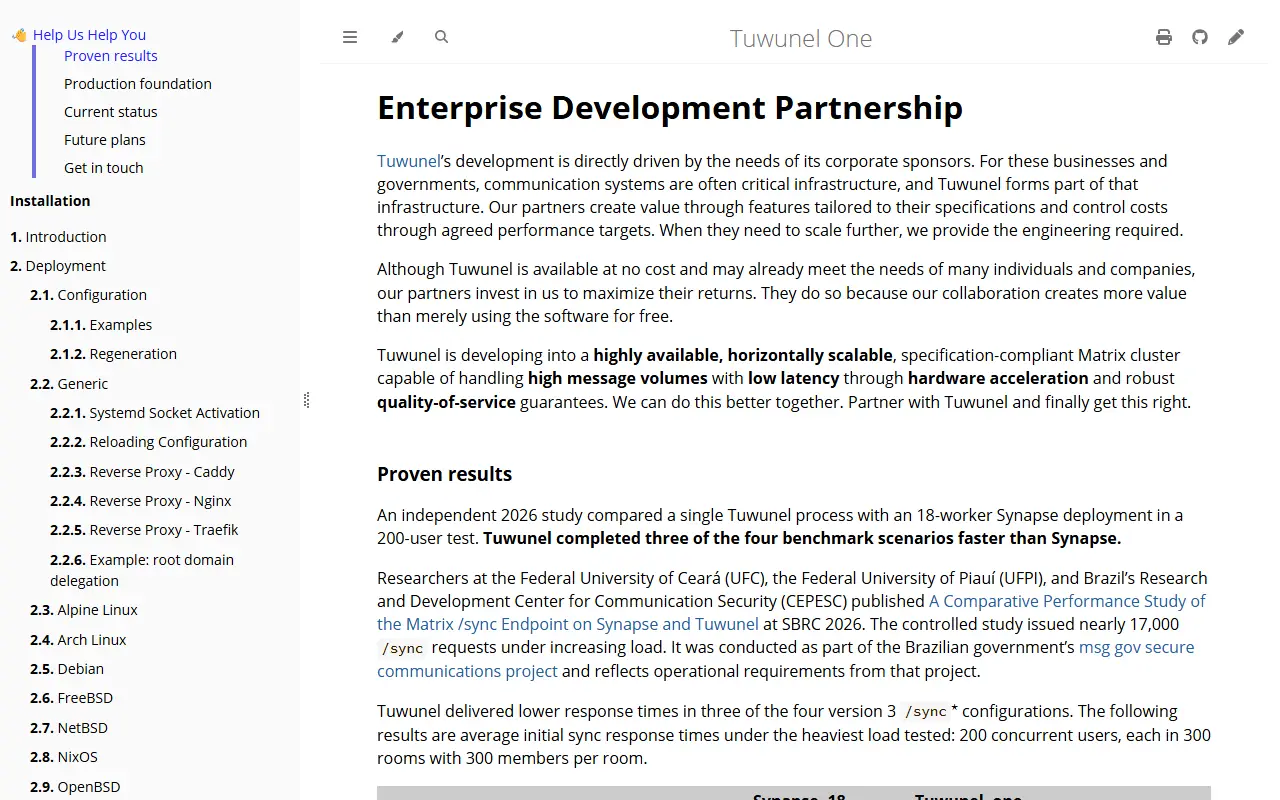
Tuwunel is a Matrix homeserver written entirely in Rust that you can use in place of Synapse with your favorite client, bridge, or bot. It aims to be scalable, low-cost, enterprise-ready, and community-driven, and implements the Matrix specification for everything except the most niche uses. It is released under the Apache-2.0 license.

The project is the official successor to conduwuit, which reached stability, and its topics mention Conduit and RocksDB. According to the README, many companies with an interest in its development now support it with full-time staff, and it is primarily sponsored by the Swiss government, where it is deployed for citizens.

You can get it from GitHub releases, build it from source, or pull a Docker image from Docker Hub. It suits individuals, communities, and organizations that want to run their own Matrix server with lower resource use than heavier implementations, and that need federation with the wider Matrix network.

Key features

  • Full-featured Matrix homeserver
  • Written entirely in Rust
  • Works with existing Matrix clients, bridges, and bots
  • Docker image and release binaries
  • RocksDB storage backend
  • Successor to conduwuit

Pricing: Free and open source under the Apache-2.0 license.

Nheko

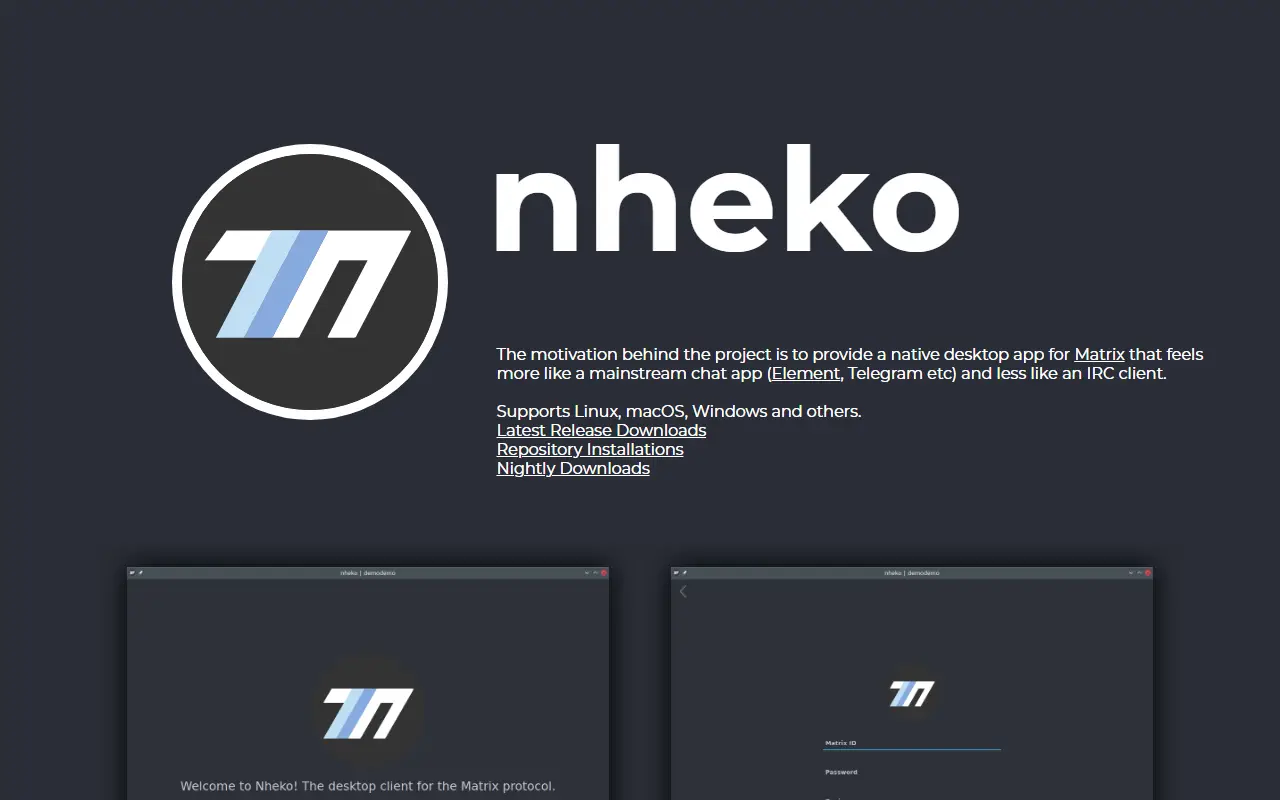
Nheko is a native desktop Matrix client built with Qt and C++20 that aims to feel like a mainstream chat app rather than an IRC client.

GitHub stars
2.5k
Last commit
22 days ago
Latest release
v0.12.1
Licence
GPL-3.0
nheko-reborn.github.ioNheko homepage screenshot

Nheko is a desktop client for Matrix, written with Qt and C++20. The project was started to provide a native app that feels more like mainstream chat applications such as Element and Telegram, and less like an IRC client. It runs on Linux, macOS and Windows and is licensed under GPL-3.0.

Supported features include end-to-end encryption, voice and video calls (with support varying by platform), user registration, creating, joining and leaving rooms, invites, file and emoji sharing with inline previews, custom stickers and emoji, replies, typing notifications, username auto-completion, notifications, message redaction, read receipts, presence and status messages, basic communities, a quick room switcher with Ctrl-K, and light, dark and system themes. A D-Bus API is available on Linux for plugins.

The README cautions that the encryption implementation is mostly stable but has never been audited, so people relying on it for security get no guarantee. Releases are provided as a Flatpak for Linux, a disk image for macOS and an MSIX or appinstaller for Windows, and translations are crowdsourced. Separate profiles can be created from the command line.

Key features

  • Native desktop Matrix client in Qt
  • End-to-end encryption
  • Voice and video calls
  • Custom stickers and emoji
  • Room switcher with keyboard shortcut
  • Light, dark and system themes
  • D-Bus API for plugins on Linux

Pricing: Free and open source under the GPL-3.0 license.

8 more Discord alternatives

Discord alternatives: questions

What is the best open-source alternative to Discord?
Element is the top-ranked open-source alternative to Discord on Enlisted: Web and desktop client for the Matrix network, offering encrypted chat, rooms and collaboration built on the Matrix JS SDK. Other strong options are Mumble, Cinny, Element Android and Stoat.
Are these Discord alternatives free?
All 18 are open source, so the code is free to use under its licence, and all of them can be self-hosted on your own server or computer. 6 also offer a paid or managed cloud version if you'd rather not host it yourself.
How is this list of Discord alternatives ranked?
By a score built from GitHub stars, star growth over the last 30 days and how recently the code changed. 15 of these projects shipped code in the last 30 days. Data is refreshed daily, and nobody can pay to move up.

People also look for alternatives to…

View all