
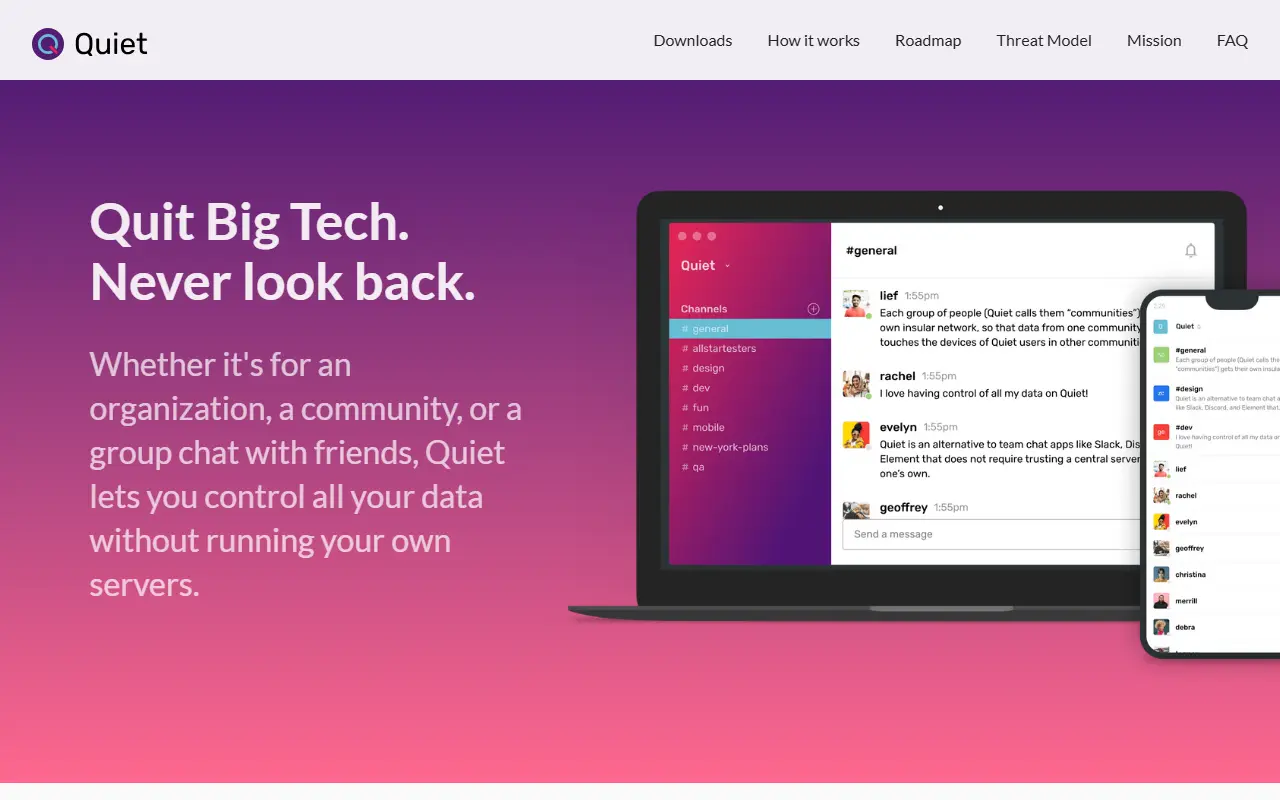
About Quiet
Quiet is an encrypted team chat application that requires neither trusting a central server nor running one yourself. Instead, messages sync directly between a team's devices over Tor, and each group, called a community, has its own isolated network so data never reaches users in other communities. It is released under the GPL-3.0 license.
The project positions itself as an alternative to Slack, Discord, and Element. Message syncing uses OrbitDB, described as a mix of Git and a gossip protocol, on top of IPFS. The app is mostly TypeScript, with Electron for desktop and React Native for mobile.
The README is candid about its limits: Quiet has not been audited and should not be used where privacy and security are critical, and it lacks basic features, so it may not yet replace a mainstream chat tool. The developers say they use it daily. It appeals to fans of decentralization and local-first software who want to experiment with server-free collaboration.
Key features
- Serverless peer-to-peer messaging over Tor
- Isolated networks per community
- Message sync built on OrbitDB and IPFS
- Desktop apps and a React Native mobile app
- Encrypted communication
Good fit for
- →Small teams that want chat without a central server
- →Experimenting with decentralized collaboration
- Built with
- TypeScript
- Tags
- team-chat
- p2p
- tor
- privacy
- decentralized
- ipfs
- slack-alternative
- local-first
Quiet: questions and answers
- What is Quiet used for?
- Quiet is a peer-to-peer team chat that syncs encrypted messages directly between devices over Tor with no central server, offered as an alternative to Slack and Discord. It is a good fit for small teams that want chat without a central server and experimenting with decentralized collaboration.
- Is Quiet open source?
- Yes. Quiet is open source under the GPL-3.0 licence. Its source code is on GitHub at TryQuiet/quiet and is written mainly in TypeScript.
- Is Quiet free?
- Yes. Quiet is open source, so the software itself is free to use.
- Can I self-host Quiet?
- Yes. Quiet can be self-hosted on your own server or infrastructure; there is no official hosted version.
- What is Quiet an alternative to?
- Quiet is an open-source alternative to Slack and Discord. Other open-source alternatives to Slack include Cabal Desktop, Chatto and Element.
- Is Quiet actively maintained?
- Yes. The most recent commit to Quiet was on 28 September 2026. The project has 2.7k stars on GitHub.
Open-source alternatives to Quiet
See all
Cabal Desktop
Team Chat
Desktop client for Cabal, the p2p/decentralized/local-first chat platform.
AGPL-3.0vs Slack★ 915
Chatto
Team Chat
A fully-featured team and group chat application that you can easily selfhost.
AGPL-3.0vs Slack★ 2.8k
Element
Team Chat
A glossy Matrix collaboration client for the web.
AGPL-3.0vs Slack★ 14k
VoceChat
Team Chat
VoceChat Web App
GPL-3.0vs Slack★ 2.3k
Mezon
Team Chat
Mezon is a new way to communicate with your team. It's faster, better organized, better fo
OSSvs Slack★ 2kFiora
Team Chat
An interesting open source chat application. Developed with node.js, mongoDB, socket.io an
MITvs Discord★ 7.2k
SaaS alternatives to Quiet
See all
Slack
Team Chat
Slack is a team messaging platform with channels, huddles, canvases, workflows and AI features, now part of Salesforce.
SaaS
Discord
Team Chat
Discord is a group chat and voice platform for gaming and community servers, with text channels, voice rooms and video.
SaaS
Pumble
Team Chat
Slack-style team chat with channels, threads and calls
SaaS
Google Chat
Team Chat
Messaging and spaces inside Google Workspace with Meet and Docs integration
SaaS
Twist
Team Chat
Threaded asynchronous team communication from the makers of Todoist
SaaS
Microsoft Teams
Team Chat
Microsoft Teams is Microsoft's workspace for chat, video meetings and file collaboration, closely tied to Microsoft 365.
SaaS