6,598 open-source and SaaS tools, with GitHub stats refreshed every day.

5 alternatives ranked by real activity

Open-source Acronis Cyber Protect alternatives

A curated, ranked list of the 5 best open-source alternatives to Acronis Cyber Protect.

The best open-source alternative to Acronis Cyber Protect is Duplicati. If that doesn't suit you, other good options are Kopia, Backrest, Zerobyte and Bareos.

Acronis Cyber Protect alternatives are mainly File Storage & Sharing tools. 5 of them shipped code in the last 30 days, 5 can be self-hosted, and 1 uses a permissive licence.

Last updated October 2, 2026 · ranked by GitHub stars, growth and recent commits

Duplicati

Duplicati is a free, open-source backup client that stores encrypted, incremental, compressed backups on cloud storage and remote servers.

GitHub stars
15k
Last commit
today
Latest release
v2.4.0.0_stable_2026-09-03
Self-hosted
Yes

Duplicati is a free, open-source backup client that securely stores encrypted, incremental and compressed backups on cloud storage services and remote file servers. According to its README it is licensed under the MIT license and available for Windows, macOS and Linux, and it is written in C#.

Data is encrypted with AES-256 or GNU Privacy Guard before it is uploaded. Only the first backup is a full copy, and later backups are differential to save bandwidth and storage. A built-in scheduler keeps backups current, and an integrated updater announces new releases. Supported destinations include Amazon S3, Backblaze B2, Box, Dropbox, FTP, Google Cloud and Drive, MEGA, Microsoft Azure and OneDrive, Storj, SFTP, WebDAV and others.

Releases are GPG-signed, and the project offers a forum, an online manual and several update channels from stable to more experimental builds. Because the backup client runs on your own machines and sends data to storage you choose, it suits individuals and small teams who want client-side encrypted backups without a vendor-hosted service.

Key features

  • AES-256 or GPG encryption before upload
  • Incremental and compressed backups
  • Built-in backup scheduler
  • Many cloud and remote destinations
  • Integrated updater with signed releases
  • Windows, macOS and Linux support

Pricing: Free and open source; the README states it is licensed under the MIT license.

Read more about DuplicatiGitHub

Kopia

Cross-platform backup tool with encrypted, deduplicated snapshots sent to cloud storage, a NAS or local disks, with both CLI and GUI.

GitHub stars
14k
Last commit
yesterday
Latest release
v0.23.1
Licence
Apache-2.0
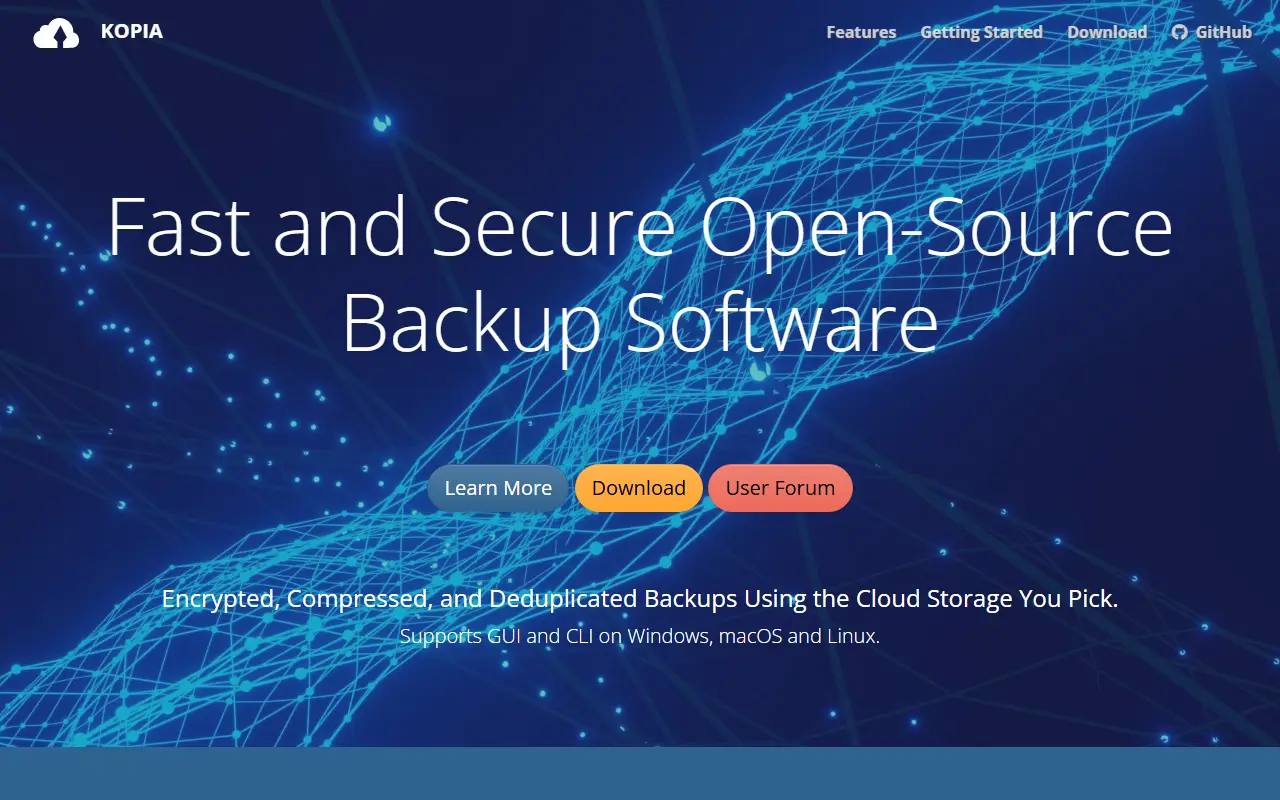
kopia.ioKopia homepage screenshot

Kopia is an open-source backup and restore tool that creates encrypted snapshots of selected files and directories. It does not image a whole machine; instead you choose the folders that matter and Kopia stores the snapshots in the location you pick, whether that is cloud storage, a network server or a local disk.

Compression, deduplication, error correction and end-to-end encryption controlled by the user are built in, so repeated backups stay small and the storage provider never sees readable data. Supported destinations include Amazon S3 and S3-compatible services, Azure Blob Storage, Backblaze B2, Google Cloud Storage, WebDAV, SFTP and, experimentally, a subset of Rclone backends.

Both a command-line interface and a graphical interface are included, so the tool suits advanced users and people who prefer a GUI. It runs on Windows, macOS and Linux, is written in Go and is licensed under Apache-2.0. The project site offers installation instructions and a step-by-step getting started guide.

Key features

  • Encrypted snapshots with client-side encryption
  • Incremental backups with data deduplication
  • Compression and error correction
  • S3, Azure, B2, Google Cloud, WebDAV and SFTP targets
  • Command-line and graphical interfaces
  • Runs on Windows, macOS and Linux

Pricing: Free and open source under the Apache-2.0 license.

Read more about KopiaWebsite GitHub

Backrest

Backrest is a web UI and scheduler for restic backups that lets you create repos, browse snapshots and restore files from a single lightweight binary.

GitHub stars
7.4k
Last commit
11 days ago
Latest release
v1.14.1
Licence
GPL-3.0
Self-hosted
Yes
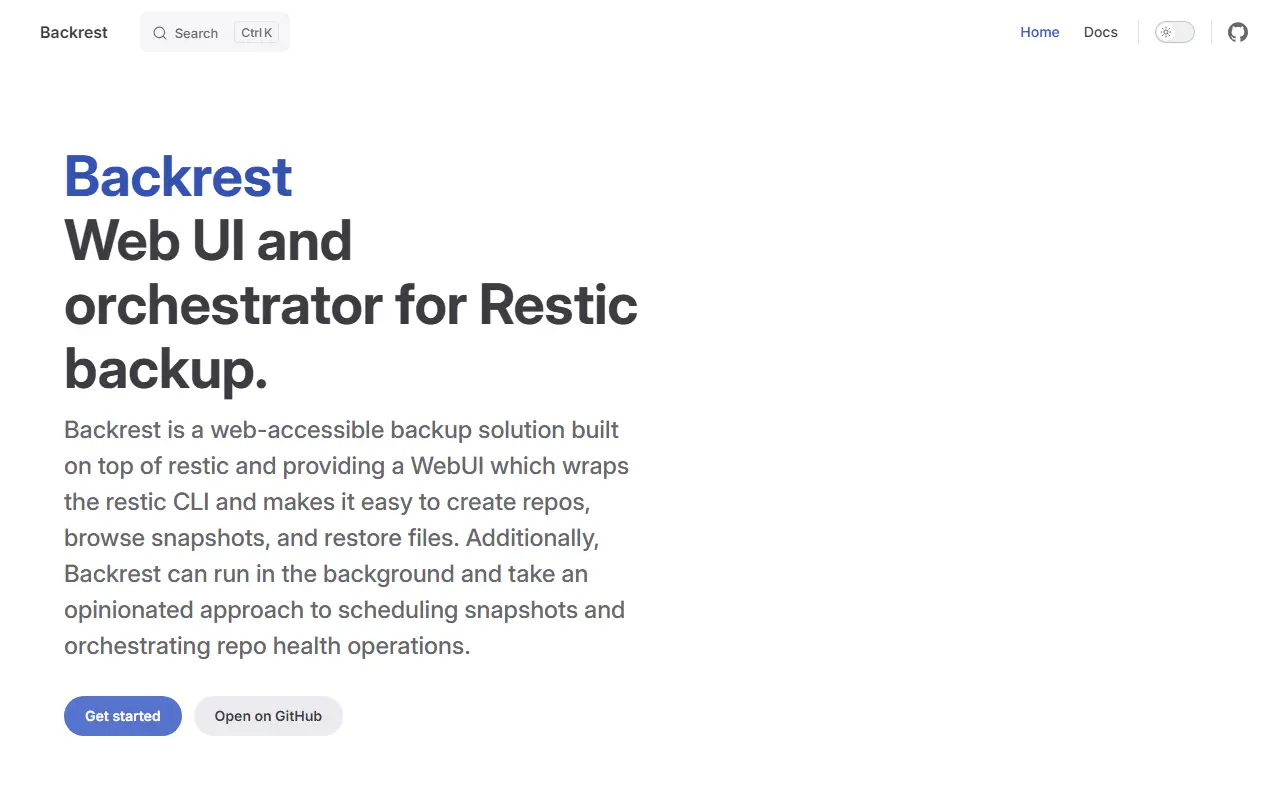
garethgeorge.github.ioBackrest homepage screenshot

Backrest is a backup tool you reach through a web browser, built on restic. Its web interface wraps the restic command-line tool so you can create repositories, browse snapshots and restore files, and it can run in the background to schedule snapshots and orchestrate repository health tasks.

It supports importing existing restic repositories and cron-scheduled backups and maintenance such as prune, check and forget. Notifications can be sent through Discord, Slack, Shoutrrr, Gotify or Healthchecks, and pre and post backup hooks can run shell scripts. All restic storage backends are supported, including S3, B2, Azure, GCS, local and SFTP, along with rclone remotes. The interface can be reached locally or remotely, which suits NAS deployments, and the restic CLI remains available for advanced operations.

Backrest is written in Go with a TypeScript interface, licensed under GPL-3.0 and distributed as a standalone binary whose only dependency is restic, downloaded on first run. It runs on Linux, macOS, Windows, FreeBSD and Docker.

Key features

  • Web UI wrapping the restic CLI
  • Browse snapshots and restore files
  • Cron-scheduled backups and maintenance
  • Notifications via Discord, Slack and Gotify
  • Pre and post backup command hooks
  • Supports S3, B2, SFTP and rclone remotes

Pricing: Free and open source under the GPL-3.0 licence.

Read more about BackrestWebsite GitHub

Zerobyte

A web control plane built on Restic that schedules, manages and monitors encrypted backups from NFS, SMB, WebDAV, SFTP and local sources.

GitHub stars
7k
Last commit
today
Latest release
v0.43.1
Licence
AGPL-3.0
Self-hosted
Yes
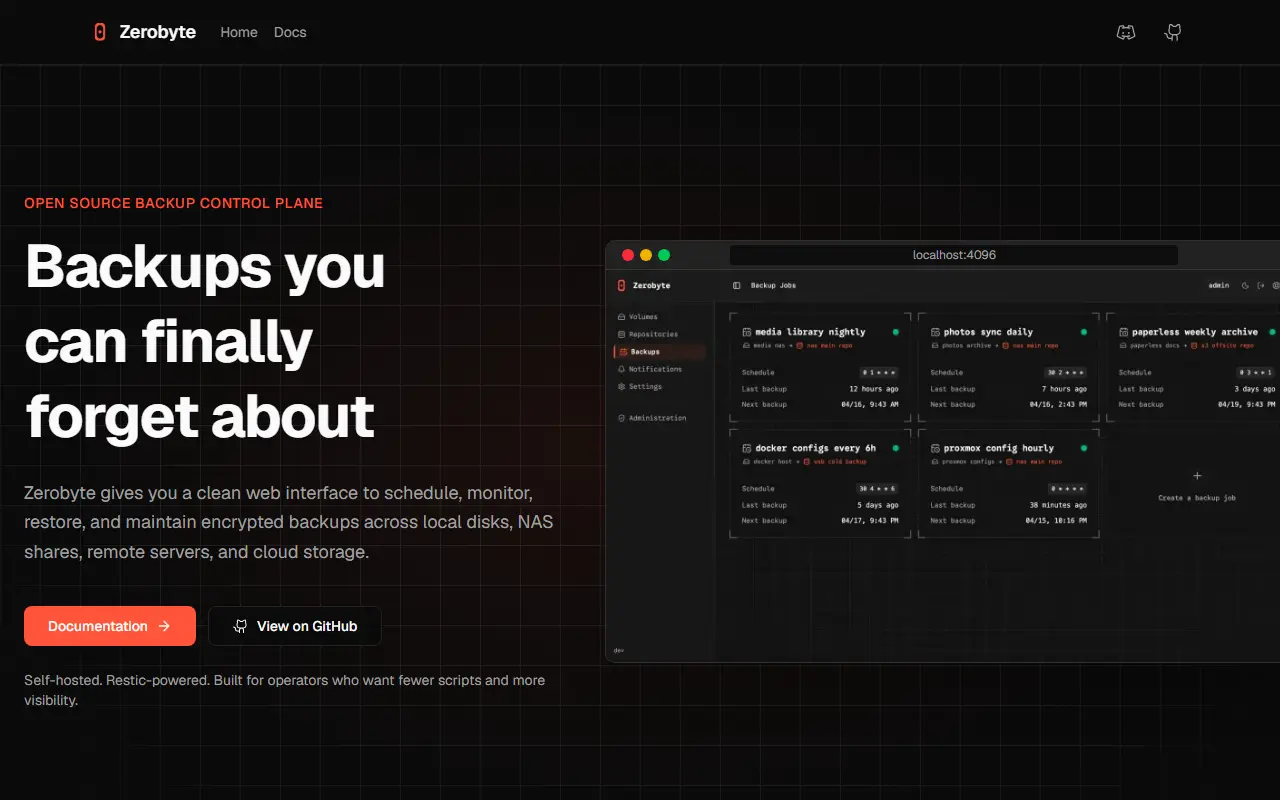
zerobyte.appZerobyte homepage screenshot

Zerobyte is a backup automation tool for self-hosters, built on top of Restic. It adds a web interface for scheduling, managing and monitoring encrypted backups of remote storage, so Restic's capabilities can be used without hand-writing scripts and cron jobs.

Backups are encrypted, compressed and kept according to retention policies, with flexible scheduling for automated jobs and fine-grained retention rules. Data can be backed up from several protocols, including NFS, SMB, WebDAV, SFTP and local directories. The README says the full documentation, with setup guides and configuration reference, is on zerobyte.app.

Zerobyte runs with Docker and Docker Compose using the provided compose file. It is licensed under AGPL-3.0 and still at version 0.x, so the authors warn of major changes between versions. They also advise against exposing it directly to the internet, recommending a localhost port mapping with a secure tunnel, and against pointing its data directory to a network share.

Key features

  • Web interface for Restic backups
  • Scheduled backup jobs
  • Encryption, compression and retention policies
  • Backup from NFS, SMB, WebDAV and SFTP
  • Monitoring of backup status
  • Docker Compose deployment

Pricing: Free and open source under the AGPL-3.0 licence.

Read more about ZerobyteWebsite GitHub

Bareos

Bareos is open-source backup and recovery software for mixed IT environments, with disk, tape and S3 storage and a web interface.

GitHub stars
1.3k
Last commit
today
Latest release
Release/25.1.1
Self-hosted
Yes
bareos.orgBareos homepage screenshot

Bareos is backup and recovery software for mixed IT environments. It helps organizations back up, restore and manage data across networks, operating systems, storage targets and workloads. The project is licensed under AGPLv3, and the README says it follows an open-source approach without open-core restrictions. Supported systems include Linux, Windows, FreeBSD and macOS.

The architecture is designed for many clients, storage daemons and backup targets across a network. Backups can go to disk, tape or S3-compatible object storage, in a format that suits deduplicating filesystems such as ZFS, VDO and btrfs, and a tool called bdedupestimate helps estimate the benefit. Always Incremental backups are available for file-based data, and a catalog with the WebUI helps teams find and restore the right data.

Administration is scriptable through bconsole and command-line tools, with the Bareos WebUI as a graphical alternative. Role-based ACLs control commands and objects, and encryption covers communication and backups. Plugins extend support to virtual environments, databases and specialized workloads, including VMware vSphere, Hyper-V and Proxmox. It is written in C++ and Python.

Key features

  • Backup to disk, tape and S3 storage
  • Always Incremental backup scheme
  • Catalog and WebUI for controlled restores
  • Role-based access control lists
  • Encrypted communication and backups
  • Plugins for VMware, Hyper-V and Proxmox
  • Scriptable administration through bconsole

Pricing: Bareos has no license fees. A subscription for maintained binaries and plugins starts at €480 per year and support at €1,080 per year; services and development are quoted separately.

Read more about BareosWebsite GitHub

Acronis Cyber Protect alternatives: questions

What is the best open-source alternative to Acronis Cyber Protect?
Duplicati is the top-ranked open-source alternative to Acronis Cyber Protect on Enlisted: Duplicati is a free, open-source backup client that stores encrypted, incremental, compressed backups on cloud storage and remote servers. Other strong options are Kopia, Backrest, Zerobyte and Bareos.
Are these Acronis Cyber Protect alternatives free?
All 5 are open source, so the code is free to use under its licence, and 5 of them can be self-hosted on your own server.
How is this list of Acronis Cyber Protect alternatives ranked?
By a score built from GitHub stars, star growth over the last 30 days and how recently the code changed. 5 of these projects shipped code in the last 30 days. Data is refreshed daily, and nobody can pay to move up.

People also look for alternatives to…

View all