
About Commvault
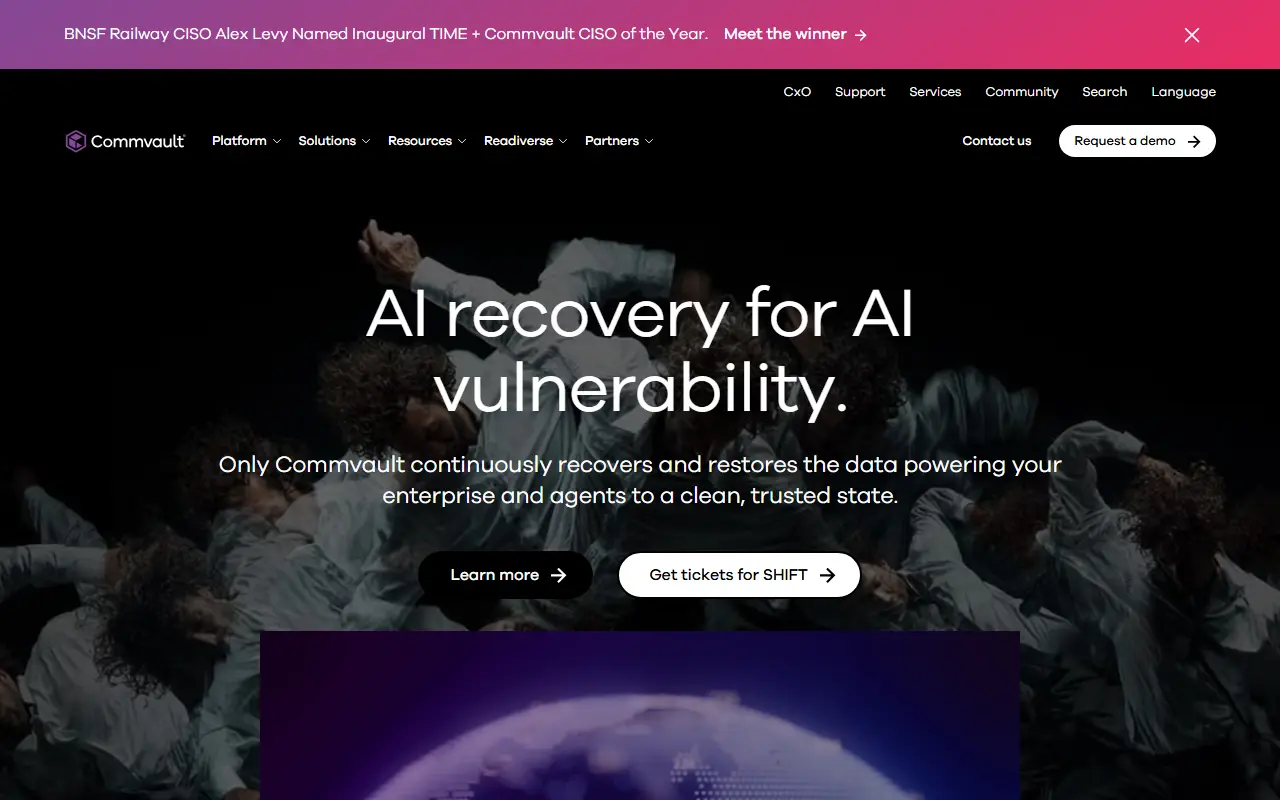
Commvault is a commercial data protection and cyber resilience platform for enterprises. Its Commvault Cloud brings backup, recovery and security tooling together so organizations can protect data across cloud, SaaS and on-premises environments from one platform.
The platform is organized around data protection for cloud-native, cloud application and hybrid or on-premises workloads, cyber recovery with cleanpoint identification, cleanroom recovery and threat hunting, identity resilience for Active Directory and Entra ID, and data and AI security with discovery, classification and access governance. Supported environments include AWS, Azure, Google Cloud, Kubernetes, Microsoft 365, Salesforce, Hyper-V, Nutanix AHV and VMware.
Newer additions focus on AI data resilience, agent workflows and its Metallic AI offering, and industry pages target government, healthcare, financial services and education. Commvault is sold commercially to enterprises, and details of plans are available on its website.
Key features
- Backup and recovery for cloud and on-premises
- Cleanroom recovery and cyber recovery tools
- Threat hunting and response
- Identity recovery for Active Directory and Entra ID
- Data discovery, classification and access governance
- Support for AWS, Azure, Kubernetes and VMware
Good fit for
- →Recovering enterprise data after a cyberattack
- →Protecting hybrid cloud and on-premises workloads
- Tags
- backup
- data-protection
- cyber-recovery
- enterprise
- ransomware
- identity-resilience
- disaster-recovery
Commvault: questions and answers
- What is Commvault used for?
- Commvault is an enterprise data protection platform that covers backup, cyber recovery, identity resilience and data security across cloud, SaaS and on-premises environments. It is a good fit for recovering enterprise data after a cyberattack, and protecting hybrid cloud and on-premises workloads.
- How much does Commvault cost?
- Commvault doesn't publish fixed prices; pricing is quoted on request.
- Is Commvault open source?
- No. Commvault is proprietary (closed-source) software. Open-source alternatives to Commvault include Bareos, restic and Kopia.
- Can I self-host Commvault?
- Yes. Although Commvault is closed source, it can be self-hosted on your own servers, and the vendor also offers a hosted version.
- What are some alternatives to Commvault?
- Commvault competes with Veeam, Rubrik and Cohesity. For open-source options, see Enlisted's ranked list of open-source Commvault alternatives.
Open-source alternatives to Commvault
See all
Bareos
File Storage & Sharing
Bareos is a cross-network Open Source backup solution (licensed under AGPLv3) which preser
OSSvs Veeam★ 1.3k
restic
File Storage & Sharing
Fast, secure, efficient backup program
BSD-2-Clausevs CrashPlan★ 36k
Kopia
File Storage & Sharing
Cross-platform backup tool for Windows, macOS & Linux with fast, incremental backups, clie
Apache-2.0vs Backblaze Computer Backup★ 14k
BorgBackup
File Storage & Sharing
Deduplicating archiver with compression and authenticated encryption.
OSSvs Backblaze Computer Backup★ 14k
Zerobyte
File Storage & Sharing
Zerobyte is a web control plane for Restic backups with scheduling, encrypted repositories
AGPL-3.0vs Acronis Cyber Protect★ 7k
Syncthing
File Storage & Sharing
Open Source Continuous File Synchronization
MPL-2.0vs Dropbox★ 89k
SaaS alternatives to Commvault
See all
Veeam
File Storage & Sharing
Backup and recovery software for virtual, cloud and physical workloads
SaaS
Rubrik
File Storage & Sharing
Data security platform for backup, cyber recovery and identity resilience
SaaSCohesity
File Storage & Sharing
Data security and management platform with backup, recovery and ransomware protection
SaaS
Druva
File Storage & Sharing
Cloud-native data protection and backup SaaS for endpoints, servers and SaaS apps
SaaS
Acronis Cyber Protect
File Storage & Sharing
Backup, disaster recovery and endpoint protection combined in one agent
SaaS
CrashPlan
File Storage & Sharing
Endpoint and cloud-app backup and recovery for businesses
SaaS