
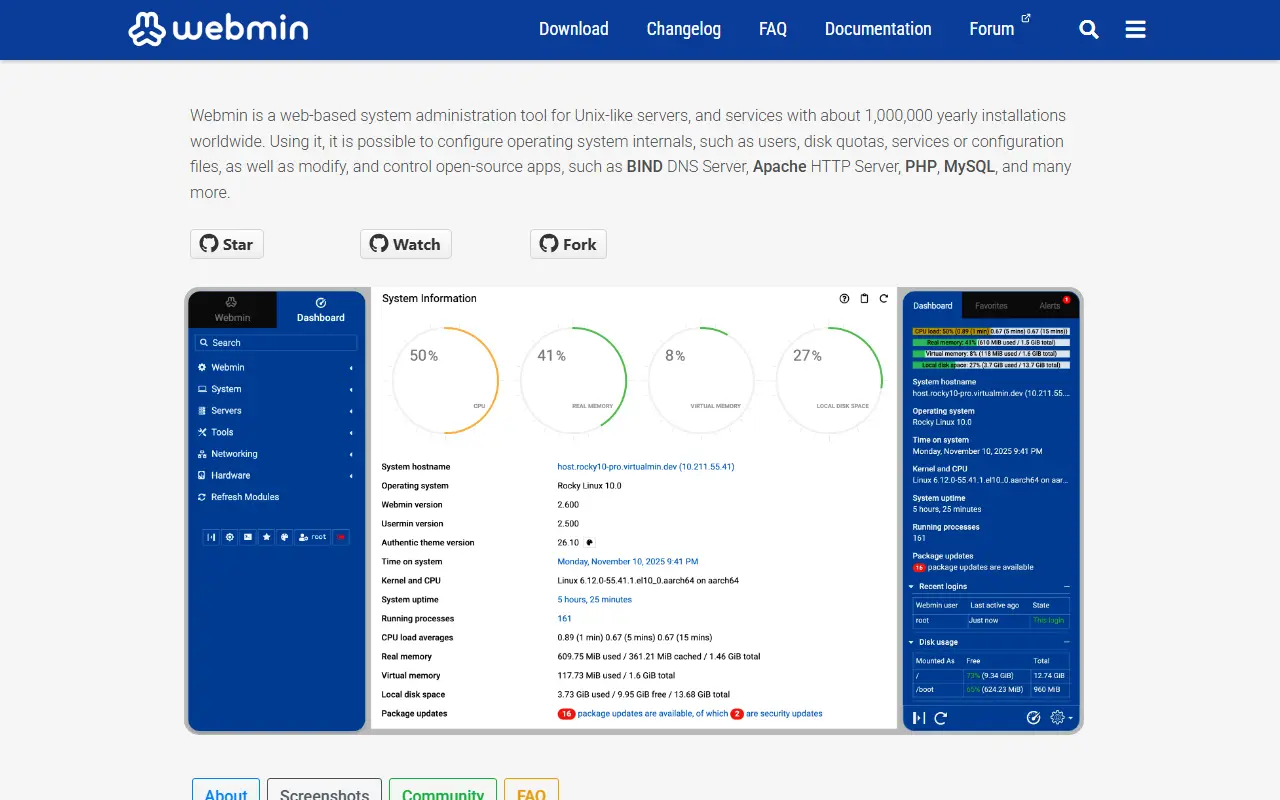
About Webmin
Webmin is a browser-based tool for administering Unix-like servers. It lets administrators change settings deep in the operating system, such as users, disk quotas, services and configuration files, from a browser, and also modify and control open-source applications including the BIND DNS server, Apache HTTP Server, PHP and MySQL.
Its functionality is expanded through modules, which can be custom made, and the project ships with a large set of standard modules while third-party modules add more. Two related projects extend it. Virtualmin is a control panel for web hosting on Linux and BSD systems, offered as a community-supported open-source edition and a fuller edition that includes premium support, and Usermin presents a subset of user-centered features rather than administrator tasks.
Webmin is written mostly in Perl, which must be version 5.10 or higher, and is released under the BSD licence. Installation instructions, documentation, a FAQ and a forum are linked from the project, and the lead developer is Jamie Cameron.
Key features
- Browser-based Unix server administration
- Manage users, disk quotas and services
- Control Apache, BIND, PHP and MySQL
- Module system with third-party modules
- Extended by Virtualmin and Usermin
Good fit for
- →Administering a Linux server without the command line
- →Managing DNS and web server settings from a browser
- Built with
- HTML
- Tags
- server-administration
- sysadmin
- control-panel
- unix
- linux
- perl
- web-interface
- virtualmin
Webmin: questions and answers
- What is Webmin used for?
- Webmin is a web-based administration tool for Unix-like servers that configures users, disks, services and apps such as Apache, BIND and MySQL. It is a good fit for administering a Linux server without the command line, and managing DNS and web server settings from a browser.
- Is Webmin open source?
- Yes. Webmin is open source under the BSD-3-Clause licence. Its source code is on GitHub at webmin/webmin.
- Is Webmin free?
- Yes. Webmin is open source, so the software itself is free to use.
- Can I self-host Webmin?
- Yes. Webmin can be self-hosted on your own server or infrastructure; there is no official hosted version.
- What are some alternatives to Webmin?
- Similar open-source tools in the Infrastructure & Containers category include Cockpit, QEMU and Talos Linux. SaaS products in the same category include OrbStack, Amazon ECR and Amazon ECS.
- Is Webmin actively maintained?
- Yes. The most recent commit to Webmin was on 2 October 2026, and the latest release is 2.670, published on 21 September 2026. The project has 6.1k stars on GitHub.
Open-source alternatives to Webmin
See all
Cockpit
Infrastructure & Containers
Cockpit is a web-based graphical interface for servers.
OSS★ 15k
QEMU
Infrastructure & Containers
Official QEMU mirror. Please see https://www.qemu.org/contribute/ for how to submit change
OSSvs VMware Workstation★ 14k
Talos Linux
Infrastructure & Containers
Talos Linux is a modern Linux distribution built for Kubernetes.
MPL-2.0vs Amazon EKS★ 11k
Incus
Infrastructure & Containers
Powerful system container and virtual machine manager
Apache-2.0vs Amazon EC2★ 6.3k
LXD
Infrastructure & Containers
Powerful system container and virtual machine manager
AGPL-3.0vs Amazon EC2★ 4.8k
libvirt
Infrastructure & Containers
Read-only mirror. Please submit merge requests / issues to https://gitlab.com/libvirt/libv
LGPL-2.1vs VMware vSphere★ 1.7k
SaaS alternatives to Webmin
See all
OrbStack
Infrastructure & Containers
Lightweight macOS app for running Docker containers and Linux machines
SaaS
Amazon ECR
Infrastructure & Containers
Managed container image registry on AWS
SaaS
Amazon ECS
Infrastructure & Containers
Managed container orchestration service on AWS
SaaS
Amazon EKS
Infrastructure & Containers
Managed Kubernetes control plane and worker nodes on AWS
SaaS
Red Hat Ansible Automation Platform
Infrastructure & Containers
Enterprise automation platform for infrastructure, network and cloud provisioning
SaaS
AWS Fargate
Infrastructure & Containers
Serverless compute engine for running containers on AWS without managing servers
SaaS