
About Velero
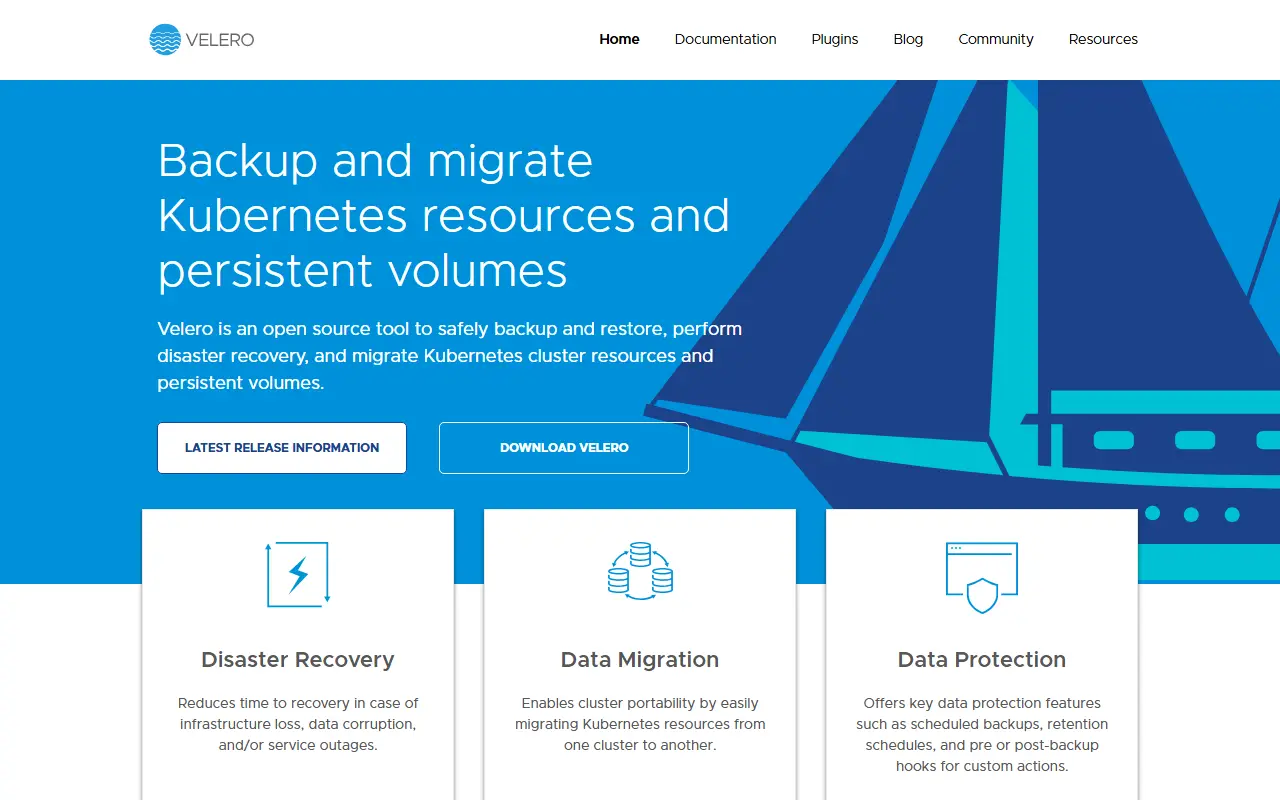
Velero, formerly Heptio Ark, gives Kubernetes administrators tools to back up and restore cluster resources and persistent volumes. It works with public cloud platforms as well as on-premises clusters, and helps teams recover from data loss or a failed cluster without rebuilding everything by hand.
Besides disaster recovery, Velero can migrate cluster resources to other clusters and replicate a production cluster into development and testing clusters. It consists of two parts: a server that runs inside the cluster and a command-line client that runs on your own machine. Documentation includes a getting started guide, architecture notes and instructions for extending the tool.
The project is written in Go and released under the Apache-2.0 license. Support is available through troubleshooting docs, GitHub issues and the velero-users and velero-dev channels on the Kubernetes Slack, and bi-weekly community meetings alternate between time zones friendly to Asia and to the US and Europe.
Key features
- Back up Kubernetes resources and persistent volumes
- Restore a cluster after data loss
- Migrate workloads to another cluster
- Clone production into dev and test clusters
- Server in-cluster plus local CLI client
Good fit for
- →Disaster recovery for Kubernetes clusters
- →Moving applications between clusters
- Tags
- kubernetes
- backup
- disaster-recovery
- migration
- persistent-volumes
- devops
- go
Velero: questions and answers
- What is Velero used for?
- Velero is a backup, restore and migration tool for Kubernetes cluster resources and persistent volumes, for public cloud or on-premises clusters. It is a good fit for disaster recovery for Kubernetes clusters and moving applications between clusters.
- Is Velero open source?
- Yes. Velero is open source under the Apache-2.0 licence. Its source code is on GitHub at velero-io/velero and is written mainly in Go.
- Is Velero free?
- Yes. Velero is open source, so the software itself is free to use.
- What is Velero an alternative to?
- Velero is an open-source alternative to Veeam. Other open-source alternatives to Veeam include Backrest, Bareos and restic.
- Is Velero actively maintained?
- Yes. The most recent commit to Velero was on 2 October 2026, and the latest release is v1.18.4, published on 28 September 2026. The project has 10k stars on GitHub.
Open-source alternatives to Velero
See allBackrest
File Storage & Sharing
Backrest is a web UI and orchestrator for restic backup.
GPL-3.0vs Backblaze Computer Backup★ 7.4k
Bareos
File Storage & Sharing
Bareos is a cross-network Open Source backup solution (licensed under AGPLv3) which preser
OSSvs Veeam★ 1.3k
restic
File Storage & Sharing
Fast, secure, efficient backup program
BSD-2-Clausevs CrashPlan★ 36k
BorgBackup
File Storage & Sharing
Deduplicating archiver with compression and authenticated encryption.
OSSvs Backblaze Computer Backup★ 14k
Duplicati
File Storage & Sharing
Store securely encrypted backups in the cloud!
OSSvs Backblaze Computer Backup★ 15k
Kopia
File Storage & Sharing
Cross-platform backup tool for Windows, macOS & Linux with fast, incremental backups, clie
Apache-2.0vs Backblaze Computer Backup★ 14k
SaaS alternatives to Velero
See all
Veeam
File Storage & Sharing
Backup and recovery software for virtual, cloud and physical workloads
SaaS
Amazon EKS
Infrastructure & Containers
Managed Kubernetes control plane and worker nodes on AWS
SaaS
Azure Kubernetes Service
Infrastructure & Containers
Managed Kubernetes service on Microsoft Azure
SaaS
Docker Desktop
Infrastructure & Containers
Desktop app for building and running containers locally, with Kubernetes support
SaaS
IBM Cloud Kubernetes Service
Infrastructure & Containers
Managed Kubernetes service on IBM Cloud
SaaS
Komodor
Infrastructure & Containers
Kubernetes troubleshooting and cluster management platform
SaaS