
About Uptime Gladiator
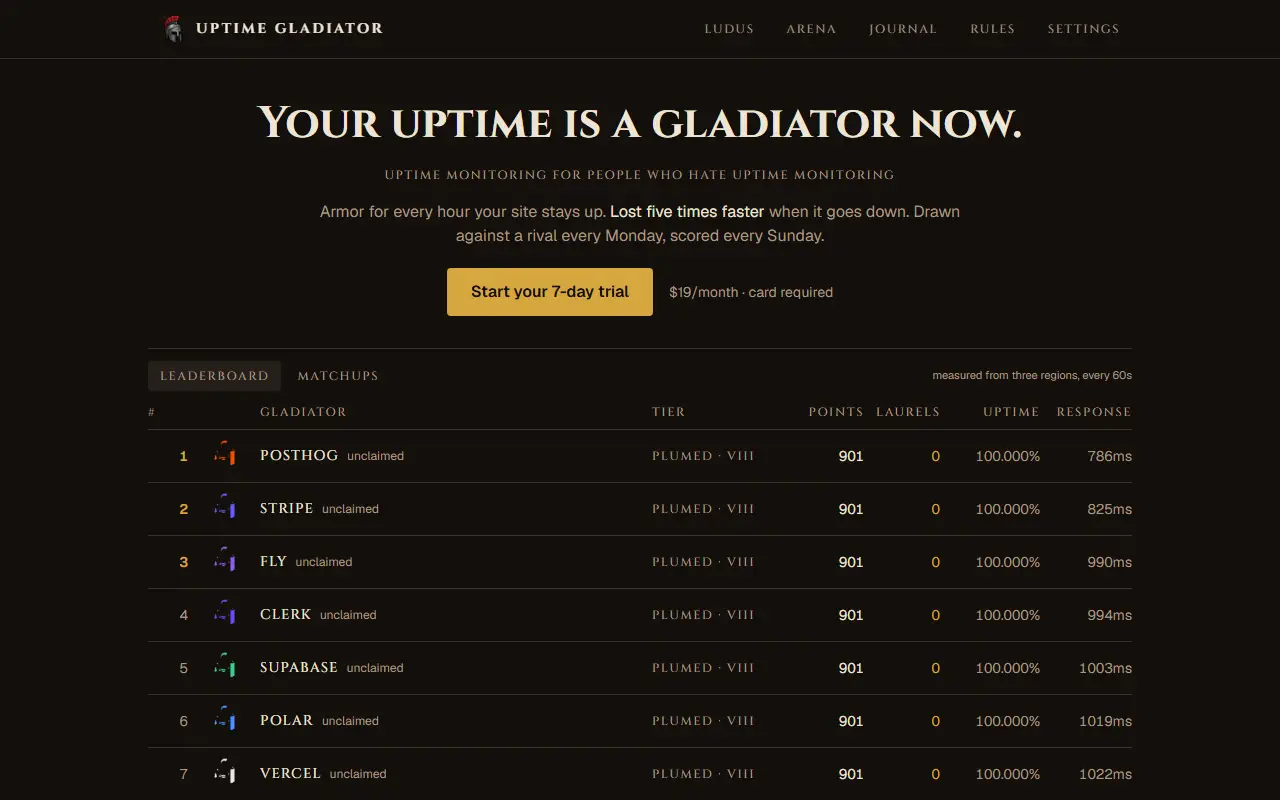
Uptime Gladiator monitors a site's availability and presents the result as a gladiator. Checks run every 60 seconds from three regions, and you earn armor for every hour your site stays up, while downtime strips it five times faster, so a single minute of downtime erases five hours of progress. Ten tiers add visible armor pieces, from the first day through shielded, helmed and segmented tiers up to the top rank at eight weeks of uptime, and the armor shows on a public profile.
Each Monday you are drawn against a rival, and matchups are scored the following Sunday, with a leaderboard of results in the arena. A higher tier gives a head start in a duel, but a lower one can still win. The site has sections for the ludus, arena, journal and rules, and describes itself as uptime monitoring for people who dislike uptime monitoring.
It is a hosted service at $19 per month, with a 7-day trial that requires a card. Because armor sits on a public profile, the uptime record doubles as a visible scoreboard anyone can check, and the rules page spells out how each duel is decided.
Key features
- 60-second checks from three regions
- Ten armor tiers earned by uptime
- Armor lost five times faster on downtime
- Weekly duels against a drawn rival
- Public leaderboard and profile
- Rules and journal pages
Good fit for
- Making uptime tracking more engaging for a small team
- Publishing a visible uptime scoreboard
Uptime Gladiator: questions and answers
- What is Uptime Gladiator used for?
- Uptime Gladiator is uptime monitoring turned into a game: checks every 60 seconds from three AWS regions, armor tiers that grow with uptime and a weekly public duel against a rival. It is a good fit for making uptime tracking more engaging for a small team and publishing a visible uptime scoreboard.
- How much does Uptime Gladiator cost?
- Paid plans for Uptime Gladiator start at $19 per month, and there is no free plan. A free trial is available.
- Is Uptime Gladiator open source?
- No. Uptime Gladiator is proprietary (closed-source) software and can't be self-hosted. In the Monitoring & Observability category, open-source options include Uptime Kuma, OpenStatus and Statping.
- What are some alternatives to Uptime Gladiator?
- Uptime Gladiator competes with UptimeRobot, Better Stack and StatusCake.
Open-source alternatives to Uptime Gladiator
See all
Uptime Kuma
Monitoring & Observability
A self-hosted monitoring tool
MITvs UptimeRobot★ 92k
OpenStatus
Monitoring & Observability
🫖 Status page with uptime monitoring & API monitoring as code 🫖
AGPL-3.0vs Pingdom★ 9.2k
Statping
Monitoring & Observability
Status Page for monitoring your websites and applications with beautiful graphs, analytics
GPL-3.0vs Statuspal★ 7.3k
CheckCle
Monitoring & Observability
CheckCle is a self-hosted, open-source monitoring platform for seamless, real-time full-st
MITvs UptimeRobot★ 3.3k
Changedetection.io
Monitoring & Observability
Best and simplest way to monitor websites for changes, change detection, website checker,
Apache-2.0★ 35k
Beszel
Monitoring & Observability
Lightweight server monitoring with historical data, Docker stats, and alerts.
MIT★ 26k
SaaS alternatives to Uptime Gladiator
See all
UptimeRobot
Monitoring & Observability
Website, port and keyword uptime checks with alerting and status pages
SaaS
Better Stack
Monitoring & Observability
Uptime monitoring, on-call alerts, status pages and log management in one product
SaaS
StatusCake
Monitoring & Observability
Uptime, page speed and SSL monitoring with alerts
SaaS
Pingdom
Monitoring & Observability
Pingdom is a website monitoring service that checks uptime and page performance from outside locations and alerts teams when a site has problems.
SaaS
Hyperping
Monitoring & Observability
Uptime monitoring with status pages and on-call alerting
SaaS
updown.io
Monitoring & Observability
Pay-as-you-go website uptime monitoring with status pages
SaaS