
About Tile38
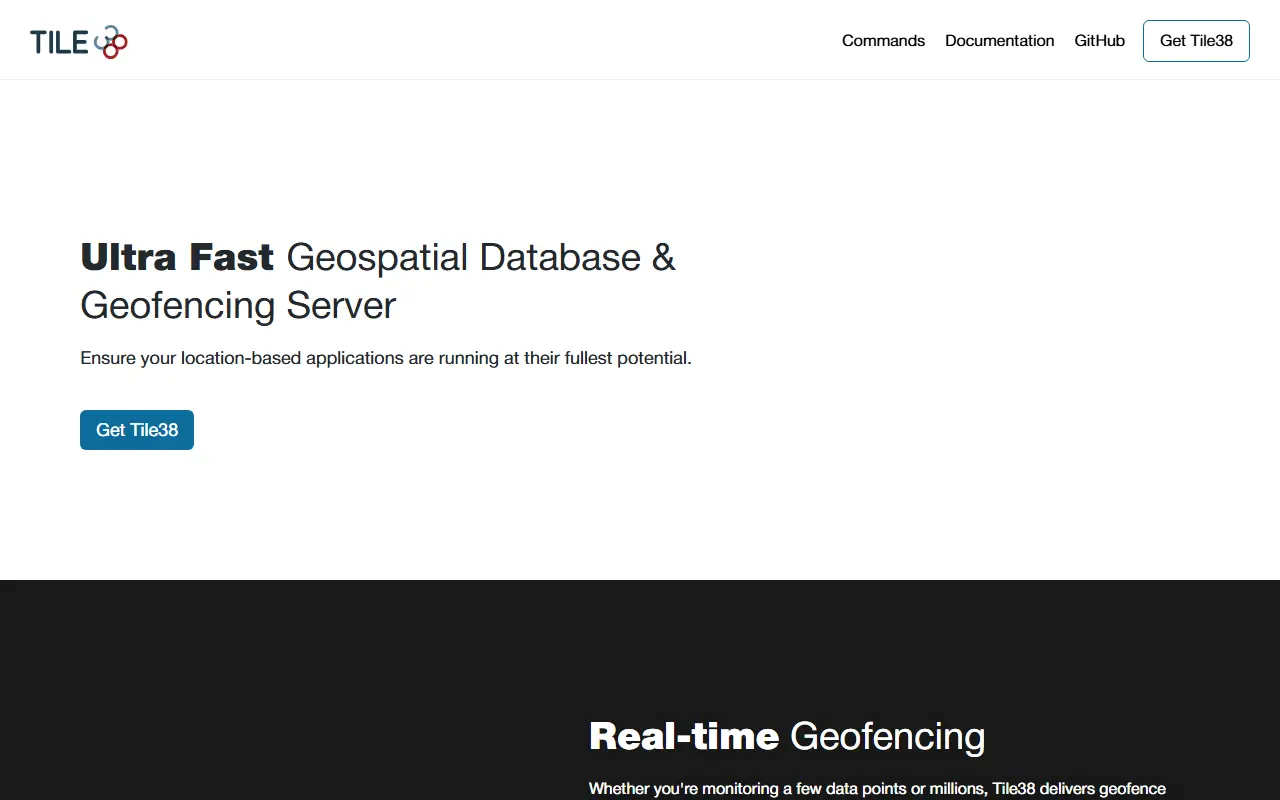
Tile38 is an open-source, in-memory data store for geolocation data, combining a spatial index with a real-time geofencing server. It stores a variety of geographic object types, including latitude and longitude points, bounding boxes, XYZ tiles, Geohashes, QuadKeys and GeoJSON.
Search methods such as Nearby, Within and Intersects let applications ask which objects are close to a point or inside an area. Geofences can notify you in real time through webhooks or pub/sub channels when objects enter, exit or cross a defined region. The server supports a variety of connection protocols and has client libraries in many languages. It is written in Go, and detailed documentation lives on the project website.
Tile38 is MIT-licensed and runs on your own servers or containers. It suits logistics, fleet tracking, delivery and location-aware applications that need quick radius and boundary queries with live alerts.
Key features
- In-memory geospatial index
- Nearby, Within and Intersects searches
- Real-time geofencing via webhooks and pub/sub
- GeoJSON, Geohash and XYZ tile objects
- Client libraries in many languages
- Written in Go
Good fit for
- →Fleet and asset tracking with geofences
- →Location-based alerts in delivery apps
- Built with
- Go
- Tags
- geospatial
- geofencing
- database
- in-memory
- golang
- location
- geojson
- real-time
Tile38: questions and answers
- What is Tile38 used for?
- Tile38 is an in-memory geospatial database and geofencing server with spatial indexing and real-time notifications over webhooks or pub/sub. It is a good fit for fleet and asset tracking with geofences, and location-based alerts in delivery apps.
- Is Tile38 open source?
- Yes. Tile38 is open source under the MIT licence. Its source code is on GitHub at tidwall/tile38 and is written mainly in Go.
- Is Tile38 free?
- Yes. Tile38 is open source, so the software itself is free to use.
- Can I self-host Tile38?
- Yes. Tile38 can be self-hosted on your own server or infrastructure.
- What are some alternatives to Tile38?
- Similar open-source tools in the Databases category include Redis, AresDB and ClickHouse. SaaS products in the same category include Aerospike, Amazon MemoryDB and Amazon ElastiCache.
- Is Tile38 actively maintained?
- Yes. The most recent commit to Tile38 was on 2 September 2026, and the latest release is 1.38.0, published on 9 June 2026. The project has 9.7k stars on GitHub.
Open-source alternatives to Tile38
See all
Redis
Databases
For developers, who are building real-time data-driven applications, Redis is the preferre
OSSvs Upstash★ 77k
AresDB
Databases
A GPU-powered real-time analytics storage and query engine.
Apache-2.0★ 3.1k
ClickHouse
Databases
ClickHouse is a fast open-source column-oriented database management system that allows ge
Apache-2.0vs Snowflake★ 50k
Dragonfly
Databases
A modern replacement for Redis and Memcached
OSSvs Upstash★ 32k
Valkey
Databases
A flexible distributed key-value database that is optimized for caching and other realtime
BSD-3-Clausevs Upstash★ 27k
rqlite
Databases
The lightweight, fault-tolerant database built on SQLite. Designed to keep your data highl
MITvs Cloudflare D1★ 18k
SaaS alternatives to Tile38
See all
Aerospike
Databases
Real-time NoSQL database for low-latency, high-throughput applications
SaaS
Amazon MemoryDB
Databases
Durable in-memory database service on AWS compatible with Valkey and Redis OSS
SaaS
Amazon ElastiCache
Databases
Managed in-memory caching service on AWS for Redis OSS, Valkey and Memcached
SaaS
Azure Data Explorer
Databases
Analytics service on Azure for exploring log, telemetry and time-series data with Kusto queries
SaaS
Cloudflare D1
Databases
Serverless SQLite-based database for Cloudflare Workers
SaaS
CockroachDB
Databases
Distributed SQL database with horizontal scaling, available as a managed cloud service
SaaS