
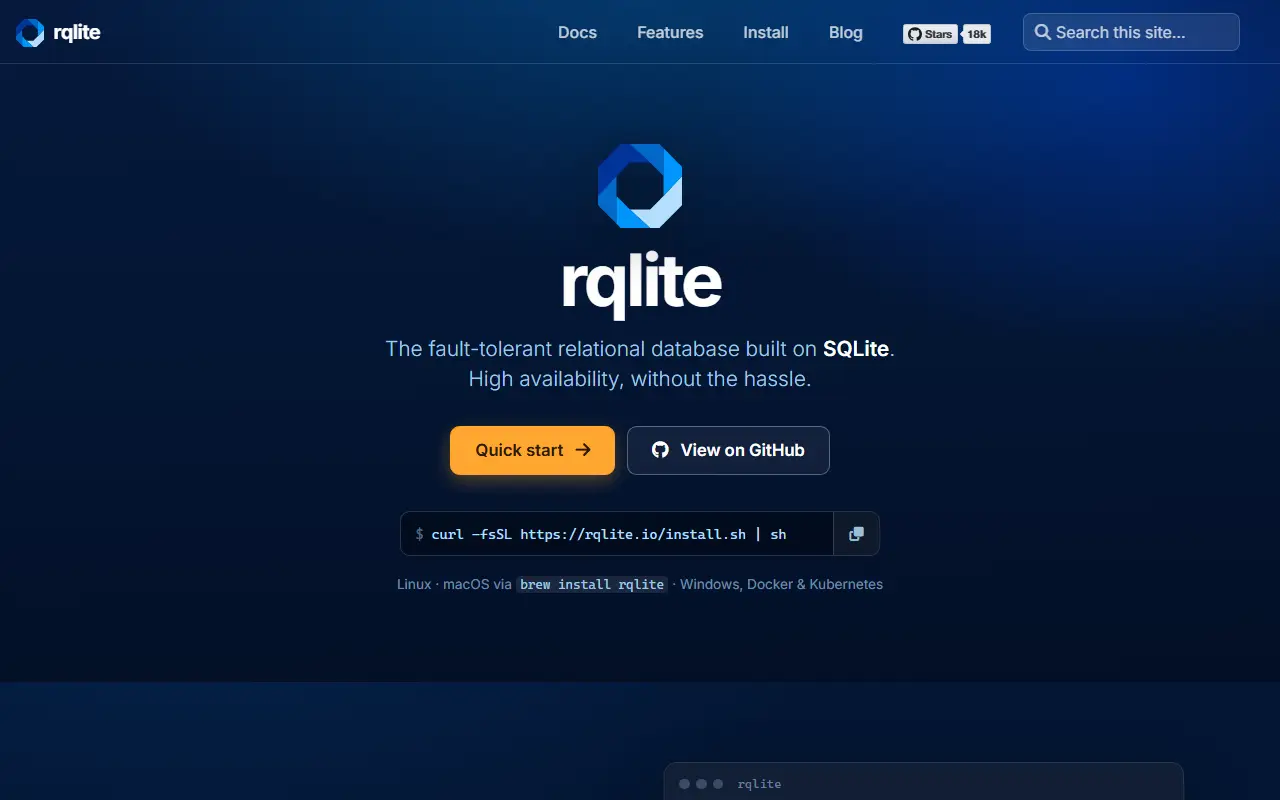
About rqlite
rqlite is a distributed relational database that uses SQLite as its storage engine and the Raft consensus algorithm to keep a cluster consistent. The project describes it as lightweight, developer-friendly and easy to operate, and compares it to etcd but with relational modeling, meaning you store important data with the guarantees of a replicated system while querying it with SQL.
Because it embeds SQLite, you get full SQL support including full-text search and JSON. Extensions can be loaded to add capabilities such as vector search and cryptographic functions, and multiple SQL statements can be executed atomically within one API request. Change data capture is listed among the key features, and a multi-node cluster can be formed in seconds following the quick start. It is written in Go.
rqlite is MIT licensed and aimed at resilient services in the cloud and reliable applications at the edge, where a full database server would be too heavy but a single SQLite file would be a single point of failure. You run it yourself, and the website, Slack community and developer guide help with getting started.
Key features
- Distributed SQLite with Raft consensus
- Full SQL including full-text search and JSON
- Loadable SQLite extensions
- Atomic multi-statement requests
- Change data capture
- Simple multi-node clustering
Good fit for
- →Highly available small relational databases
- →Edge deployments needing replication
- →Replacing a single SQLite file with a cluster
- Tags
- database
- sqlite
- distributed
- raft
- high-availability
- golang
- sql
- edge
- fault-tolerant
rqlite: questions and answers
- What is rqlite used for?
- rqlite is a lightweight, fault-tolerant distributed relational database built on SQLite and Raft consensus, easy to run on cloud or edge. It is a good fit for highly available small relational databases, edge deployments needing replication and replacing a single SQLite file with a cluster.
- Is rqlite open source?
- Yes. rqlite is open source under the MIT licence. Its source code is on GitHub at rqlite/rqlite and is written mainly in Go.
- Is rqlite free?
- Yes. rqlite is open source, so the software itself is free to use.
- Can I self-host rqlite?
- Yes. rqlite can be self-hosted on your own server or infrastructure; there is no official hosted version.
- What is rqlite an alternative to?
- rqlite is an open-source alternative to Cloudflare D1. Other open-source alternatives to Cloudflare D1 include libSQL.
- Is rqlite actively maintained?
- Yes. The most recent commit to rqlite was on 1 October 2026, and the latest release is v10.5.0, published on 1 October 2026. The project has 18k stars on GitHub.
Open-source alternatives to rqlite
See all
libSQL
Databases
libSQL is a fork of SQLite that is both Open Source, and Open Contributions.
MITvs Cloudflare D1★ 17k
TiDB
Databases
TiDB is built for agentic workloads that grow unpredictably, with ACID guarantees and nati
Apache-2.0vs Amazon Aurora★ 41k
CockroachDB
Databases
CockroachDB — the cloud native, distributed SQL database designed for high availability, e
OSSvs Google Cloud Spanner★ 33k
NebulaGraph
Databases
A distributed, fast open-source graph database featuring horizontal scalability and high
Apache-2.0vs Amazon Neptune★ 12k
YugabyteDB
Databases
YugabyteDB - the cloud native distributed SQL database for mission-critical applications.
OSSvs Google Cloud Spanner★ 11k
CloudNativePG
Databases
The most popular Kubernetes Operator for PostgreSQL.
Apache-2.0vs Amazon RDS★ 9.4k
SaaS alternatives to rqlite
See all
Cloudflare D1
Databases
Serverless SQLite-based database for Cloudflare Workers
SaaS
CockroachDB
Databases
Distributed SQL database with horizontal scaling, available as a managed cloud service
SaaS
Oracle Database
Databases
Oracle relational database for enterprise transactional and analytical workloads
SaaS
Aerospike
Databases
Real-time NoSQL database for low-latency, high-throughput applications
SaaS
Amazon Athena
Databases
Serverless interactive query service for analyzing data in Amazon S3 with SQL
SaaS
Amazon MemoryDB
Databases
Durable in-memory database service on AWS compatible with Valkey and Redis OSS
SaaS