 TrackMedia
 TrackRev

About Skydive
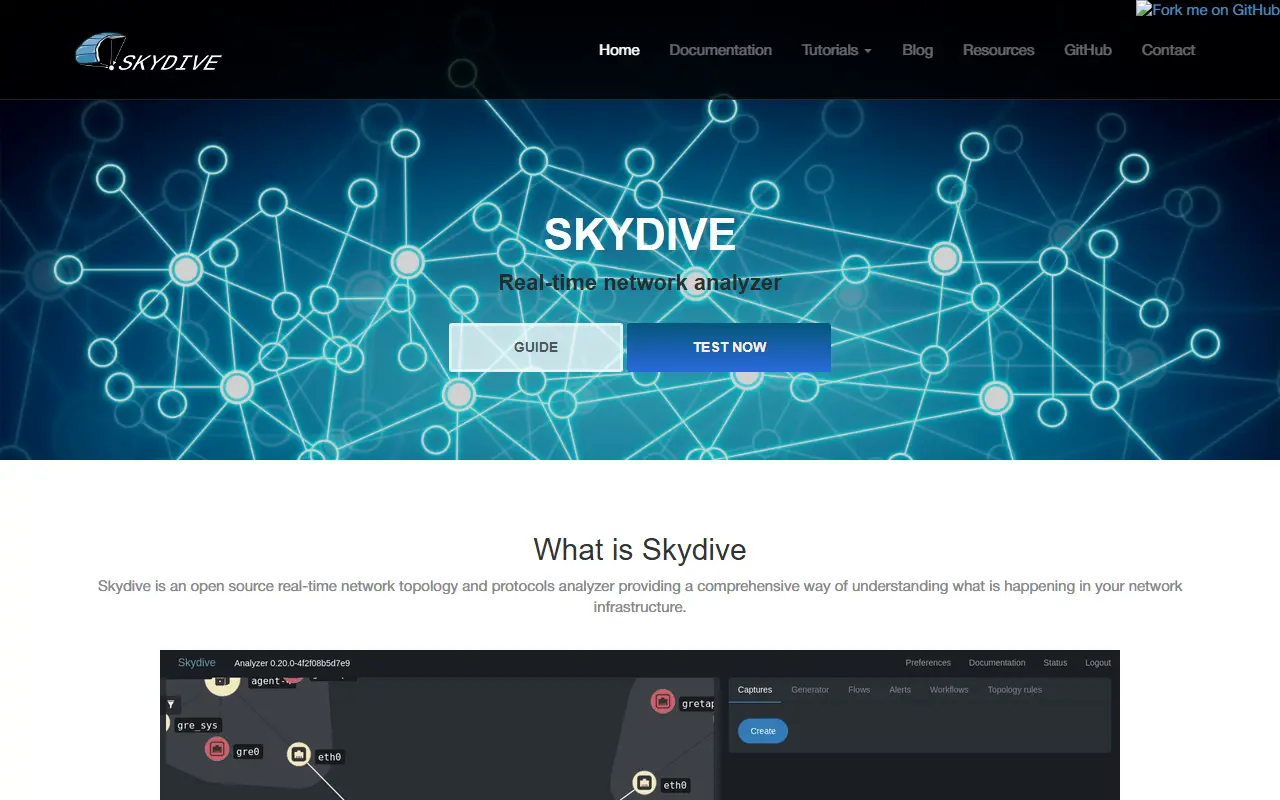
Skydive is a real-time network topology and protocol analyzer aimed at network and infrastructure teams who need to understand what is actually happening across a complex network, including virtual machines, containers and software-defined networking layers, rather than relying only on static diagrams.
Distributed Skydive agents collect topology information and traffic flows and forward them to a central analyzer, with all information stored in an Elasticsearch database for later querying. It supports following a flow along its path through the topology, a unified Gremlin-based query language covering both topology and flows, and connectors for OpenStack, Docker, OpenContrail and Kubernetes, while remaining SDN-agnostic with optional SDN-specific drivers.
Skydive offers a web UI, a command-line client and a REST API, and can be deployed as a standalone all-in-one binary, through Helm on Kubernetes, or with Docker and Docker Compose for a fuller setup including Elasticsearch. It is written in Go and released under the Apache-2.0 license.
Key features
- Real-time network topology capture
- Flow tracking along the topology path
- Unified Gremlin query language
- OpenStack, Docker and Kubernetes connectors
- Web UI, CLI and REST API
- Elasticsearch-backed history storage
Good fit for
- Visualizing network topology across VMs and containers
- Troubleshooting traffic flows in SDN environments
Skydive: questions and answers
- What is Skydive used for?
- Skydive is a free, Apache-licensed, open-source real-time network topology and protocol analyzer that captures and visualizes flows across VMs, containers and SDN infrastructure. It is a good fit for visualizing network topology across VMs and containers, and troubleshooting traffic flows in SDN environments.
- Is Skydive open source?
- Yes. Skydive is open source under the Apache-2.0 licence. Its source code is on GitHub at skydive-project/skydive and is written mainly in Go.
- Is Skydive free?
- Yes. Skydive is open source, so the software itself is free to use.
- Can I self-host Skydive?
- Yes. Skydive can be self-hosted on your own server or infrastructure; there is no official hosted version.
- What is Skydive an alternative to?
- Skydive is an open-source alternative to Kentik. Other open-source alternatives to Kentik include Prometheus, Telegraf and Grafana.
- Is Skydive actively maintained?
- The most recent commit to Skydive was on 19 September 2025, and the latest release is v0.28.0, published on 17 August 2021. The project has 2.8k stars on GitHub, with 4 added in the last 30 days.
Open-source alternatives to Skydive
See all
Prometheus
Monitoring & Observability
The Prometheus monitoring system and time series database.
Apache-2.0vs Datadog★ 68k
Telegraf
Monitoring & Observability
Agent for collecting, processing, aggregating, and writing metrics, logs, and other arbitr
MITvs Cribl★ 18k
Grafana
Monitoring & Observability
The open and composable observability and data visualization platform. Visualize metrics,
AGPL-3.0vs Datadog★ 78k
Zabbix
Monitoring & Observability
Official Zabbix Dockerfiles
AGPL-3.0vs Datadog★ 2.9k
Nagios Core
Monitoring & Observability
Nagios Core
GPL-2.0vs Datadog★ 2.1k
Kibana
Monitoring & Observability
Your window into all of your data
OSSvs Splunk★ 21k
SaaS alternatives to Skydive
See all
Kentik
Monitoring & Observability
Network observability platform with flow analytics and performance monitoring
SaaS
Auvik
Monitoring & Observability
Cloud network monitoring and management software for MSPs and IT teams
SaaSCisco Meraki
Networking & VPN
Cloud-managed networking platform for wireless, switching, security and SD-WAN
SaaS
Cloudflare
Networking & VPN
CDN, DNS, DDoS protection and edge computing platform
SaaS
Fastly
Networking & VPN
Edge cloud platform for CDN, security and serverless compute
SaaS
NordVPN
Networking & VPN
Consumer VPN service with threat protection, double VPN and meshnet
SaaS