 Ideogram
 Adobe Firefly
 Krea
Krea Recraft
 Stability AI
 Freepik AI Suite
 Black Forest Labs
 Hailuo AI
 Higgsfield
 Microsoft Designer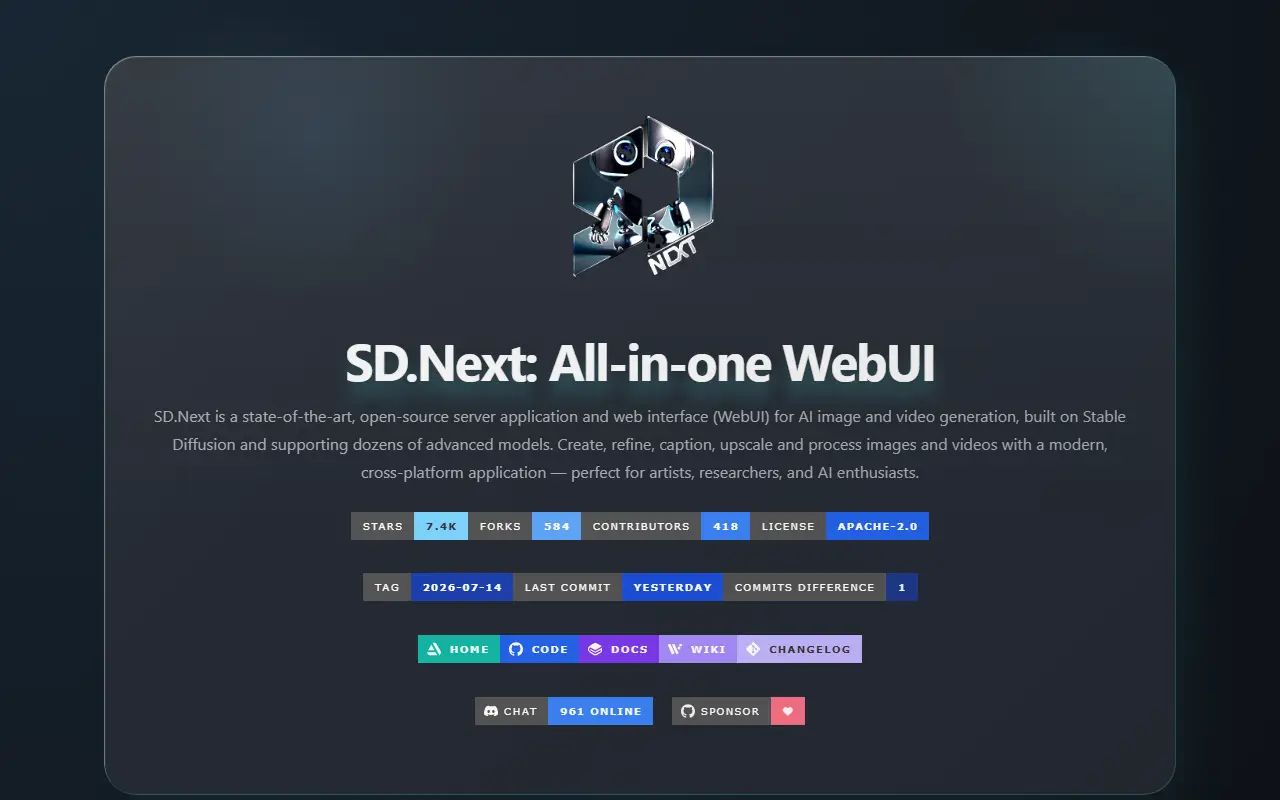
About SD.Next
SD.Next is an all-in-one web interface and server application for AI image and video generation. It is built on Stable Diffusion and supports dozens of models, and it is aimed at artists, researchers and hobbyists who want to create, refine, caption, upscale and process media from a single cross-platform application.
Its README lists features such as automatic model download from a list of reference models, automatic detection of models you add yourself and SDNQ, a quantization engine that can cut VRAM use by up to 4x. Balanced Offload shifts load between CPU and GPU memory so larger models fit on modest hardware. SD.Next can also caption and enhance images with more than 25 built-in language and vision models plus taggers, offers image processing and color-grading tools, and is localized into 15 languages.
SD.Next is written in Python with PyTorch and Hugging Face diffusers and is licensed under Apache-2.0. It performs platform-specific detection and tuning at install time, and it runs on your own computer or server.
Key features
- Web UI for image and video generation
- Automatic model download and detection
- SDNQ quantization to reduce VRAM use
- Balanced Offload for limited hardware
- Captioning with built-in language and vision models
- Image processing and color-grading tools
- Interface localized into 15 languages
Good fit for
- →Generating AI images on local hardware
- →Captioning and tagging image datasets
- Built with
- Python
- Tags
- stable-diffusion
- image-generation
- ai-art
- webui
- diffusers
- pytorch
- captioning
- python
SD.Next: questions and answers
- What is SD.Next used for?
- SD.Next is an open-source web UI and server for AI image and video generation, captioning and processing, built on Stable Diffusion and diffusers. It is a good fit for generating AI images on local hardware, and captioning and tagging image datasets.
- Is SD.Next open source?
- Yes. SD.Next is open source under the Apache-2.0 licence. Its source code is on GitHub at vladmandic/sdnext and is written mainly in Python.
- Is SD.Next free?
- Yes. SD.Next is open source, so the software itself is free to use.
- Can I self-host SD.Next?
- Yes. SD.Next can be self-hosted on your own server or infrastructure; there is no official hosted version.
- What is SD.Next an alternative to?
- SD.Next is an open-source alternative to Midjourney, Leonardo.Ai, Runway and Pika. Other open-source alternatives to Midjourney include ComfyUI, Open Generative AI and InvokeAI.
- Is SD.Next actively maintained?
- Yes. The most recent commit to SD.Next was on 1 October 2026. The project has 7.4k stars on GitHub.
Open-source alternatives to SD.Next
See all
ComfyUI
AI Tools
The most powerful and modular diffusion model GUI, api and backend with a graph/nodes inte
GPL-3.0vs Midjourney★ 136k
Open Generative AI
AI Tools
Unrestricted Open-source alternative to AI video platforms — Free AI image & video generat
MITvs Midjourney★ 30k
InvokeAI
AI Tools
Invoke is a leading creative engine for Stable Diffusion models, empowering professionals,
Apache-2.0vs Midjourney★ 28kStable Diffusion WebUI
AI Tools
Stable Diffusion web UI
AGPL-3.0vs Midjourney★ 165kFooocus
AI Tools
Focus on prompting and generating
GPL-3.0vs Midjourney★ 53k
DramaClaw
AI Tools
A general-purpose AIGC video engine: script to finished film in one pipeline — dramas, ads
OSSvs InVideo★ 6.6k
SaaS alternatives to SD.Next
See all
Midjourney
AI Tools
Midjourney is a text-to-image AI service that generates pictures from written prompts, used by artists, designers and hobbyists.
SaaS
Leonardo.Ai
AI Tools
AI image and video generation platform with fine-tuned models and editing tools
SaaS
Runway
AI Tools
AI video, image and audio generation and editing for creative teams
SaaS
Pika
AI Tools
AI creative platform for generating and editing short videos from text and images
SaaS
Luma AI
AI Tools
AI platform for generating video and images, including the Dream Machine tool
SaaS
Kling AI
AI Tools
Kuaishou's AI video and image generator that turns text and pictures into clips
SaaS