7,363 open-source and SaaS tools, with GitHub stats refreshed every day.

6 alternatives ranked by real activity

Open-source Luma AI alternatives

A curated, ranked list of the 6 best open-source alternatives to Luma AI.

The best open-source alternative to Luma AI is ComfyUI. If that doesn't suit you, other good options are Open Generative AI, SD.Next, DramaClaw and ArcReel.

Luma AI alternatives are mainly AI tools. 6 of them shipped code in the last 30 days, 6 can be self-hosted, and 3 use a permissive licence.

Last updated October 2, 2026 · ranked by GitHub stars, growth and recent commits

ComfyUI

A modular, node-based interface and backend for building and running diffusion model workflows such as Stable Diffusion on your own machine.

GitHub stars
136k
Last commit
today
Latest release
v0.38.0
Licence
GPL-3.0
Self-hosted
Yes
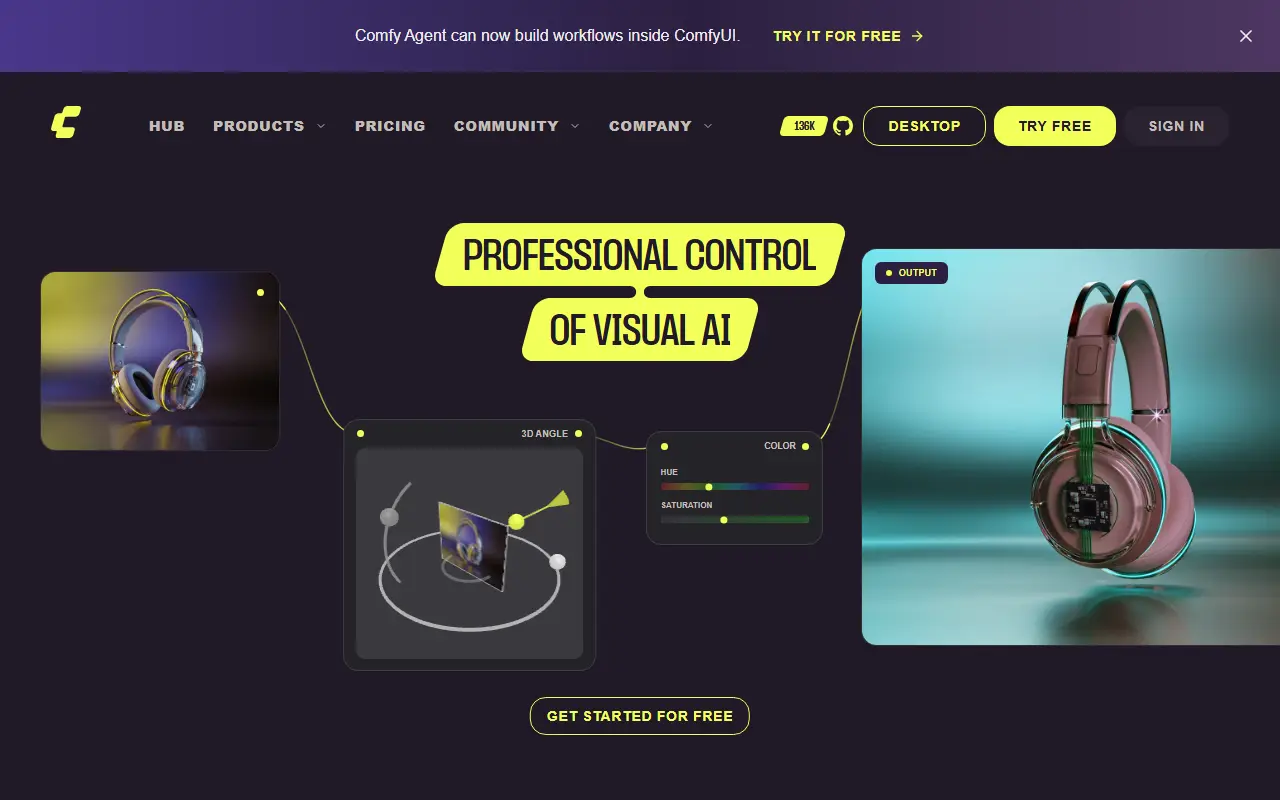
comfy.orgComfyUI homepage screenshot

ComfyUI is an open-source application for creating images and other media with diffusion models. Instead of a fixed form, you build a workflow as a graph of connected nodes, where each node handles a step such as loading a model, encoding a prompt or sampling. It is written in Python on top of PyTorch and licensed under GPL-3.0.

The project provides a graphical interface, an API and a backend in one package. The modular design means workflows can be saved, shared and extended, and new capabilities are added through additional nodes. Because inference runs locally, users keep control over their models and outputs. The maintainers describe it more broadly as an engine for AI content creation.

The code is maintained by Comfy Org, which also runs the website at comfy.org, and releases are published on GitHub. ComfyUI suits artists, researchers and developers who want fine control over image generation pipelines and are comfortable wiring nodes together rather than using a simple prompt box.

Key features

  • Node-and-graph editor for diffusion workflows
  • Modular backend with an API
  • Local inference on your own hardware
  • Support for Stable Diffusion models
  • Reusable, shareable workflows
  • Extensible through additional nodes

Pricing: Local ComfyUI is free and Comfy Cloud offers 5 free runs without a card. Cloud plans cost $20 (Standard), $35 (Creator), $100 (Pro) and $700 (Team) per month, cheaper billed yearly; Enterprise is custom.

Open Generative AI

A self-hostable studio front end for generating AI images and videos with many third-party models, advertised as having no content filters.

GitHub stars
30k
Last commit
2 days ago
Latest release
v2.0.0
Licence
MIT
Self-hosted
Yes

Open Generative AI is a JavaScript application that presents itself as a free, open-source alternative to commercial AI image and video platforms. It bundles a set of generation studios for creating images and video from prompts, and the README advertises access to several hundred models, including well-known image and video model families.

The project promotes itself as unrestricted, with no content filters, no closed ecosystem and no subscription fees for the app itself. The generation is performed through a third-party model API service called MuAPI, which the README also promotes through a white-label offering for people who want to launch their own branded studio. Because the app has no built-in filters, operators who run it are responsible for how it is used and for complying with applicable laws and provider terms.

The code is MIT licensed, and topics tag it as an alternative to Midjourney and Sora-style tools. Community help is available through Discord. Anyone considering it should review what data is sent to external services and what usage costs the underlying API will bill.

Key features

  • Image and video generation studios
  • Hundreds of supported models via an API service
  • Text-to-video and image-to-video tools
  • Self-hostable web application
  • White-label option through MuAPI
  • Discord community support

Pricing: The app is free and open source under the MIT license; generation depends on a third-party API that may charge for usage.

SD.Next

SD.Next is an open-source web UI and server for AI image and video generation, captioning and processing, built on Stable Diffusion and diffusers.

GitHub stars
7.4k
Last commit
2 days ago
Licence
Apache-2.0
Self-hosted
Yes
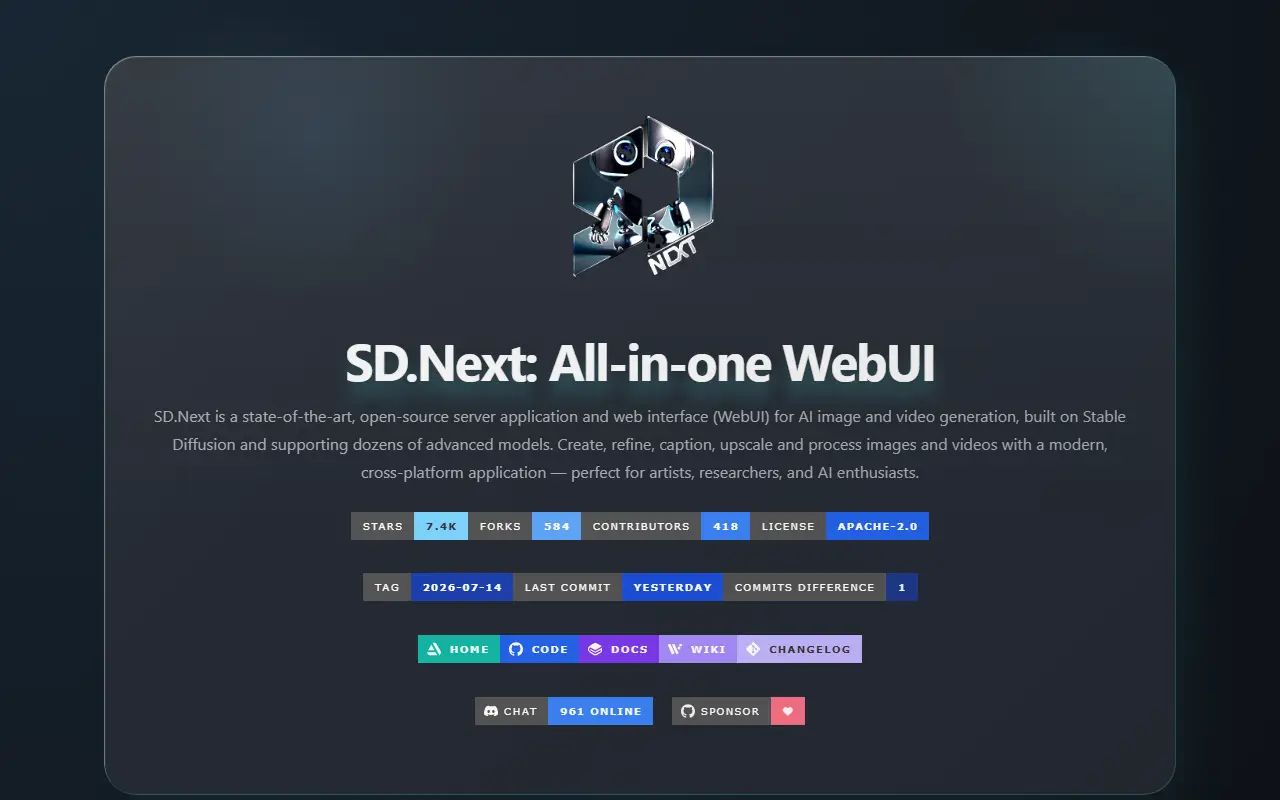
vladmandic.github.ioSD.Next homepage screenshot

SD.Next is an all-in-one web interface and server application for AI image and video generation. It is built on Stable Diffusion and supports dozens of models, and it is aimed at artists, researchers and hobbyists who want to create, refine, caption, upscale and process media from a single cross-platform application.

Its README lists features such as automatic model download from a list of reference models, automatic detection of models you add yourself and SDNQ, a quantization engine that can cut VRAM use by up to 4x. Balanced Offload shifts load between CPU and GPU memory so larger models fit on modest hardware. SD.Next can also caption and enhance images with more than 25 built-in language and vision models plus taggers, offers image processing and color-grading tools, and is localized into 15 languages.

SD.Next is written in Python with PyTorch and Hugging Face diffusers and is licensed under Apache-2.0. It performs platform-specific detection and tuning at install time, and it runs on your own computer or server.

Key features

  • Web UI for image and video generation
  • Automatic model download and detection
  • SDNQ quantization to reduce VRAM use
  • Balanced Offload for limited hardware
  • Captioning with built-in language and vision models
  • Image processing and color-grading tools
  • Interface localized into 15 languages

Pricing: Free and open source under the Apache-2.0 licence.

DramaClaw

A self-hosted AI video engine that takes a script through storyboards, assets, voices and video generation to a finished film, for dramas, ads and product videos.

GitHub stars
6.6k
Last commit
yesterday
Latest release
v2.0.6
Self-hosted
Yes
dramaclaw.aiDramaClaw homepage screenshot

DramaClaw is a general-purpose AIGC video engine that moves from script to finished film in a single pipeline. It is used for short dramas, advertisements, product videos, otome games and more, and its team says it is the same production line they use internally, covering storyboards, assets, voice synthesis and video generation. Topics include text-to-video, image-to-video, TTS and AI filmmaking.

The software is written in Python with FastAPI and a React front end and is self-hosted. Documentation, a quick start and trailers are provided, with README versions in several languages. Sample short dramas produced with the pipeline are linked from the repository.

Licensing is notable: DramaClaw uses the Elastic License 2.0, so it is source-available rather than open source. The standalone version is free for commercial use without asking permission, on the condition that a small Powered by DramaClaw credit appears in the interface, but wrapping it as a hosted SaaS for other people is not allowed under the current license. The repository was created in March 2026, so the project is young.

Key features

  • Script-to-film video pipeline
  • Storyboard and asset generation
  • Text-to-video and image-to-video
  • Voice synthesis for characters
  • FastAPI backend with React interface
  • Self-hosted deployment on your servers

Pricing: Elastic License 2.0: free for commercial use of the standalone version with a Powered by DramaClaw credit; offering it as a hosted SaaS is not permitted.

ArcReel

ArcReel is a self-hosted, agent-driven AI video workspace that turns novels and scripts into assets, storyboards and videos, exporting CapCut drafts.

GitHub stars
5.3k
Last commit
yesterday
Latest release
v0.32.0
Licence
AGPL-3.0
Self-hosted
Yes
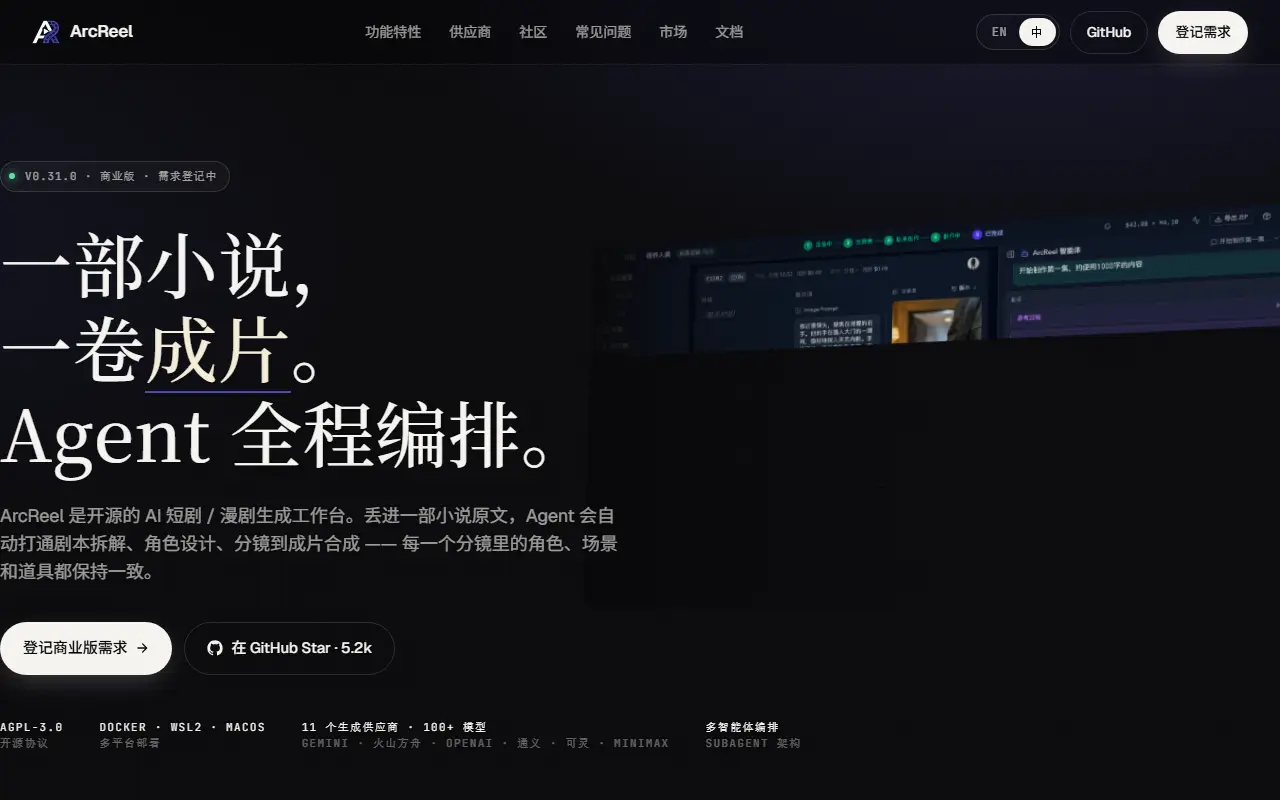
arc-reel.comArcReel homepage screenshot

ArcReel is an open-source video production workspace that you host yourself. Its AI agents convert novels, finished scripts or product material into characters, scenes and props, then storyboards and video, aiming for shots where characters stay consistent and the process remains controllable and editable.

The workflow outputs finished clips and can produce draft projects for the CapCut editing app, called JianYing in China, for further editing. The README highlights consistency across shots, support for multiple model providers, and cost tracking so you can see what each generation costs. Repository topics mention the Claude Agent SDK, FFmpeg, image-to-video and text-to-video generation, short drama and storyboarding. It is built in Python and deployed with Docker.

ArcReel is licensed under AGPL-3.0, with documentation mainly in Chinese. It suits short-drama creators, small studios and marketers who want an AI video pipeline on their own server using their own model API accounts.

Key features

  • Novel and script to storyboard conversion
  • Character, scene and prop asset generation
  • Cross-shot consistency controls
  • Multi-provider AI model support
  • Cost tracking for generations
  • CapCut draft export

Pricing: Free and open source under AGPL-3.0; you pay your chosen AI model providers.

Vibe Workflow

Vibe Workflow is an open-source, node-based visual builder for AI image and video generation pipelines, positioned as an alternative to Weavy AI and Krea Nodes.

GitHub stars
607
Last commit
16 days ago
Licence
MIT
Self-hosted
Yes
Hosted version
Available
muapi.aiVibe Workflow homepage screenshot

Vibe Workflow is a free, open-source node-based AI workflow builder aimed at creators and developers who design, edit and compose generative image and video pipelines. It is presented as a self-hostable alternative to commercial node-based creative tools such as Weavy AI, Krea Nodes, Freepik Spaces and FloraFauna AI, with no vendor lock-in.

The editor lets you connect nodes visually to build modular pipelines around what the project calls Artistic Intelligence. The stack uses a Next.js front end and a FastAPI back end, and the topics mention ComfyUI and self-hosted AI. The author says the project was built because paid AI creative tools were getting expensive. Related projects in the same family include a self-hosted AI media studio that can act as the model backend and an autonomous design agent that can be embedded in workflows.

A fully managed hosted version is available at muapi.ai/workflow with API and embed support for plugging workflows into your own platform. The self-hosted code is licensed under MIT.

Key features

  • Node-based visual workflow editor
  • Image and video generation pipelines
  • Modular pipeline composition
  • Next.js front end and FastAPI back end
  • Self-hostable open-source code
  • Optional hosted version with API and embeds

Pricing: Free tier available for AI model API calls. Usage-based pricing with rates varying by model, starting from $0.03 per generation.

Luma AI alternatives: questions

What is the best open-source alternative to Luma AI?
ComfyUI is the top-ranked open-source alternative to Luma AI on Enlisted: A modular, node-based interface and backend for building and running diffusion model workflows such as Stable Diffusion on your own machine. Other strong options are Open Generative AI, SD.Next, DramaClaw and ArcReel.
Are these Luma AI alternatives free?
All 6 are open source, so the code is free to use under its licence, and all of them can be self-hosted on your own server or computer. 1 also offers a paid or managed cloud version if you'd rather not host it yourself.
How is this list of Luma AI alternatives ranked?
By a score built from GitHub stars, star growth over the last 30 days and how recently the code changed. 6 of these projects shipped code in the last 30 days. Data is refreshed daily, and nobody can pay to move up.

People also look for alternatives to…

View all