
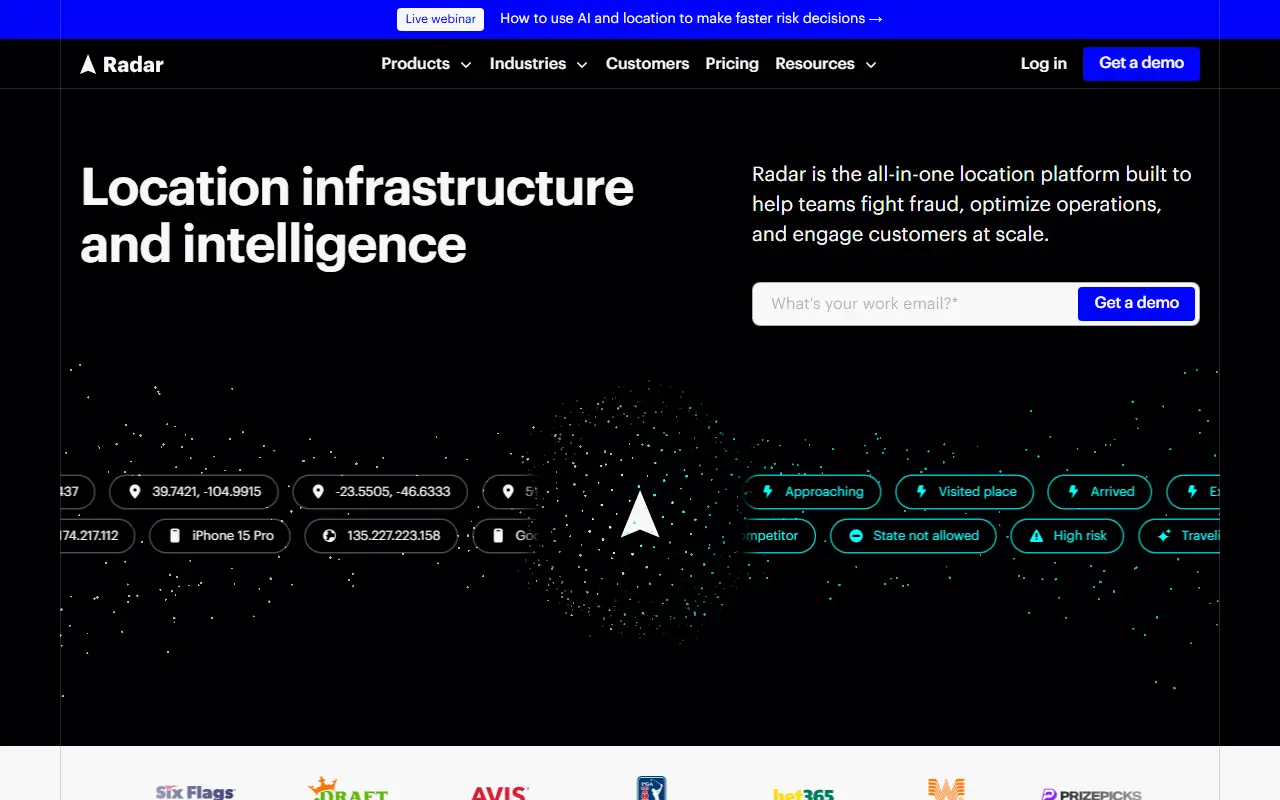
About Radar
Radar is a location infrastructure platform that development and operations teams use to build location features into their apps. It combines geofencing, real-time location tracking, geocoding, search and routing APIs with SDKs, and it is organized around three goals: protecting against fraud, optimizing operations and engaging customers.
The Protect solution covers location verification and geo-compliance, Optimize covers arrival detection, live tracking and job management, and Engage supports location-based marketing. On the platform side there are Maps for base maps, geocoding, autocomplete and routing, Geofencing for location tracking, and Reveal for detecting risky web and mobile traffic. Industries served include financial services, retail, restaurants, gaming, travel and logistics. Radar is a hosted commercial service with a pricing page.
Key features
- Geofencing and real-time location tracking
- Location verification and geo-compliance
- Arrival detection for deliveries and pickups
- Base maps, geocoding and routing APIs
- Detection of risky web and mobile traffic
- Location-based marketing triggers
Good fit for
- →Tracking pickups and deliveries in real time
- →Verifying user location to prevent fraud
- →Sending location-triggered messages to customers
- Tags
- geofencing
- location-tracking
- geocoding
- api
- sdk
- fraud-prevention
- logistics
- maps
Radar: questions and answers
- What is Radar used for?
- Radar is a location platform offering geofencing, location tracking, maps and geocoding APIs for apps in fraud prevention, logistics and marketing. It is a good fit for tracking pickups and deliveries in real time, verifying user location to prevent fraud, and sending location-triggered messages to customers.
- How much does Radar cost?
- Radar is a paid product with no free plan. No free tier; every plan is an annual commitment quoted by sales. Starting rates are $0.02 to $0.04 per monthly tracked user for Protect, Optimize and Engage, and $0.50 to $2.00 per 1,000 API calls for maps and Reveal.
- Is Radar open source?
- No. Radar is proprietary (closed-source) software and can't be self-hosted. In the Maps & Navigation category, open-source options include OpenStreetMap, Organic Maps and Dawarich.
- What are some alternatives to Radar?
- Radar competes with Mapbox, Foursquare and Google Maps Platform.
Open-source alternatives to Radar
See all
OpenStreetMap
Maps & Navigation
The Rails application that powers OpenStreetMap
GPL-2.0vs Google Maps★ 2.8k
Organic Maps
Maps & Navigation
🍃 Organic Maps is a free Android & iOS offline maps app for more than 6M travelers, touri
OSSvs Google Maps★ 16k
Dawarich
Maps & Navigation
The private alternative to Google Timeline. Import your location history, keep it forever.
AGPL-3.0★ 11k
OsmAnd
Maps & Navigation
OsmAnd
OSSvs Google Maps★ 6.1k
Wanderer
Maps & Navigation
wanderer is a self-hosted trail database. Save your adventures!
AGPL-3.0vs Komoot★ 3.9k
iD
Maps & Navigation
🆔 The easy-to-use OpenStreetMap editor in JavaScript.
ISC★ 3.9k
SaaS alternatives to Radar
See all
Mapbox
Maps & Navigation
Maps, navigation and location APIs and SDKs for developers
SaaS
Foursquare
Maps & Navigation
Location data and places APIs, plus consumer discovery apps
SaaS
Google Maps Platform
Maps & Navigation
APIs and SDKs for adding maps, places and routes to apps
SaaS
HERE Technologies
Maps & Navigation
Location data, mapping and navigation platform for enterprises and automakers
SaaS
TomTom
Maps & Navigation
Maps, traffic data and navigation APIs and SDKs for developers and automakers
SaaS
Geocodio
Maps & Navigation
Geocoding and address data API for US and Canada
SaaS