About Purse
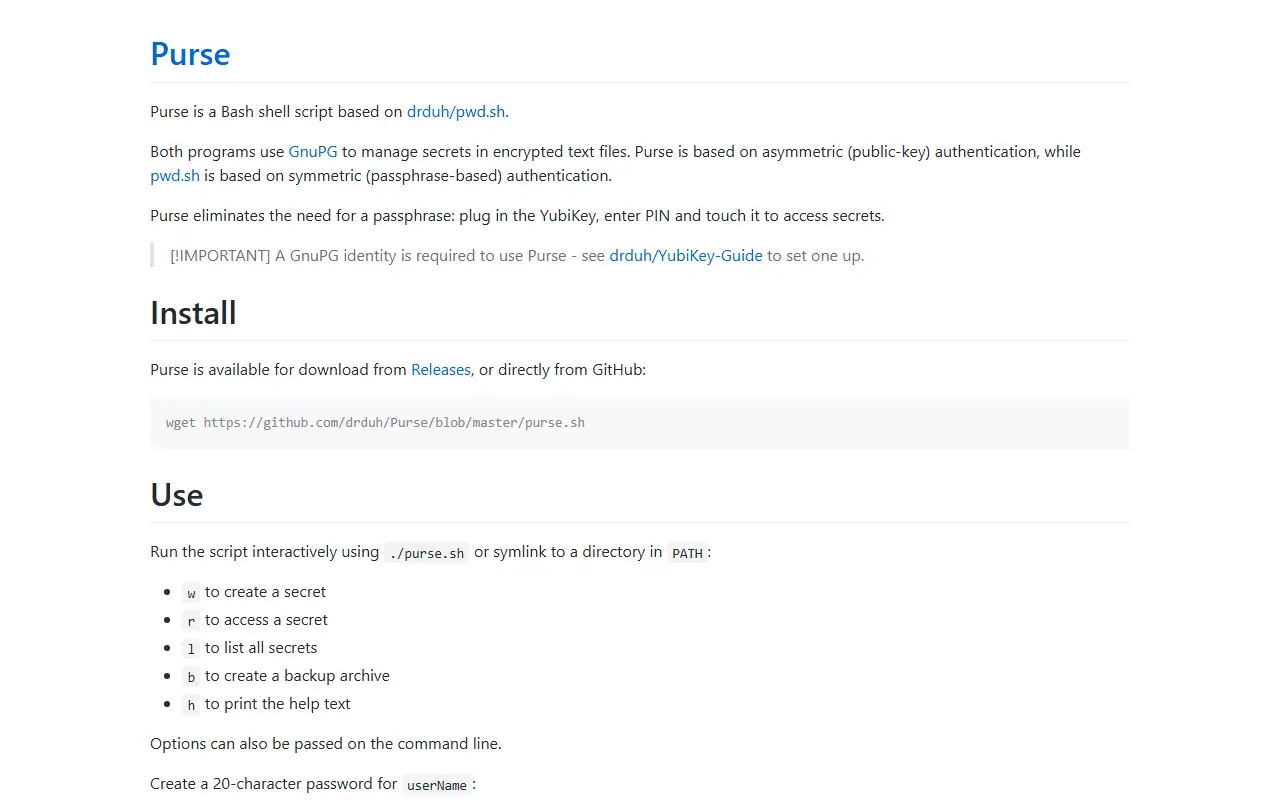
Purse is a command-line secrets manager written as a Bash script. It stores passwords and other secrets in encrypted text files using GnuPG, and relies on asymmetric, public-key authentication rather than a passphrase. With a YubiKey you plug in the key, enter a PIN and touch it to read a secret. It is a sibling of the same author's pwd.sh, which uses symmetric, passphrase-based encryption. It suits technical users comfortable with GnuPG and the shell.
A GnuPG identity is required, and the README points to the author's YubiKey guide for setting one up. Run the script interactively or from the command line to write, read and list secrets, and to create and restore backup archives. Passwords are stored with an epoch timestamp so earlier versions are kept, and reading a password copies the most recent one to the clipboard, which is cleared after a configurable number of seconds.
Behavior can be tuned through environment variables, for example the clipboard command and clipboard arguments, the clear delay and the default generated password length. The repository ships recommended GnuPG options. Purse is MIT licensed and runs on Unix-like systems, using xclip on Linux and pbcopy on macOS by default.
Key features
- GnuPG-encrypted secrets in plain files
- YubiKey unlock with PIN and touch
- Password generation
- Timestamped password versions
- Backup and restore archives
- Clipboard auto-clear
Good fit for
- →Keeping personal passwords under hardware-key control
- →Scripting secret retrieval in a shell workflow
- Built with
- Shell
- Tags
- password-manager
- gnupg
- yubikey
- bash
- encryption
- secrets
- cli
- security
Purse: questions and answers
- What is Purse used for?
- Purse is a bash script that stores secrets in GnuPG-encrypted files and unlocks them with a YubiKey instead of a passphrase. It is a good fit for keeping personal passwords under hardware-key control and scripting secret retrieval in a shell workflow.
- Is Purse open source?
- Yes. Purse is open source under the MIT licence. Its source code is on GitHub at drduh/Purse and is written mainly in Shell.
- Is Purse free?
- Yes. Purse is open source, so the software itself is free to use.
- What are some alternatives to Purse?
- Similar open-source tools in the Password Management category include pwd.sh, Gopass and KeePassXC. SaaS products in the same category include Bitdefender SecurePass, Codebook and 1Password.
- Is Purse actively maintained?
- Yes. The most recent commit to Purse was on 26 July 2026, and the latest release is 3.0, published on 5 July 2024. The project has 615 stars on GitHub.
Open-source alternatives to Purse
See allpwd.sh
Password Management
Manage secrets with Bash and GnuPG symmetric encryption
MIT★ 1.6k
Gopass
Password Management
The slightly more awesome standard unix password manager for teams
MITvs Keeper★ 7.2k
KeePassXC
Password Management
KeePassXC is a cross-platform community-driven port of the Windows application “KeePass Pa
OSSvs Dashlane★ 29kpass-import
Password Management
A pass extension for importing data from most existing password managers
GPL-3.0★ 917
Passbolt
Password Management
Passbolt Community Edition (CE) API. The JSON API for the open source password manager for
AGPL-3.0vs Keeper★ 6.1k
LessPass
Password Management
:key: stateless open source password manager
GPL-3.0vs Dashlane★ 6.1k
SaaS alternatives to Purse
See all
Bitdefender SecurePass
Password Management
Password manager from Bitdefender with passkey support and a digital wallet
SaaS
Codebook
Password Management
Secure password and data vault for Apple and Android devices by Zetetic
SaaS
1Password
Password Management
Password manager for individuals, families and teams with shared vaults and passkeys
SaaS
Avira Password Manager
Password Management
Password manager from Avira with a free version and paid Pro features
SaaS
Dashlane
Password Management
Password manager with autofill, passkey support, dark web monitoring and a built-in VPN
SaaS
Delinea Secret Server
Password Management
Privileged access and credential vault for storing and rotating enterprise secrets
SaaS