
About Primo
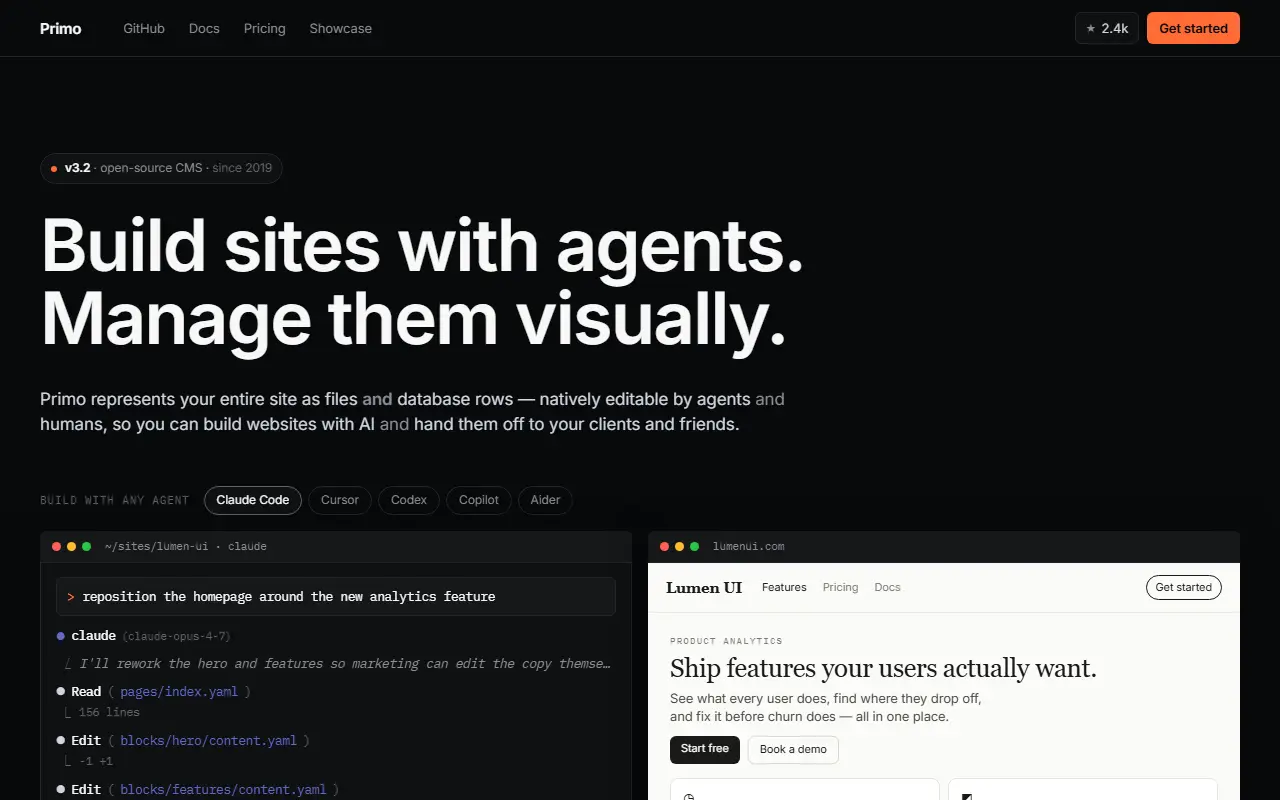
Primo is a CMS for developers who build sites for clients who need to manage them afterward. The whole site exists in two synchronized forms, a database and a folder of files, so AI coding tools such as Claude Code and Cursor can edit it directly while clients change content visually in the browser. It has been in active development since 2019 and is released under the MIT license.
It ships as a single Go binary that uses PocketBase with SQLite for storage and Svelte 5 for both the editor and the blocks you write. The same server hosts the CMS and serves the published sites, so no external services or separate front end are needed. One-click deployment is available, and the project positions itself as an alternative to Webflow.
Primo is used by freelancers, agencies, and small teams that self-host it. It suits developers who want a visual editing layer for client sites but prefer code-first components and an AI-friendly workflow over a proprietary page builder.
Key features
- Site synced as database and files
- Visual content editing for clients
- Svelte 5 components as blocks
- Single Go binary with PocketBase and SQLite
- Serves the published sites itself
- One-click deployment
Good fit for
- →Agencies handing off editable client sites
- →Developers using AI agents to build site components
- Built with
- Svelte
- Tags
- cms
- visual-editor
- svelte
- pocketbase
- ai-agents
- website-builder
- self-hosted
- webflow-alternative
Primo: questions and answers
- What is Primo used for?
- Primo is a self-hosted CMS for developers and agencies that stores a site as both a database and files, so AI agents edit code while clients edit content visually. It is a good fit for agencies handing off editable client sites and developers using AI agents to build site components.
- Is Primo open source?
- Yes. Primo is open source under the MIT licence. Its source code is on GitHub at primocms/primo and is written mainly in Svelte.
- Is Primo free?
- Yes. Primo is open source, so the software itself is free to use. Paid plans are also available, starting at $25 per month.
- Can I self-host Primo?
- Yes. Primo can be self-hosted on your own server or infrastructure.
- What is Primo an alternative to?
- Primo is an open-source alternative to Webflow. Other open-source alternatives to Webflow include Instatic, WordPress and Webstudio.
- Is Primo actively maintained?
- Yes. The most recent commit to Primo was on 1 October 2026, and the latest release is v3.3.0, published on 1 October 2026. The project has 2.4k stars on GitHub.
Open-source alternatives to Primo
See all
Instatic
CMS
The open-source alternative to Webflow, Framer and WordPress. Agentic self-hosted visual C
MITvs Webflow★ 8.8k
WordPress
CMS
WordPress, Git-ified. This repository is just a mirror of the WordPress subversion reposit
OSSvs Wix★ 21k
Webstudio
CMS
Open source website builder and Webflow alternative. Webstudio is an advanced visual build
AGPL-3.0vs Webflow★ 9k
Silex
CMS
Silex is an online tool for visually creating static sites with dynamic data. With the fre
AGPL-3.0vs Webflow★ 3k
Frappe Builder
CMS
Craft beautiful websites effortlessly with an intuitive visual builder and publish them in
MITvs Webflow★ 2.4k
Microweber
CMS
Drag and Drop Website Builder and CMS with E-commerce
MITvs Webflow★ 3.4k
SaaS alternatives to Primo
See all
Webflow
CMS
Webflow is a visual web design and hosting platform that combines a designer, CMS, hosting and SEO tools so teams can build and run websites without coding.
SaaSABHUB
CMS
No-code website builder and content management system for small and mid-size wineries
SaaS
CloudCannon
CMS
Git-based visual CMS for static sites with editing tools for content teams
SaaS
Dorik
CMS
AI-assisted website builder with drag-and-drop editing and CMS features
SaaS
Duda
CMS
White-label website builder for agencies managing many client sites
SaaS
Framer
CMS
Visual website builder and design tool that publishes live sites
SaaS