 TrackMedia
 TrackRev

About Pgloader
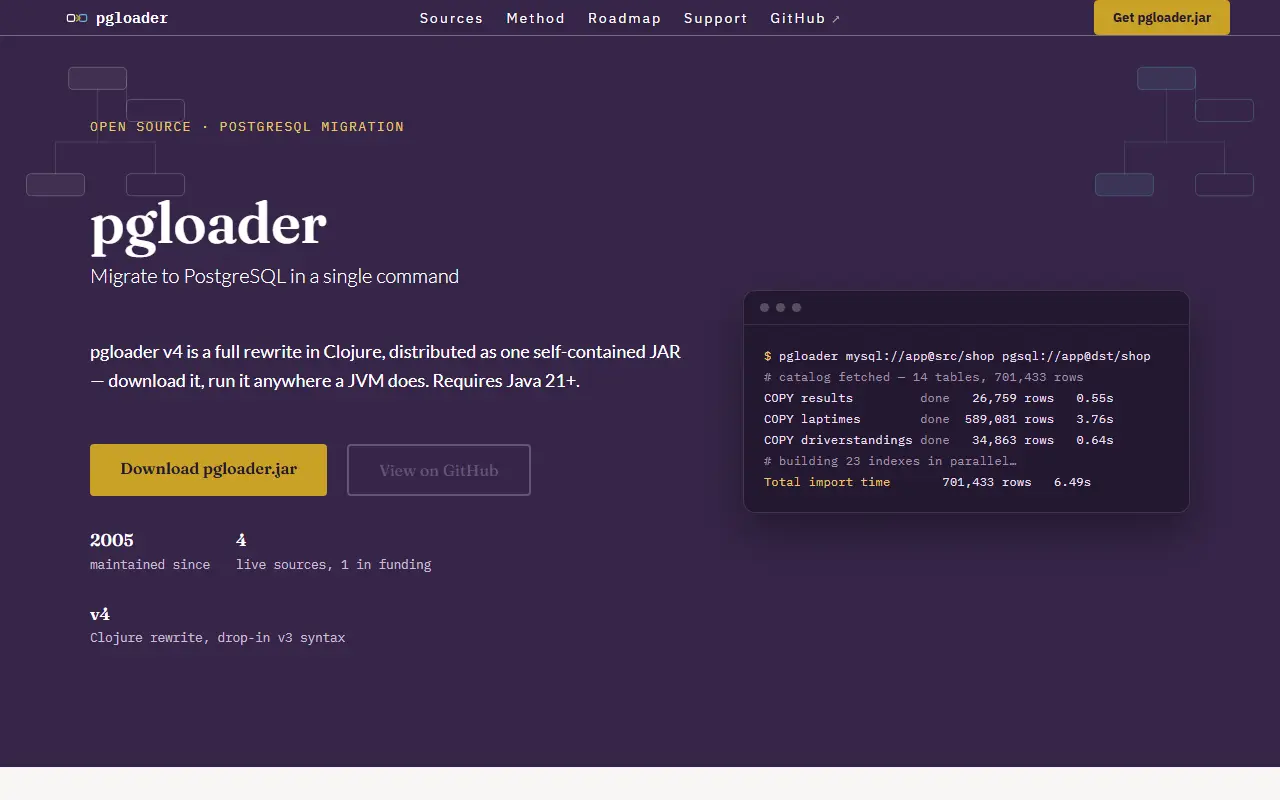
pgloader loads data into PostgreSQL using the COPY protocol while handling bad rows gracefully. A plain COPY aborts the whole table load when a single line is invalid. pgloader instead writes rejected records to a separate file and keeps loading the good ones, which makes large imports from messy data far less painful.
Beyond loading, it reformats data on the way in, for example converting MySQL zero dates into proper NULL values. It can read flat files such as CSV, IXF and dBase files, and it can read directly from other databases including MySQL, SQL Server and SQLite, so migrating a whole schema along with its data can be done with a single command. The tool is written in Common Lisp.
pgloader is open source, though its license shows as 'Other' in the repository metadata. It runs on your own machine or server as a command-line program, and there is no hosted version. It suits database administrators and developers moving to PostgreSQL or regularly importing external data.
Key features
- Bulk loading into PostgreSQL via COPY
- Rejected rows saved to a separate file
- Data reformatting during load
- Direct migration from MySQL, SQL Server and SQLite
- CSV, IXF and dBase file imports
- Single-command database migrations
Good fit for
- Migrating a MySQL database to PostgreSQL
- Importing large CSV files with dirty rows
- Moving SQLite data into Postgres
Pgloader: questions and answers
- What is Pgloader used for?
- pgloader is a command-line data loading and migration tool for PostgreSQL that imports from MySQL, SQLite, SQL Server, CSV and other sources. It is a good fit for migrating a MySQL database to PostgreSQL, importing large CSV files with dirty rows and moving SQLite data into Postgres.
- Is Pgloader open source?
- Yes. Pgloader is open source under a custom licence. Its source code is on GitHub at dimitri/pgloader and is written mainly in Common Lisp.
- Is Pgloader free?
- Yes. Pgloader is open source, so the software itself is free to use under the terms of its own licence.
- What are some alternatives to Pgloader?
- Similar open-source tools in the Database Tools category include Goose, Beekeeper Studio and Adminer. SaaS products in the same category include TablePlus, Valentina Studio and Base.
- Is Pgloader actively maintained?
- Yes. The most recent commit to Pgloader was on 14 September 2026, and the latest release is v3.6.9, published on 24 October 2022. The project has 6.6k stars on GitHub, with 14 added in the last 30 days.
Open-source alternatives to Pgloader
See all
Goose
Database Tools
A database migration tool. Supports SQL migrations and Go functions.
OSS★ 12k
Beekeeper Studio
Database Tools
Modern and easy to use SQL client for MySQL, Postgres, SQLite, SQL Server, and more. Linux
OSSvs DataGrip★ 24kAdminer
Database Tools
Database management in a single PHP file
OSSvs DataGrip★ 8k
q
Database Tools
q - Run SQL directly on delimited files and multi-file sqlite databases
GPL-3.0★ 10k
Outerbase Studio
Database Tools
A lightweight Database GUI in your browser. It supports connecting to Postgres, MySQL, and
AGPL-3.0vs TablePlus★ 6k
Ora2Pg
Database Tools
Ora2Pg is a free tool used to migrate an Oracle database to a PostgreSQL compatible schema
GPL-3.0vs AlloyDB for PostgreSQL★ 1.2k
SaaS alternatives to Pgloader
See all
TablePlus
Database Tools
Native database client for PostgreSQL, MySQL, SQLite, Redis and more
SaaSValentina Studio
Database Tools
Database administration and query tool with a free edition for several database engines
SaaS
Base
Database Tools
macOS app for creating, browsing and editing SQLite databases
SaaS
DBCode
Database Tools
VS Code extension for browsing and querying databases
SaaS
dbForge Studio
Database Tools
Devart IDE suite for developing and managing MySQL, SQL Server, Oracle and PostgreSQL
SaaS
ERDAuto
Database Tools
Describe a schema in plain English to generate ER diagrams, relational models and SQL exports
SaaS