 TrackMedia
 TrackRev

About Pandoc
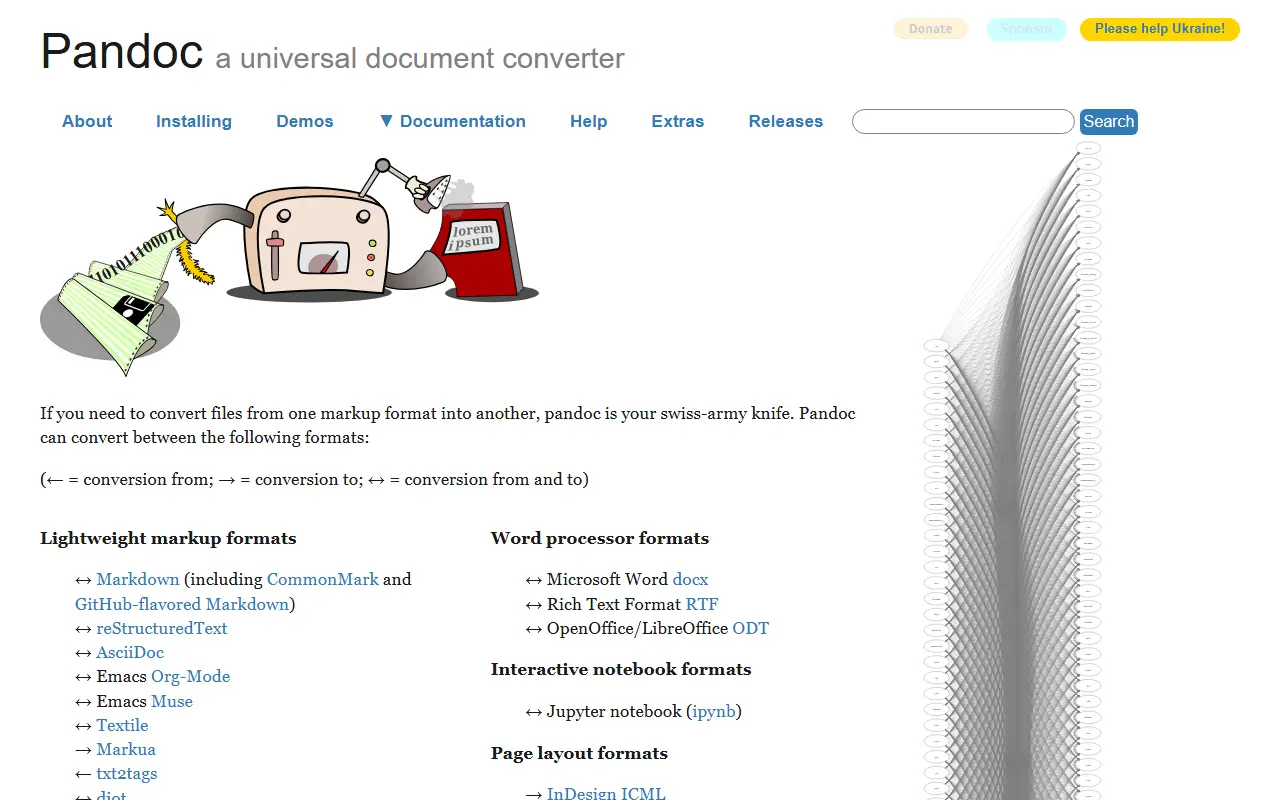
Pandoc is a universal markup converter, made up of a Haskell library that translates content between markup formats and a command-line tool built on it. It can read a very wide range of formats, including AsciiDoc, BibTeX, CommonMark, DocBook, Word docx, EPUB, HTML, Jupyter notebooks, LaTeX, several Markdown variants, MediaWiki, Org mode, reStructuredText, Textile and Typst. It is released under the GPL-2.0 license.
Beyond the built-in readers and writers, the documentation describes custom readers and writers written in Lua. Pandoc can also write to many output formats, such as HTML, docx, EPUB and LaTeX. Its topics reference publishing, presentations and CommonMark, reflecting its use in academic writing and document pipelines.
Because it is a command-line tool and a library, Pandoc is easy to script and to embed in build systems, static-site generators and writing workflows. It suits writers, researchers, documentation teams and developers who need to move content between Markdown, Word, web and print formats without retyping.
Key features
- Converts between dozens of markup formats
- Reads Markdown, HTML, LaTeX, docx and EPUB
- Command-line tool and Haskell library
- Custom readers and writers in Lua
- Bibliography and citation formats supported
- Scriptable for publishing pipelines
Good fit for
- Converting Markdown to Word or PDF
- Academic writing pipelines
- Documentation build systems
Pandoc: questions and answers
- What is Pandoc used for?
- Pandoc is a Haskell library and command-line tool that converts documents between dozens of markup formats, including Markdown, HTML, LaTeX and Word. It is a good fit for converting Markdown to Word or PDF, academic writing pipelines and documentation build systems.
- Is Pandoc open source?
- Yes. Pandoc is open source under the GPL-2.0 licence. Its source code is on GitHub at jgm/pandoc and is written mainly in Haskell.
- Is Pandoc free?
- Yes. Pandoc is open source, so the software itself is free to use.
- What is Pandoc an alternative to?
- Pandoc is an open-source alternative to HelpNDoc and Inkdrop. Other open-source alternatives to HelpNDoc include Quarkdown, Sphinx and Docfx.
- Is Pandoc actively maintained?
- Yes. The most recent commit to Pandoc was on 12 November 2026, and the latest release is 3.14, published on 12 November 2026. The project has 47k stars on GitHub, with 274 added in the last 30 days.
Open-source alternatives to Pandoc
See all
Quarkdown
Docs & Wikis
🪐 Markdown with superpowers: from ideas to papers, presentations, websites, books, and kn
GPL-3.0vs HelpNDoc★ 16k
Sphinx
Docs & Wikis
The Sphinx documentation generator
OSSvs Document360★ 8.1k
Docfx
Docs & Wikis
Static site generator for .NET API documentation.
MITvs Bump.sh★ 4.5k
Gramax
Docs & Wikis
Embrace a docs-as-code approach to build, version, and publish Git-driven documentation si
GPL-3.0vs GitBook★ 625
GitBook
Docs & Wikis
The open source frontend for GitBook doc sites
GPL-3.0vs GitBook★ 29k
Readthedocs.org
Docs & Wikis
The source code that powers readthedocs.org
MITvs GitBook★ 8.4k
SaaS alternatives to Pandoc
See all
HelpNDoc
Docs & Wikis
Help authoring tool that generates CHM, HTML, PDF and Word documentation from one source
SaaS
Inkdrop
Note Taking
Markdown note app with a plugin ecosystem aimed at developers
SaaS
Adobe RoboHelp
Docs & Wikis
Help authoring tool for online help, knowledge bases and policy documentation
SaaS
ProProfs Knowledge Base
Docs & Wikis
Knowledge base software for help centers, internal wikis and user manuals
SaaS
HelpSmith
Docs & Wikis
XML-based help authoring tool for CHM, Web Help, manuals, PDF, Word, ePub, Markdown
SaaS
mdedit.ai
Note Taking
AI-powered, offline-first Markdown editor for developers, students, researchers and technical writers
SaaS