
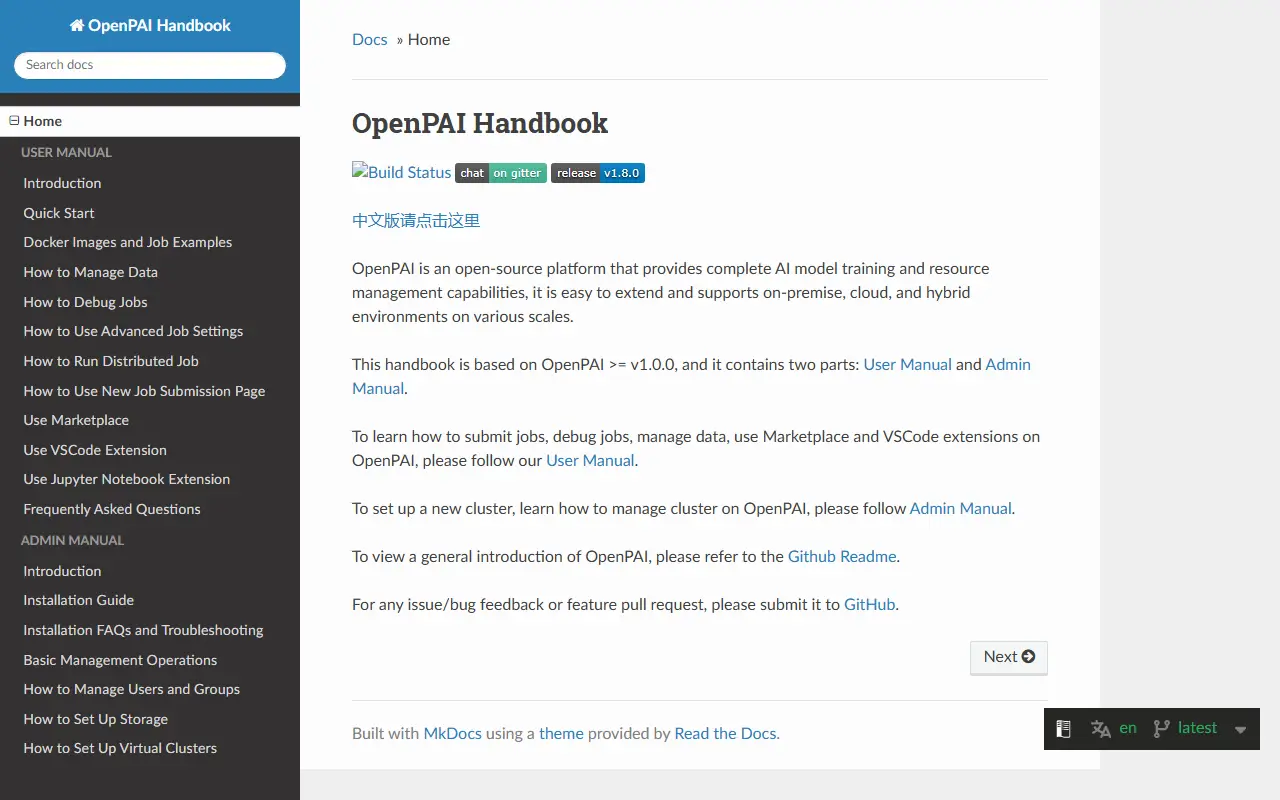
About OpenPAI
OpenPAI, or Open Platform for AI, is a cluster management and resource scheduling platform for AI workloads, created by Microsoft. It helps administrators share GPU clusters among users and lets data scientists submit training jobs on-premises or in the cloud. It runs on Kubernetes and is released under the MIT license.
Since version 1.0 the platform has used a lighter and more modular architecture that can be customized and expanded. It includes features aimed at AI users, such as running popular frameworks like TensorFlow, PyTorch, and Chainer, notebook environments like Jupyter, and scheduling for GPU resources.
The README notes that after the 1.8.1 release OpenPAI entered a stable mode with no major feature releases planned, and the repository was set to read-only to save maintenance effort. Collaboration requires contacting the repository admin. It remains relevant for teams that operate their own GPU clusters and want an existing, documented scheduler.
Key features
- GPU cluster resource scheduling
- Kubernetes-based architecture
- Job submission for TensorFlow and PyTorch
- Jupyter notebook support
- Modular design for customization
- On-premises and cloud deployment
Good fit for
- →Sharing a GPU cluster among a research team
- →Running model training jobs on-premises
- Tags
- ai
- gpu
- scheduling
- kubernetes
- cluster-management
- machine-learning
- model-training
- microsoft
OpenPAI: questions and answers
- What is OpenPAI used for?
- OpenPAI is Microsoft's Open Platform for AI, a Kubernetes-based resource scheduler and cluster manager for GPU training workloads; now in stable, read-only mode. It is a good fit for sharing a GPU cluster among a research team and running model training jobs on-premises.
- Is OpenPAI open source?
- Yes. OpenPAI is open source under the MIT licence. Its source code is on GitHub at microsoft/pai and is written mainly in JavaScript.
- Is OpenPAI free?
- Yes. OpenPAI is open source, so the software itself is free to use.
- Can I self-host OpenPAI?
- Yes. OpenPAI can be self-hosted on your own server or infrastructure; there is no official hosted version.
- What is OpenPAI an alternative to?
- OpenPAI is an open-source alternative to Azure Machine Learning. Other open-source alternatives to Azure Machine Learning include KubeDL, MLflow and Backend.AI.
- Is OpenPAI actively maintained?
- Yes. The most recent commit to OpenPAI was on 29 September 2026, and the latest release is v1.8.0, published on 16 July 2021. The project has 2.7k stars on GitHub.
Open-source alternatives to OpenPAI
See all
KubeDL
AI Infrastructure
Run your deep learning workloads on Kubernetes more easily and efficiently.
Apache-2.0vs Amazon SageMaker★ 534
MLflow
AI Infrastructure
The open source AI engineering platform for agents, LLMs, and ML models. MLflow enables te
Apache-2.0vs Weights & Biases★ 28k
Backend.AI
AI Infrastructure
Backend.AI is a streamlined, container-based computing cluster platform that hosts popular
LGPL-3.0vs RunPod★ 673
Superduper
AI Infrastructure
Superduper: End-to-end framework for building custom AI applications and agents.
Apache-2.0★ 5.3k
RD-Agent
AI Infrastructure
Research and development (R&D) is crucial for the enhancement of industrial productivity,
MIT★ 15k
Ollama
AI Infrastructure
Get up and running with Kimi, GLM, MiniMax, DeepSeek, gpt-oss, Qwen, Gemma and other model
MITvs ChatGPT★ 182k
SaaS alternatives to OpenPAI
See all
Azure Machine Learning
AI Infrastructure
Microsoft cloud service for training, deploying and managing machine learning models
SaaS
H2O.ai
AI Infrastructure
AI platform for predictive and generative AI model building and deployment
SaaS
NVIDIA AI Enterprise
AI Infrastructure
Software suite of NIM microservices, frameworks and tools for running production AI
SaaS
Domino Data Lab
AI Infrastructure
Enterprise MLOps platform for building, governing and deploying data science models
SaaS
Google Vertex AI
AI Infrastructure
Google Cloud platform for building, tuning and deploying machine learning and generative AI models
SaaS
Valohai
AI Infrastructure
MLOps platform for automating machine learning pipelines and experiment tracking
SaaS